Providers
OBEY API Gateway supports multiple AI providers through a unified OpenAI-compatible interface. Configure one or more providers to enable intelligent routing, failover, and load balancing.
| Type | Provider | API Key Required | Notes |
|---|---|---|---|
openai |
OpenAI, Nano-GPT, any OpenAI-compatible API | Yes | Generic OpenAI protocol |
ollama |
Ollama | No | Local models, no API key needed |
bedrock |
AWS Bedrock | Varies | API key or AWS SDK auth |
groq |
Groq | Yes | |
together |
Together AI | Yes | |
nvidia_nim |
NVIDIA NIM | Yes | |
vllm |
vLLM | No | Self-hosted inference |
lmstudio |
LM Studio | No | Local models |
The Admin Panel provides a visual interface for adding and configuring providers:
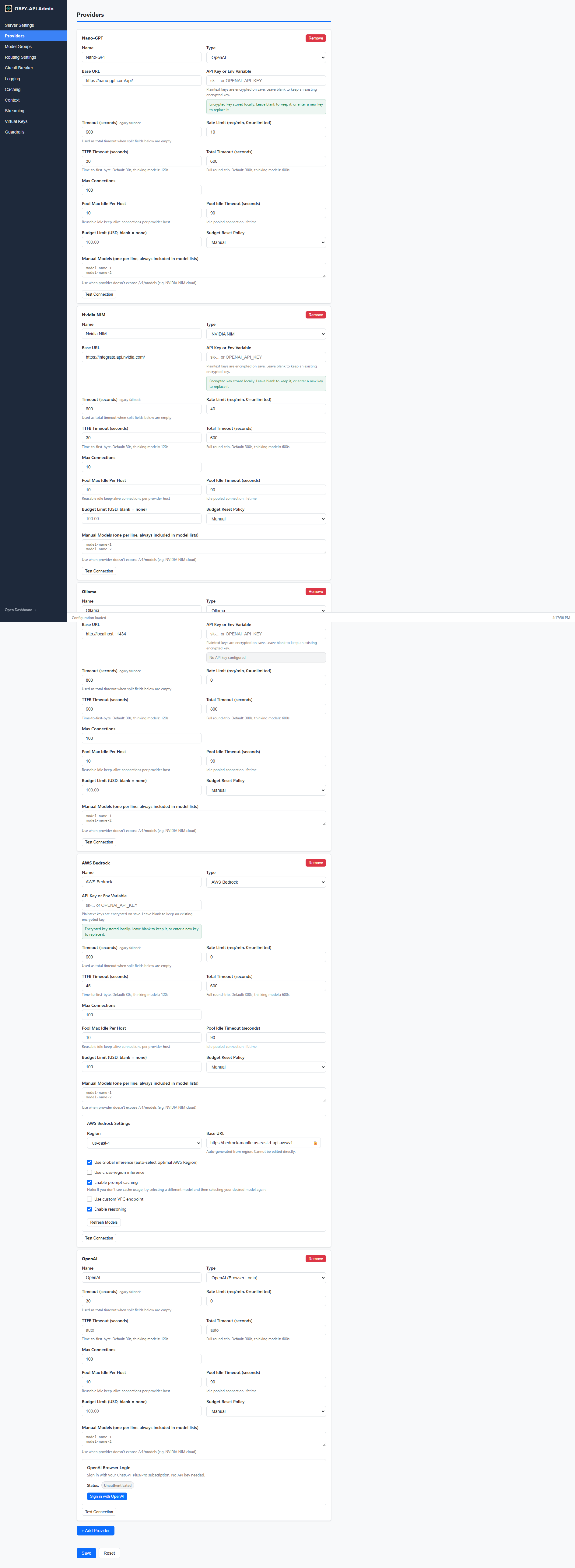
All providers share these configuration fields:
providers:
  - name: "my-provider"              # Unique identifier (referenced in model_groups)
    type: "openai"                   # Provider type (see table above)
    base_url: "https://..."          # Provider API endpoint
    api_key_env: "MY_API_KEY"        # Env var name for the API key
    timeout_seconds: 30              # Legacy total timeout
    ttfb_timeout_seconds: 30         # Time-to-first-byte timeout
    total_timeout_seconds: 300       # Total round-trip timeout
    max_connections: 100             # Connection pool limit
    rate_limit_per_minute: 60        # Per-provider RPM (0 = unlimited)
    custom_headers:                  # Optional extra headers
X-Custom: "${MY_ENV_VAR}" # Supports env var substitutionStandard OpenAI or any OpenAI-compatible API (Nano-GPT, OpenRouter, etc.).
providers:
  - name: "openai"
    type: "openai"
    base_url: "https://api.openai.com/v1"
    api_key_env: "OPENAI_API_KEY"
    timeout_seconds: 30
    max_connections: 100
rate_limit_per_minute: 60Instead of an API key, authenticate with your ChatGPT Plus/Pro subscription:
providers:
  - name: "openai-oauth"
    type: "openai"
    base_url: "https://api.openai.com/v1"
    auth_method: "oauth"
See OAuth & Codex for details.
Local models via Ollama. No API key needed.
providers:
  - name: "ollama-local"
    type: "ollama"
    base_url: "http://localhost:11434"
timeout_seconds: 120Bedrock supports two authentication modes.
providers:
  - name: "bedrock-api-key"
    type: "bedrock"
    region: "us-east-1"
    api_key_env: "AWS_BEARER_TOKEN_BEDROCK"
    timeout_seconds: 60
max_connections: 100Uses standard AWS credential resolution (env vars, shared credentials file, IAM role):
providers:
  - name: "bedrock-sdk"
    type: "bedrock"
    region: "us-east-1"
timeout_seconds: 60Bedrock uses two maintained fallback catalogs so model IDs always match the provider's active endpoint:
-
API key / Mantle: only models verified for the OpenAI Chat Completions API on
bedrock-mantle, using Mantle IDs such asopenai.gpt-oss-120b. -
AWS SDK / Runtime: only models verified for Converse or Invoke on
bedrock-runtime, using runtime IDs such asopenai.gpt-oss-120b-1:0andanthropic.claude-opus-4-8.
Live /models or ListFoundationModels results are merged first; the matching fallback fills missing IDs. API-key mode dispatches by model family: current GPT-5.6/5.5/5.4 models use the Mantle Responses API, Claude models use the Anthropic Messages API, and open-weight models use Chat Completions. SDK mode uses Bedrock Converse for a unified request schema across runtime models. Legacy models are excluded. manual_models remains optional and additive; configured entries override/deduplicate built-ins.
Maintainers synchronize both catalogs with scripts/sync-bedrock-fallback.ps1. The weekly docs-first workflow verifies AWS endpoint compatibility, API compatibility, lifecycle status, and exact Programmatic Access IDs before opening an update PR. Removal requires two consecutive confirmations; region-specific live listing differences never remove a documented active model.
| Field | Default | Description |
|---|---|---|
cross_region_inference |
false |
AWS SDK mode only: use a geographic inference-profile ID for models that publish one; unsupported and Mantle model IDs stay unchanged |
global_inference_profile |
false |
AWS SDK mode only: use a global. inference-profile ID for models that publish one; takes precedence over geographic cross-region inference |
prompt_caching |
false |
Enable prompt caching only where the selected Bedrock model/API explicitly supports cache checkpoints; no synthetic Mantle header is added |
custom_vpc_endpoint |
false |
Use base_url as-is (no auto-generation) |
reasoning |
true |
Enable extended thinking for supported models |
Before invoking Claude Fable 5 through Bedrock, you must opt into data sharing via the AWS Data Retention API by enabling provider_data_share on your account. This is a one-time, account-level setting — must be done programmatically via the AWS CLI or SDK (no console UI at launch).
providers:
  - name: "groq"
    type: "groq"
    base_url: "https://api.groq.com/openai/v1"
    api_key_env: "GROQ_API_KEY"
timeout_seconds: 30providers:
- name: "together"
type: "together"
base_url: "https://api.together.xyz/v1"
api_key_env: "TOGETHER_API_KEY"
timeout_seconds: 60providers:
- name: "nvidia-nim"
type: "nvidia_nim"
base_url: "https://integrate.api.nvidia.com/v1"
api_key_env: "NVIDIA_API_KEY"
timeout_seconds: 60The hosted NVIDIA catalog is volatile, so the gateway ships a small maintained fallback list for model discovery. It activates only when NVIDIA's live /v1/models request fails or returns an empty list. manual_models remains optional; configured values are merged first and therefore override/deduplicate the built-in entries.
Maintainers synchronize the fallback with scripts/sync-nvidia-nim-fallback.ps1. The weekly GitHub Actions workflow requires the repository secret NVIDIA_API_KEY; it confirms retired/unreachable entries in two consecutive probes before opening a replacement PR. The scope is the hosted catalog at https://integrate.api.nvidia.com/v1, not the self-host NIM Support Matrix.
Self-hosted inference with vLLM:
providers:
  - name: "vllm"
    type: "vllm"
    base_url: "http://localhost:8000"
timeout_seconds: 120Local models via LM Studio:
providers:
  - name: "lmstudio"
    type: "lmstudio"
    base_url: "http://localhost:1234"
timeout_seconds: 120Provider keys can be configured four ways (in order of preference):
| Method | How |
|---|---|
| Environment variable reference | Set api_key_env: "OPENAI_API_KEY" and export the env var |
| Admin UI | Enter keys through the web interface; encrypted automatically |
| Encrypted in config | Stored as api_key_encrypted: "enc-v1:<nonce>:<ciphertext>"
|
| OAuth login | For OpenAI — authenticate via browser sign-in |
The api_key_env field is resolved by:
- Looking up the value as an environment variable name
- Falling back to using the literal string as the key
Timeouts split into two phases:
| Field | Default (standard) | Default (thinking models) | Description |
|---|---|---|---|
ttfb_timeout_seconds |
30s | 120s | Time-to-first-byte |
total_timeout_seconds |
300s | 600s | Total round-trip ceiling |
timeout_seconds |
30s | — | Legacy (used as total_timeout when split fields omitted) |
Thinking models (o1, o3, DeepSeek-R1, QwQ, Claude 3.5 Sonnet v2+, Claude Opus/4+) are auto-detected and get higher defaults.
When a timeout fires, the error response tells the caller which timeout was hit and which config field to adjust.
Provider URLs are automatically normalized:
- Trailing
/is stripped -
/v1is appended if not already present (for OpenAI-compatible providers)
- Configuration — full config reference
- Routing & Failover — how providers are selected
- OAuth & Codex — browser-based OpenAI authentication