Repository navigation
Home
Orientation for newcomers, contributors and reviewers. This wiki explains and links. It never states a safety claim: those live in the assurance record, where they are reviewed.
Important
LionDriver is research and development software. It is a driver-assistance system: the driver must stay attentive and in control at all times. It is not certified, makes no claim of ISO 26262 compliance or ASIL capability, and is not approved for unsupervised operation.
An open-source driving platform derived from openpilot. It keeps openpilot's driving stack, its panda safety layer and every upstream car port, and adds the engineering record around them: functional safety, SOTIF, cybersecurity, AI safety and a safety case that is published as it is built, with the evidence for each claim and the known counter-evidence against it. The README is the long version.
| If you want to | Read |
|---|---|
| See how the device connects to the car and steers it safely | How LionDriver works |
| Understand how the code and the record fit together | How the repository is organized |
| See what is done, active and planned | Roadmap and status |
| Contribute, or follow a Claude session's work | How decisions are made |
Decode WP-C-03, BL-002, DQ-052, SWF-090
|
Glossary |
| Review the safety argument | Reading the Living Safety Case |
| See which standards apply and how they are tailored | Standards at a glance |
| Review, audit or assess it independently | For the assessor |
| Know which car the analysis is about | Reference vehicle |
| Set up, branch, and open a pull request | Contributor guide |
| Report a vulnerability, an incident or a hazard | Reporting a safety concern |
| See what was merged, session by session | Session log |
| Get a short answer | FAQ |

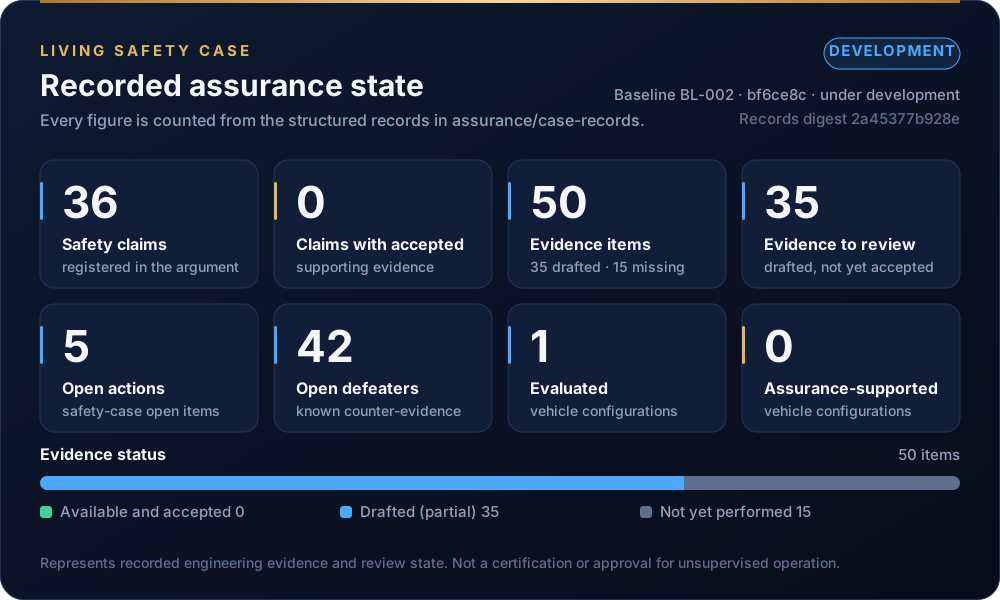
Generated by generate_dashboard.py on every pull request; embedded from the repository, never copied.
The badge, the dashboard and the headline in the README are generated from the records in
assurance/case-records/ on every pull request. No number on this wiki is typed by hand.
Reading the Living Safety Case explains what the numbers mean.
Assurance status represents recorded engineering evidence and review state. It does not constitute certification or approval for unsupervised operation.
- Not a work product. Nothing here carries a document-control header or counts as evidence.
- Not the place for hazard, requirement or vehicle-support text. Each page links to the record that owns it.
- Not illustrated by hand. Every image is a figure that already exists in the repository, embedded from the synced branch so it cannot drift from the record.
-
Not edited in place. Pages are kept in the repository under
wiki/, reviewed by pull request, and mirrored here on merge. An edit made on the wiki itself is overwritten by the next sync.