Repository navigation
Reading the Living Safety Case
The safety argument is published while it is being built. This page explains the figures on the dashboard and
what they do and do not promise. New to safety cases? Start with What is a safety case?. The dashboard itself, with every value also given as text, is in the
README and in assurance/README.md.
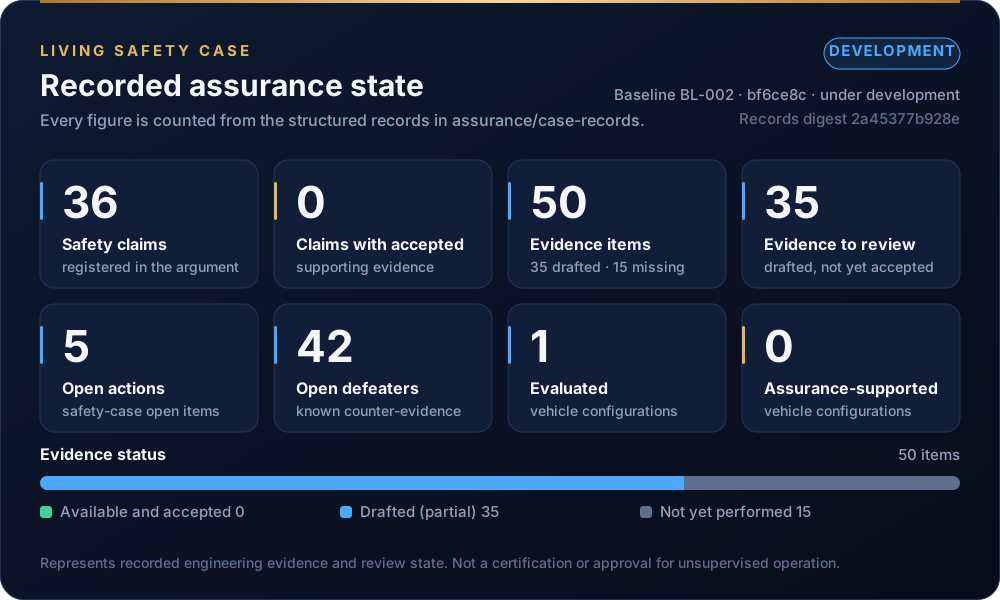
The README carries a one-line headline generated from the records. Read left to right:
| Figure | What it means |
|---|---|
| Lifecycle stage (for example Development) | Where the project is. Nothing is released; every work product is a draft until reviewed. |
Baseline (BL-nnn at a commit) |
The frozen state of the record the figures are computed against, and the commit it was taken at. |
| Claims, with how many have accepted evidence | Statements the case argues. "0 with accepted evidence" means no claim has passed confirmation review yet. |
| Evidence items, with how many are accepted | Tests, analyses and reviews that are recorded. Recorded is not accepted. |
| Open defeaters | Known reasons the argument might not hold. Published on purpose. |
| Records digest | A hash of every record. It changes whenever any record changes, so two readers can confirm they saw the same state. |
Evidence becomes accepted only after a confirmation review by someone independent of the author (WP-P-05). No work product has had one yet, so the count is zero. A project that showed accepted evidence before any review had happened would be the one to distrust.
- Every figure is generated from the records under
assurance/case-records/bygenerate_dashboard.py, never typed by hand. - The assurance workflow validates the records and regenerates the dashboard on every pull request, and fails if the committed dashboard is out of date or the records are inconsistent.
- The records digest in the headline identifies the exact state the figures describe.
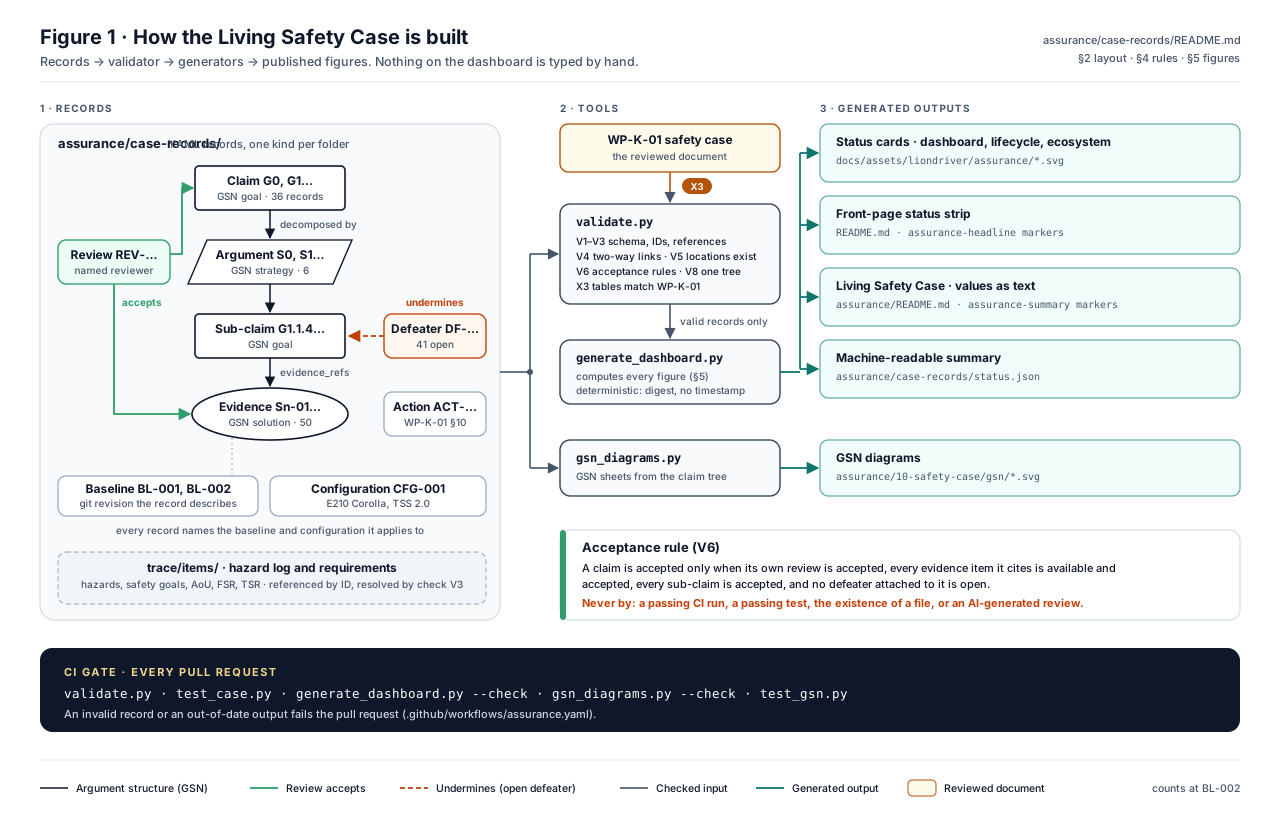
Figure 1 of the case records README.
- Hazards and safety goals, from the HARA. Each goal carries an ASIL.
- Claims: the argument that each goal is met, broken into statements that can be evidenced. The argument structure is drawn as GSN diagrams from the records.
- Evidence, linked to claims. Each item carries a review state and, once reviewed, who reviewed it and when.
- Defeaters, attached to claims. The gap assessment is their main source.
- Baselines and reviews: named states of the whole, and the confirmation reviews recorded against them.
The record formats are described in assurance/case-records/README.md and enforced by
validate.py.
Each snapshot release carries the safety case as a PDF at a named baseline, with a manifest of hashes and a build attestation. The release page has the exact steps to verify a copy against the repository. A numbered controlled copy for a named recipient is issued by the controlled copy workflow and recorded in the distribution record.
Assurance status represents recorded engineering evidence and review state. It does not constitute certification or approval for unsupervised operation.