Repository navigation
ASPICE process capability
The safety and security standards ask whether the product is safe. Automotive SPICE (ASPICE) asks a different question: is the way the product is built good enough to trust what comes out of it? This page explains ASPICE from the start for someone who has never used it, with LionDriver's own self-assessment. It explains and links. The ratings are in WP-M-13, the traceability in WP-T-01 and the process model in WP-P-11; nothing here is a rating.
Note
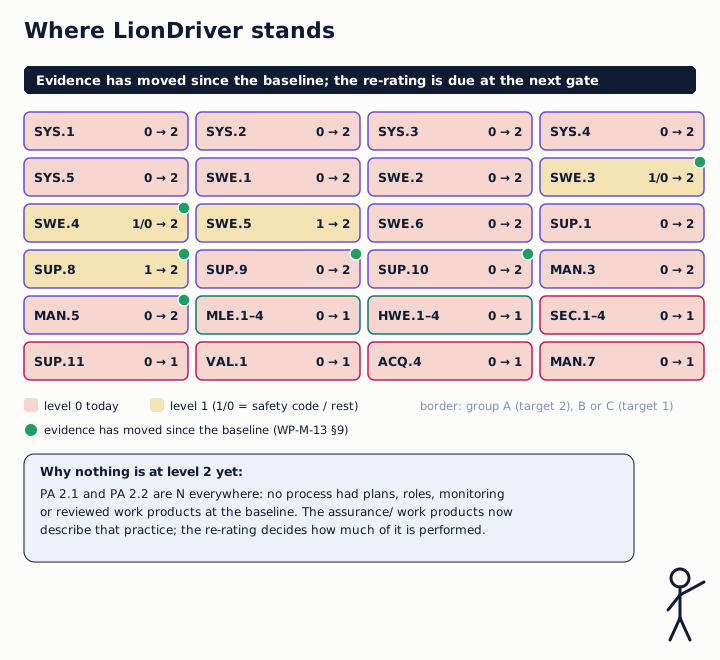
WP-M-13 is a self-assessment, not a formal ASPICE assessment. Its levels cannot be quoted as an ASPICE result.
Every figure is drawn at each wiki sync by tools/wiki/aspice_animations.py.
The levels, targets, improvement actions and coverage are read from the records, and every other phrase is checked
against its record. When a record changes, the build fails instead of showing old text.
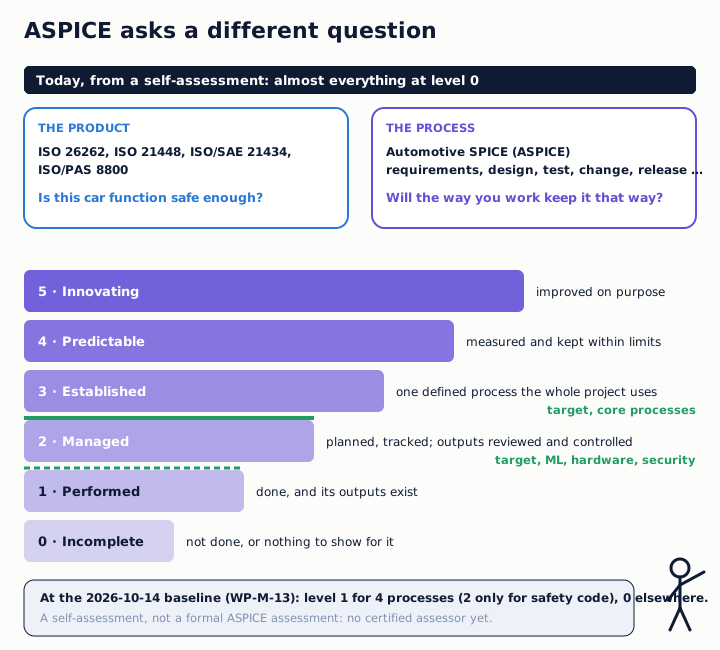
ASPICE rates each process on a capability level: 0 when it is not done or leaves nothing to show, 1 when it is done and its outputs exist, 2 when it is also planned, tracked and its outputs reviewed and controlled, and higher levels for a defined, measured and improving organisation.
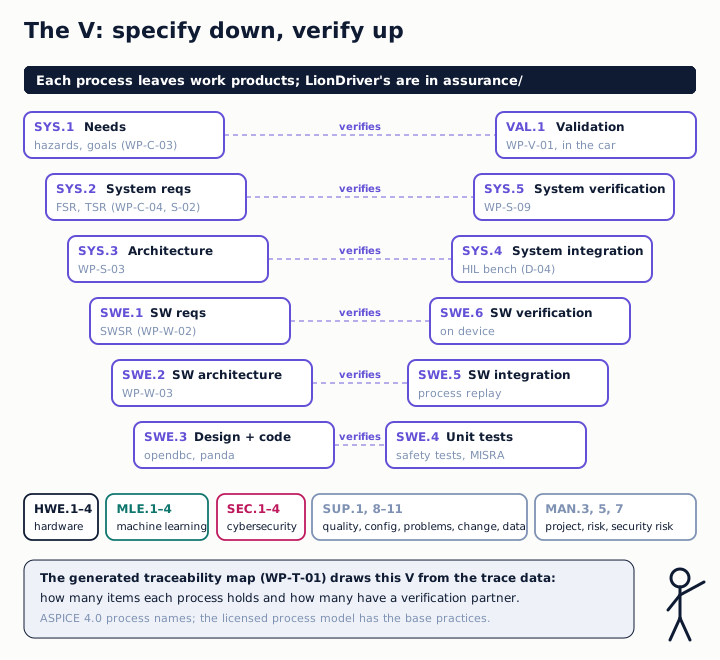
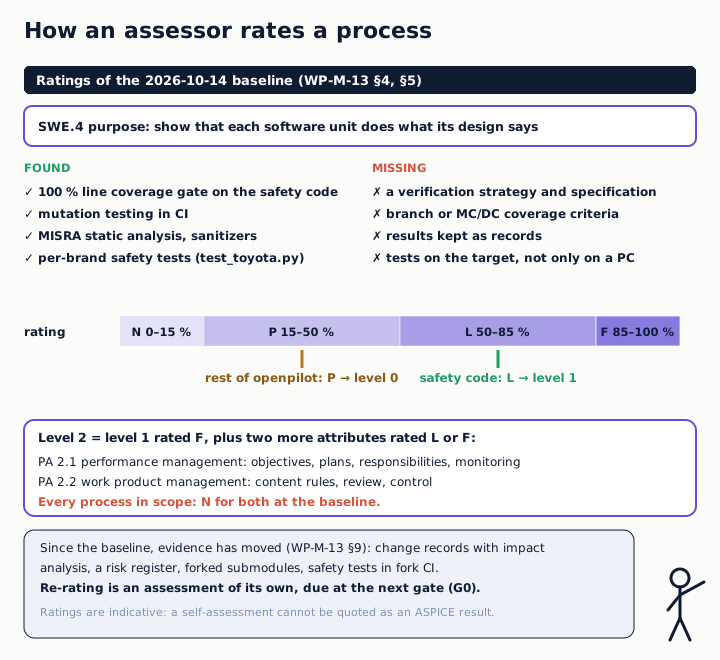
An assessor looks for evidence that each expected practice is performed and rates how fully: N (not), P (partly), L (largely) or F (fully). Level 1 needs that rating to be L or F. Level 2 also needs the process to be managed: planned, tracked, and its work products reviewed and controlled.
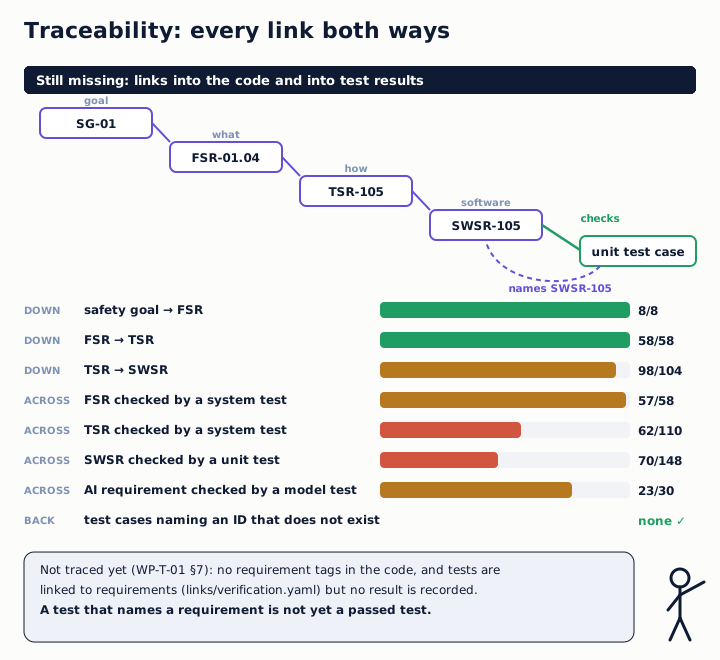
Every requirement should come from a parent, be checked by a test, and every test should name a requirement that exists. The trace map counts this from the data; the open part is the link from a test to its result (Building a fault tree and From hazard to test show the same chain from the safety side).
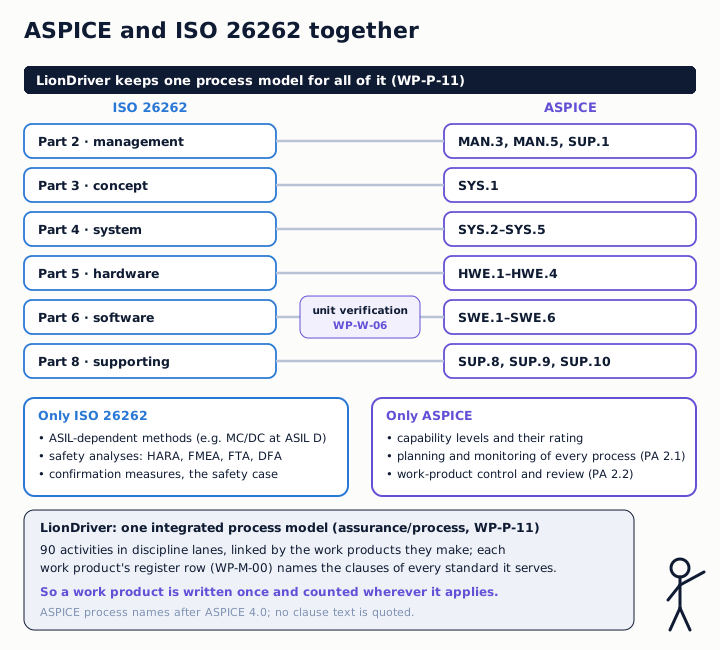
ISO 26262 says which work products must exist and how rigorous they must be; ASPICE says how well the process that makes them runs. LionDriver keeps one process model for all of it, so a work product is written once and counted wherever it applies.
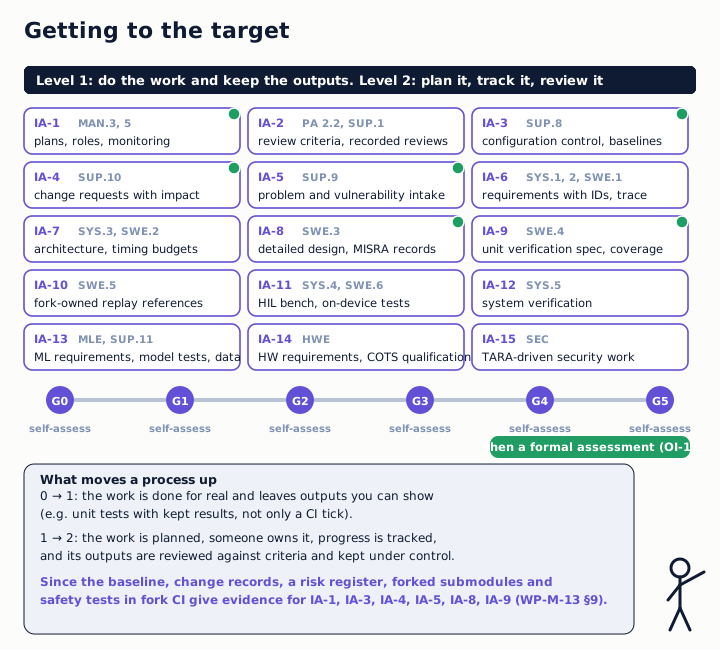
- Standards at a glance: how the standards divide the work.
- How decisions are made: where the lead's decisions are recorded.
- Glossary for the work product and ID codes.