Repository navigation
How the repository is organized
Two kinds of content live side by side: the driving software inherited from openpilot, and the engineering record LionDriver adds around it.
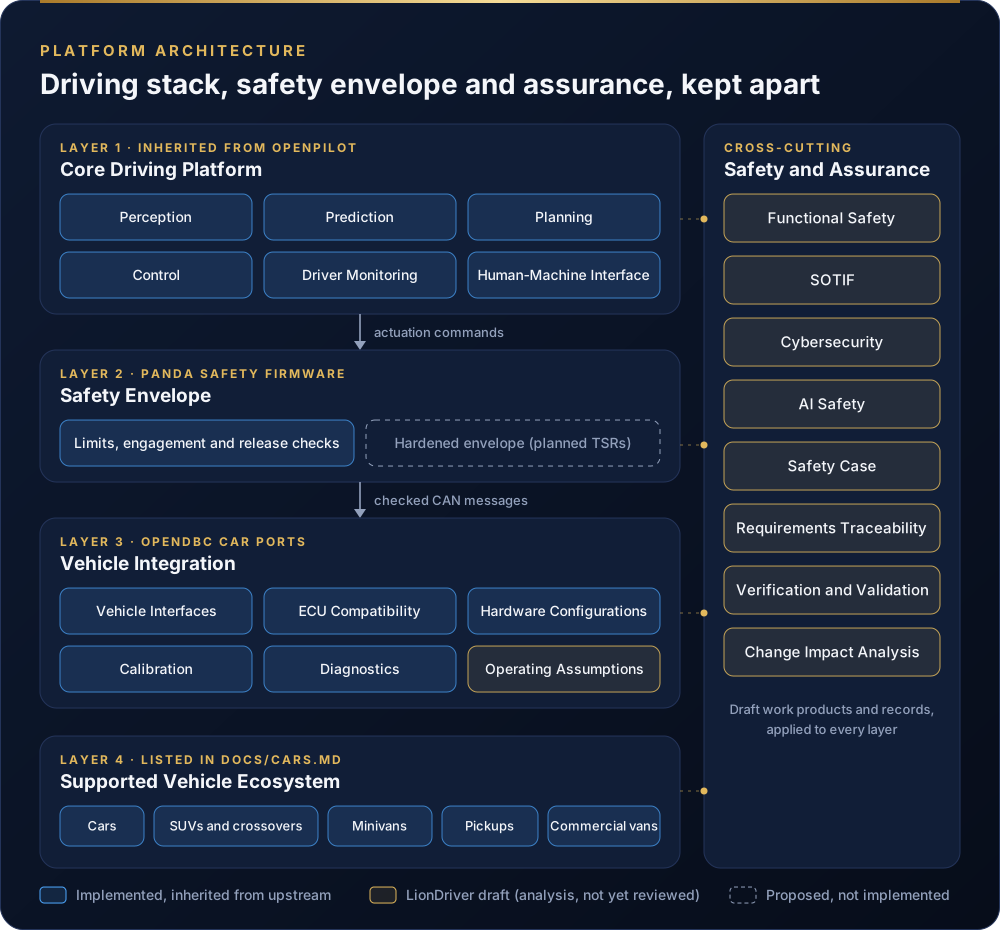
The README architecture figure. Layers 1 to 4 are the inherited code below; the cross-cutting column is what LionDriver adds.
| Path | What it is |
|---|---|
openpilot/ |
Perception, planning, control, driver monitoring, HMI: the application stack |
panda/ |
The safety layer on the panda microcontroller that checks every actuator command |
opendbc_repo/ |
Vehicle interfaces, safety modes and car ports, listed in CARS.md |
msgq_repo/, rednose_repo/, tinygrad_repo/, teleoprtc_repo/
|
Upstream libraries |
docs/ |
Upstream documentation, kept where upstream keeps it |
Changed only by merging upstream or through a documented impact analysis. The pinned versions, and which submodules point at LionDriver forks, are recorded in WP-M-11, upstream and supplier management.
| Path | What it is |
|---|---|
assurance/ |
Every work product, analysis, decision and review |
assurance/case-records/ |
Machine-readable claims, evidence, defeaters, baselines and reviews; the dashboard is generated from here |
assurance/trace/ |
Traceability data between hazards, goals, requirements and tests |
docs/liondriver/ |
Architecture, vehicle compatibility, vehicle register, contributing |
docs/safety/field-monitoring/ |
Hazard log, case register and the root cause process |
tools/ |
LionDriver tooling that the workflows run: sync reports, severity, field monitoring, vehicles, CI manifests |
wiki/ |
These pages |
Changed by pull request to liondriver-dev and checked by the workflows below.
Folders are numbered in lifecycle order. Each work product is named WP, a letter for its area, and a number;
the glossary decodes the letters. The authoritative table, with the standard clauses each folder
answers to, is in assurance/README.md.
| Folder | Prefix | What it holds |
|---|---|---|
00-assessment/ |
Gap assessment of the inherited openpilot baseline against the safety goals; ISO 26262:2018 clause map | |
01-management/ |
WP-M |
Plans: assurance strategy, safety, SOTIF, cybersecurity, AI safety; impact analysis; the decision register |
02-concept/ |
WP-C |
Item definition, ODD, HARA, functional safety concept, SOTIF hazards and triggering conditions, TARA, AI system definition |
03-system/ |
WP-S |
System and technical safety requirements, technical safety concept, timing budget, HSI, system verification |
04-hardware/ |
WP-H |
Hardware safety requirements, design, FMEDA, metrics, PMHF, component qualification |
05-software/ |
WP-W |
Software safety requirements, architecture, safety analysis, unit design and verification, ML engineering |
06-validation/ |
WP-V |
Safety validation, SOTIF known and unknown scenarios, fault injection, cybersecurity validation, vehicle test operations |
07-supporting/ |
WP-P |
Configuration, change and problem management, documentation, reviews, tool and component qualification, release |
08-analyses/ |
WP-A |
ASIL decomposition, freedom from interference, dependent failure analysis, FTA and FMEA, STPA |
09-production-operation/ |
WP-O |
Installation and provisioning, operation and service, user information, field monitoring, cybersecurity incident response |
10-safety-case/ |
WP-K |
The safety case, the cybersecurity case, assessment and release records |
case-records/, trace/, process/, models/, sim/
|
Machine-readable records, traceability, the integrated process model, reference models and simulation |
Every workflow lives in .github/workflows/.
| Workflow | Runs when | What it checks |
|---|---|---|
| assurance | A change touches assurance/, the README, docs/liondriver/ or the tools |
Trace consistency, relative links, every generated figure and page current, the decision register's lifecycle rules, Markdown tables, HARA and FSC consistency, FMEA data lint |
| safety | A change touches the panda or opendbc submodule pins or the coverage tooling | Safety tests with UBSan and a 100 % line-coverage gate, MISRA C:2012 on the opendbc safety code and on panda, the reference release build, build manifests |
| b2b | A change touches the reference models or the safety code | Back-to-back run of the reference model against the safety C, both build variants |
| safety case snapshot | A push to liondriver-dev touches assurance/, or a bl-* tag |
Builds, attests and publishes the PDF snapshot as a release |
| safety case controlled copy | Started by hand | Issues a numbered controlled copy of the safety case for a named recipient and records it |
| wiki | Every pull request, and every push to liondriver-dev
|
Builds these pages and checks that every link target still exists; on a push, syncs them and the generated figures to the GitHub wiki |
| PR review, diff report, tests, docs | Inherited from openpilot | Labels pull requests by the paths they touch, posts the process-replay diff, runs the upstream unit tests and documentation build |
A passing workflow accepts nothing on its own. It can be evidence that a reviewer accepts; see contributing to LionDriver.