Repository navigation
Hardware safety and interference
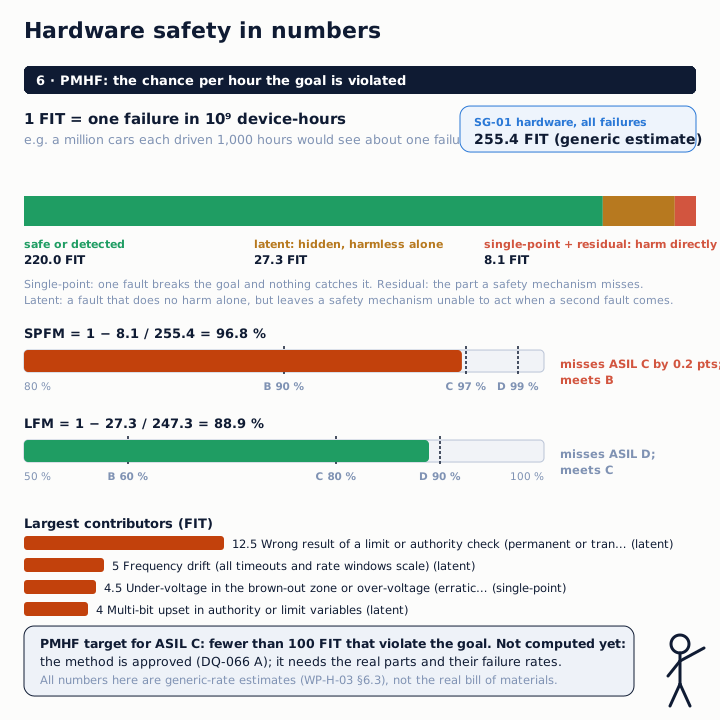
Two questions an assessor asks of every safety-related element, explained for someone who has not met them before: how often can the hardware fail in a way that breaks a safety goal, and can the parts that are not safety-rated disturb the parts that are? This page explains and links. The analyses are WP-H-03 (FMEDA), WP-H-04 (SPFM and LFM), WP-H-05 (PMHF) and WP-A-02 (freedom from interference); nothing here is an analysis result.
Both figures are drawn at each wiki sync by tools/wiki/hw_animations.py. The
metrics are computed from the FMEDA records
(fmeda-sg001.yaml) with the same formulas as
tools/safety/fmea_lint.py, and the interference verdicts are read from WP-A-02 §8, so the figures follow the
records.
Important
The failure rates are generic estimates for each part type, not values for the actual parts: the device's bill of materials is not available yet. The numbers show where the architecture stands; they are not evidence.
| Term | Meaning |
|---|---|
| FIT | Failures in time: one failure in 10⁹ device-hours. |
| FMEDA | Failure modes, effects and diagnostic analysis: every hardware part's failure rate, split by how it fails, and whether a safety mechanism catches it. |
| Single-point fault | One fault that violates the safety goal and that no safety mechanism catches. |
| Residual fault | The part of a fault that a safety mechanism is meant to catch but misses. |
| Latent fault | A fault that does no harm alone and is not detected, but leaves a safety mechanism unable to act when a second fault comes. |
| SPFM | Single-point fault metric: the share of failures that are not single-point or residual. |
| LFM | Latent fault metric: the share of the remaining failures that are not latent. |
| PMHF | Probabilistic metric for random hardware failures: the rate per hour at which hardware failures violate the goal. |
Each ASIL sets a target for each metric (WP-H-04 §4). The fixes are safety mechanisms with higher diagnostic coverage, better failure rates for the real parts, or a different architecture. The open items and the lead's decisions on them are in WP-H-04.
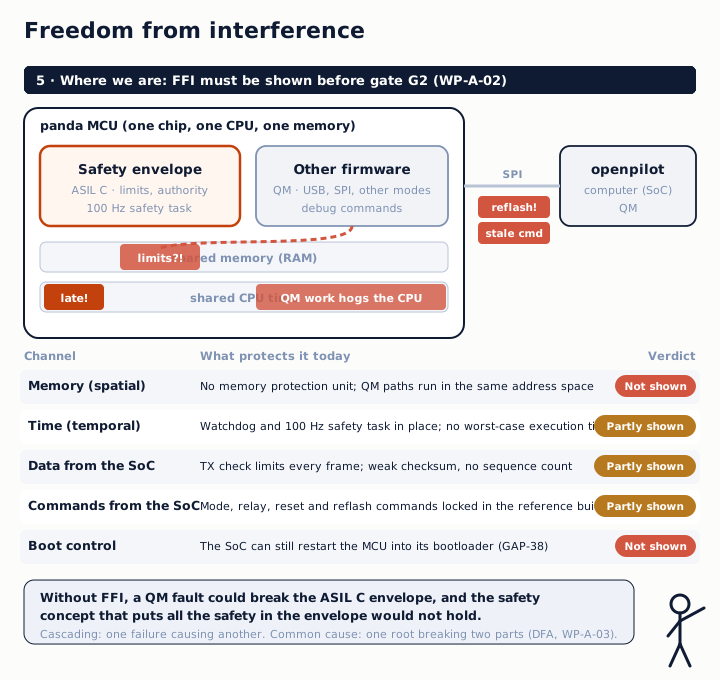
When parts of different ASILs share a chip, the higher-rated part must be shown to be free from interference by the lower-rated ones: through memory (spatial), time (temporal) and messages (communication). Otherwise a fault in QM code could break the ASIL C envelope that the safety concept relies on.
Two related ideas belong with it, and are analysed in the dependent failure analysis:
- Cascading failure: one failure causing another, for example a QM process flooding the link and starving the envelope of commands.
-
Common-cause failure: one root cause breaking two parts at once, for example one power supply feeding both the
openpilot computer and the safety chip. The fault-tree AND gates and the shared resources behind them are checked
in
dfa-gates.md.
The harness box decides whether the stock camera reaches the car or the item intercepts it. Its switch path is a circuit you can open in the browser and break: the harness box results page has a Falstad link where each DFMEA fault of the box (pull-down open, switch threshold too high, ignition-sense transistor shorted, clamp diode leaking) is a switch to flip. The numbers of record are ngspice's, on the same page, and CI checks the two agree. Synthetic, no evidence credit; three part values are still estimates.
- From hazard to test: where these hardware requirements come from.
- Building a fault tree: the traps of common causes and latent faults, in fault-tree form.