Repository navigation
After release
Safety work does not end when the software is released. ISO 26262 Part 7 covers what comes after development:
planning, production, operation, service and decommissioning. This page explains those stages in plain words, then
shows what each one means for LionDriver, which is not built in a factory but installed on an owner's car. It
explains and links. The procedures are the work products of
09-production-operation/ and their requirements are in
WP-S-06; nothing here is a procedure.
Both figures are drawn at each wiki sync by tools/wiki/p7_animations.py. Every
LionDriver step names the record it comes from and is checked against it, so a changed procedure fails the build
instead of showing an old status.
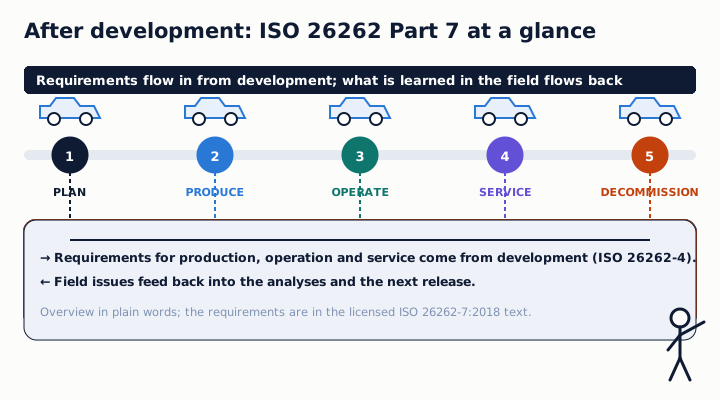
An overview in plain words. It quotes nothing from the standard and gives no clause numbers; the requirements are in the licensed ISO 26262-7:2018 text.
The idea that joins the stages: the requirements for production, operation, service and decommissioning are written during development (ISO 26262-4), so that what keeps the item safe after release is designed in, not improvised. What is learned in the field flows back into the analyses and the next release.
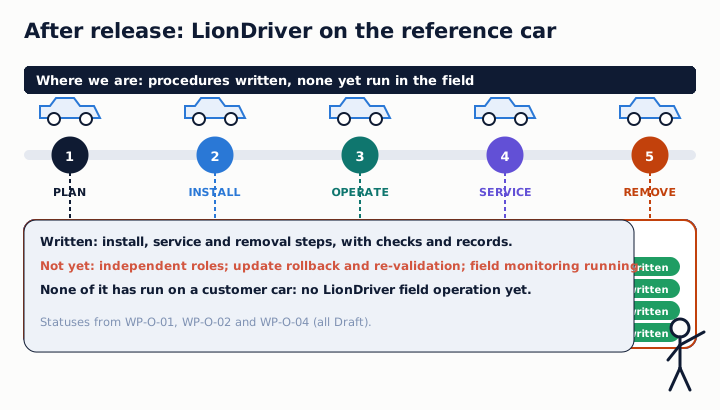
| Stage | For a retrofit it means | Record |
|---|---|---|
| Plan | Requirements for each stage, procedures, and who does them | WP-S-06, WP-O-01…05 |
| Install | The owner's car is the "production line": identify device, harness and car, check the special characteristics (harness variant, connector seating, mount), install only released software, verify the panda firmware, then an engagement check with a trained driver | WP-O-01 |
| Operate | Only released baselines run; parameters are checked after each update; a withdrawn release forces dashcam mode; field monitoring watches for problems | WP-O-02 §3, §6; WP-O-04 |
| Service | A workshop can change what LionDriver relies on: a dealer EPS update, an alignment, a new windscreen. Each one has a follow-up check, and TSR-620 refuses engagement until the car's ECU firmware matches the release record | WP-O-02 §4–§5 |
| Remove | Reconnect the stock camera, confirm the stock driver-assist functions and no trouble codes, reset the device and wipe its identity keys, revoke its credentials | WP-O-02 §7 |
What is not yet in place, as the figure shows: independent roles (one maintainer does every stage, DFI-19), a way to roll back an update and re-validate after it (WP-O-02 OI-7), and field monitoring with a LionDriver data path (WP-O-04 §11). None of these procedures has run on a customer car yet.
- From hazard to test: where the requirements for these stages come from.
- What is a safety case?: how operation feeds back into the case (defeaters, evidence).