Repository navigation
Design: Consumables and Stock
Status: phase 1 built (2026-11-04): materials, items with codes and QR labels, locations, loading into machines, weighing, the ledger, the scan box. Next: the jobs counting (phase 2).
How to use what is built: the Materials guide.
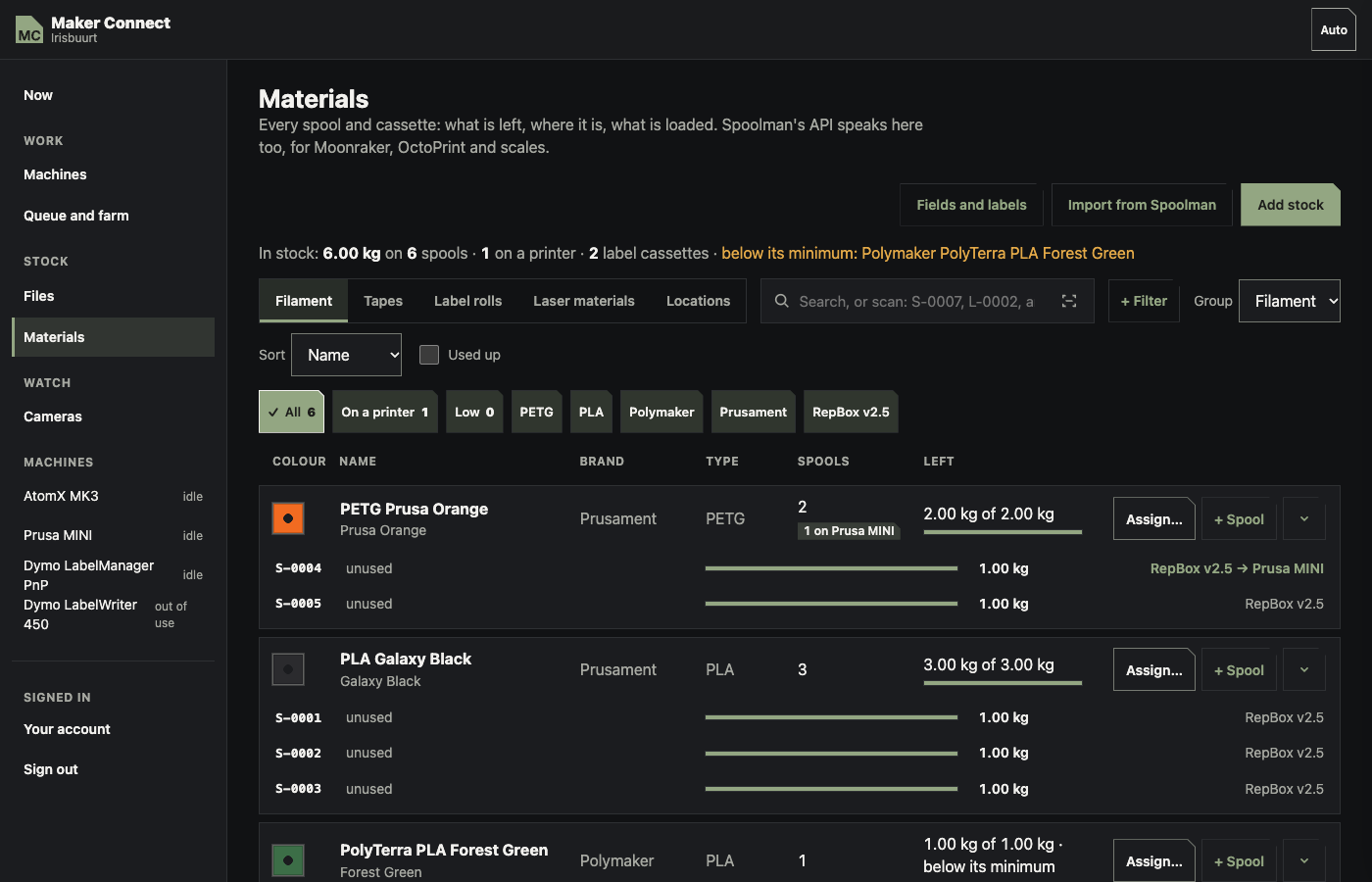
Every machine eats something: filament, resin, label tape, plywood and acrylic sheets, vinyl. A makerspace wants to know what it has, where it is, what is loaded in which machine, what a job used, and when to reorder. Maker Connect already knows the jobs (and what the slicer says they use) and prints labels with QR codes; stock keeping closes the loop: a label on every spool, a scan where it goes, and the jobs do the counting.
Ideas taken, gratefully, from Prusa Connect's Materials page (a catalogue apart from the spools you have, totals on top, in warehouse and assigned filters, favourites and your own materials) and from Spoolman (spools as items, weighed, with their history). Better well stolen than badly invented, in our own design and code.
flowchart LR
    C["Material<br/>(the catalogue)<br/>Prusament PLA Galaxy Black, 1 kg<br/>DYMO 45013, 12 mm, 7 m"] -->|"bought as"| I["Item<br/>(one spool, one cassette)<br/>#S-0107, 812 g left<br/>QR label on it"]
    I -->|"is at"| L["Location<br/>shelf B2 · dry box 1 ·<br/>loaded in MK3S Gonzo"]
    J["Job"] -->|"uses"| I
| Level | What | Examples |
|---|---|---|
| Material | What can be bought: a catalogue entry, shared or the space's own | Prusament PLA Galaxy Black 1 kg (1.75 mm, 1.24 g/cm³, a spool of 193 g empty); DYMO 45013 (12 mm, black on white, 7 m); 3 mm poplar plywood 600 × 300 |
| Item | One thing the space has: a spool, a cassette, a sheet, a pack | Spool S-0107 of that PLA, opened 2026-10-02, 812 g left |
| Location | Where an item is: a place, or a machine | Shelf B2, dry box 1, drawer D12, loaded in MK3S Gonzo, used up |
-
Kinds: filament, resin, label tape, sheet (wood, acrylic, card), vinyl, other. Each kind has its own properties: filament its diameter, density, temperatures, spool weight; tape its width, length and colours (already in the DYMO profile's
[[media]]); a sheet its size and thickness, and for a laser its settings. - Where it comes from: a shared catalogue imported from an open source (candidates: SpoolmanDB, the Open Filament Database: licences to check), the media lists in machine profiles, and the space's own materials. Each with its barcode (EAN) when it has one, so a scan finds it.
- Favourites keep the list short: what this space actually buys.
- Every item gets an id (
S-0107) and a QR label, printed on arrival with the label printer: the id, the material, the date. The QR code holds a short link (/i/S-0107), so a phone camera opens its page too. - Amount left: grams (filament, resin), metres (tape, vinyl), or a count (sheets, packs). Set on arrival from the material (1 kg, 7 m), corrected by weighing (gross weight minus the empty spool) or by hand.
- Lot and opened date, and for filament dried (when, how long): moisture matters.
- Owner: the space, or a member's own spool (kept apart, not billed).
A tree like the device tree: room → cabinet → shelf → box. Every location gets a QR label too. A machine is a location: loaded in. A dry box with a sensor is a device and a location at once.
Stock is never edited in place; every change is a movement with who, when and why, and the amounts follow from them:
| Movement | When |
|---|---|
| Received | Items arrive (scan the product's EAN, say how many: items made, labels printed) |
| Moved | Scan the item, scan the location |
| Loaded / unloaded | Scan the item at the machine, or choose it on the machine's page |
| Used | A job ended: its use taken from the loaded item |
| Weighed | A scale or a hand-entered weight corrects the amount; the difference is recorded |
| Used up / discarded | Empty, broken, wet beyond saving |
This gives history per item (where it went, what it printed), usage per machine and per member, and a correct total at any moment.
-
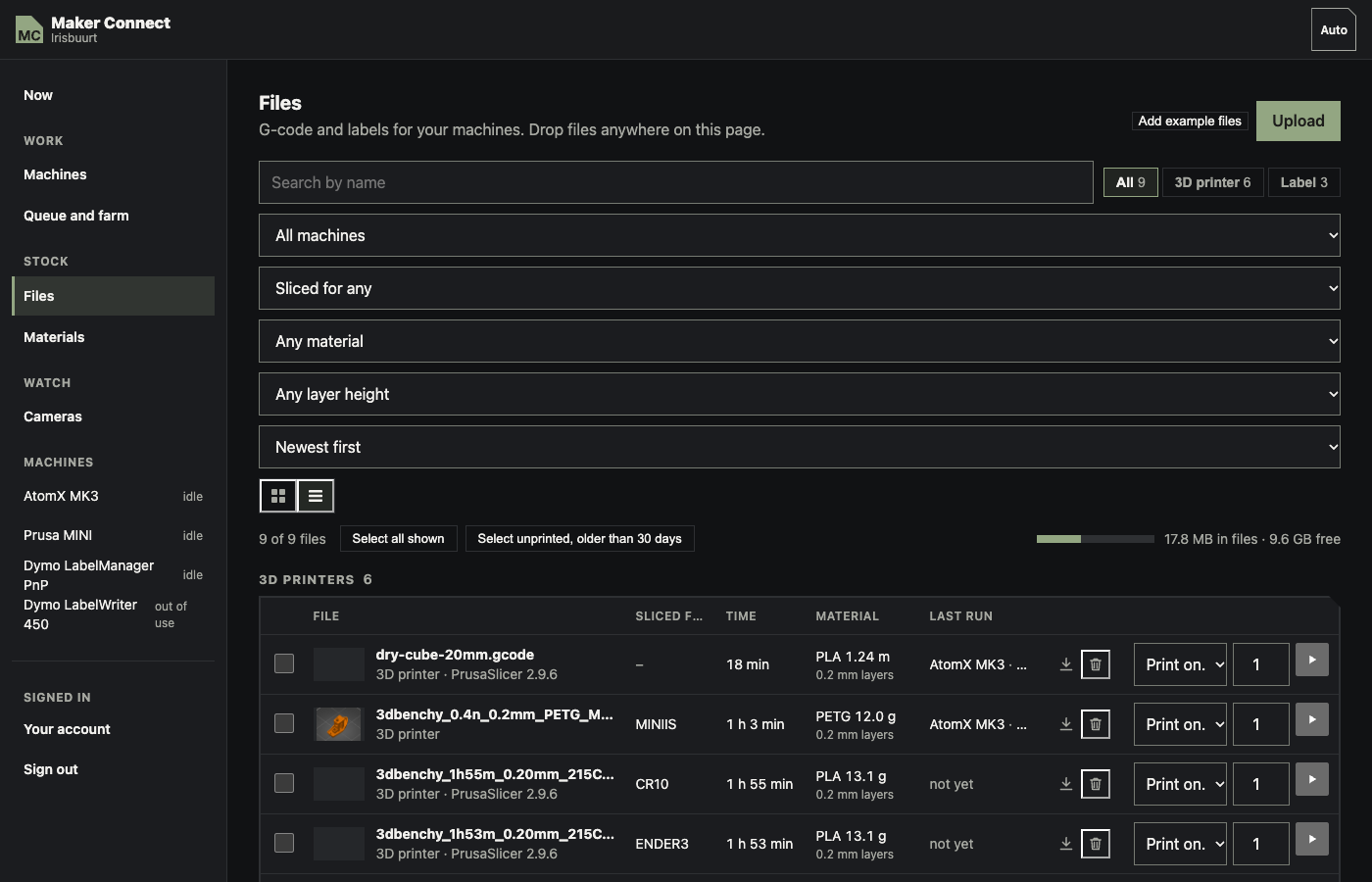
3D printers: the slicer writes the filament a file uses (
filament used [g], already read); when the job ends, that is taken from the item loaded. A stopped job takes its share (by progress). Several extruders: per tool. - Label printers: a label's length plus the feed before and after (both known to the printer's code) is taken from the cassette, in millimetres: a 7 m cassette shows how many labels are left.
- Lasers: a job on a sheet takes the sheet (or a part of it, later from its outline).
- The loaded item comes from: the machine's page (as the DYMO's Tape loaded today, which becomes a choice of items), a scan at the machine, or what the machine says (Prusa's MMU and filament sensors, Bambu's AMS, later NFC tags on spools).
- Checks before a job: not enough left on the loaded spool → a warning ("needs 38 g, 22 g left"); the wrong material for the file (sliced for PETG, PLA loaded) → a warning.
Scanners: a USB or Bluetooth barcode scanner is a keyboard: it types the code and Enter. A Scan box on the stock pages (and a global shortcut) catches that: no driver, every scanner, every platform. A phone's camera works too, through the browser's barcode detector; that needs HTTPS.
What a scan does depends on what it finds:
| Scanned | What happens |
|---|---|
| An item's QR | Its page: amount, location, history; buttons to move, load, weigh, use up |
| A location's QR | Its contents; the next item scanned is moved there |
| A machine's QR | The next item scanned is loaded into it |
| A product's EAN | Its material: receive how many? (then the labels print) |
| Something unknown | Make a material of it, with this EAN |
So a delivery is: scan the EAN, type 5, Enter: five items, five labels from the DYMO. Loading a spool: scan the printer's label, scan the spool's.
A kitchen scale per space, connected: an ESP32 with an HX711 load cell, a USB or Bluetooth scale, reporting weights as a device. Scan the spool, put it on: its amount is set (gross minus the material's empty spool weight), the difference recorded as weighed. Later: a scale under the spool holder, reporting while it prints.
- Stock: totals on top (grams of filament, spools, cassettes, sheets, by kind), then materials with what is in stock of each; filters: kind, in stock, loaded, low, favourites, the space's own; search; sorting. The materials, with the items of each folded out.
- An item: its label to print again, amount, location, history, the jobs it printed.
- A location: what is there; its label.
- A machine's page: what is loaded, with how much left; load and unload.
- Reorder: materials below their minimum, as a shopping list (with the supplier's link and the article number), and a notification when one drops below.
- A price per item (or per material), so a job's material cost is known: grams × price per gram; label tape per metre.
- Use per member and per machine over a period, for a space that charges for material, alongside the energy per job from the plugs.
Materials of the shared catalogue are shared; a space's own materials, items, locations and movements belong to the space (see Multi-Tenant Hub). Stock events go over the same bus (t.<tenant>.stock.*), so a job's end moves stock in a worker, not in the request.
- Built: materials (with the media of the profiles), items, locations, movements; the page (named Materials); receiving and labels for items and locations; the Scan box with a USB scanner.
- Loading built; the jobs counting next (3D printers from the slicer's grams, label tape by length).
- Built: the shared catalogue, imported from PrusaSlicer's vendor profiles (271 filaments with density and empty spool weight), searched as you type. EAN lookups to come.
- Weighing by hand built (the empty spool taken off); a scale as a device, reorder points and the shopping list, costs per job to come.
- Phone camera scanning (with HTTPS), NFC tags, multi-material units reporting what is loaded.