Contrast Appearance
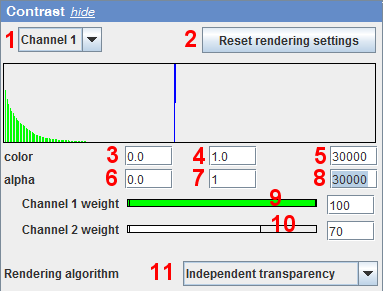
Like contrast adjustments in ImageJ/Fiji, the intensity contrast for the 3D rendering is specified by a minimum (3) and maximum (5) displayed intensity value for each channel. Additionally, the input interval between minimum and maximum can be mapped to the output interval non-linearly using a gamma parameter (4). Opposed to 2D contrast adjustment, for 3D rendering each pixel is transparent to some degree, depending typically on its intensity. This dependency is typically called the transfer function. Analogously to intensity contrast, the transfer function is specified by a minimum value (6) (for full transparency), a maximum value (8) (fully opaque) and a gamma parameter (7) for non-linear mapping of the interval in-between.
The channel weight sliders (9, 10) are used to adjust the contributions of each channel to the final output image. Double-clicking the weight sliders opens a color chooser dialog for adjusting a channel’s color. The combo box (1) at the top is used for switching between channels. Additionally, there is a button (2) at the top right to reset the rendering settings to the default values.
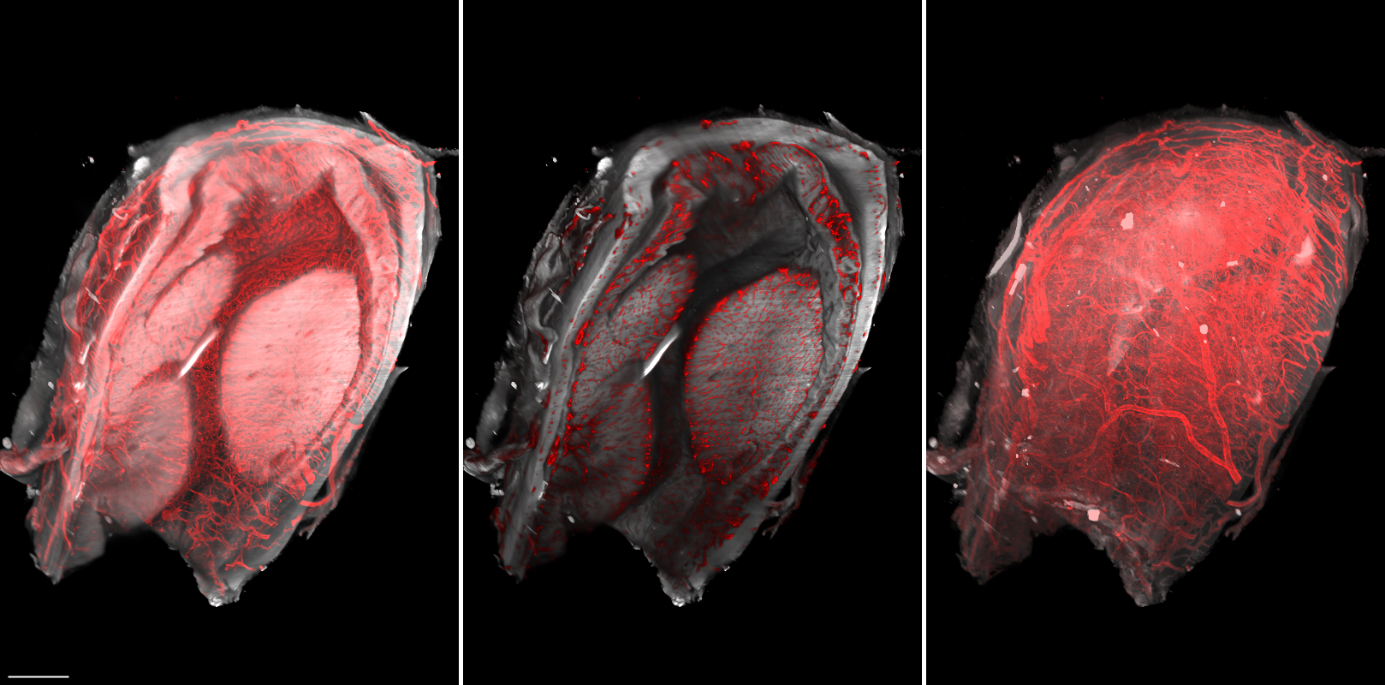
Three different rendering algorithms are implemented (11):
- Independent transparency: Each channel is processed individually, without influencing the other channels.
- Combined transparency: The transparencies of multiple channels influence each other
- Maximum intensity projection: There is no transparency involved at all, the maximum intensity of each channel along the ray of sight is taken for the output pixel
In more detail: The independent and combined transparency modes both use standard front-to-back ray-casting with the following formulas:
c = (1 - α) * αi * ci
α = (1 - α) * αi
Where c is the output intensity of a ray (i.e. pixel), α is its output opacity, and ci and αi are the corresponding input values at discrete sampling positions along each ray. Independent transparency mode applies these formulas separately for each channel, combined transparency mode uses sums up the values of αi across all channels before advancing to the next ray sample.
Here is a comparison of the different rendering algorithms (left: independent transparency, middle: combined transparency, right: maximum intensity projection; contrast settings have been adjusted to the corresponding algorithm):