Repository navigation
Poetry
Mark a note with type: poem (also poema or poesía), or add poem to its cssclasses, and it is treated as verse.
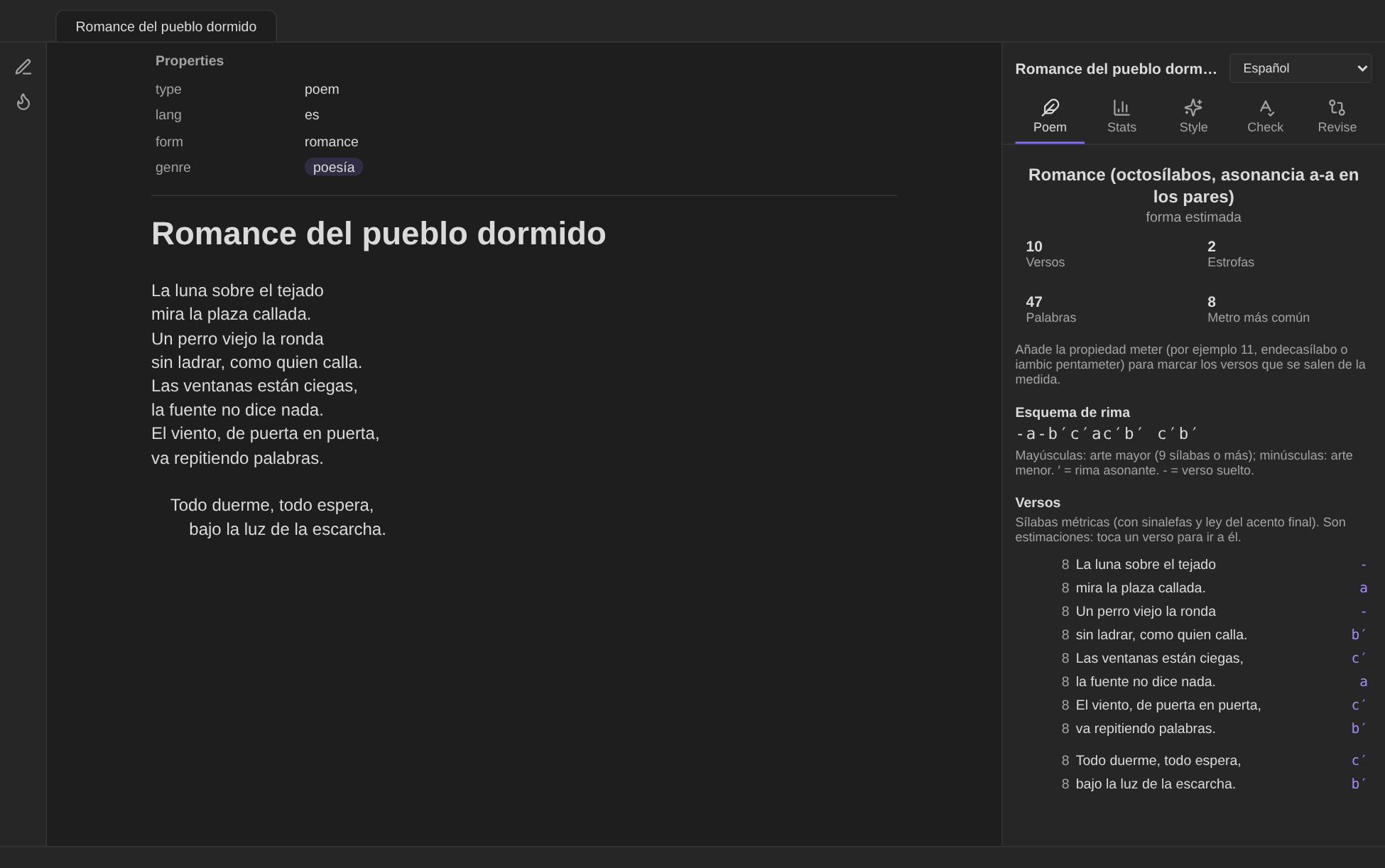
Markdown is unkind to poems: indented lines turn into code blocks, and with "strict line breaks" lines run together. In poem notes:
- Every line stays a line and keeps its indentation, in the editor and in Reading view.
- Long lines wrap with a hanging indent, so it's clear where a line of verse begins.
- A blank line separates stanzas.
-
%%center%%or%%right%%at the start of a stanza aligns the whole stanza (see Formatting tools). - Comments (
%% … %%), such as instructions in a template, are not shown or counted as verse.
-
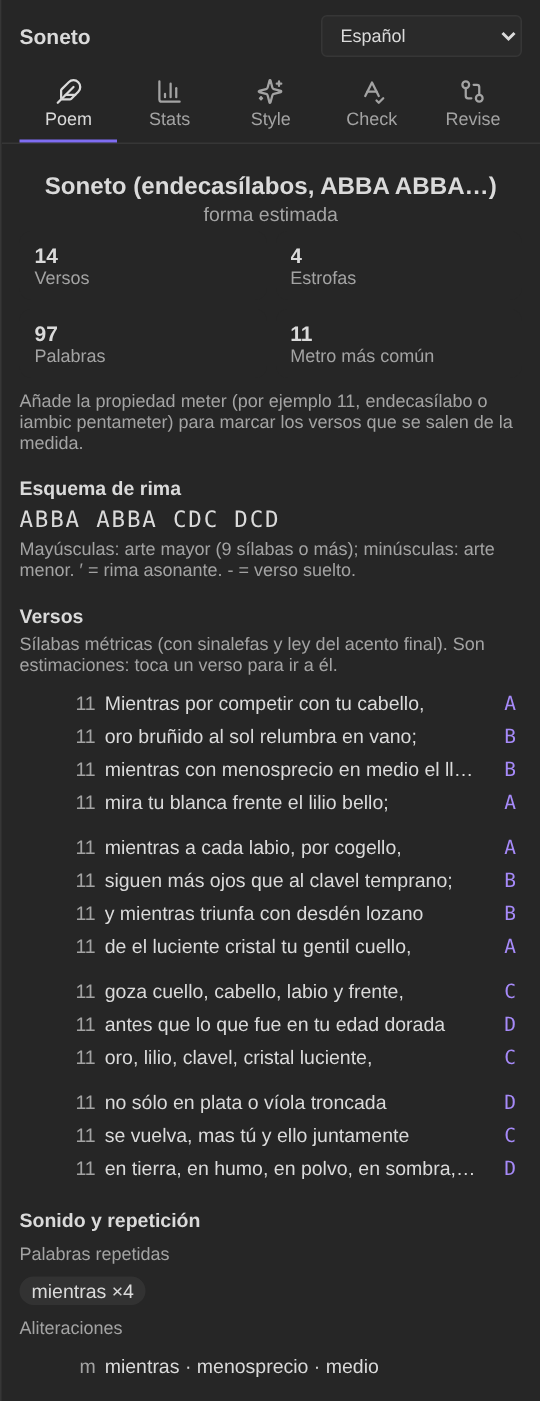
Form, when the poem matches one: sonnet (14 hendecasyllables; ABBA ABBA… for the classic Spanish scheme), haiku (5‑7‑5), décima espinela (ten octosyllables, abbaaccddc), romance (octosyllables with the same assonance on even lines), couplets, tercets, quatrains up to octaves, isometric verse (all lines the same length) or free verse. The form is an estimate.
-
Lines, stanzas, words and the most common metre.
-
Rhyme scheme by stanza.
-
Every line with its syllable count and rhyme letter. Tap a line to jump to it; hover it to see how the count was reached.
-
Scansion (English): the foot most lines follow (iambic pentameter, trochaic tetrameter…), the stress pattern under each line (
˘unstressed,/stressed,·either way) and the lines that depart from it. -
Meter target: see below.
-
Sound & repetition: refrains, repeated words and alliteration.
The labels follow the poem's language (Versos, Estrofas, Esquema de rima… in Spanish).
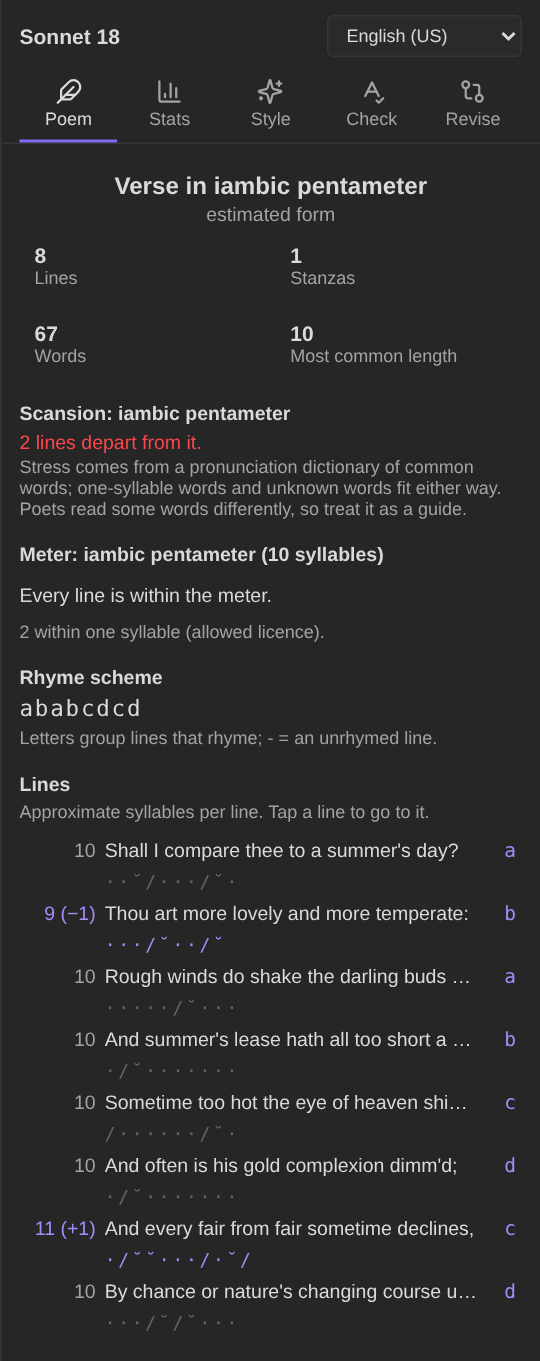
(Right: an English sonnet with meter: iambic pentameter.)
Add a meter property and the Poem tab checks every line against it:
---
type: poem
meter: endecasílabo     # or 11, "8 syllables", octosílabo, alejandrino, soneto, iambic pentameter…
---- Lines more than one syllable away are marked in the list (
(+2),(−3)) and with a wavy underline in the editor. A line one syllable away is allowed, the same licence the form recogniser uses, and is only counted as close. - Accepted values: a number; a Spanish line name (octosílabo, endecasílabo, alejandrino…); an English foot count (tetrameter, pentameter, optionally with iambic, trochaic…); or a form that fixes the length (soneto, sonnet, romance).
- The underline can be turned off in settings (Poetry → Underline lines out of meter).
- Refrains: lines of two words or more that come back word for word (ignoring case, accents and punctuation), with how many times. Tap one to jump to it.
- Repeated words: words used three times or more, without the small function words.
- Alliteration: lines with three or more words that start with the same consonant sound (Peter picked a peck of pickled peppers). Silent h, soft and hard c and g, qu, ph and the like are taken into account.
- Villanelle and pantoum are recognised from their repeated lines: a villanelle has 19 lines in five tercets and a quatrain with its two refrains returning on lines 1, 6, 12, 18 and 3, 9, 15, 19; a pantoum is a run of quatrains whose second and fourth lines come back as the first and third of the next.
Settings → Poetry → Number every fifth line puts 5, 10, 15… in the margin of poem notes and in the Word, PDF and EPUB exports (the export window has the same switch, Number poem lines). Titles, epigraphs, dedications and comments are not counted. Plain-text export is not numbered.
Write them as callouts:
> [!dedication]
> for M.

> [!epigraph]
> "A line from somebody else" — Author([!epígrafe] and [!dedicatoria] work too.) In the note they are shown without a box, in italics, the dedication to the right; in exports the dedication is set to the right and the epigraph indented, both in italics and never numbered.
Spanish poetry counts metrical syllables, not grammatical ones:
- Grammatical syllables of each word: vowels together form a diphthong unless both are strong (a, e, o) or the weak one is accented (hiato: ma-rí-a). qu and gu before e/i are one sound; ü keeps its vowel.
- Sinalefa: the last vowel of a word and the first vowel of the next one merge into one syllable (que‿es-tá), also across a silent h (no‿ha-bla). The conjunction y is a vowel (labio y frente) except before another vowel, where it sounds like a consonant (y el); a final y (soy, hoy) closes a diphthong and does not merge with the next word.
- Ley del acento final: the count depends on the stress of the last word. A line ending in an aguda (stress on the last syllable: can-tar) adds one; an esdrújula (pá-ja-ro) subtracts one; a llana stays as it is.
So "Ca-mi-nan-te, no‿hay ca-mi-no" has 9 grammatical syllables and 8 metrical ones (the llana camino adds nothing).
English has no fixed metrical rules of this kind. The plugin carries the stress patterns of the 25,000 most frequent English words (from the CMU Pronouncing Dictionary, see Third-party notices); the list is read the first time an English poem is analysed. Syllables come from it, and each line is compared with iambs, trochees, anapests and dactyls: the best fit names the line (iambic pentameter), and the dominant foot of the poem is the scansion. Words not in the list use an approximate syllable count (vowel groups, a silent final e, -ed and -es endings) and fit either stress.
Two things to know: one-syllable words and secondary stresses are treated as flexible, because verse bends them either way; and the dictionary records how words are spoken, so a poet's tem-per-ate (three syllables) is counted as two. The one-syllable licence of the meter target covers most of these.
The rhyme of a line is its last word from the stressed vowel to the end: cabello → -ello, gitana → -ana.
- Lines with the same ending have consonant rhyme (rima consonante) and share a letter: A, B, C…
- In Spanish, lines that share only the vowels of that ending (callada / escarcha: á‑a) have assonant rhyme (rima asonante), shown with ′ (a′, b′).
-
Uppercase letters mark arte mayor (lines of 9 syllables or more), lowercase arte menor;
-is an unrhymed line (verso suelto). - ñ is kept as a distinct sound, so montaña and gitana don't rhyme, though they share the assonance á‑a.
Poems keep their layout in every export format: single-spaced lines with their indentation, a blank line between stanzas, never justified. Line numbers (every fifth line) and epigraphs and dedications are described above.

Syllable counts and rhyme are estimates. Poets bend the rules on purpose (sinéresis, diéresis, licences), and a word's stress can depend on its meaning. The Poem tab is a second pair of eyes, not a judge.