Repository navigation
Operations and Safety
Note
Design stage. This page describes planned mechanics from the design document. Not implemented yet — see Roadmap (milestone M10).
At real plants most serious incidents happen not in normal operation but in deviations from it: maintenance, startup, shift change, a temporary bypass. Prompt Critical turns these moments into mechanics. Hazardous energy is isolated with a personal lock, work goes ahead under a permit, the atmosphere is checked with an instrument, pressure goes to the flare, and fires are fought by a system you designed. Mistakes lead to realistic consequences, and hazards are recognized through instruments.
This section owns the sim.ops package (Lockout, WorkPermit, ShiftLog) and the items lockout_padlock, lockout_tag, work_permit.
-
Hazardous energy kinds (
EnergyKind):ELECTRICAL,MECHANICAL(Create rotation, flywheels),PRESSURE,THERMAL,CHEMICAL,RADIATION,GRAVITY(raised loads, control rods). - Isolation point — a block that physically cuts off energy and accepts a lock. Its isolated position is fixed (gate valve closed, breaker open and racked out).
-
Enforcement level
ops.permit_enforcement:OFF,ADVISORY(default: warnings, log entries, shift score),ENFORCED(actions without a permit or lock are blocked). A LOTO lock works always when hung — it is a physical item. - Single player: you hold all roles, sign a permit yourself on one screen, and two-sided procedures (shift handover) are off. Isolation and atmosphere mechanics stay fully active.
- Time: confined-space atmosphere, fires and flares run in real time (1–4 Hz). Repairs, wear and inspection intervals run in SLOW physical time. Permit and shift durations are real minutes.
The procedure follows OSHA 29 CFR 1910.147 and equipment-isolation practice:
| Step | Action | In the mod |
|---|---|---|
| 1 | Identify all energy sources | the permit builds an isolation plan automatically from network topology |
| 2 | Notify affected people | permit shown on permit_board and via pc_ops
|
| 3 | Normal shutdown | command from panel or Lua |
| 4 | Isolate: close, open, disconnect | isolation points moved to the isolated position |
| 5 | Hang a personal lock and tag on each point |
lockout_padlock + lockout_tag
|
| 6 | Release stored energy | drain, vent, discharge, lower loads |
| 7 | Verify zero energy | try to start + measure |
| 8 | Work | permit ACTIVE
|
| 9 | Remove: people and tools out, locks off, return to service | only the lock owner |
| id | What | Mechanic |
|---|---|---|
lockout_padlock |
personal lock |
lock_owner component (UUID, name, body colour); the key cannot be transferred; up to 8 locks per player (ops.max_locks_per_player) |
lockout_tag |
"Do not operate! People at work" |
lock_tag (owner, reason, permit number, time); without a lock it is only a warning (tagout) |
lockout_hasp |
6-lock hasp | the point returns to service only when the last lock is removed |
lockout_box |
group lock box | the responsible person locks the points and puts keys in the box; the crew hangs personal locks on the box |
line_blind |
spectacle blind on a flange |
OPEN/BLIND; positive isolation for hazardous media; swapping takes 10 s and needs ≤ 0.05 MPa in the line (otherwise a release) |
mechanical_disconnect |
lockable coupling on a Create shaft | breaks rotation transfer; upstream keeps turning |
voltage_tester |
voltage detector | shows voltage on a bus or breaker; must be proved on a known live source before and after (three-point test) |
| Block | Energy | Isolated position | Lock |
|---|---|---|---|
valve_gate, manual valves |
pressure, chemical, thermal | closed | on the handwheel / actuator (motor-operated: also cut actuator power) |
valve_control |
same | closed | only together with a manual valve — a control valve is not an isolation valve; under ENFORCED it alone does not count |
esd_valve |
same | fail position | on the manual override + vent actuator air |
line_blind |
same | BLIND |
on the turning mechanism |
grid breaker (pc_breaker) |
electrical | open, racked out, earthed | on the cell shutter |
relay_power_supply, ups_cabinet
|
control power | off | on the switch |
mechanical_disconnect, pump couplings |
mechanical | disengaged | on the lever |
control_rod_drive |
gravity | rods in, gripper released | on the drive; only in SHUTDOWN
|
While at least one lock hangs on a point:
- manual operation is impossible ("LOCKED OUT: ");
- Lua commands return
E_INTERLOCK: LOCKED_OUT; - wired PLC/relay outputs and watchdog actions are ignored;
- the safety system cannot move a locked device. If its action matches the isolated position (close a closed valve) there is no conflict; if it needs the opposite (open a deluge valve locked closed), the lock wins and the safety function reports failure to execute. Locking fire-protection or emergency-relief elements therefore needs a permit with compensating measures (fire watch).
When a permit is created for equipment, the domain walks the network graphs: hydraulic connections up to the nearest isolation points, breakers feeding motors and heaters plus control circuits, drive couplings, and stored-energy items. For TOXIC, FLAMMABLE, TOXIC_CO or ASPHYXIANT media above 1 MPa (ops.dbb_pressure_pa) it proposes double block and bleed (two valves with an open drain between them) or a line_blind.
Why: a single valve leaks through its worn seat. Example: 1 g/s of methane leaking into a 2 m³ isolated section raises pressure by 78 Pa/s — 0.1 MPa in 21 minutes. With an open bleed between two valves the pressure at the work site does not rise.
| Stored energy | Release | Check |
|---|---|---|
| pressure in an isolated section | vent to flare or stack, drain | gauge ≈ 0 |
esd_valve spring |
stroke to fail position | limit switch |
| pump flywheel | coast down (tens of seconds) | shaft speed = 0 |
| capacitors, UPS batteries | disconnect and discharge | voltage_tester |
| raised load, counterweight | lower and secure | visual |
| hot medium | cool below 333 K | thermometer |
"Verified" is ticked only by fact: an attempted start from the normal station does nothing, voltage_tester reads dead, pressure ≤ 0.01 MPa gauge, shaft speed 0, temperature below 333 K, and gas testing for atmosphere.
| Action | Who | Station log |
|---|---|---|
| Hang a lock | any station member with a work role (MAINTENANCE, ENGINEER, OPERATOR, OWNER) |
LOCKOUT_ON |
| Remove own lock | owner only | LOCKOUT_OFF |
| Remove someone else's lock |
no player; an admin with /pc lockout cut <point> <reason>
|
LOCKOUT_ADMIN_CUT (CRITICAL), announced to the station |
| Abandoned lock (owner offline) | if ops.abandoned_lock_hours > 0, a SHIFT_SUPERVISOR may remove it by procedure after inspecting the site |
LOCKOUT_REMOVED_BY_PROCEDURE |
| Break a locked block | forbidden in all server modes except realistic, where it raises a P1 "ISOLATION TAMPERING" alarm |
UNAUTHORIZED_ACCESS (CRITICAL) |
The lock is also an anti-griefing tool: a member can lock equipment under repair and nobody — no member, no foreign computer — can start it. See Multiplayer.
Isolation point states: IN_SERVICE → ISOLATED → LOCKED → VERIFIED; removing the last lock returns to ISOLATED.
PermitType |
Required (under ENFORCED) |
Mandatory items | Max duration |
|---|---|---|---|
COLD |
repair in an operating unit | isolation plan | one shift |
HOT |
any spark or flame within 11 m of a FLAMMABLE medium |
isolation, LEL test before and continuously, fire watch, extinguishers | 4 real hours |
CONFINED_SPACE |
entry into a confined space | positive isolation, ventilation, O₂/LEL/H₂S/CO test, attendant, rescue equipment | one shift |
ELECTRICAL |
work on grid equipment | open, rack out, earth, voltage_tester check |
one shift |
RADIATION |
work in controlled unserviced areas | dose plan, health physicist, radiological PPE (Radiation Safety) | per dose plan |
MOC |
change to a PLC program flagged critical, safety bypass longer than 1 h, temporary pipe bypass | change description, risk checklist, approval by ENGINEER + SHIFT_SUPERVISOR
|
until the change is closed |
work_permit is a form item (component permit_data) opened with right-click; the original lives in the domain, items are copies for the crew. A permit_board in the control room shows all station permits. Fields: number, type, scope (click blocks), hazards (HazardTag, EnergyKind, pre-filled), isolation plan, gas tests with timestamps, required PPE, times, signatures.
| Permit role | Who | Confirms |
|---|---|---|
| Issuer |
ENGINEER, SHIFT_SUPERVISOR, OWNER
|
scope, hazards, measures |
| Area authority |
SHIFT_SUPERVISOR, on-shift OPERATOR
|
isolation done, site prepared |
| Person in charge |
MAINTENANCE, ENGINEER
|
crew briefed, work per permit |
| Crew member | any station member | read and acknowledged (signature = right to be in the work area) |
Permit states: DRAFT → ISSUED → ISOLATED → GAS_TESTED → ACTIVE → WORK_COMPLETE → CLOSED; gas alarm, safety trip, fire, unhanded shift end or expiry → SUSPENDED; EXPIRED. In SUSPENDED nobody may be in the work area: under ENFORCED players get 60 s to leave, then UNAUTHORIZED_WORK is logged.
Use a portable_gas_detector (four sensors: catalytic LEL, electrochemical O₂, H₂S, CO) or a fixed gas_detector bound to the work area. Results go into the permit automatically when you hold the instrument in the area for ≥ 30 s (T90); in confined spaces at three heights — top, middle, bottom — because gases stratify.
| Parameter | Confined space entry | Hot work |
|---|---|---|
| O₂ | 19.5–23.5 % | 19.5–23.5 % |
| Flammables | < 10 % LEL | 0 % LEL in the area, < 10 % with continuous monitoring |
| H₂S | < 10 ppm | < 10 ppm |
| CO | < 25 ppm | < 25 ppm |
The instrument needs a bump test with calibration_gas within the last 24 h (ops.bump_test_max_age_s), otherwise the result is marked "instrument not checked" and rejected under ENFORCED. Retest every 2 h (ops.gas_retest_s) and after any break. For hot work and confined spaces the detector must be worn — an alarm suspends the permit.
Hot work is anything that can ignite a flammable atmosphere: placing, removing or "welding" pipe blocks on hydrocarbon networks and on flammable vessels; angle grinders, welding sets and similar tools; open flame (flint and steel, torches) within 11 m (35 ft, OSHA 1910.252). On each hot action the domain samples the atmosphere at 27 points around it; if any point is at ≥ 100 % LEL, the cloud flashes or explodes through DamageBudget. With an active HOT permit (0 % LEL, a fire watch with an extinguisher within 11 m, isolation in place) the only risk is what changed after testing — hence continuous monitoring.
A confined space is registered by a manway block on a vessel, column, header or pit wall. On placement a flood fill finds an air volume of ≤ 2048 blocks (ops.confined_max_volume) with no more than two 1×1 openings — otherwise it is a room. Mine workings use the separate mine model (Coal and Metallurgy).
The atmosphere is a well-mixed volume (O₂, N₂, Ar, CO₂, CH₄, H₂S, CO, hydrocarbon vapours) with inflows from valve seat leaks (which is why positive isolation matters), nitrogen purge, sludge decomposition and combustion, and ventilation — natural through the manway (0.002 m³/s per opening) or a portable_ventilator (0.5 m³/s). It is computed at 1 Hz only when a player is inside or at the entry, or inflows are changing.
Example: a 20 m³ vessel with nitrogen leaking through a valve at 1.7 L/s drops from 20.9 % to 16 % O₂ in 52 minutes; a 50 L/s purge reaches 10 % in 5 minutes. Ventilating from 5 % back to 19.5 % takes 2.4 volume changes with perfect mixing; the mod applies a mixing factor of 3 → 7.3 air changes.
| Gas | Level | Effect on the player |
|---|---|---|
| O₂ (asphyxiant) | 16–19.5 % | Slowness I |
| 12–16 % | Slowness II, nausea, blur, 10 % of right-clicks miss (impaired judgement) | |
| 8–12 % | Blindness, Weakness, 1 damage/s (promptcritical:asphyxiation) |
|
| < 8 % | unconscious after 10 s, 2 damage/s; below 6 % death in ≈ 40 s | |
| H₂S | 10–50 ppm | nausea |
| 100–500 ppm | olfactory paralysis — the rotten-egg smell cue disappears; poison | |
| 500–1000 ppm | unconscious in 30 s | |
| > 1000 ppm | instant collapse, 4 damage/s | |
| CO | carboxyhaemoglobin builds with time constant 600 s | 10–20 % nausea, 30 % slowness, 40–50 % unconscious, > 60 % death. 100 ppm → 10.3 % COHb (headache); 1000 ppm → 53 % (unconscious) |
Why a filter mask does not help: a gas_mask removes contaminants but adds no oxygen and gives no protection below 17 % O₂. A catalytic LEL sensor in nitrogen reads zero — "no flammables", which is true, but there is nothing to breathe. Hence the mandatory O₂ sensor in every gas test.
Attendant and rescue. Under CONFINED_SPACE:
- an attendant must stand within 4 m of the
manwayand not enter; without one, entry is blocked underENFORCED; - the entrant wears a
safety_harnesswith alifelineattached to arescue_tripodover the opening; the attendant rescues without entering (right-click the tripod — the winch pulls the player out in 5 s, even unconscious); - entering to rescue without a
scbameans the same atmosphere and the same collapse. A large share of confined-space deaths are would-be rescuers, and the mod reproduces this without scripting.
Patrol rounds. A route is an ordered list of patrol_checkpoint blocks. With a patrol_reader, right-clicking a checkpoint records the visit and opens its card: read the local instrument and enter the value (a discrepancy > 2 classes flags "instrument faulty?"), listen to the equipment (choose "bearing noise", "cavitation" — a correct choice opens a repair work order), inspect for leaks, locks and tags. The route must be walked within ops.patrol_period_s = 3600 s, otherwise a P4 "PATROL OVERDUE" alarm. Patrols find what telemetry cannot: hidden sensor failures and early acoustic symptoms.
Shift log (ShiftLog) summarizes for people: events (scrams, trips, P1 alarms, starts/stops), operator entries, standing orders, equipment under repair, deviations (safety bypasses, PLC forces, shelved alarms, devices in MAINTENANCE), and the shift report from the historian.
Shift handover. A shift lasts ops.shift_length_s = 3600 real seconds when a SHIFT_SUPERVISOR is online (servers can disable shifts). States: ON_SHIFT → HANDOVER_PENDING → ON_SHIFT (new); 10 min without a signature keeps the old shift with a P3 "SHIFT NOT ACCEPTED"; outgoing player leaves → UNATTENDED. The incoming supervisor must tick every checklist item: open permits, locked points, safety bypasses, forces, shelved alarms, deviations, orders. Permits pass to the new shift; an unsigned transfer suspends them. Shift score: −5 for an unaccepted shift, −3 per item marked "not checked", +5 for a shift with no overdue permits and completed patrols.
| Block | Function |
|---|---|
intercom_station |
PA console: push-to-talk, channel and zone selection, prerecorded message buttons; usable by a player within 2 m holding a key card of the right role |
plant_loudspeaker |
horn speaker; zone assigned in its GUI |
| Channel | Who speaks | Heard | Priority |
|---|---|---|---|
EVAC |
automatic: fire panel in FIRE, fire & gas safety logic, radiation alarm; live voice only SHIFT_SUPERVISOR
|
all speakers | 0 |
FIRE_GAS |
automatic, SHIFT_SUPERVISOR
|
event zone and neighbours | 1 |
ALL |
OWNER, SHIFT_SUPERVISOR
|
all zones | 2 |
CONTROL |
OPERATOR, SHIFT_SUPERVISOR
|
control room, turbine hall, units | 3 |
MAINTENANCE |
MAINTENANCE, ENGINEER
|
workshops | 3 |
CHEM_RAD |
CHEMIST, HEALTH_PHYSICIST
|
chemistry, controlled area | 3 |
A message is intelligible where the speaker level exceeds the plant noise by ≥ 10 dB: with 110 dB(A) at 1 m, one horn covers 5.6 m in an 85 dB(A) turbine hall but the full 48 m limit in a 55 dB(A) yard — so noisy halls need many speakers. Live voice uses optional Simple Voice Chat integration (mod.compat.voicechat); without it, and always for automatic messages, there are sirens, gongs and prerecorded phrases (pa.voice.fire_zone, pa.voice.gas, pa.voice.evacuate, pa.voice.all_clear) with subtitles. The PA runs on 0.4 kV backed by station_battery. Lua: announce, page, getPaStatus; event pc_pa_announce.
valve_relief gets a psv_spec component: set pressure, orifice letter (API 526), discharge destination (atmosphere / flare header / drain), conventional or balanced bellows, last bench test date.
| Parameter | Value |
|---|---|
| Set pressure | ≤ MAWP of the protected volume |
| Accumulation | 10 % (single valve), 16 % (multiple), 21 % (fire) |
| Blowdown | 7–10 % below set |
| Back pressure | conventional ≤ 10 % of set; bellows up to ≈ 50 % |
| Inlet loss | ≤ 3 % of set ("3 % rule", otherwise chatter) |
Orifice area is sized per API 520 for gas (critical flow) or liquid. Example: separator gas, 10,000 kg/h, M = 18, 320 K, set 1000 kPa(g) → 1342 mm² → next larger orifice L (1841 mm²). Standard orifices: D 71, E 126, F 198, G 325, H 506, J 830, K 1186, L 1841, M 2323, N 2800, P 4116, Q 7129, R 10 323, T 16 774 mm². If the required flow is < 25 % of capacity (oversized valve) or inlet loss > 3 %, the valve chatters: seat wear ×10 and leakage after reseating. Relief scenarios to check: blocked outlet, cooling/condenser failure, exchanger tube rupture, thermal expansion of trapped liquid, and external fire (API 521). The valve GUI has a sizing wizard.
| Discharge to | When allowed | Consequence |
|---|---|---|
| Atmosphere (vent stack) | steam, air, nitrogen, water | nitrogen is an asphyxiant within 3 m below the stack in still air |
| Atmosphere, hydrocarbons | forbidden under ENFORCED, warning under ADVISORY
|
vapour cloud, ignition from any source, emissions |
| Flare header | flammable and toxic gases and vapours | see below |
| Closed drain | liquids | drain vessel |
| Block | Function | Mechanic |
|---|---|---|
| flare header |
pipe_large designated "flare" |
back pressure on relief valves rises with flow |
flare_knockout_drum |
separates droplets | overfilled drum → liquid carryover → burning rain: class B fire within 40 m (ops.flare_rain_radius_m) |
flare_seal_drum |
water seal | stops air and flame flashing back; low water level → explosion in the header |
| purge gas | nitrogen or fuel gas at the stack base | without purge, air enters the stack (O₂ > 6 % at the base: P2 alarm) |
flare_stack |
stack segments 1×1×1, height H | height sets ground-level radiation |
flare_tip |
tip with 3 pilots and steam ring | losing all pilots → unburnt release (P1) |
flare_ignition_panel |
flame-front generator | pilot ignition; thermocouple, steam and gas tags |
Smokeless burning. Steam to the tip entrains air: required steam/hydrocarbon ratio is 0.25–0.5 kg/kg for light saturated gas, up to 1 for olefins. Too little steam → smoke (Ringelmann particles, emissions); more than 3× required → combustion efficiency falls below 0.98, down to 0.6 and flame-out. CO₂, SO₂ (from H₂S) and unburnt methane go to the emissions ledger (Environment and Economy).
Radiation (API 521 point source, 25 % radiant fraction):
| kW/m² | Permissible | Effect on the player |
|---|---|---|
| 1.58 | continuous presence | — |
| 4.73 | emergency action 2–3 min | 0.5 damage/s without fire_suit
|
| 6.31 | emergency action ≤ 30 s | 1 damage/s |
| 9.46 | seconds — escape | 3 damage/s, ignition |
| ≥ 12.5 | wood and wool blocks ignite | through DamageBudget
|
Example: an emergency release of 50 kg/s of gas (50 MJ/kg) = 2.5 GW; the 6.31 kW/m² boundary is ≈ 89 m from the flame centre. The stack must be tall and the sterile zone around it empty.
Before opening equipment — gas freeing; before startup — air freeing. Nitrogen comes from the air separation unit.
| Method | Formula | Example |
|---|---|---|
| Continuous sweep with dilution | x = x₀·e⁻ⁿ | 100 % CH₄ → 1 %: 4.6 volumes, 6.9 with mixing factor 1.5 |
| Pressure cycles | x = x₀·(p_low/p_high)ᵏ | 0.1 ↔ 0.6 MPa abs: 3 cycles to 1 % |
Air freeing target: O₂ ≤ 60 % of the limiting oxygen concentration — for methane ≤ 7 % O₂ (ops.purge_o2_target). A nitrogen-purged vessel is an asphyxiant hazard for entry: ventilate with air and gas-test first.
| Class | Burns | Extinguish with | Never with | Where in the mod |
|---|---|---|---|---|
| A | solids (wood, coal, polymers) | water, foam | — | stores, cables, graphite (special) |
| B | liquids (oil products, alcohols) | foam, powder | solid water jet (spreads burning liquid) | tanks, spills |
| C | gases | shut off the source; powder | extinguishing a gas flame without cutting supply (re-ignition of the cloud) | pipelines, gas plant |
| D | metals (Na, K, Mg, Zr, U) | special powder, dry sand | water (reaction, hydrogen, explosion) | sodium reactor, zirconium, melts |
| E | live electrical equipment | powder, CO₂, gas | water and foam before de-energizing | grid, I&C cabinets |
| id | Detector | Response |
|---|---|---|
smoke_detector |
optical smoke | above threshold, 10–30 s lag |
heat_detector |
fixed 57/68 °C or rate > 10 K/min | RTI element model with Alpert ceiling jet |
flame_detector |
IR/UV, line of sight to 30 m | ≤ 5 s; safety input FIRE_DETECTED, usually 2oo3 |
manual_call_point |
manual | instant |
gas_detector |
gas | GAS_DETECTED |
Example: a 1 MW fire under a 6 m ceiling heats the ceiling jet by 85 K; a standard-response sprinkler (RTI 100, 68 °C bulb) operates in ≈ 36 s. The fire_alarm_panel groups detectors into zones, uses two-detector logic before releasing suppression, adds a warning delay for gas systems, and drives sirens. Process-unit fire & gas logic uses a sis_logic_solver with energize-to-act outputs.
| id | System | Rate | Activation | Notes |
|---|---|---|---|---|
sprinkler_head |
sprinkler | 4.1 / 6.1 / 8.1 / 12.2 / 16.3 mm/min by hazard class (NFPA 13) | each bulb individually | only over the fire; class A |
deluge_nozzle |
open deluge nozzle | vessel cooling ≈ 10.2 L/(min·m²) | group valve from fire panel or safety logic | cools vessels near a fire — without it, BLEVE |
foam_chamber |
tank foam chamber | ≥ 4.1 L/(min·m²) on the surface, 55 min | panel, safety logic or manual |
foam_concentrate via foam_proportioner (3 % or 6 %) |
fire_monitor |
monitor nozzle | 1000–4000 L/min, up to 60 m | manual or remote | water or foam |
fire_hydrant |
ring main hydrant | 0.6–1.0 MPa | hose connection | — |
fire_water_pump |
fire pump | — | auto-start on main pressure drop | diesel drive or Create shaft; small jockey version |
gas_suppression_cylinder |
room gas suppression for I&C rooms | inert gas (O₂ to 12–13 %), CO₂ ≥ 34 % (lethal), clean agent ≈ 7 % | two detectors + 30 s delay with siren | inert gas and CO₂ are asphyxiants; lock it out with LOTO while people work in the room |
fire_extinguisher |
water, foam, ABCE powder, CO₂, D powder | one fire up to 1–4 m² | right-click | wrong class is useless or dangerous |
New fire kinds: POOL_HYDROCARBON, JET_GAS, SOLID_A, ELECTRICAL_E, alongside the reactor fires (graphite, uranium metal, hydrogen jet, sodium). A pool fire's power is Q = 0.7 · ṁ'' · ΔH_c · A (burning rate gasoline ≈ 0.055, crude and diesel ≈ 0.045 kg/(m²·s)); a 20 m gasoline tank fire is ≈ 530 MW.
-
Foam: at solution rate ≥ 4.1 L/(min·m²) the burning area shrinks linearly over
t = 300 s × r_min / r; below the minimum rate the flames destroy the foam and the fire is not extinguished — the real reason many tank fires fail. Plain water on class B spreads the pool by 20 % per minute. - Deluge cooling at or above the design rate keeps neighbouring vessel walls below 573 K; otherwise BLEVE or rupture.
- Sprinklers: a class A fire is extinguished if operated heads over it deliver the class rate within 120 s; otherwise it grows as a "fast" t² fire until fuel-limited.
All fire damage goes through DamageBudget. A station fire brigade building and a Create fire engine contraption are backlog (M15).
A WorkOrder is created automatically from counters and due dates, or manually, and proposes the right permit type and isolation plan.
| Input | Counter | Default threshold | Work |
|---|---|---|---|
| pump and turbine bearings | accumulated L10 damage | 0.7 of life or vibration zone C | bearing replacement |
| valve seats | cycles, seat leakage | leak > 1 % of rated flow | valve overhaul |
| sensors | calibration due | 30 physical days | calibration |
| safety functions | proof test due | per SIL | proof test |
| relief valves | bench test due | 365 physical days (ops.psv_test_interval_days) |
remove, test on valve_test_bench, refit |
| catalysts | activity | < 0.6 | replace at turnaround |
| walls | remaining life | < 2 × inspection interval | thickness survey, section replacement |
| UPS | capacity | < 80 % | discharge test, battery replacement |
A full unit overhaul lasting several physical days that you plan and execute:
| Phase | Work | Mechanic |
|---|---|---|
PLANNING |
work list, spare parts, crews, schedule | planning screen with critical-path calculation |
SHUTDOWN |
normal shutdown by procedure | safety logic in "planned shutdown" without trips |
FREEING |
drain, steam out, nitrogen purge, blinds | gas tests; nitrogen from air separation |
OPEN |
open vessels, inspect, repair, change catalyst | mass permits and LOTO, confined spaces; pyrophoric iron sulfide in sour service ignites on air unless wetted first |
BOX_UP |
reassemble, remove blinds, leak test | leaks show as particles and pressure drop |
PSSR |
pre-startup safety review (OSHA 1910.119(i)) | automatic checklist: permits closed, locks off, blinds out, safety proof tests done, loop check sheet closed, no forces |
STARTUP |
start | — |
COMPLETE |
results | duration vs plan, incidents, cost |
A turnaround can also be triggered by statutory pressure-vessel inspection every 1460 physical days (ops.statutory_inspection_days): escalating P3 alarm, then optionally no restart after the next shutdown.
Ultrasonic thickness. ultrasonic_thickness_gauge shows wall thickness (±0.1 mm). Minimum thickness per ASME B31.3, remaining life RL = (t_actual − t_min) / corrosion rate, next inspection at RL/2 (API 570). Example: 219 mm pipe at 4 MPa → t_min 3.14 mm; 6.1 mm actual at 0.25 mm/yr → 11.8 years remaining, inspect within 5.9 years.
Spare parts carry a spare_part_spec (DN, shaft size): bearing_kit, mechanical_seal, gasket_set, gland_packing, valve_trim_kit, filter_cartridge. No repair without the part. Parts come from the machine shop (steel, copper) and chemistry (seals, PTFE, elastomers). Valve overhaul and relief-valve setting are done on the valve_test_bench.
Every major unit — pump, compressor, turbine, column, furnace, blast furnace, exchanger, generator — gets one maintenance_panel (an idea from GregTech: New Horizons' maintenance hatch, mapped onto real engineering). It shows what exactly is wrong, how badly, what it leads to, and how to fix it. Faults are never random: each is a threshold on a wear variable already computed elsewhere. The front shows 6 category lamps (mechanical, seals, heat transfer, corrosion, instruments, electrical); right-click opens the screen:
┌ MAINTENANCE  P-101 "Feed pump"                          run time 4,812 h ┐
│ ● BEARING (coupling end)      ███████░░  REPAIR REQUIRED               │
│   effect: vibration ×2.4 (zone C), efficiency −3 %, trip risk 0.8 %/h   │
│   fix: [bearing_kit 50]  stop  LOTO(mech+elec)  ~60 s                   │
│ ● MECHANICAL SEAL             ████░░░░░  ATTENTION                      │
│   effect: leak 0.02 kg/s (flammable)                                    │
│ ? DISCHARGE WALL THICKNESS    not measured for 412 days → [ultrasonic_thickness_gauge] │
│ ● LUBRICATION                 ██░░░░░░░  normal for 30 h                │
└ [Create work order]  [Add to turnaround]  [Log] ─────────────────────────┘
Severity: 0 normal, 1 ATTENTION, 2 REPAIR REQUIRED, 3 CRITICAL. Faults never stop a unit permanently; they reduce efficiency and output, raise vibration, leaks and trip rate (λ_trip = λ₀(1 + Σ c_k·s_k²) — the square keeps wear invisible until mid-life, then sharply dangerous).
| Fault | Detected by | Fixed with | Conditions |
|---|---|---|---|
BEARING_WEAR |
stage 1–2 only by vibrometer spectrum; stage 3 by bearing temperature |
bearing_kit |
stop, LOTO mech + elec, 60 s |
LUBRICATION |
counter |
grease_gun + lube_oil
|
greasing on the run |
IMBALANCE |
vibrometer |
balancing_weights |
on the run (trial weight) |
MISALIGNMENT |
vibrometer (2×) |
alignment_kit |
stop, LOTO, 120 s |
SEAL_LEAK |
leak rate, patrol |
mechanical_seal + torque_wrench
|
stop, LOTO, double block and bleed |
FLANGE_LEAK |
inspection, gas test |
gasket_set + torque_wrench (cross pattern) |
depressurize, LOTO |
PACKING_LEAK |
inspection | tighten or gland_packing
|
isolation to replace |
VALVE_SEAT_WEAR |
pressure test behind a closed valve |
valve_trim_kit or bench overhaul |
isolation (an unreliable isolation valve!) |
HX_FOULING |
temperature approach and Δp trends | hydroblast_lance |
isolation, COLD permit |
FURNACE_COKING |
tube wall thermocouples, Δp | steam-air decoking procedure (PLC sequence) | unit down, furnace on steam |
CORROSION_THINNING |
only ultrasonic_thickness_gauge
|
section replacement (hot work) |
HOT permit, gas freeing |
SENSOR_DRIFT |
calibration due; size only by calibration | instrument_calibrator |
sensor in MAINTENANCE
|
FILTER_CLOGGING |
differential pressure | filter_cartridge |
isolate filter |
INSULATION_AGING |
insulation_tester on a de-energized machine |
drying or rewinding | electrical LOTO |
CATALYST_DEACTIVATION |
analyzers | catalyst change | turnaround OPEN phase |
The panel only shows what is diagnosable: early bearing wear, wall thinning and sensor drift appear as "?" with the instrument to use; exact severity appears after measurement and ages. With the tool in hand and conditions met, a progress bar runs, the part is consumed, the wear variable resets and MAINTENANCE_DONE is logged. Under ADVISORY you may repair "on the run" with consequences (medium release when changing a seal under pressure, injury from rotating parts) and an UNSAFE_MAINTENANCE log entry. Lua: getFaults() on any pc_device; event pc_maintenance_required; tag <unit>.maint.severity.
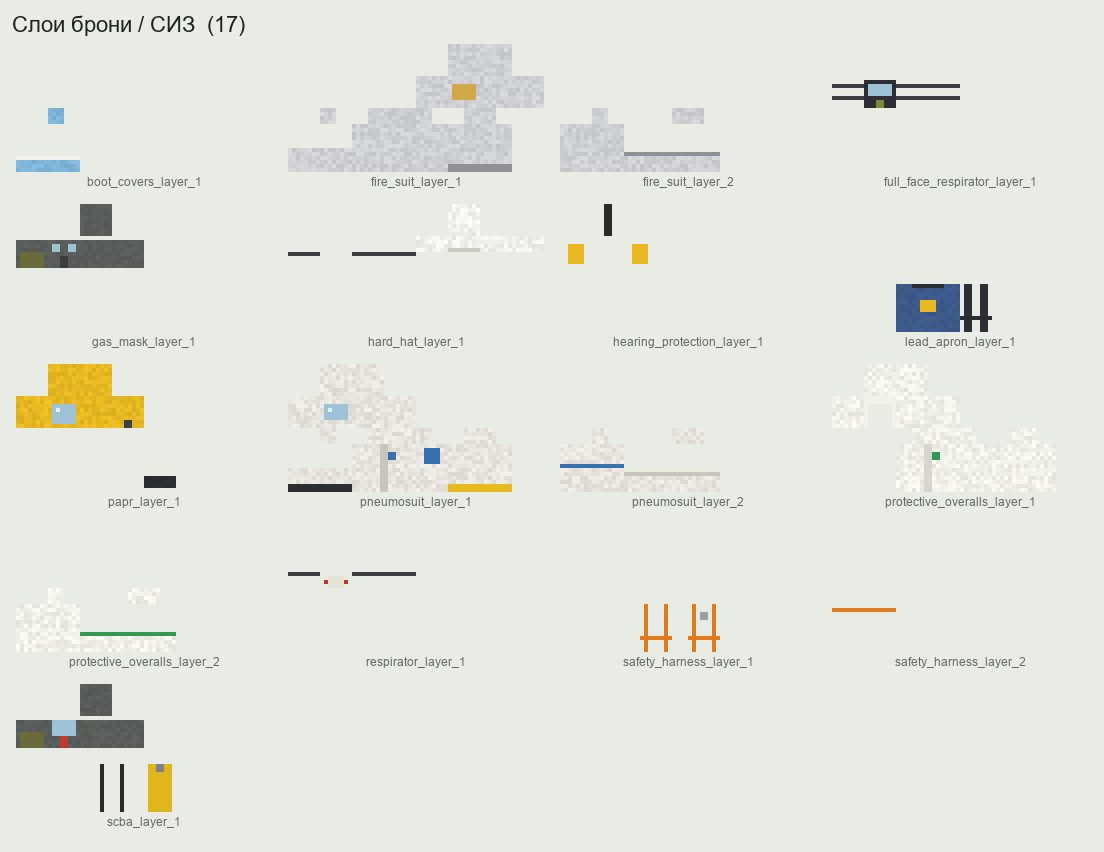
| id | Slot | Protection | Limits |
|---|---|---|---|
hard_hat |
head | falling objects ×0.3 damage | one head slot; masks fit as an insert |
gas_mask + gas_mask_filter
|
head | ×50 against gases of the filter type: A organic vapours, B inorganic (H₂S, Cl₂), E acid (SO₂, HCl), K NH₃, CO, AX low-boiling organics |
no protection below 17 % O₂ or against N₂/Ar/CO₂; filter consumed by concentration × time |
scba + scba_cylinder
|
chest + mask | full isolation, ×10,000, any O₂ | 6.8 L × 30 MPa ≈ 2000 L at 40 L/min ≈ 50 min; whistle at 20 % |
fire_suit |
body | radiant heat ×0.1, burning ×0.2 | Slowness I, overheating after 5 min of work |
safety_harness + lifeline
|
body overlay | fall ≤ 2 m with no damage when anchored; confined-space rescue | 16 m lanyard |
hearing_protection |
head insert | −25 dB on hazardous sounds (deafening effect only) | — |
The hard_hat has one insert slot (ppe_attachments): gas_mask, scba mask, hearing_protection or the radiological half-mask. Radiological PPE is covered in Radiation Safety.
Hazard signs (radiation, chemical, electrical, UN numbers and hazard diamonds for products) are functional blocks owned by this section; the decor family only uses them (Player Content).
The section reproduces, without naming sites, lessons such as: a permit lost at shift change (a pump started without its relief valve), a forced interlock left after commissioning, a misreading level gauge and column overfill, a temporary bypass without calculation, and nitrogen in a confined space. Each is available as a simulator scenario (Player Content).
-
Multiplayer — roles, station log, anti-griefing,
DamageBudget - Automation Platform — analyzers, safety logic solvers, forces, MOC for PLC programs
- Accidents — consequence pipeline, reactor fires
- Radiation Safety — radiological PPE and zones
- Oil and Gas — flares, tanks, pipelines
- Environment and Economy — flare and fire emissions