Repository navigation
Player Content
Note
Design stage. This page describes planned mechanics from the design document. Not implemented yet — see Roadmap (milestone M2 for the handbook and first advancements; M13 for world structures, the full advancement set and decor).
The other design sections describe how the industrial complex works. This page covers what you see and do around the physics: how you find out what to build next, how progress is marked, where you can practice before a mistake becomes an accident, what you find in the world, what instruments are made of, and how you decorate your station. The fuel cycle alone takes 60–100 hours and dozens of machines, and the industry ladder doubles that — without this layer a newcomer would give up on the first evening.
| # | Principle | Consequence |
|---|---|---|
| C1 | The handbook explains, instruments show | The handbook never shows live plant values. It teaches you to read instruments, it does not replace them. |
| C2 | Progress is unlocked by materials, not quests | Advancements and handbook chapters mark progress but block nothing. There is no "turn in a quest, get a recipe". |
| C3 | In-game presentation | The handbook is an "Engineer's Handbook", an operating procedure is a document issued with the controller, an operator licence is an ID card. No "tip of the day" windows. |
| C4 | Mistakes belong in the simulator | Every accident can be lived through on the training simulator with no consequences in the world. |
| C5 | The world tells stories | Structures give information (maps, cores, logs, handbook pages) and a few early parts, never finished machines. |
| C6 | One source of truth | Lua help, register tables and tag captions are generated from DeviceDescriptor, not written by hand. |
The goal: in half an hour you understand that (1) this mod is about a whole plant, not one reactor; (2) the first step is coal and steam; (3) where to look for answers.
| Minute | What happens | Mechanic |
|---|---|---|
| 0 | On first join you receive the engineering_handbook (once per player, content.give_handbook_on_join) |
opens on "How the complex works" |
| 0–5 | One picture of the industry ladder; "you are here" — I0 | clickable illustration, each era leads to its chapter |
| 5–15 | Find coal, build a coal boiler and a steam engine on a Create shaft | advancement "First Steam"; chapter "Boiler: water, fuel, pressure" opens |
| 15–25 | The boiler boils dry or overpressures — the relief valve lifts | the first "accident" with no losses: valve whistle, steam cloud; the handbook points to the pressure gauge |
| 25–30 | Place a pressure gauge (instrument_pressure, level A0) |
chapter "Reading instruments": scale, normal, warning, alarm (ISA-101) |
On TRAINING difficulty the first boiler has a larger pressure margin and every chapter ends with "What to do next" hints. On HARDCORE there are no hints. See Multiplayer for difficulty modes.
engineering_handbook is the mod's own book (not Patchouli, so no hard dependency). Content is a datapack that servers can override or extend:
data/promptcritical/handbook/
  categories/<category>.json      ← eras and industries
  entries/<entry>.json            ← chapters
  pages/<lang>/<entry>/*.md       ← text in simplified Markdown
assets/promptcritical/textures/gui/handbook/*.png   ← illustrations, diagrams
| Page type | Shows |
|---|---|
text |
text with links to chapters and blocks (hover shows the block) |
image |
diagram or illustration |
recipe |
recipe from the registry (vanilla, Create, process recipe) |
multiblock |
rotatable 3D layer-by-layer multiblock view |
ponder |
"Show" button that starts a Ponder scene |
formula |
formula pre-rendered to PNG from LaTeX at build time, with variables explained |
register_map |
Modbus register table generated from the device descriptor |
lesson |
short engineering lesson from real practice |
Chapters unlock on always, advancement:<id>, item_obtained:<id> or block_placed:<id>. Locked chapters show as "???" with a hint ("Obtain yellowcake"). content.handbook_all_unlocked = true opens everything.
| Category | Example chapters |
|---|---|
| How the complex works | industry ladder, cross-industry flows, units and instruments |
| I0 Coal and Steam | mine and methane, boiler, steam engine, relief valves |
| I1 Steel and Power | coke plant, blast furnace, steel and pipe, generator and synchronization, grid |
| I2 Oil and Gas | exploration, drilling and blowout preventer, production, refinery, gas plant |
| I3 Chemistry | cracking, polymers, chlor-alkali, syngas |
| I4 Nuclear | criticality, kinetics, xenon, thermal-hydraulics, scram, fuel cycle, waste |
| Automation A0–A5 | relays, analog blocks, PLC and IEC languages, safety systems, Lua and pcui, historian |
| Safety | dosimetry, LOTO and permits, fires, chemical hazards |
| Engineering lessons | simulator lessons |
Operating procedures. Building the controller of a major unit (reactor_controller, refinery column, blast furnace, coke battery, generator) gives you an operating_procedure item with a procedure_ref. Put it on a document_lectern next to the panel and anyone nearby can read that unit's procedure — just as real procedures sit at operator workstations.
Lua help in CC: Tweaked. Pages go under data/computercraft/lua/rom/help/ (pc_reactor.txt, pc_plc.txt, pcui.txt, pc_tags.txt …), generated by the Gradle task generateCcHelp from device descriptors. Two pages are hand-written: pcui and pc_start (first program in 10 lines). On a computer, help pc_pump shows the same content as the handbook, sized for a 51×19 screen.
These continue the Create integration scenes (1–25). Each is ≤ 60 s and uses the same formulas as the simulation.
| # | Scene | Teaches |
|---|---|---|
| 26 | coal_boiler_basics |
water, fuel, pressure, relief valve |
| 27 | mine_ventilation |
ventilation, methane, canary |
| 28 | coke_battery_cycle |
coking cycle, gas and tar |
| 29 | blast_furnace_tap |
burden, blast, tapping |
| 30 | generator_synchronization |
closing in phase |
| 31 | grid_frequency |
frequency drops on deficit, load shedding |
| 32 | drilling_mud_window |
mud weight window, kicks |
| 33 | bop_shut_in |
shutting in a well |
| 34 | pumpjack |
stroke, Create shaft, rate |
| 35 | distillation_column |
fractions and trays |
| 36 | relay_ladder |
ladder logic from blocks |
| 37 | plc_scan_cycle |
input → program → output |
| 38 | current_loop_break |
a broken loop is visible; zero is not |
| 39 | cause_effect_matrix |
safety logic without code |
| 40 | lockout_tagout |
a lock holds until its owner removes it |
| 41 | radiography_exposure |
exposure and barrier zone |
| 42 | ntd_rotation |
why the ingot rotates |
| 43 | cooling_tower |
evaporation, weather |
| 44 | wafer_cleanroom |
clean room |
The handbook has a Route tab: a graph of tasks across eras I0–I4 and automation levels A0–A5, inspired by the GregTech: New Horizons questbook — with key differences:
| GT:NH questbook | Prompt Critical Route | |
|---|---|---|
| Blocks progress | no, but recipes follow quest order | no: a task only marks and explains |
| Rewards | loot bags, resources | XP and decor; no resources or machines |
| Completion check | item in inventory | item or plant state: tag value, simulator scenario, run time without a scram |
| Link to text | short description | every task opens a handbook chapter and, where available, a Ponder scene |
| Task type | Condition | Example |
|---|---|---|
obtain |
item in inventory or station container | "Obtain 16 coke" |
build |
multiblock assembled and validated | "Build a blast furnace" |
reach |
plant tag in range for a given time | "Hold boiler drum pressure at 1.2 ± 0.1 MPa for 10 minutes" |
operate |
unit runs without a trip for a given time | "Generator on the grid for 1 game day" |
scenario |
simulator scenario passed | "Pass out_of_phase_sync" |
program |
PLC/Lua program does the job on the digital twin | "Write a PI level controller, error < 5 %" |
discover |
structure or deposit sign found | "Find a bitumen seep" |
choice |
one of several (a fork) | "Choose your path to the atom" |
Target: 30–60 tasks per era and 15–25 per automation level, about 300 at release. The graph lives in data/promptcritical/handbook/route/<era>.json; CI checks that it references only existing items, blocks, tags and scenarios. Hints: full "how" on TRAINING, only "what" on STANDARD, titles of open tasks only on HARDCORE.
Advancements are vanilla (data/promptcritical/advancement/...) so they work in the vanilla screen, chat and third-party trackers. Almost all conditions use one custom trigger, promptcritical:sim_event, with predicates on domain events. With station_member: true an advancement counts for every station member online within 64 m of the controller — a shared shift success. Rewards are XP and the record only. Types: task, goal, challenge; (H) = hidden.
Production
| id | Name | Condition | Type |
|---|---|---|---|
root |
Prompt Critical | obtain engineering_handbook
|
task |
first_steam |
First Steam | steam engine delivers torque to a Create shaft | task |
canary |
Canary in a Cage | place a canary cage in a mine | task |
coke |
Coke and Gas | first batch of coke | task |
pig_iron |
Pig Iron | first blast furnace tap | task |
steel |
Steel | first converter heat | goal |
seamless |
Seamless | first seamless pipe | task |
synchronized |
On the Grid | generator synchronized with torque shock ≤ 10 % | goal |
first_oil |
Gusher | first oil from a well | goal |
pumpjack |
Nodding Donkey | pumpjack runs for 1 day | task |
first_cut |
First Cut | column delivers on-spec gasoline | task |
sulfur |
Yellow Mountain | 64 sulfur from a Claus unit |
task |
helium |
Light as Helium | helium recovered from gas | task |
ethylene |
Ethylene | first steam cracking | task |
bakelite |
Age of Plastics | first bakelite
|
task |
yellowcake |
Yellowcake | first yellowcake
|
goal |
uf6 |
Hexafluoride | first UF₆ cylinder | task |
enriched |
Three Percent | UF₆ at ≥ 3 % enrichment | goal |
first_fa |
First Assembly | first fuel assembly passing inspection | task |
closed_cycle |
Closed Cycle | MOX assembly from your own plutonium loaded, and a vitrified HLW canister in storage | challenge |
industrial_complex |
Industrial Complex | blast furnace, refinery, gas plant and reactor above 50 % all running at once | challenge |
Operations
| id | Name | Condition | Type |
|---|---|---|---|
first_criticality |
First Criticality | k_eff ≥ 1 by operator decision | goal |
one_over_m |
1/M Method | critical after ≥ 3 count-rate measurements at different loadings | task |
xenon_pit |
Iodine Pit | recovered from a xenon pit without violating the reactivity margin | goal |
scram_clean |
Clean Scram | scram from > 50 % power with no cladding damage | task |
hundred_days |
Hundred Days | 100 SLOW days without an automatic scram | challenge |
load_follow |
Load Follow | reactor followed the dispatcher schedule for 1 day within 5 % | goal |
black_start |
From Zero | grid restored after a blackout without outside help | challenge |
quiet_pump |
Quiet Pump | cavitating pump found and fixed before it failed | task |
kill_well |
Well Killed | kick handled without a blowout | goal |
no_surge |
No Surge | compressor started without a single surge cycle | task |
refinery_lp |
Blending | on-spec gasoline at ≤ 105 % of the LP optimum cost | challenge |
turnaround |
Turnaround | unit shut down, repaired under permits and restarted | goal |
Automation
| id | Name | Condition | Type |
|---|---|---|---|
relay_logic |
Click-Clack | first ≥ 5-relay circuit controlling a mechanism | task |
analog_pid |
No Computer | analog PI controller holds a value for 1 day | goal |
plc_first |
First Scan | PLC program in RUN | task |
all_languages |
IEC Polyglot | LD, FBD, SFC and ST programs in one PLC | challenge |
sis_matrix |
Matrix | cause-and-effect matrix with ≥ 10 causes and 2oo3 voting | task |
proof_test |
Proof Tested | safety function proof test done before due | task |
lua_first |
Hello, Reactor | Lua program called readMany on a pc_* device |
task |
hmi |
High-Performance HMI | L1 pcui screen with ≥ 20 tags |
task |
historian |
Plant Memory | historian stores ≥ 100 tags for ≥ 1 day | task |
digital_twin |
Twin First | program tested on the digital twin, then loaded into a real PLC | goal |
tuner |
Tuner | tuning task solved in the server's top 10 % | challenge |
telemetry |
Telemechanics | 10 remote RTUs on one master | goal |
Safety and science
| id | Name | Condition | Type |
|---|---|---|---|
dosimeter |
Count Your Dose | wear a dosimeter for 1 day | task |
alara |
ALARA | main coolant pump repair with team dose < 10 mSv | challenge |
lockout |
Lock | first LOTO on a valve | task |
permit |
By Permit | hot work under a permit with gas testing | task |
own_sun |
Your Own Sun | first Co-60 source | task |
through_steel |
Through Steel | weld defect found on radiographic film | task |
everlasting |
Everlasting Battery | RTG powers a remote well RTU | goal |
pulse |
Pulse | TRIGA pulse ≥ 100 MW without fuel damage | challenge |
annealing |
Annealing | controlled Wigner energy release | challenge |
operator_license |
Licensed | operator exam passed on the simulator | goal |
World and hidden
| id | Name | Condition | Type |
|---|---|---|---|
oklo (H) |
The Planet Got There First | assay shows depleted U-235 in natural reactor ore | challenge |
gas_crater (H) |
Door to Hell | found a burning gas crater | task |
pitch_lake (H) |
Pitch Lake | found a natural bitumen seep | task |
orphan_found (H) |
Nobody's Source | found and surrendered an orphan source | task |
canary_saved (H) |
The Bird Lives | the canary survived a methane outburst because you got out in time | task |
stuck_valve (H) |
Don't Trust the Lamp | stuck valve found by its position sensor, not the "command sent" signal | challenge |
Station record board. station_record_board shows station records from the historian: days without scram, 30-day capacity factor, output, product yield, collective dose. /pc stats compares stations on a server.
Real NPP, refinery and grid operators train for years on full-scope simulators. In the game the simulator lets you survive any accident without consequences, delivers lesson content, and tests programs before they go to real hardware (it is the consumer of the digital twin, see Automation Platform).
| Block | Function |
|---|---|
training_simulator |
compute cabinet; runs an isolated copy of SimulationWorld
|
simulator_console |
simulator panel; normal panel blocks and CC computers attached to it work on the copy |
instructor_station |
start, pause, rewind, fault insertion, scoring |
A copy is made either from your real station (snapshot of the chosen controller and all connected networks: hydraulic, electrical, PLCs, safety systems — the Minecraft world itself is not copied) or from a reference plant in the datapack: I0 boiler, generator unit with grid, T0, T1, PR-300, crude distillation column, compressor station, well with rig.
Scenario format (example):
{
  "id": "promptcritical:stuck_porv",
  "plant": "promptcritical:pr300",
  "initial": { "preset": "full_power_mol" },
  "faults": [
    { "t": 30, "type": "VALVE_STUCK_OPEN", "target": "rcs.pzr.porv", "indication": "COMMAND" },
    { "t": 30, "type": "SENSOR_FAIL", "target": "rcs.pzr.porv.position", "mode": "FROZEN" }
  ],
  "success": [ { "within": 900, "all": ["core.cladding.max_temp < 1477", "operator.found:rcs.pzr.porv"] } ],
  "failure": [ "core.cladding.max_temp >= 1477" ],
  "debrief": "promptcritical:lessons/stuck_porv"
}
Fault types: sensor (FROZEN, DRIFT, OPEN_LOOP, NOISY), stuck valves (STUCK_OPEN, STUCK_CLOSED, STUCK_AT), pump or compressor failure, pipe break of a given size, bus power loss, PLC WATCHDOG, wrong indication (COMMAND — lamp shows the command, not the position), safety system failure on demand, fire, gas release. The instructor can insert faults live. After a scenario, a lesson page debriefs what happened, which instruments showed it and when, and where time was lost — from the copy's historian trends.
Lessons are presented as engineering lessons without naming real sites or countries.
| id | Lesson | Mechanic | Release |
|---|---|---|---|
stuck_porv |
"Valve closed" lamp showed the command, not the position; coolant was lost |
COMMAND indication vs position sensor |
★ |
iodine_pit |
leaving a xenon pit with a low reactivity margin and a coastdown test | reactor kinetics | ★ |
rod_withdrawal_maintenance |
manual rod withdrawal during maintenance beyond limits | rod interlocks, 1/M | ★ |
wigner_anneal |
graphite annealing on wrong thermocouples | Wigner energy | ★ |
solution_criticality |
uranium solution drained into a vessel of unsafe geometry | criticality_alarm |
★ |
permit_shift_change |
pump taken for repair, permit not handed over at shift change, next shift started it without its relief valve; fire spread across the platform | permits, LOTO, shift handover | ★ |
blowout |
misread pressure test, kick, BOP failure | mud window, BOP | ★ |
column_overfill |
column filled above the level gauge range at startup; vapour cloud found an ignition source | limited-range level gauge, relief system | ★ |
tank_overfill |
night overfill: level sensor froze, independent switch failed | safety system, FROZEN sensor, vapour cloud explosion |
★ |
temporary_bypass |
temporary pipe bypass without calculation or supports | management of change, pipe strength | ★ |
hydro_vibration |
unit with rising vibration left running | vibration diagnostics | backlog |
coal_dust |
methane ignited coal dust in an un-dusted roadway | coal mine | ★ |
lpg_bleve |
fire under an LPG vessel, relief valve could not cope | BLEVE | ★ |
ammonium_nitrate |
years-long storage of ammonium nitrate at a port, fire | oxidizer, DamageBudget
|
backlog |
out_of_phase_sync |
generator closed onto the grid out of phase | synchroscope | ★ |
compressor_surge |
compressor start without anti-surge protection | PLC anti-surge block | ★ |
black_start |
blackout: restore the grid when the NPP needs offsite power | diesels, gas turbines, UFLS | ★ |
forced_bit |
a forced signal left after commissioning silently disabled an interlock | PLC forcing | ★ |
orphan_source |
a decommissioned source disappeared from storage | orphan sources | backlog |
operator_license is an ID item with a license_spec: level (TRAINEE, OPERATOR, SHIFT_SUPERVISOR), plant type, date, station signature. It is issued for passing a set of simulator scenarios with a score ≥ content.license_pass_score (0.75). A server may require it (ops.require_license, default false): then control keys and bypass keys turn only for players with a valid licence of the right level, and the station log shows actions by licence number.
Structures are vanilla structure + structure_set in the datapack, tuned by worldgen.structures.*. Loot is information and early parts: cores, geological_map (marks the nearest ore body or trap, like a treasure map), handbook pages, logs, broken instruments to salvage, a little coal, steel and copper wire. No finished machines, fuel assemblies or category 1–2 sources — except where the source itself is the hazard.
| id | Real prototype | Where | What it gives and teaches | Release |
|---|---|---|---|---|
natural_reactor_oklo |
the natural fission reactor in a Gabon uranium deposit | very rare, deep under a uraninite body | ore with depleted U-235 (0.60 % instead of 0.72 %), fission product traces; handbook page on why it ran and why it stopped. Advancement oklo
|
★ |
abandoned_survey_camp |
abandoned geological survey camp | common, mountains and plateaus | cores, geological_map, survey log, broken radiometer |
★ |
abandoned_uranium_mine |
1940–50s uranium mine | rare, near ore bodies | radon in adits — the dosimeter shows danger where "nothing is there" | ★ |
old_coal_mine |
old coal mine | common in coal provinces | methane pocket that explodes from a torch; canary cage in loot; rotten timber supports collapse | ★ |
pitch_lake |
natural asphalt lake | rare, warm biomes |
natural_bitumen — sign of an oil basin within 200–500 m; first bitumen without a refinery |
★ |
gas_seep_crater |
burning gas crater | very rare, deserts | eternal flame — sign of a gas field; heat makes it dangerous to approach | ★ |
oil_seep |
natural oil seep | rare, shores and swamps | pools of crude_oil, sign of a trap |
★ |
abandoned_rtg_lighthouse |
RTG lighthouse on the coast | very rare, cold coasts | broken rtg_thermoelectric with sr90_heat_source — an orphan source; teaches dosimeter use |
backlog |
weather_station |
weather station | common | weather log (storms and power lines), anemometer | backlog |
research_institute_ruin |
ruined industry research institute | rare | handbook pages for I2–I4, early electronics (vacuum_tube, relay_coil), old analog_gauge
|
backlog |
railway_halt |
siding with tank cars | common | empty tank cars with UN markings, Create rails | backlog |
The Oklo reactor is the only place where ore has a non-natural isotopic composition — you find it only by noticing the anomaly on the assay_station.
| Sign in the world | Meaning |
|---|---|
| halo of ore blocks | uranium ore body nearby |
| coal outcrop on a slope | coal seam |
natural_bitumen, oil_seep
|
oil basin |
gas_seep_crater, bubbles on water |
gas |
| rock salt near the surface | trap under a salt dome |
| radon in a cave | uranium or radium nearby |
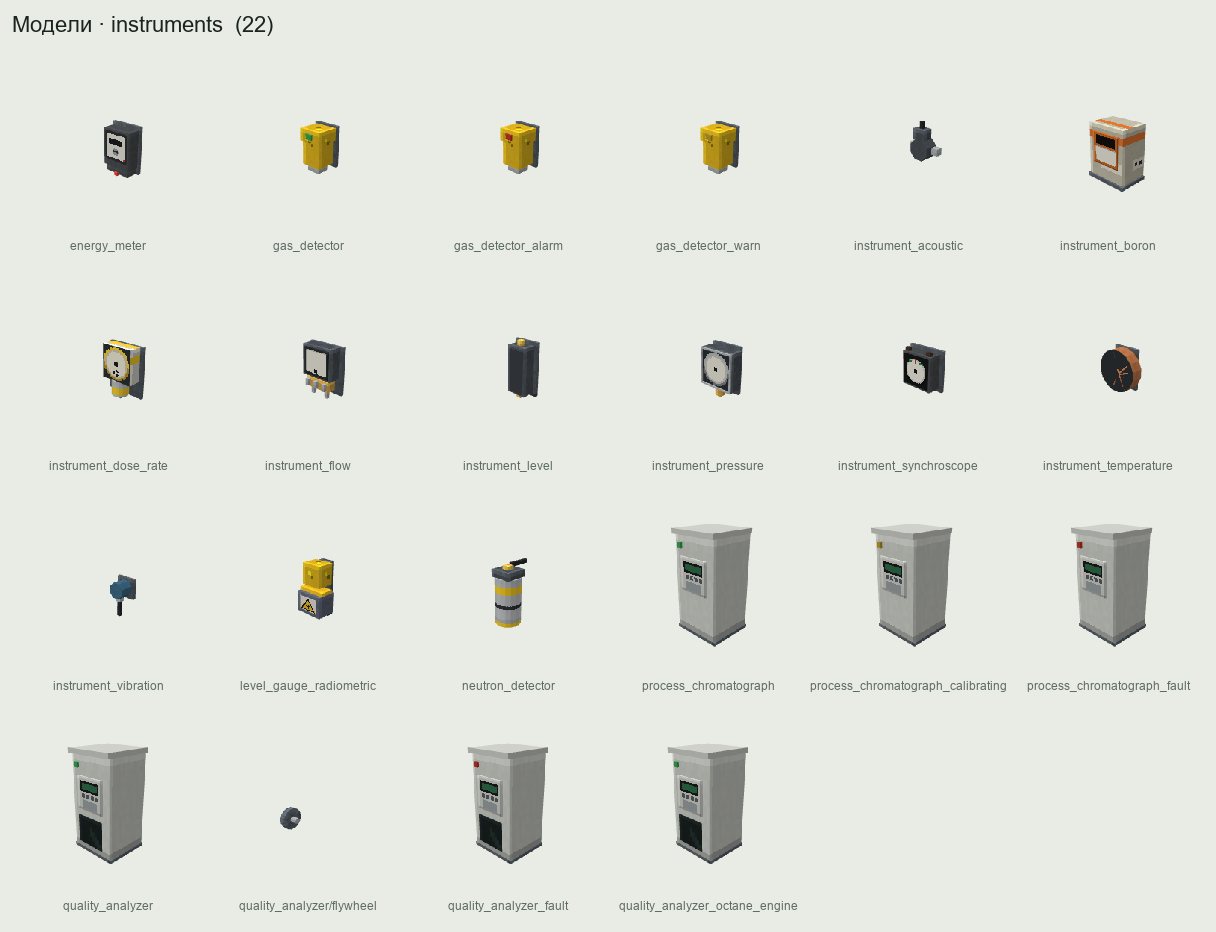
| Level | Electronics | Key components | Materials from |
|---|---|---|---|
| A0 | mechanical | Bourdon tube, bellows, float, bimetal | Create brass and copper, steel |
| A1 | electromechanical |
relay_coil, contacts, bakelite, copper_wire
|
metallurgy, coke-plant or chemical bakelite |
| A2 | vacuum tubes | vacuum_tube |
glass, copper_wire, nickel grid, magnesium getter, vacuum pump on a Create shaft |
| A3 | semiconductors |
transistor, printed_circuit_board
|
silicon_wafer, epoxy_resin, copper foil, glass cloth |
| A4–A5 | integrated circuits | integrated_circuit |
silicon_wafer + clean room |
| A4–A5 power | power semiconductors | power_thyristor |
doped_silicon_wafer (neutron transmutation doped) |
Power thyristors from NTD silicon are the real main application of neutron transmutation doping (Isotopes and RTG). They are needed for variable_frequency_drive (soft speed control of pumps and centrifuges, ESP drives) and grid static compensators (backlog). Ordinary ICs do not need NTD silicon; otherwise level A4 would sit behind the reactor.
| Stage | Unit | Process | Input | Output | Era |
|---|---|---|---|---|---|
| Metallurgical silicon | submerged_arc_furnace |
SiO₂ + 2C → Si + 2CO, 1900–2100 °C, ~11–13 kWh/kg | quartz (minecraft:quartz or quartz_sand), coke |
metallurgical_silicon 98–99 % |
I1 |
| Trichlorosilane |
trichlorosilane_reactor (fluidized bed) |
Si + 3 HCl → SiHCl₃ + H₂, ~300 °C | silicon, HCl from chlorine + hydrogen | trichlorosilane |
I3 |
| Purification | fractionating_column |
distillation | trichlorosilane |
purified trichlorosilane
|
I3 |
| Polysilicon | siemens_reactor |
SiHCl₃ + H₂ → Si + 3 HCl on rods at ~1100 °C; 50–100 kWh/kg | trichlorosilane, hydrogen
|
polysilicon (9N) |
I3 |
| Single crystal | czochralski_puller |
pulling from the melt, seed rotated and raised by a Create shaft |
polysilicon, boron dopant
|
silicon_ingot |
I3 |
| Wafers | wafer_saw |
sawing | ingot |
silicon_wafer / doped_silicon_wafer
|
I3 |
Czochralski window: pull rate 0.5–2 mm/min and rotation 5–30 rpm. Outside it you get polycrystal and zero yield. The ingot grows visibly out of the crucible.
Clean room. wafer_fab is a multiblock: cleanroom_panel walls, HEPA ventilation (hepa_filter), airlock. Particle concentration inside is C = C_out · L / (L + n·V·η_HEPA) with η_HEPA = 0.9997; leakage L grows with open doors, player passages and unsealed blocks. Chip yield follows the Poisson model Y = e^(−D₀·A) with defect density ∝ C. A dirty room means scrap — ventilation becomes a production problem, not only a radiological one.
| Block | Level | Key components |
|---|---|---|
instrument_pressure (local) |
A0 | brass Bourdon tube, glass |
analog_gauge, chart_recorder
|
A1 |
relay_coil, bakelite, copper_wire
|
relay_controller, A1 relays |
A1 |
relay_coil, bakelite
|
protection_cabinet, basic relay sis_logic_solver
|
A1 | relays, keys — hardware protection needs no computer |
| A2 analog computing blocks | A2 |
vacuum_tube, resistors, capacitors |
io_module, plc_controller
|
A3 |
transistor, printed_circuit_board
|
sis_logic_solver SIL 3 |
A4 |
integrated_circuit ×2 (redundancy), PCB |
historian_server, RTU |
A4 |
integrated_circuit, storage |
variable_frequency_drive |
A4 |
power_thyristor, integrated_circuit
|
| CC: Tweaked computer and monitor | A4 | see below |
CC: Tweaked recipes. content.cc_recipe_override = true (default) replaces the recipes of the CC computer, monitor and modem so they need an integrated_circuit (advanced computer: ×4). Otherwise level A4 would be available in the first minutes and the automation ladder would collapse. Servers that run other CC mods can turn it off.
Stations and plants are large builds, and builders want them to look real. Each family is a block + slab + stairs + wall where it makes sense.
| Family | Variants | Real-world place |
|---|---|---|
tile_white, tile_blue, tile_green
|
15×15 ceramic tile | change rooms, labs, spent fuel pool |
porcelain_tile |
grey, beige | turbine halls |
linoleum_control |
grey, beige, parquet pattern | control rooms, offices |
raised_floor |
perforated or plain | server rooms, I&C rooms |
ceiling_tile + ceiling_light_panel
|
suspended ceiling, glowing panel | control rooms |
painted_concrete_two_tone |
green / blue / beige lower half, white upper | industrial corridors |
painted_concrete |
grey, yellow, red (fire) | |
glass_block |
clear and frosted | 1960–80s industrial buildings |
corrugated_steel |
painted, 5 colours | warehouses, shops |
sandwich_panel |
white, grey, blue | modern shops |
grating |
floor grating, steps, see-through | service platforms |
handrail |
yellow and galvanized, with toe board | |
cage_ladder |
caged vertical ladder | columns, cooling towers |
cable_tray |
straight, corner, tee, vertical; with or without cables | everywhere |
pipe_rack |
posts and crossbeams | refinery, gas plant |
asphalt + asphalt_marking
|
white and yellow lines, arrows | roads, yards |
curb |
kerb | |
industrial_light |
industrial, street, floodlight, green emergency "Exit" | |
room_sign |
room numbers, "MCR", "Switchgear", "Pump room", evacuation arrows | |
wall_clock |
shows game time | control room |
safety_poster |
2×1 and 2×2 safety posters | |
tritium_lamp |
self-luminous signs | |
blast_door_decor |
massive decorative doors (functional airlocks are containment_hatch) |
Hazard signs (radiation, chemical, electrical, UN numbers, diamonds) are owned by Operations and Safety; decor only uses them.
Asphalt is the first use of bitumen, long before a refinery: bitumen from a pitch_lake + gravel → asphalt in a Create mixer. Walking on asphalt is 15 % faster (content.asphalt_speed_bonus) — a natural reason to pave roads between plant units.
- Getting Started
- Progression — the industry ladder and automation levels
- Automation Platform — digital twin, PLCs, safety systems
- Create Integration — Ponder scenes 1–25
- Coal and Metallurgy, Oil and Gas, Petrochemistry
- Isotopes and RTG — NTD silicon, orphan sources
- Art Pipeline