Repository navigation
EN backend live 2026 10 20
All labs | Français | Live ledger
The later licensing History/source check retains the original incomplete history and a distinct failed inline-citation navigation check, with zero new native questions or configuration writes. The actual wiki publication independently verifies the public destination, unchanged human-edit baseline, normal push, remote revision and rendered English/French pages. This publishes an honest in-progress snapshot, not an agent or Azure deployment. T009, T016, remaining acceptance and human governance stay open.
The two corrected static wrappers
pass native CTR/SAR checks with all 12 literal quotation/reference pairs exact,
French disclaimers and the conditional SAR extension preserved. One fresh conversation
contains four accepted messages: two lookups and two language controls, with zero
retries or readiness questions. Intended static sends and processed cancellations
have native response-end proof; no separate DynamicPlanFinished is fabricated.
Native retrieval/MCP/Foundry counts are zero, not evidence of live source retrieval.
System.User.Language is French then restored to English; actual Activity.Locale
stays en-US. The persisted override is not cleared or browser detection tested.
One French upload persisted the corrections. Strict map-equality and two-file-only checks failed and remain failures. A separate read-only audit explains 41 reordered positions preserving all 42 Escalate phrases, one materialized fallback translation and bookkeeping. The complete clone grows from 64 to 65 files; postflight preserves all 64 non-token files, 23 French translations, 50 components, 158 English/153 French resources and 1,814 historical files. A strict UTF-8 BOM failure is preserved; BOM-aware validation reads unchanged evidence without another message or export. No agent publication, Azure write, whole-lab rerun or full-static/general French claim.
The bounded integrated-user probe
uses native Microsoft Entra ID Integrated with the documented ai:// namespace,
not a client secret or another service-principal cohort. Exactly one Create
stops on the explicit consent-popup-blocked error. OAuth is incomplete, Next
disabled and picker invocations zero; there is no picker HTTP status/body or
effective runtime principal. VS Code documents popup blocking.
Normal OAuth in a supported external browser is a prerequisite, not proof of a
picker fix. Do not bypass popup/token handling or replay questions.
Cleanup independently verifies the seven original connections exactly and no persisted probe connection, with no guessed deletion. Complete long-path PAC snapshots remain 64 files, with 63 non-token files, 22 French translations and 49 components unchanged. Zero questions, source additions, agent saves, publications or Azure writes; no continuous external-state audit. The earlier service-principal HTTP 400 and S5-10/T014/T016 remain open.
The two sequential isolated service-principal cohorts
each use manual credential entry and one Create, with saved notification and
independent Connected inventory. Both native index pickers fail with
Something went wrong., console HTTP 400 and Add to agent disabled.
No response body is available; cause and effective native principal are unknown.
The first uses only exact-index Search Index Data Reader, a documented metadata
gap but not proven 400 causation. The second verifies exactly two assignments:
index-only Reader and a separate existing-service-scoped custom role containing
only Microsoft.Search/searchServices/indexes/read in Actions, no DataActions,
writes or operations/read. Direct correct-principal metadata listing and its own
synthetic canary query pass. Service-wide metadata is exposed, not service-wide
documents. Native failure persists; metadata addition is not a demonstrated fix.
No source addition, index binding, schema/field mapping or readiness occurs. Native positive, negative and model questions all remain zero; no post-revocation direct 403 or no-leak acceptance is run/proved. Neither Connected nor direct controls constitute native acceptance or a partial paired pass. Issue #4 requests supported picker diagnostics and the minimum permission contract. S5-10/T014/T016 and workshop completion remain open.
Both independent cleanups verify zero owned resources, explicit credential revocation/deletion and protected secret-file removal. The first preserves a PAC environment-filter error followed by guarded exact-connection recovery, then a DNS snapshot error followed by separate read-only verification without deletion replay. The second guarded cleanup and separate verify-cleaned have no errors. Original five agents/seven connections/three schemas, full Search configuration and unowned roles/definitions, embedding roles, hosted v5 and 181 historical files remain exact. No original changes, Activity/Foundry questions, M365 publish, ZIP import, auth/network weakening, key authentication or public-storage change occurs.
The two read-only agent GETs
return identical successful metadata with and without the documented feature
header. The original v5 already has the new endpoint/identity model,
Activity/Invocations, Entra/BotServiceRbac and not_published approval state.
Nested protocol configuration and version selection are present. No writes or
questions occur; legacy application failures and T005/T006 remain unresolved.
The retained error correlation finds the approved user's object ID in the activity blueprint-ID position, not the target blueprint client ID. The summary's target blueprint and the instance identity remain identical across saved v3/current v5. No new request or question; upstream identifier selection and a supported native fix remain unresolved.
The paired-SP cleanup receipt records zero authorized/denied native question intents. Independent final reads verify removal of the owned credential, identity, draft, four role grants and Azure fixture. All original agent/connection/schema/embedding-role/hosted-v5 comparisons pass; 181 historical files stay unchanged. Actual portal inventory redirects to sign-in, so only official PAC/Dataverse absence is established. No question replay or authentication change occurs during recovery. This does not pass S5-10/T014/T016 or finalize spending.
The read-only Dataverse/history receipt retains the Graph CAE challenge and normal CLI login timeout, followed by an independently verified successful Graph read for the approved administrator. Power Platform's admin environment read also succeeds; neither grants Dataverse transcript access. The original-agent query returns 403 and a fresh five-defined- privilege audit confirms missing transcript-read and role-assignment rights. The earlier incomplete capability assertion remains failed, not retroactively passed.
Basic User and Environment Maker direct-role rows stay exact. No role, retention or transcript policy changes, broad self-elevation or new questions occur. The original October 19 History run is still In progress with no complete answer. T009 remains blocked; neither a reconstructed answer nor a newer run is substituted.
The native connected receipt
records a failed documented ai:// connection and a separately guarded
successful HTTPS/Entra correction. An isolated unpublished Standard draft uses
one Ready fictional Search source, web/general knowledge Off and preserved
model/authentication. Its first cohort passes 3/4, retaining the English answer
to French input. After adding French and selecting it in the test pane,
a separate frozen cohort passes 4/4 with real knowledge traces, supported
citations and explicit price abstention. Eight native questions and exports
are retained, not merged across configurations. One export's configuration
is empty; independent official before/after clones confirm 17 unchanged files.
A real native citation click opens the exact published fictional source file; the section fragment is omitted. All three owned temporary logical objects are deleted and original inventories/schema hashes preserved. The official validator's missing-module error remains; no bundle patch or schema-validation success is claimed. Original hotel source URLs and genuine denied identity remain unverified. This progress does not close T014 or the workshop.
The separate fresh recovery
passes the public readiness guard after confirmed revocation, a 600.002-second
wait, its own successful fresh connector sign-in and fresh direct 403/conversation
checks. Exactly one closing-time question executes. Native Search returns
ConnectorRequestFailure / AzureAISearchClientError, zero records and zero
citations; its official trace exposes no HTTP status. The full parent reply is:
“I'm sorry, I'm not sure how to help with that. Can you try rephrasing?”
The UI additionally reports no information found. No source fact appears, but
this generic response is not proof of permission-specific error handling.
This cohort has a direct authorized baseline, not an authorized native baseline, and uses the approved administrator, not a separate unprivileged identity. It does not pass S5-10/T014, attribute the effective request principal, establish the historical failure's cause or reclassify either earlier result. Official export/configuration and independently verified owned cleanup/original inventories are preserved; browser closed normally, zero pending commands. Actual spending remains unfinalized.
The separate denial receipt
records a failed no-leak check, not an S5-10 pass. An authorized native baseline
succeeds on a new keyless fictional Search service. After removing only its
owned index Reader grant, direct queries return 403, but the single denied-phase
native turn returns Harbor 07:00 and its genuine citation. The actual Search
trace has two fixture records and no Search error. Both official configuration
payloads match and an independent clone verifies 17 unchanged authored files.
The existing conversation's snapshot is recovered after a read timeout,
without replay. Same administrator, not independently unprivileged identity;
effective native principal and cause remain unproved.
All owned objects, including the service, empty group and cross-resource embedding grant, are removed. The CLI connection-delete route/filter rejection is preserved; a correctly scoped first-party deletion and independent 404 complete that removal. Original agents, connections, embedding account/roles and Search schemas remain unchanged. Owned browser closed normally, actual spending not finalized. S5-10, T014 and whole-roadmap acceptance stay open.
The latest candidate continuation supersedes earlier sign-in, browser and clone blockers. Human administrator authentication, official PAC clone/push and independent persisted readback succeed. Narrow CTR/SAR snapshots and intake pass native 3/3, including a second 3/3 run on the final draft. Broad SAR specialist routing and final coverage pass, but whole-output fidelity fails at 15/16 exact quotations across two messages. Parent instructions improve the later synthesis without removing the earlier defect; no unsupported external-action suppression setting is invented. The original 26 component rows are unchanged; candidate 28 components, owned two-topic additions, instructions-only existing change, files, bindings and Off/On/On action states are independently verified. No publication occurs. The original native diagnostic/SDK authorization and full matrix remain open; this is not acceptance of the hosted renderer through the connected agent. The older failures below remain part of the chronological record.
The later local MCP proof returns structured, exactly rendered evidence without conversational activities, reusing the unchanged retriever. One original SAR tool call returns two exact records. Real OAuth, remote MCP hosting and native candidate binding are not verified. The tenant onboarding wizard offers manual OAuth but is cancelled without creating a connection; no additional Azure resource is provisioned at that local checkpoint.
The subsequent hosted MCP preflight deploys a separate Python 3.13 Linux B1 App Service in Sweden Central, with HTTPS, TLS 1.2 and no FTP/basic publishing. Live missing/invalid bearer controls return 401 and correct OAuth resource discovery returns 200. The owned API/client, account-scoped outbound identity role, official MCP connector and generated callback are created and read back. Local receipt-lock recovery avoids duplicate applications; the first PAC title-length validation failure is retained.
Correct browser/PAC administrator identity is verified. The integrated browser blocks the connector consent popup; standard new-tab code/PKCE authorization instead reaches the administrator password prompt. The user-response tool is unavailable. No successful OAuth, outbound retrieval, candidate binding or new native question is claimed. The temporary callback/helper are removed, and zero user consent grants are observed. The separate host remains billable at a published USD 0.018/hour compute estimate, without an established actual bill, numerical budget or retention owner/date.
Fresh native preservation again verifies original 26/candidate 28 rows, authoring, files, bindings and Off/On/On states. Readback also matches the protected retriever and current version-5 definition/principal/client IDs. An extra identity status field is not mistaken for an identity change or whole-object equality. No Storage policy change, publication or full-roadmap acceptance occurs.
The app-container runtime proof now verifies real outbound managed identity, the unchanged original SAR question, both exact source records and complete renderer output. All five deployed source hashes and the configured retriever match; the protected retriever is unchanged before and after. Earlier HTTP 403 attempts remain retained. Existing-response reads and nonexistent-model probes distinguish authorization from inference. One custom assignment with agent read/write data actions remains at project scope after the three owned trial assignments are removed. The write action also permits agent authoring, but no agent-authoring request is made.
Fresh full native preservation passes again. No Storage/Search privilege or policy change, token persistence, new native question, candidate binding or publication occurs. Missing/invalid inbound bearers still receive 401. A real delegated MCP connection and whole native SAR acceptance remain open; direct shared retrieval is not a substitute. The host remains billable and no numerical budget or retention owner is invented.
The native continuation
supersedes the earlier OAuth/native-SAR boundary. Explicit human tenant-wide
consent is verified as AllPrincipals, only Evidence.Read; PAC reports the
actual connection Connected. Native discovery saves one candidate MCP component,
whose exact connection binding is independently read back. The candidate has
29 components. Only its parent instructions and old retrieval enabled state
change; exact Author text, remaining definitions, original 26 rows and controls
are verified. The original emitting retrieval definition is retained but disabled.
One unchanged original SAR question invokes the native MCP tool and actual local
search, then produces one domain answer. Both complete-record quotations match
the pinned corpus exactly, with separate canonical markers, local reference,
conditional timing, insider exception, form, narrative/investigation coverage
and applicability limits. Full visible capture includes greeting and connection
consent. Missing/malformed bearers still return 401; no publication or policy
change occurs. The management bundle's missing-module error is retained and
supported UI used without patching it. Raw DynamicPlanFinished, the full fresh
matrix and broader lab/governance acceptance remain unverified.
The subsequent native matrix preserves original cases 1-4 passing and case 5 failing individual attribution. A saved repair passes fresh case 5 but fails a source-versus-renderer quotation. The next repaired SAR has two exact complete MCP quotations, yet fails a period added inside a local quotation. Official exports now retain actual non-cancelled completion events. Multiple evidence steps are audited individually, not hidden as one call or counted as new user questions. No failed cohort closes the full matrix or changes the backend.
The latest complete native matrix passes all eleven unchanged original cases with twelve submissions, including one preserved pre-plan native stall and one explicitly counted retry after normal reconnection. All thirteen native agent-content exports are byte-identical. Actual completion, seven MCP calls, pinned records, intended local-source output and complete semantic/attribution checks pass. Final MCP answers are grounded unquoted paraphrases; twelve deterministic local quotations are exact. Original 26 rows and candidate 29 components remain preserved. T008 closes; T007 retains the separately observed duplicate validation control. No deployment, publication, new role or policy change is inferred from this native acceptance.
The later control-only repair is saved once through native UI and independently read back. Its counted recovery proves one validation invocation, binding and reply. The new regression accepts 10/11 cases: case 9 has completed evidence/plan without a reply, then a counted retry without plan or reply. Neither failure is hidden or accepted. Fifteen submissions, fourteen matching agent-content exports and seven actual MCP calls are retained; one of those calls belongs to the failed parent-answer attempt. Current case 7 has two exact MCP quotations, not zero. All other complete rows, instructions/authentication/publication and the protected original are preserved. The owned browser closes; no backend deployment or policy change occurs. T007 and current-configuration acceptance remain open.
The scoped ownership/cost refresh now reads six owned ARM resources, including the MCP site and B1 plan, using the verified approved administrator. Reported pretax cost is USD 11.26126391 through the October 25 cutoff, after a retained 429 and one successful recovery. Only two resource IDs have posted cost rows; absent charges do not imply free resources, and Copilot credits are excluded. No configuration/inference/question is submitted. Human ownership, review date, numerical budget and attributable role sign-offs remain unavailable; T001/T002 are not closed.
The verified Invocations release is active version 5, following the initial successful version-4 transport. It preserves Activity and exposes a stateless question/verified-evidence JSON contract, authenticated OpenAPI and bounded explicit errors. All 54 service tests, dependency checks and final real local/hosted SAR literal-renderer comparisons pass. Seven hosted controls pass, including no-token denial and session-correlated zero-model invalid input. The original Activity HTTP 400 for missing API version is preserved beside the separately guarded corrected HTTP 200 result.
The version-5 deployment CLI timeout is retained: independent reads establish active service and doctor reports 11 passed, zero failed, two skipped, without another deployment. Both authentication schemes, original identity, retriever version 4 and four resources/roles remain unchanged. The native readback also verifies parents, definitions, bindings, files, grants, cache and PAC. No Storage/network policy is weakened.
This is direct hosted transport acceptance, not native connected-agent or published SDK authorization recovery. The shared browser remains hidden after normal recovery attempts; no new native question or configuration is submitted. The additional generated evaluation suite is deferred while the user is unavailable. Native/full-matrix, retention and organizational signoffs remain open.
This was the earlier read-only checkpoint. The later authorized release below supersedes its undeployed-version and unavailable-user status, not its failures.
The completion checkpoint records current owned-resource reconciliation, reported costs, exact-candidate hash verification and repeated local checks. It does not close live acceptance. The completion-progress.json receipt records USD 6.219977042 in returned pretax group costs, with billing lag and partial-day limits. Search remains running; its expiry tag is not cleanup. Retention ownership and attributable release approvals remain pending.
The native-state-readback.json receipt verifies the diagnostic is still Inactive through three current authenticated Dataverse GETs. The current Foundry metadata separately confirms the original target selects active version 4 with its creation definition intact. Neither read is a native response or an SDK-repair deployment. The hosted extension remains active version 1, with unchanged endpoint authorization.
The independent-lab-review.json receipt preserves original acceptance IDs and historical failures for T009, T010 and T014. No outstanding criterion was newly passed. A browser-open attempt timed out without a page ID; its effects remain unknown. No new model question, email, evaluation, cloud write, protected-source access, deletion or remote publication occurred. All roadmap tasks remain open.
The user's explicit deployment/credit authorization is recorded in authorized-release.json. The original exact SDK repair deployed as version 2 and its hosted-repair-smoke.json test returned genuine, individually attributed source evidence. The subsequent hosted-negative-checks.json preserves one new failure: the trusted completed MCP tool returned a newline, which could not be parsed as JSON. Invalid input correctly stopped before inference.
A surgical parser repair accepts only whitespace from successful verified calls as empty evidence; malformed nonblank output still raises an explicit verification error. Five new tests bring the extension suite to 38. The actual retained failed response replays successfully without another model request. The repair deployed as active version 3. All three real hosted-version3-regression.json checks pass: unchanged case 6 exact quotes/individual markers, unchanged astronomy abstention, and oversized-input error with no model invocation. The six total Activity requests across versions 2/3 are not a billed-credit or internal-model count. Authentication stayed Entra plus BotServiceRbac. The original version-4 route remains preserved; no native pass is inferred.
The reported Azure CLI browser login failure was AADSTS65002, a Microsoft first-party API preauthorization restriction, not an Azure-role problem. The native-api-access-recovery.json record retains that failure and the supported recovery: one owned single-tenant secretless PKCE client, current-user-only delegated read/write maker-operation consent, and HTTP 200 for the known bot's evaluation list. No tenant-wide consent, directory role or Azure-profile change was made.
Initially, the API returned zero test sets.
native-canary-preparation.json
retains the private two-case CSV and the remaining supported UI prerequisite:
import on the existing bot, configure the authenticated Microsoft Copilot Studio
profile and save both. Real test-set and connection IDs are required before the
draft API run. A later preparation ConnectionError does not establish an auth
regression. At that preparation stage the diagnostic remained Inactive and no
evaluation had been submitted.
T003/T004 are complete within hosted scope; native and full-workshop acceptance
remain open. The original failed SDK/native records below are unchanged.
The later canary checkpoint supersedes the missing-test-set prerequisite. In the verified admin/MngEnv context, one saved two-case test set ran with explicit authenticated draft connections. The actual run returned HTTP 202 and Completed with one General Quality Pass and one Fail. No submission was retried. Final answers and question-to-result mapping are not exposed by the documented run response; exact native acceptance is unproven.
The verified rollback
restores the isolated diagnostic to Inactive with its exact definition intact.
Original attachment and parent full rows remain unchanged. Endpoint readback
confirms @latest, active hosted version 3 and unchanged Entra plus BotServiceRbac.
The documented, bot/time-filtered transcript read returned 403 for missing
prvReadconversationtranscript. Normal admin-browser foreground activation
also failed; no keyboard input was sent and no role was broadened.
This is an actual failed acceptance investigation, not a native transport pass,
a reproduction of the earlier tenant-ID error or an eleven-case result.
The supported recovery attempts
restore official PAC 2.14.1 and verify the exact intended admin/MngEnv identity.
The existing Global Administrator membership is not a Dataverse System
Administrator assignment. Both documented self-elevation paths fail;
the owned-client request requires unpublished UserManagement.Users.Apply.
Original role sets and the prior active PAC profile are independently verified
unchanged. No unsupported scope, broad role or tenant-wide consent was added.
The fresh infrastructure reconciliation completes T013's reconciliation deliverable. Official-checksum-verified Terraform 1.16.6 runs against a private byte-identical copy of 23 original files. Init and validation exit 0; the saved 15-instance plan exits 2. Validation reports zero errors/warnings. No apply, destroy or automatic provider registration occurs; the plan-only group is independently absent. The original paid corrected apply, its policy-preserving deviations, runtime identity setup and cleanup are preserved as historical evidence, not rerun. The unchanged model/security/network gaps remain explicit; only D5-02/D5-03 gain fresh acceptance, not the full infrastructure or connected-query sequence.
The new fixture execution passes S5-03/S5-05/S5-06 with the original fictional Harbor/Forest text. Six measured checks cover lexical, natural-language vector, hybrid, semantic hybrid, exact parent filtering and the useful HTTP 400 nonfilterable-field error. The first attempt stopped on zero index statistics despite two successful uploads and was cleaned up. The deliberate second attempt checks actual query count and reuses exact input embeddings. Its temporary index is also deleted and the original three schemas independently verified unchanged. No roles, authentication, existing index or native route changed. No Blob/indexer, citation navigation, native answer, denied identity or whole-lab pass is inferred.
The initial native SDK alternatives now have a real clone and verified file payloads. PAC's packaging failure and Author result remain explicit. The template/file preflight establishes a supported file column and the existing connection binding, but the template omits routing instructions and five source components. Those probes submit no SDK questions and do not establish whole-parent delivery.
The subsequent staging operation creates one unpublished candidate after correcting a rejected display name under the same schema. Its two uploaded files round-trip to the source hashes, the approved binding is verified, and authentication/access/trigger are 2/2/1. The parent is preserved; no SDK questions, publish or permission change occurs. The candidate still needs the routing instructions and five missing components.
The local reconstruction now authors those missing definitions and instructions: 26-component coverage, 24 schema-validated YAML definitions, one source display-name warning and 14 staged operations with before-data/ETag guards. Source clone and knowledge hashes remain unchanged. No cloud application, publication or answer acceptance is inferred from this local projection.
The subsequent guarded atomic apply has now passed all 14 operations and independent 26-component fidelity checks after allowlisted background-sync metadata reconciliation. File hashes, binding, auth controls and original full source rows are verified. This advances the candidate from a local projection to a verified cloud reconstruction, not to a published or answer-tested runtime. The same-phase capture still contains zero questions and no final answer.
The next candidate-only publication succeeds according to independent API state and timestamp despite a PAC status-parser crash. No repeated publication or original-agent change occurs. All 26 component definitions/states, files, binding and auth/access/trigger 2/2/1 remain verified. The subsequent SDK capture does not reach a conversation or question because the owned client receives no silent Invoke token. App/grant rollback has zero errors; original access and refresh entries and the prior PAC profile are retained. Actual authentication error diagnosis is still required; no answer or whole-turn proof is claimed.
The explicit OAuth diagnostic
then resolves the suppressed error to AADSTS65001/consent_required.
Correct-profile prompt=none also returns consent-required; one normal PKCE
attempt times out without a callback. The listener is closed, no cookies/session
databases are read and zero SDK requests
are submitted. Final grant/manifest readback matches baseline; source rows,
file hashes, binding and candidate published/auth state remain verified.
The subsequent consent recovery verifies an Invoke token after a single five-minute pre-probe wait and one force-refresh request. Account/resource mappings are correct; standard OIDC scopes are not proven blockers. SDK start produces one typing activity, no completed start or question. Transport errors initially affect restoration, then independent recovery verifies the exact manifest/all current-user grants, retained Maker/refresh entries, original rows/files/bindings and candidate published/auth state. Expired consent tabs cannot be safely identified for closure; do not accept them. Conversation-start diagnosis remains open.
The next SDK start diagnostic
captures the authoritative conversation header and closes normally with the start
event suppressed. This is diagnostic configuration, not greeting acceptance.
The actual two-turn capture
submits Hello and unchanged SAR case 6 with zero retries: three HTTP 200 responses
including start, and three normally closed streams. Hello returns the expected
investigation clarification. SAR returns the real parent Adaptive Card asking
the user to connect an Azure AI Foundry Agent Service account, then Continue.
Connect/Continue is not invoked. The actual SAR events are DynamicPlanReceived,
DynamicPlanStepTriggered and DynamicPlanStepBindUpdate; no
DynamicPlanFinished, domain answer or source comparison is observed.
Stored binding verification does not establish runtime user authorization.
Exact manifest/all current-user grants are restored, one temporary Invoke access
token removed, Maker/valid refresh entries retained, and source/candidate
definitions/files/bindings/authentication plus the prior PAC profile preserved.
Native acceptance remains open.
The connector follow-up verifies the browser profile and environment, but cannot verify the website admin account through UIAutomation. It stops before Connect with zero new questions, permission changes or cloud writes. No MFA/OAuth failure is observed. All independent preservation checks pass with zero verification/rollback errors. Human website-account verification and the current approved connection flow are required; Continue must wait for observed connection success.
The October 24 Azure refresh independently verifies both Azure authentication contexts, four retained resources, two Succeeded model deployments, registered providers and actual regional quota meters. Chat is 26/5,000; embedding is 1/1,000 (thousands of tokens/minute). Reported owned-resource pretax cost is now USD 7.650361288, including USD 7.373 Search, through the partial October 24 period. It excludes unrelated subscription resources and is not a final invoice or Copilot-credit total. No cloud configuration, inference, billing or permission change occurs. Budget/retention and full Lab 0 acceptance remain open. Azure identity checks do not verify the browser website.
The visual browser follow-up inspects a window-scoped PrintWindow image, but the white crop exposes no readable website account or tenant. It performs no Connect/Continue action and restores the original minimized state; independent preservation checks pass.
The later single focus request does bring the verified browser to the foreground. The account control rejects InvokePattern and its capture bounds fail the safety guard, so no screenshot, Connect, Continue or new question follows. Original window state and all cloud, source/candidate, permission and cache preservation checks pass.
The supported browser-page attempt then verifies the exact website administrator and intended environment route. It opens the current first-party Foundry Connect form and submits Create once using the approved project endpoint. The actual form returns Unable to sign in. Please try again. No connection success, Continue, fresh SAR question, consent acceptance, publication or YAML change occurs. One create submission is a cloud-write attempt. Source full rows, candidate published definitions/auth, four file hashes, bindings, app/grants, cache and PAC state remain verified preserved. This replaces the unreadable-account boundary with a concrete connector sign-in failure, whose root cause remains unproven.
The later native Studio connection manager offers the existing approved connection and establishes the actual per-user association without another Create or OAuth flow. Native SAR answers are delivered, but contain three non-verbatim quoted passages across two messages; the final paraphrase has no quotations and cannot pass by absence. Published-channel authorization and retrieval membership remain unproved.
The existing hosted diagnostic then fails with the actual BotServiceRbac caller-tenant HTTP 403. The bounded Entra-only endpoint experiment gets a different HTTP 400 blueprint-ID mismatch, not a successful answer. Both candidate-only diagnostic activations are restored Off. The endpoint/card, Entra plus BotServiceRbac, hosted version 3, original manifest and independent source/candidate/app/grant/cache checks are verified preserved or exactly restored, with zero verification or rollback errors. Azure RBAC is unchanged; there is no anonymous access, deployment or publication. These results replace the native Studio connection blocker, not the source-fidelity acceptance gate. The subsequent published SDK retest still returns a per-user connection card for one unchanged SAR case, despite HTTP 200 and normal stream closure. No domain answer or plan-finished event is observed. No Connect/Continue is attempted; temporary owned app/current-user grant changes are restored exactly, the new Invoke token alone is removed, and source/candidate/files/bindings/authentication/fixture/PAC checks pass.
The public-path failure records Storage policy changing public network access to Disabled; scoped RBAC does not bypass that boundary. Twenty-five bounded upload attempts return 403. No indexer or inference runs. Temporary Storage and both container-scoped roles are removed and original inventory verified unchanged.
The private upload
uses a private-IP managed-identity container job, private DNS/endpoint and
keyless anonymous-disabled Storage. Both original fictional files round-trip
with exact hashes and the list is exactly forest.txt, harbor.txt: S5-01 passes.
The run is interrupted while the Search shared link is pending. Its recovery
selects a historical 404 as the Storage definition and fails before indexing.
An asynchronous DNS-child deletion race causes an initial cleanup error, then
the exact owned empty zone is removed and four-resource inventory restored.
All failed receipts are retained.
The private retry successfully approves the owned shared link and runs private Blob indexing: two processed, zero failed, zero warnings. The verification query returns 400 because the vector field is not retrievable. S5-02 is not claimed from status alone. Cleanup and independent original object/role/shared-link/ARM checks pass. No protected documents, agent questions, connected answers or source-navigation acceptance are involved.
The corrected vector-readback execution passes S5-01 and S5-02. Expired ARM/Search tokens initially interrupt readback and cleanup; original errors remain preserved. Supported CLI auth recovery resumes the existing deployment/upload, without another deployment or upload. The private indexer succeeds with two files, zero failures and zero warnings. Both real child chunks exactly match input, including verified parent/source metadata and 1,536-dimensional vectors. The disposable vector field is explicitly retrievable. Final targeted cleanup and independent Search object/role/shared-link/ARM checks pass with zero unresolved cleanup errors. No policy exception or original security setting is changed. Five Lab 5 criteria now pass, not connected-answer acceptance or the complete roadmap.
The portal failure did not end the investigation. Authenticated Power Platform and Dataverse calls succeeded, and the official Power Platform CLI cloned the saved workshop agent, its two tools and its uploaded licensing PDF. No agent configuration was changed or published. No email was resent and no new paid Azure resource was created.
This proves a supported management route, not a completed conversation route. The saved agent uses the newer CLI/GitHub Copilot harness. Its successful clone does not establish that standard-harness Topics, Search knowledge, telemetry, BYOM prompts or connected Foundry agents have been exercised.
| Check | Observed result | Acceptance boundary |
|---|---|---|
| Intended Power Apps environment | HTTP 200; provisioning succeeded | Environment discovery only |
Dataverse WhoAmI
|
HTTP 200 | Caller identified, not every service permission granted |
| Known workshop agent | HTTP 200 | Existing agent and configuration exported privately |
| Components scoped to that agent | Four records; no continuation page | Two connector tools, one file attachment and one settings component |
| Serialized component definitions | YAML in data; content null |
Read actual definitions rather than treating null content as missing tools |
| Official CLI authentication | Default Azure identity authenticated and connected | Existing Azure CLI login reused; no new app registration |
| Official agent clone | Completed in a short path | Management/export passed, not a new runtime test |
| Direct Line endpoint discovery | Outer HTTP 400, nested 403/code 1002: Bot does not belong to the tenant.
|
No endpoint or conversation obtained; cause not established |
| Maker evaluation test-set discovery | HTTP 403, InsufficientDelegatedPermissions; missing CopilotStudio.MakerOperations.Read
|
No evaluation run started |
The agent's stored recognizer is CLICopilotRecognizer and its template is
cliagent-1.0.0. Integrated authentication remains enabled. The two exported
tools are Search for users (V2) and Send an email (V2) with invoker
authentication. Connection identities and references remain private.
The CLI list displays the Dataverse component state as Published, while the
agent record's publishedon field is null. Neither observation was treated as
proof of a usable published channel. The existing agent was not published to
make the test pass.
- Check the existing installation before changing dependencies. In this run,
pacwas absent from PATH. - Try Microsoft's documented .NET tool distribution in a session-local path. NuGet v3 failed TLS; the official v2 attempt stalled and was stopped. Certificate validation and proxy settings were not disabled.
- Use the official Microsoft Power Platform VS Code extension distribution when its bundled CLI is available. Resolve its package through the Visual Studio Marketplace's Microsoft publisher metadata, not an untrusted mirror.
- Retrieve the bundled package through its actual HTTPS gallery CDN asset. The initial package gateway timed out. The CDN honored ordinary byte-range requests, allowing only the required bundled packages to be retrieved.
- Verify package integrity. The Windows executable had a Valid Authenticode signature from Microsoft Corporation. ZIP CRC and byte lengths were checked. This is not a claim that a separate package-signature verification was performed.
- Keep the CLI isolated. Both Windows and .NET CLI 2.13.1 were obtained. The .NET tool installed from the already downloaded official bundle using a local-only NuGet source. No global tool installation was required.
The Windows .NET Framework CLI reports that its MCP server is unsupported. The .NET tool's MCP server initialized and returned its actual tool schemas. Its management/evaluation discovery is not itself agent conversation evidence.
The installed Copilot plugin's management bundle also failed on a missing
native dependency. A session-local restore was attempted, but npm returned
EALLOWREMOTE under the configured package policy. No alternate registry or
policy override was used. The working PAC route was kept separate.
Use the actual Dataverse URL discovered for your intended environment. Do not substitute a tenant domain or infer a URL from the agent's display name. The examples use placeholders and omit private connection details.
$env:AZURE_TOKEN_CREDENTIALS = 'AzureCliCredential'
& $pac auth list
& $pac auth create --name 'workshop-test' --managedIdentity `
  --environment '<actual Dataverse HTTPS URL>'
& $pac copilot clone --bot '<known workshop bot ID>' `
  --display-name 'lab1' --output-dir '<short private output directory>'
Here --managedIdentity means the documented default Azure identity chain.
It successfully reused the existing Azure CLI identity in this run; it does
not imply that this workstation acquired an Azure resource's managed identity.
The process-only credential selector was not persisted as a machine setting.
Record the original active PAC profile and restore it in finally after
each operation. This run preserved the existing profile and restored it after
each use of the uniquely named lab profile. Never clear all profiles.
The first clone hit DirectoryNotFoundException when writing a long connection
filename below the deep session path. Its partial output was not counted as a
successful clone. A retry into that nonempty destination was rejected.
A fresh, short private path then completed; a persistent short-path clone also
completed. No system-wide long-path setting or user file was changed.
Raw configuration, source PDF, connection definitions and identity responses are private. The sanitized backend results publish only narrow observations, counts and failed acceptance boundaries. The independent Lab 1 evidence audit distinguishes source identity from answer accuracy: a matching PDF hash cannot prove that every answer claim or citation is correct.
The freshly cloned PDF contains 867,776 bytes. Its SHA-256 equals both the freshly hashed approved original and the previously recorded source hash. The independent audit passed 6 of 8 checks, with 2 blocked and none failed. It made no new live call or PDF content-check claim.
The complete saved supported-answer text and citation-target mapping are still needed for a full Lab 1 citation audit. Existing clipped screenshots must not be reconstructed into an invented transcript. The six earlier PDF content checks remain historical evidence unless actually rerun.
Before additional paid provisioning, establish an authorized standard-agent authoring and test route. Evaluation requires an identity accepted by that API; Dataverse access alone did not provide it. Do not bypass the observed 403, disable authentication, broaden roles speculatively, or publish the existing user agent to work around the barrier.
No new product screenshot is claimed for this backend-only continuation. The existing gallery preserves its real screenshot provenance. All earlier paid test environments remain deleted; the local tools and private source backup are not cloud deployment resources.
The official PAC diagnostic response body identifies the maker-evaluation
failure precisely: InsufficientDelegatedPermissions, with the application
missing the delegated permission CopilotStudio.MakerOperations.Read.
This is an observed API error, not a guess that the user lacks an Azure
subscription role. Assigning a broader Azure role is not a justified fix.
The separate Direct Line tenant-membership error remains unexplained.
The Power Platform authentication guidance requires an application with the relevant API permissions and an appropriately authorized user token. Application configuration, user consent and admin consent are distinct from an existing successful Azure CLI or Dataverse login. No application, permission grant or tenant-wide consent was created in this test.
A token request for only the observed read scope was attempted using the
existing login. It returned no usable token result before the attempt was
stopped. That is not evidence of successful consent, a corrected token, or
an additional server rejection. The configured npm policy also rejected an
offline dependency-restore attempt with EALLOWREMOTE; no policy override
was attempted.
An independent Test Agent tried the historically verified current-harness Preview route, rather than repeating the broken classic route. The previous browser tab was unavailable. One browser-open operation timed out without returning a page ID; its eventual effect is unknown. No retry loop, prompt, answer, citation check or new screenshot resulted.
The next legitimate recovery is an authorized delegated application/user session for evaluation, plus an accessible standard-agent test destination. Requesting a permission, granting it and successfully exercising the API must be recorded as separate steps. A real authorized person must complete any required consent or interactive sign-in; an automated unavailable-user response does not authorize it.
On October 20, the signed-in browser route became accessible again. Saved configuration and conversation history matched the earlier workshop licensing advisor. This confirms continuity with that Default-environment agent, not independent verification of the originally intended environment or a standard agent destination.
Three fresh Preview checks passed their narrow expectations:
- Uploaded-file retrieval returned
Power-Platform-Licensing-Guide.pdf, referenceturn1doc1, with a displayed latency of 4.9 seconds. The complete new answer identifies October 2026, quotes an introductory sentence and cites the uploaded-file title throughcite:1. - A fictional Contoso unpublished-discount question explicitly refused to invent a tenant-specific discount or negotiated price.
- Search for users (V2), called once with a synthetic search term and
top=-1, displayed the matching input and Request validation · 400, with a displayed latency of 4.5 seconds. No retry was observed. The more specific positive-number error text came from the agent, not the expanded error panel.
The sanitized browser evidence preserves exact prompts, complete new answers, observed tool output and limits. The uploaded PDF's actual page, edition and quotation still require an independent source audit. A title match does not establish a working page anchor, and the new answer does not reconstruct the earlier historical transcript. The directory result proves request validation, not downstream outage recovery.
Evaluate now opens and displays Create your first evaluation, alongside a Copilot Credits warning. No evaluation was created or run. The approval form received an unavailable-user response, not authorization. This browser boundary is distinct from the earlier PAC missing delegated-permission failure, which has not been repaired.
No email, agent configuration, permission, consent, authentication or publication was changed, and no Azure resource was provisioned. Preview inference and retrieval did run; a displayed zero-credit estimate does not prove zero billing. No new screenshot file was retained, so none is claimed in the published gallery. The full workshop remains incomplete, including independent citation auditing, evaluation grading and the connected Search, telemetry, BYOM and Foundry paths.
After runtime recovery, an independent PyMuPDF check inspected the retained official PAC clone, rather than asking the agent to verify itself. All five checks passed: the clone matches the original download and prior SHA-256, and the new answer's edition, complete quotation and named section match physical page 3. Only whitespace was normalized for the quotation check. The PDF has 30 pages and contains 867,776 bytes.
The source-audit results
supersede the earlier unverified-content boundary for this one new answer.
They do not audit the historical full licensing-plan response or prove that
clicking cite:1 opens the intended file/page. No fresh remote download was
performed in this local comparison. Full Lab 1 citation navigation and full
workshop acceptance therefore remain open.
The owner subsequently approved Copilot Credits and Azure resources. The signed-in Evaluate route saved Read-only licensing 3 cases 2026-10-20 and submitted exactly one run at the displayed 7:25 AM start time. All three cases use the actual UI's General quality grader:
- Retrieve the uploaded guide's edition and one introductory sentence
- Refuse an invented tenant-specific discount and negotiated price
- Reject an unsupported fictional product and unlimited-free-capacity claim
General quality checks relevance and completeness; it does not compare against an expected response. No exact-match grader or completed score is claimed. The actual notification said the evaluation was queued and would start when capacity became available. The overview showed Waiting, with no per-case responses, grades or credit total. A ticking duration and a credits field labeled Running were not treated as proof of execution.
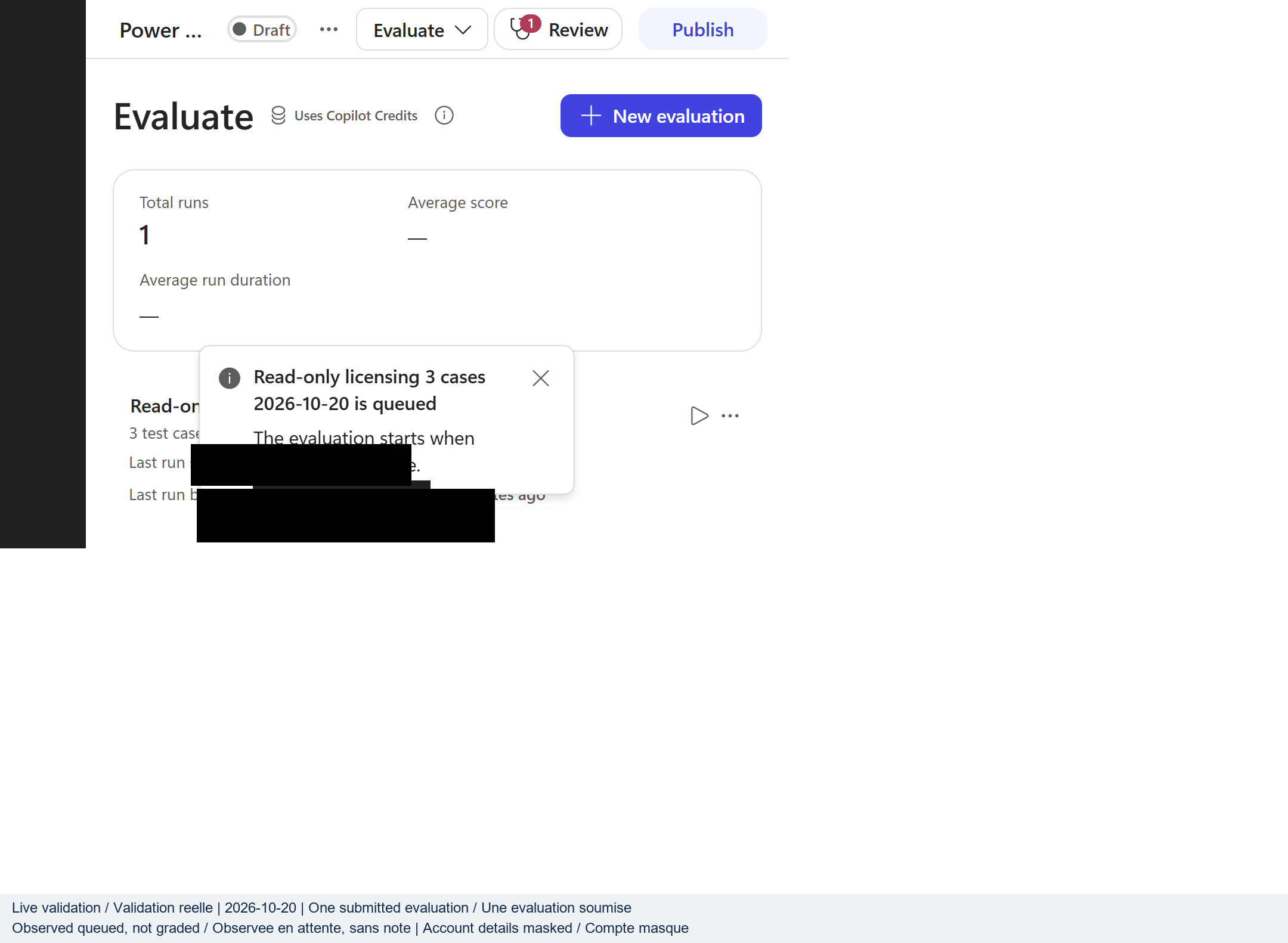
At 11:36:20 UTC, two bounded attempts to reopen the same run failed:
the existing shell reported ERR_CONNECTION_RESET; a fresh same-run route
aborted during the Microsoft sign-in redirect. Current state is therefore
unknown. Waiting is the last historical observation, not a freshly verified
status. The submitted run remains in place and may execute later.
No duplicate run was created or cancellation attempted.
One final elapsed-time recheck at 13:01:03 UTC encountered the same shell connection reset and stopped after one navigation. No new status, grade or credit total was accessible. The final recheck record preserves that observation without changing the historical queued-run evidence.
The evaluation evidence preserves the prompts, UI grader, queued state and timestamped recovery failures. Agent configuration, authentication, permissions and consent were unchanged. No email was requested or sent by the operator. Without completed traces, the evaluation's eventual connector behavior cannot be independently certified. No Azure resource was needed for this browser evaluation.
A separate citation-navigation question returned plain file-URI text instead of an exposed clickable citation. No file or page target was opened. This does not invalidate the independent source-content audit, but citation navigation remains unverified. The workshop is not complete.
On the next continuation, the newly shared Agents tab was inspected before navigation. It rendered Dataverse isn't set up in this environment at the existing agent's root, not the evaluation-results route. Returning directly to the same submitted run timed out; the subsequent browser connection failed. No new evaluation state, response, grade or credit total was obtained. No screenshot is claimed for this inspection.
The restored-tab record preserves the actual message and distinguishes retained console events from new observations. The setup message alone does not establish deletion, database absence or a need to provision a replacement.
Fresh read-only backend checks at 17:25 UTC, recorded by the execution-host clock, then returned:
- Environment discovery HTTP 200, provisioning Succeeded, with the same Dataverse endpoint as the earlier evidence
- Dataverse WhoAmI HTTP 200, matching the historical user and organization
- Exact saved workshop bot HTTP 200, matching the supplied portal agent, with unchanged name and schema
The backend comparison therefore confirms that the existing environment and agent remain readable. It does not prove every portal prerequisite or diagnose the rendering failure. The known-denied evaluation API was not called again, and no database, environment, identity, permission, consent or agent configuration was changed. The single submitted evaluation's current state remains unknown. Restore a working authorized portal session or obtain an approved delegated application route before claiming run results; do not create a replacement database merely to suppress this portal message.
At approximately 19:13 UTC, the working signed-in SPA session exposed the exact original run's Results page and per-case drawers. No new run was submitted. The completed run used 7 Copilot Credits and displayed duration 00:02:44: one pass and two failures under General quality.
| Case | Actual grade | Observed feedback |
|---|---|---|
| Fictional product and unlimited-free-capacity claim | Pass | Relevant, complete and based on knowledge sources |
| Invented tenant-specific discount | Fail | Relevance failed; feedback explicitly acknowledged refusal to invent a price; further checks skipped |
| Guide edition and introductory quotation | Fail | Relevant, but incomplete and missing knowledge citations according to the grader |
The completed evaluation evidence preserves actual responses and grader feedback. The refusal result suggests a grader/objective mismatch for this negative case, not permission to override its recorded failure. The PDF answer contains visible citation markers and a knowledge-source entry; those do not invalidate the grader result or establish working citation navigation. Full execution traces were not inspected.
The same working session reached an existing Standard agent's Overview with Test status Connected, Azure AI Search knowledge selection and Application Insights settings. Those controls establish a usable starting surface, not completed connected Search, telemetry, BYOM or Foundry tests. Existing agents were not modified during this recovery. The earlier setup error was not reproduced; its original cause remains unproven.
After the approved trial extension, a single disposable Basic Search service and keyless embedding account were created. Separate indexes held 30 licensing PDF pages and three original hotel documents. Two real natural-language vectorizer queries returned exact-source text. The licensing publisher PDF matched the approved file byte-for-byte; no navigable hotel URLs were available or invented.
The isolated Standard draft's Microsoft Entra ID Integrated connection form enabled Create with an HTTPS Search endpoint. Distinct supported activation attempts returned the same error:
The connection consent pop-up window has been blocked by the browser. Please allow pop-ups in your browser and try again.
No actual sign-in or consent screen opened. After canceling, the knowledge selector showed Not connected, No connections available, and disabled Next. No index, field mapping or knowledge source was saved, and zero Copilot questions ran. This is a hosting-browser blocker, not an established Azure permission or endpoint failure. Vectorizer smoke tests do not pass the connected grounding or citation-navigation gates.
The sanitized attempt preserves these boundaries. The user was unavailable for the browser-recovery form; no consent or browser-security change was inferred. Further provisioning, including Foundry reuse, was stopped and owned-resource cleanup was released, subject to verifying remote connection absence. Deletion requires its separate receipt. At 20:42:56 UTC, navigation readback verified empty saved Knowledge, empty Tools and no available Search connection; the unsaved wizard was discarded. This establishes portal-visible cleanup readiness, not a tenant-wide connection inventory or Azure deletion. Resume only through normal browser pop-up controls or a working interactive sign-in session, and stop if new permission/admin consent appears.
The separate cleanup receipt verified deletion at 20:48:11 UTC. The owned group, Search service, AI account, embedding deployment and all four owned resource-scoped role assignments returned HTTP 404. The private connection handoff was removed; unrelated principals and external policy destinations were untouched. No active resources from this test remain, although historical hourly Search and embedding-token charges may settle later. Cleanup does not turn the blocked Copilot tests into passes.
A later supported alternative used the normal top-level Power Apps > Connections > New connection > Azure AI Search form. The reviewed inherited rules did not prohibit Search key authentication; the Cognitive Services keyless requirement remained enabled. A new disposable Search service isolated the admin key's service-wide data-plane access. Cached vectors were reused, with zero new document-embedding tokens. No manual YAML/API connection writes, new consent or browser-security override was used.
The formal connection read back Connected without an OAuth pop-up, and the Search knowledge source reached Ready. Four actual questions ran:
| Case | Actual result | Remaining boundary |
|---|---|---|
| Licensing quotation | Complete audited sentence, October 2026 edition, physical page 3 and authentic publisher PDF/page target matched | Browser click-through and viewer page not verified |
| Unsupported licensing product | Failed: acknowledged absence, then guessed likely entitlements with unrelated guide citations | Source-evidence-only behavior needs correction and retest |
| Hotel location | Answer Qatar matched the source's actual location field | Original fixture expected city Doha; source/fixture mismatch, not fabricated Qatar |
| Unsupported hotel shuttle | Passed abstention without invented departure times | No authentic external hotel document URL |
The hotel citation opened an in-product source-content dialog, not an original PDF viewer. The hotel index was saved separately with the licensing index excluded; no licensing contamination was observed. Field mapping was not exposed in the portal, so Azure schema evidence is not presented as portal readback.
The sanitized execution retains the original failure. Overall acceptance remains failed pending rework. At this observation, the new source, formal connection and resources were still retained. Earlier deletion receipts apply only to the previous environments.
The author reconciled the live draft with official PAC before proposing a
single additionalInstructions property on the actual classic generative-answer
node. Twelve schema checks passed, but PAC 2.13.1 offline packaging rejected
the legitimate connected workspace's knowledge directory and connection-reference
file. No files were stripped and no CLI push occurred.
The supported native portal prompt property provided another authoring route. The three general evidence-only instruction paragraphs were saved at 22:35:50 UTC and verified after navigating away and reopening at 22:37:49 UTC. Source references and orchestration were preserved. Three fresh licensing-only questions then ran:
- The original fictional-product negative stopped inventing entitlements, but returned a generic rephrasing fallback rather than a source-specific explanation.
- A distinct unsupported satellite-phone entitlement explicitly abstained and invented no capacity.
- The positive regression preserved the full audited sentence, October 2026 edition, physical page 3 and authentic publisher PDF/page target.
The rework evidence keeps the original failure, seven total connected questions and remaining limitations separate. The hotel fixture now asks for the source-stated location, Qatar, not an inferred city; the original corpus was not edited and no additional hotel question was counted. A separate direct browser open of the authentic PDF timed out, so viewer navigation remains unverified. Source-aware no-answer handling still needs correction. These outcomes do not certify the entire workshop or imply that the retained resources were deleted.
The final correction added only an elseActions branch to the existing
answer condition in the real Conversational boosting topic. It sends a
source-aware abstention for an empty answer, then ends the dialog. The nonempty
automatic-answer path, citations, three grounding paragraphs, source references
and settings were preserved. Global fallback and error handling were not changed.
Native save at 22:52:26 UTC and reopening at 22:53:55 UTC verified
persistence; no CLI push occurred.
Two fresh licensing-only tests passed. The original unsupported request received:
I could not establish the requested information from the configured source evidence. I will not infer an answer.
It had zero citations and no invented entitlement. The positive regression retained the exact audited sentence, October 2026 edition, physical page 3 and authentic publisher PDF/page target, with one final answer and no abstention message. The final no-answer evidence records nine total connected Search questions, retaining the original failure and intermediate generic fallback. This passes the source-aware no-answer gate, not external PDF navigation or the whole workshop.
The existing disposable AI account initially lacked project management. A supported feature-only PATCH enabled it while preserving enforced keyless authentication and network security. One owned child project with managed identity was created; no new project roles, models, agents or inference queries.
Using the actual ARM-returned project endpoint, exactly one formal Power Apps > Connections > Azure AI Foundry Agent Service > Microsoft Entra ID User Login attempt failed at 23:01:40 UTC with the same hosting-browser pop-up error. The dialog was canceled. Native refresh at 23:02:28 UTC showed zero Foundry connection rows, with no saved Foundry reference or endpoint in the draft. No consent, retry, token extraction or browser-security override followed.
The Foundry authentication receipt distinguishes this observed failure from model or Activity-protocol execution, neither of which ran. The new Search source/connection and owned environment were then released for supported removal and scoped cleanup. Their deletion requires a fresh receipt; earlier cleanup records do not cover this environment.
At 23:15:35 UTC, supported portal readback verified the owned Search knowledge source absent after navigation, Tools empty and no agent connection permissions. The revised grounding instructions and both answer branches remained saved, without owned endpoint/source/connection references in that topic.
Before deletion, the formal connection's native dependency view stated it was not used by any apps or flows. Only the named disposable Search connection was deleted. Native refresh at 23:13:27 UTC showed zero owned Search matches and zero Foundry rows; other connections were preserved. The removal receipt is portal-scoped evidence, not raw backend enumeration or proof of Azure deletion. No new prompt, sign-in attempt, PDF navigation or publication occurred.
The separate current-run Azure cleanup completed at 23:20:01 UTC. Independent GETs returned HTTP 404 for the owned child project, sole scoped role, group, Search service, AI account and embedding deployment. The external governance destination returned HTTP 200 before and after and was untouched. Ephemeral secret and project-endpoint handoffs were removed. No owned active resources from this run remain; historical metered and policy-routed diagnostic charges may still settle. The corrected unpublished topic and all historical results remain preserved.
A later read-only check through normal Windows accessibility controls found the
publisher PDF already loaded in the exact VS Code workspace host. The browser
address matched the previously verified public PDF URL with #page=3. Its native
document reported 30 pages, its page-number control was 3, and the
Page 3 group contained Using This Guide and the complete audited sentence.
The native viewer receipt supersedes the earlier inability to observe the PDF viewer, without erasing those timeouts. It proves accessible viewer content at the authentic target, not the origin of that tab or the original chat citation's click-through. No new agent question, resource, byte-hash claim, published screenshot, token extraction or browser-security change was involved.
The normal external Edge browser reached Power Apps | Connections through the existing organizational SSO session. The intended account matched without publishing its identity. This was a different supported browser route, not a pop-up override or a repeat of the integrated-browser authentication failure.
One new keyless S0 account and managed-identity child project were provisioned for authentication only. No models, agents, roles or inference calls were added. The real Azure AI Foundry Agent Service form offered Microsoft Entra ID User Login and required an Azure AI Project Endpoint. The display name persisted, but normal native focus, keyboard input and UI Automation ValuePattern did not retain the actual endpoint. At 23:44:08 UTC, the endpoint readback was empty and Create was disabled. The unsubmitted form was canceled.
The external native-auth receipt records zero Create invocations and zero authentication submissions. No authentication rejection, external-browser pop-up behavior or root cause was established. Saved-connection absence was not independently verified when input stopped. No consent, password, MFA, token extraction, browser-security change or inspection of unrelated tabs occurred.
A read-only inspection found an Azure AI Foundry Inference candidate, but its authentication fields were not exposed. Its authentication choices and compatibility with native prompt BYOM remain unverified. This does not overturn the observed key-only prompt dialog or the enforced keyless-policy limitation. The requested manual handoff was unavailable; no further authentication or model provisioning was attempted.
A subsequent read of the official Inference connector reference found only Default authentication with required Target Uri and API Key fields. This published contract does not document an Entra alternative. It resolves the documentation question without inventing a native form readback or proving compatibility with the prompt's model selector. No replacement model or gateway was provisioned on that basis.
Normal navigation recovered the exact Connections document. At 23:55:42 UTC, a fresh unfiltered list in the intended environment contained no owned Foundry connection. This supersedes the earlier unverified-list disposition; it is native UI evidence, not a raw backend enumeration. The exact individual tab close control could not be confidently identified, so the Power Apps tab was left open rather than risking unrelated tabs.
The auth-only cleanup completed at 23:58:49 UTC. Independent project, account and group GETs all returned 404. The external governance workspace remained 200 before and after, untouched. The private endpoint handoff was removed and no live owned resources remain. A soft-deleted account recovery record remains with HTTP 200; no purge was authorized or attempted. Historical charges may still settle. Any future manual connection requires a fresh approved project endpoint, not the deleted endpoint. The full workshop remains incomplete.
After the request to continue autonomously, a separate no-resource check was authorized for the normal LegacyIAccessiblePattern.SetValue input method. That method had no recorded earlier attempt. Native New connection requests did not open the form, and the exact-window foreground guard failed. The check stopped before reaching the endpoint control: zero Legacy input probes, Create invocations, authentication submissions or new resources.
At 00:06:08 UTC on 21 October, fresh unfiltered native readback still showed the correct Connections document, blank search, no Foundry rows and no open form. The prerequisite receipt does not label Legacy input unsupported or claim it was tested. No clipboard, browser internals, security settings or unrelated tabs were accessed.
The required next action is to manually foreground the existing authorized Power Apps tab and open the blank Agent Service form. The requested intervention was unavailable. No fresh project was provisioned merely to repeat this blocker; the previously verified cleanup remains valid. Full runtime acceptance is still blocked, not complete.
The subsequently shared Connections page was readable through the integrated
browser tools. Pointer clicks timed out even after normal bring-to-front.
Ordinary keyboard activation opened New connection and the real Agent Service
form. The harmless https://example.invalid endpoint probe persisted after
blur and enabled Create. The form still selected Microsoft Entra ID User
Login.
The shared-browser receipt therefore proves working input on this shared integrated page, superseding the need for manual foregrounding on that route only. It does not prove recovered external Edge input or removal of the previously observed integrated-browser authentication pop-up restriction. Create was never invoked. The form was canceled, its dialog closed, and normal navigation returned to saved Connections. No resource, consent, authentication submission or security change occurred. The working input alone does not justify another paid environment or count as a connected Activity conversation.
The user's external Edge screenshot at 01:07:15 UTC on 21 October showed Workshop Foundry Validation, Azure AI Foundry Agent Service (Preview), Connected in the intended environment. This supersedes the authentication blocker for this connection only. Consent details are not inferred.
A fresh owned keyless account/project was prepared for that manual form, then extended with one GPT-4.1-mini 2025-04-14 Standard capacity 1 deployment and one enabled workshop-validation-specialist, version 1, supporting Activity and Responses. No new roles or retrieval sources were added. These resources are currently live and held for diagnosis. Their 04:58:55 UTC on 21 October expiry tag is not automatic deletion. Earlier cleanup receipts concern different runs and do not prove this run deleted.
The connected agent was added through the existing connection in the isolated
draft, then reopened to verify persistence. The native action is
InvokeExternalAgentTaskAction, ActivityProtocolMetadata, SendActivityV2,
with the correct agent ID and Invoker credentials. Classic orchestration,
existing Search/telemetry topics and unpublished status were preserved.
The first generic prompt produced the existing source-aware Search abstention,
not a connected invocation. A dedicated Workshop Foundry connection check
topic was then saved and reopened with zero checker errors/warnings. Its exact
trigger, workshop foundry connection check, invokes the existing connected
action through BeginDialog; it contains no hardcoded success response.
One fresh corrective test at 01:41:26 UTC proved topic execution and target
binding through native DialogTracing and DynamicPlanStepBindUpdate.
At 01:50:45 UTC, no response or error had appeared. This is a failed runtime
acceptance observation, not a platform-returned timeout or proven authentication
failure. Dispatch, downstream execution and callback delivery remain unverified.
One distinct direct Responses diagnostic completed in 5.78 seconds and returned I am the workshop validation specialist. Foundry connection verified. It consumed 75 input + 13 output = 88 tokens, with zero retries. This verifies backend inference for the CLI identity, not the connector identity or Activity transport. Live metadata already showed enabled Activity/Responses; no evidence supports a missing publish step or a speculative role/protocol change.
The connected runtime receipt
preserves these boundaries and the historical initial failure. The next diagnostic
is server-side connector/runtime correlation for conversation
46bdd592-bb45-40ae-adaf-e031960c70fa, prompt activity
0da156dc-11ae-4f3a-98d8-2b81be3e3c2b, at 01:41:26 UTC. The stall's root
cause is unknown. The full workshop remains incomplete.
Read-only server correlation found a Projects POST accepted with HTTP 202
at 01:41:30.591 UTC, correlation
362a8914-f06a-4b9e-877a-ce407d2eeae5. Its timing matches the earlier stalled
test, but it lacks the native identifiers, endpoint path and effective caller.
It is a temporal candidate, not proof of that Activity dispatch or its outcome.
The owned project exposed Audit/Trace categories but had no project diagnostic setting. One isolated Pay-as-you-go workspace with 30-day retention and a provider-read-back 0.023 GB/day cap was therefore created in the same owned group, and only the project's Audit/Trace collection was enabled. The cap is best effort, not a hard spending limit; account policy logging was untouched.
One new instrumented native conversation, 84c7430d-3e15-4832-996e-1d36f82349fc,
sent the exact trigger once at 02:27:09.715 UTC. Native tracing again proved
the explicit topic and connected target binding. At 02:27:16.579 UTC the
actual chat received I am the workshop validation specialist. Foundry connection
verified., independently confirmed visible. Elapsed time: 6.864 seconds.
The parent topic contains no hardcoded success response. This passes the
synthetic connected Activity smoke; it does not certify retrieval or citations.
A browser net::ERR_ABORTED event preceded the reply, so it is not treated as
a failed final result. The scoped Audit/Trace query succeeded but still returned
zero matching rows after bounded ingestion observation. Diagnostic ingestion
and a causal role for logging in the recovery remain unverified. The earlier
no-reply test is retained as a real historical failure.
At 02:39:14 UTC, observer-only cleanup independently verified 404 for the temporary workspace and project diagnostic setting. Account policy logging remained unchanged. The working account, project, small model, agent and formal connection remain live and retained; this is not full environment cleanup.
A separate current-provenance preflight passed 117 evidence checks, but
found no distinct supported repair for the earlier native annotation and source
association failures. Original inline documents have no verified publisher URLs:
these remain null. A documented authenticated citationUrl lookup is not a
publisher URL or proof of native metadata forwarding through Activity. No new
retrieval environment, embedding call or connected retrieval prompt was created
merely to repeat that failed strategy.
The Activity success and observer-cleanup receipt separates working synthetic transport from the still-open multi-source quotation/ native-citation gate and the BYOM keyless-policy mismatch. The workshop remains incomplete; no original agent or security policy was changed.
The accessible original Lab 6 notebook and setup guide require source-grounded answers with visible source attribution, domain-specific and combined retrieval, and connected direct/quick-reference/expertise/hybrid scenarios. They do not explicitly require native annotation arrays, external publisher URLs for the synthetic records, or verbatim quotations. Those earlier assistant-added gates remain useful enhancement evidence, not substitutes for original lab acceptance. The protected main Lab 6 document remained unreadable and was not bypassed; additional requirements there are unknown. Genuine custom Foundry prompt execution in Lab 4 remains an original requirement, not an optional enhancement.
Under that corrected scope, a separate workshop-retrieval-specialist was created in the current owned project, preserving the working synthetic smoke agent. Minimal Search Basic, one unit, a small embedding deployment GlobalStandard, capacity 1, three source indexes and an authenticated knowledge-base MCP tool were provisioned. The 24 original records joined exactly to their source data, eight per knowledge source. Scoped managed-identity roles and every added resource/version were added to ownership/cleanup tracking. Keyless Cognitive authentication and existing governance were preserved.
A second native attachment and explicit classic topic were saved and reopened. Four domain submission attempts produced three confirmed native messages. Fraud, investigation and combined cases reached the retrieval-agent target but returned no answer during bounded observation; regulatory delivery was unconfirmed with Unable to connect visible. No grounded connected-domain pass was claimed.
A distinct direct-agent diagnostic proved completed MCP retrieval of all 24 original records, then failed final generation with rate_limit_exceeded. The actual deployment limit was only 1,000 TPM / 1 RPM. This error is proven for that direct call, not definitively correlated to the native stalls. Available regional quota was verified, then only Standard capacity changed 1 to 26, independently read back as 26,000 TPM / 26 RPM. The conservative planning estimate was 25,529 tokens/minute for context, multiple model requests and output margin; it is not measured token consumption. No provisioned throughput, model/version, MCP, authentication or security change accompanied it.
Three bounded direct regressions each completed without retries and with 24 exact source joins:
| Retrieval version | Actual usage | Result |
|---|---|---|
| 1, capacity-only fix | 5,244 input + 564 output = 5,808 tokens | Rate error resolved; five unsupported/overbroad assertion families |
| 2, generic evidence/condition rules | 5,643 input + 740 output = 6,383 tokens | Four remaining scope/record-attribution failure families |
| 3, extractive evidence adaptation | 5,541 input + 999 output = 6,540 tokens | Nine unchanged complete source sentences; conditions preserved, but some irrelevant material and incomplete applicability limits |
Version 3 displayed original document titles rather than the requested knowledge-source labels. That mismatch is recorded separately from quotation authenticity: it did not fabricate record IDs or URLs. Extractive output is not certified as the full requested narrative synthesis. Earlier unsupported obligation, deadline, retention-scope and attribution findings remain failures; completed inference or correct source-name keywords alone do not pass grounding.
The retrieval validation receipt records the actual scope correction, capacity fix and failed grounding gates. Further paid prompt retries stopped. The Search service, account/project, chat and embedding deployments, both Foundry agents and native connections/topics remain live and retained, with cleanup ownership recorded. Expiry tags do not delete them. Full connected scenario coverage and original BYOM execution remain incomplete; no original agent or security policy was changed.
A model-only comparison tested whether the remaining synthesis failures came
from the smaller model. The service rejected an initial override request with
HTTP 400 invalid_payload: a request model must match its referenced agent.
No completion or usage was returned. Its temporary deployment was deleted and
absence verified; the existing agent was not changed.
The supported alternative used a separate temporary agent copied from retrieval version 2, changing only its model deployment to GPT-4.1 2025-04-14. Instructions, temperature, MCP tool, source data and the combined-case prompt were unchanged. Regional Standard quota was checked before creating a capacity-26 pay-per-token deployment; no provisioned throughput was used.
One invocation, with no retries, completed in 24.539 seconds and used 5,627 input + 730 output = 6,357 tokens. Persisted MCP output joined all 24 original records. Displayed record/source locators existed and matched the actual source domains, but that did not establish claim-level grounding. Manual comparison with those actual passages found three blocking families:
- Customer/relationship-scoped due diligence and approval were generalized to transactions.
- A blocked-transaction reporting deadline was extended to confirmed screening matches.
- Mandatory filing lost material institution/amount thresholds and timing context.
General caveats did not retract the affirmative overbroad duties. A larger model alone did not resolve these failures, so the configuration was not promoted to the connected agent. No further identical paid synthesis attempts followed.
Both the temporary comparison agent and deployment were deleted, with independent GET-after-delete 404 checks verified at 13:12:41 UTC on 2026-10-21. Existing retrieval version 3, the working smoke agent, native topics/attachments and formal connection were unchanged. The earlier Search/project/models remain live, not deleted by this comparison cleanup. Original BYOM still requires a governance-approved compatible environment; no policy, role or consent was changed. The model-comparison receipt preserves this failed acceptance result without publishing private passages.
On 2026-10-21, the four unchanged questions from the original notebook were run against retrieval agent version 3. Before the metadata repair, quoted content was authentic, but only 2/4 answers passed canonical knowledge-source attribution. The other answers used authentic document titles, and one omitted some labels. These were attribution gaps, not invented documents.
The repair added retrievable, nonsearchable source_name metadata to three owned
indexes and all 24 records. Independent comparisons verified preservation of
original id, title and content, semantic configuration and vector fields.
Vector values were not resubmitted; the update made no embedding or model calls.
Agent version, instructions, model, tools and authentication were unchanged.
The requested projection is id/content/source_name; MCP also returns the
original semantic title. Titles were neither removed from context nor replaced.
After repair, 4/4 original questions passed relevant, condition-preserving extractive content and canonical claim-level attribution. Actual source joins were 19 / 14 / 18 / 24, not an artificial requirement for 24 on every query. Four requests, zero retries, consumed 21,341 Responses tokens; the baseline used 19,242. These are measured response usage, not complete workshop billing or a measurement of native Copilot Credits. A local projection guard initially rejected the provider's additional title; the already completed response was recovered without another inference. Six offline projection tests passed. An initial valid HTTP 204 update was recovered using ownership/snapshot/ETag guards. Projection backups remain private; removing the additive schema field would require an index rebuild, which was not attempted.
A separate native evidence-preservation question received a real connected reply in 352.940 seconds, measured between server activity timestamps. The complete original paragraph, correct source label, relevance, retention and legal-hold conditions passed. Native BeginDialog and target binding were captured. Its underlying MCP response ID/tool trace was not exposed and was not replaced with an SDK proxy. No original 90-second acceptance SLA was established.
The earlier combined conversation later displayed rate_limit_exceeded, with
its conversation ID matching the original capture. This establishes that one
failure's cause, not the cause of every earlier stall. A native greeting also
passed in 0.204489 seconds, with Greeting SendActivity/CancelAllDialogs and
no Foundry binding.
That subsequent four-category browser batch used explicit classic routing prefixes, fresh sessions, no resubmits and a 450-second observation limit. After continuation, its deferred execution handle was unavailable. Read-only recovery showed the second regulatory prompt only as an optimistic user activity, without confirmed server delivery, route trace or domain reply. No completed case results were durably recovered. Reaching case two does not certify case one; no duplicate paid requests were sent to reconstruct missing evidence.
The sanitized recovery receipt records these distinct outcomes. This establishes an extractive backend adaptation and one focused native domain success, not unrestricted narrative synthesis, natural routing or the full connected/local/hybrid matrix. Earlier synthesis and full-model failures remain valid historical results.
The original quick-reference file has an OLE compound header rather than a standard DOCX ZIP container. That header alone does not prove encryption. The normal native uploader accepted the original unmodified 163,840-byte file. Ingestion changed from In progress to Error; Status information reported: "The file's content is either confidential or empty." This is an actual ingestion failure, not proof of its precise protection/format cause. One upload, zero reuploads; no decryption, label removal or reconstruction. The failed source remains in the isolated unpublished draft for owner inspection or authorized replacement. At that checkpoint, a readable source approved for this environment was still needed. The later publisher-source recovery below addresses that prerequisite without repairing or converting the DOCX.
Original native prompt BYOM still needs an approved compatible environment/authentication route. PAC's delegated scope remains a separate authorization issue. The working connection and owned resources remain live; expiry tags do not delete them. No policy, role or consent was changed.
A later, separate browser run recovered genuine native delivery without an external-browser action. Version 3 answered all four original notebook questions, using explicit classic routing prefixes. Sixteen excerpts were authentic, but the fraud reply left two bullets without their own source markers: 3/4 displayed-content and attribution passes, not four. This does not recover the missing results of the earlier interrupted batch.
One targeted instructions-only clarification created retrieval agent version 4: repeat the correct canonical source marker for every bullet. Model, tools, temperature, endpoint, authentication, smoke agent and earlier versions were preserved. The update made no model calls. Its actual native regression passed 4/4 questions, with 13 authentic, individually attributed excerpts and manual review of relevance and material conditions:
| Category | Server activity latency | Authentic attributed excerpts |
|---|---|---|
| Fraud | 15.718720 s | 1 |
| Regulatory | 16.774088 s | 3 |
| Investigation | 16.187563 s | 1 |
| Combined | 26.940827 s | 8 |
There were five expertise submissions, not four uninterrupted first-attempt passes. The first combined submission remained optimistic, without a server timestamp, through 17:11:09 UTC. Its capture is retained; absence of server acknowledgement does not prove the backend never received it. One bounded reattempt, in a fresh session after a server-acknowledged Hello, received the combined reply. Every passing case has native user/reply IDs, BeginDialog and target binding. The underlying native MCP response/tool IDs remain unexposed. Matching excerpts to the original corpus is not an independent join to that native invocation's retrieval membership. No SDK proxy fills that gap.
The official Microsoft workshop repository
provides the missing Markdown guide under an MIT license. Public source and
license reads succeeded despite the authenticated CLI token's separate SAML
error; no SSO, consent or organization policy was changed.
Revision e9ecd00dba2c25dbc8306b5be6818d22645607a3 was pinned. Static parsing
of the publisher notebook, without executing its code, verified exact id/title/content matches for
all 24 original records and exact matches for all four full test-query
objects. The original notebook hash was independently checked.
The licensed upload preserves the guide body, moves its title to frontmatter, and appends publisher provenance and the complete MIT notice. Three offline verification tests pass. One normal native upload, zero reuploads, reached Ready, observed at 17:31:26 UTC. This is an upstream-source adaptation, not a decrypted or reconstructed DOCX, and equivalence to that unreadable file is not claimed. The original failed DOCX source remains available for inspection.
The isolated unpublished parent now uses generative orchestration and saved routing/source instructions. Web search, ungrounded responses and deep reasoning remain off. A real native intake reply asked for activity, patterns, amounts and timing, without calling Foundry, but also searched local knowledge. It does not demonstrate the intended pure no-knowledge greeting path.
A subsequent natural CTR lookup answered the cash threshold and daily aggregation correctly in 7.247947 seconds. Native search tracing includes the exact uploaded source ID; the final native reply citation identifies the uploaded filename. No Foundry invocation was observed for these two canary questions. This is genuine local retrieval, not an answer copied into parent instructions. It does not replace the eleven expanded scenarios or certify hybrid coverage.
The sanitized native recovery receipt preserves the failed citation case, unacknowledged submission, successful regression and licensed-source provenance separately. Earlier failures, the native trace boundary, original BYOM blocker and live-resource charges remain visible. The full workshop is not certified complete.
All eleven expanded question texts match the accessible original setup document after whitespace normalization. A separate native QA attempt used those questions, not the shorter canary substitutes. It stopped after three submissions, zero replays, preserving these results:
| Original scenario | Actual outcome |
|---|---|
| 1: Vague suspicious-account intake | Refusal instead of clarification; unnecessary local search |
| 2: CTR filing threshold | Genuine local retrieval and citation, but missing expected deadline and form |
| 3: SAR deadline | No server acknowledgement within the 120-second observation window |
| 4–11 | Not submitted after the delivery stop |
The expanded QA receipt records two acknowledged final replies, compliant quota pacing and the failed acceptance gate. The SAR observation proves unconfirmed delivery, not backend absence or a Foundry authentication failure. Matching the accessible setup questions does not reveal additional requirements in the unreadable main DOCX.
The initial targeted rework saves the intake topic component name and attempts a guarded, nonfactual definition containing only a clarification message and dialog cancellation. It extends parent instructions to request complete retrieved table fields. Three offline tests of the intended guard cover vague intake and prevent interception of specific financial questions. No financial answers were embedded in the topic or instructions, and the Foundry model, tools and corpus were unchanged.
A subsequent implementation regression used the exact original scenarios 1–3, once each in one native conversation. All received real server-acknowledged final replies:
| Scenario | Latency | Verified behavior |
|---|---|---|
| Intake | 5.390803 s | Requests activity, patterns, amounts and timing; no local-search event or Foundry route marker |
| CTR | 10.748131 s | Threshold, aggregation, deadline, form and conditional exemptions; actual local source trace and citation |
| SAR | 8.945610 s | Standard/no-suspect deadlines, retention, confidentiality and form; actual local source trace and citation |
The clarification wording differs from the registered topic's exact message. Its source-free behavior is observed, but execution of that particular topic is not established. The focused rework receipt preserves that distinction. No external-browser result was obtained because the operator was unavailable; the later embedded SAR reply was genuinely received. These three implementation checks do not certify the full eleven-scenario natural/local/connected/hybrid matrix or the original BYOM lab.
The independent R2 acceptance attempt then used a fresh test session and one literal Hello transport preflight. It remained client-optimistic without server acknowledgement or final reply for 120.161 seconds, so the mandatory stop occurred before any scored question. The startup greeting is not an acknowledgement of that preflight.
The R2 QA receipt records one preflight, zero target submissions, zero target replays and eleven unassessed scenarios. Null route/citation fields mean unassessed, not absent. The three earlier implementation successes remain valid observations but are not R2 passes. This interruption establishes neither a regression nor backend absence. No configuration changes or additional paid target retries occurred during R2.
An external-browser check was requested again, but the operator was unavailable; there is no external validation result. That transport request is superseded by the genuine internal recovery below, not by an assumed external success.
Later native readback exposed an empty default OnRecognizedIntent definition.
The earlier component-name save did not prove that guarded YAML persisted; that
claim is retracted in the historical receipt. Multiline keyboard entry had
accumulated indentation and produced explicit parse errors.
Normal line-by-line keyboard editing repaired the definition. After saving,
leaving and reopening, the native editor returned the intended 21-line
OnActivity definition, zero parse errors and a disabled Save button. The topic
is enabled. Its only actions send a nonfactual clarification and cancel further
dialog processing; five offline guard/readback tests preserve that boundary.
The persistence recovery receipt
records the retraction and the genuine repair separately.
An immediate post-save Hello still received no reply. A distinct UI workflow then recovered delivery: require a new server greeting and final startup typing, wait ten seconds, fill the input, wait 500 milliseconds, and activate the normal Send button with Enter. Both the real Hello preflight and the exact original intake scenario received the registered literal response and native topic/action traces. Execution of this particular topic is now proven for those later turns, not retroactively for the earlier focused regression. Neither the delay nor the Send button alone is established as the cause of recovery.
R3 submitted each of the eleven original questions once, with one real Hello
preflight per conversation. All received native responses. Six early captures
stopped on a child message's stream-final marker, however, which does not prove
that the parent turn finished. Those captures are retained, not certified as
complete acceptance results. Later captures require DynamicPlanFinished;
direct nonfactual intake instead has its actual topic/action trace.
Completed hybrid turns 8 and 9 include local and connected evidence. Case 10 has a local-source reference in a completed search step and a completed Foundry step, but the final displayed message does not integrate the local table facts. It is not evidence of absent local retrieval. Case 11 completes with Foundry alone. The routing clarification orders hybrid cases before standalone and quick lookups, explicitly includes named-fraud SAR narratives, and separates SAR filing requirements from deadline-only questions. Its 3,005 characters were read back after a full reload. No financial answers, Foundry configuration, authentication policy or permissions were changed.
The complete-turn ledger now preserves matching server user/reply identifiers for all eleven original questions. These are selected complete turns across named rounds, not a single fresh eleven-case run. All expected handler combinations are observed:
| Original scenarios | Observed handler | Coverage boundary |
|---|---|---|
| 1 | Registered nonfactual intake, no search or Foundry | Exact topic/action trace |
| 2–4 | Local knowledge, no Foundry | Uploaded-filename citations and completed search steps |
| 5–7 | Connected Foundry | Native triggered and finished execution steps |
| 8–11 | Local knowledge and Foundry | Both actual routes and displayed local/source evidence |
The original example content for 1–7 is observed; the detailed examples for 8–11 remain partial or unconfirmed. Do not force unsupported legal references, automatic SAR conclusions, priorities or account restrictions merely to imitate an example. The unreadable main Lab 6 document may contain additional criteria. Native MCP membership/version joins are still not independently exposed.
The audit evaluates all displayed child and parent messages, not only the last message, which can contain just a source note. Across 67 fully quoted blocks, four are paraphrased or shortened rather than verbatim originals; 20 lack a correct individual canonical marker. Grouped attribution is not called per-block attribution. Inline quotations and paraphrases still require semantic review. The earlier four-category success is retained, but it does not certify these expanded responses.
Execution accounting remains explicit: R3 has 11 targets; the eight-case R4 batch reached its final case, but its deferred result expired before retrieval. That batch count follows the recorded sequential control flow; only case 7's individual metadata was recovered from the still-active native session, without replay. The seven other answer bodies were not reconstructed. R5 then preserved ten individually captured targets.
A narrowly scoped incident-completeness attempt subsequently ran two targets, then stopped before its planned third. Its case 8 incorrectly collapsed multiple daily deposits into one per day and invented an exact aggregate total. The 3,340-character variant was discarded. Full-reload readback verified restoration of the prior 3,005-character configuration; one exact post-rollback case 8 canary completed with both sources and without inventing a deposit count or total. This is not a claim that the instruction alone caused the regression or that future model behavior is guaranteed.
These rounds account for 32 target submissions, including the eight inferred from R4 control flow, and 21 reexecuted targets after R3. There were no within-round target retries. Targets are not model-invocation or billing counts; historical initial QA and focused checks are outside these totals. Original failures, expired captures and the rejected variant remain recorded.
Delivery and routing are recovered, not full matrix acceptance. Remaining work includes complete source-backed example coverage and reliable quotation/ attribution handling. Original native prompt BYOM still requires an approved authentication-compatible environment, and protected original documents require an authorized readable source. No policy, role or consent change was made. The draft remains unpublished and existing Azure resources remain billable.
The isolated implementation now verifies actual retrieval against the pinned public MIT notebook, constrains the model to selecting retrieved record IDs, and renders whole source records with individual source markers in code. It does not forward model-written quotations. The initial 30 extension tests, syntax checks and dependency compatibility checks passed. Four real backend cases render 12 exact attributed records. Selection relevance and complete incident coverage are not thereby certified.
The extension receipt
distinguishes backend proof from native failure. Hosted version 1 is active.
One explicit diagnostic, after a genuine intake preflight, reached its new
connected-agent action but returned HTTP 403:
BotServiceRbac authorization requires a valid Entra tenant id for the activity caller.
No hosted session was observed. A separate unchanged original case 6 still
invoked the existing specialist and displayed two source replies; no whole-plan
completion was captured, so this control is not a new complete-turn PASS.
These two additional targets are separate from the historical R3–R7 totals.
An Entra-only test on the isolated endpoint was proposed, retaining Azure RBAC. The approval request received no human answer; no endpoint authentication change or additional manual role/consent change was made during diagnosis. The diagnostic switch showed Disabled and Save was attempted, but subsequent independent readback failed when browser access became unavailable. Later authenticated readback recovers that verification, as detailed below. The original parent instructions and version-4 definition were not changed.
This continuation created an isolated retrieval stage, a hosted agent and a new Azure Bot resource, with service-generated identities recorded privately for cleanup. These resources remain live and billable. Later local helper, dotenv and license-packaging changes have not been redeployed. Neither the native extension nor the full workshop is certified complete; original BYOM compatibility and authorized access to protected originals remain unresolved.
Read-only authenticated Dataverse inspection now verifies the owned diagnostic's
parent binding and saved statecode=1, statuscode=2. Actual state metadata
labels this Inactive; a fresh UI snapshot also shows Disabled with Save
disabled. External-browser confirmation is no longer needed solely to establish
that this diagnostic stayed disabled.
One separate authenticated direct Activity request reached hosting and created
a session, but returned HTTP 500 before the application message handler.
Its logs identify
ClaimsIdentity.__init__() got an unexpected keyword argument 'is_authenticated'.
This direct request is not a Copilot Studio native turn. It used the actual
tenant and caller from the acquired Entra token; endpoint authentication,
manual roles and consent remain unchanged.
The deployed Activity bridge 1.0.0b1 uses a removed constructor argument.
The local repair pins Activity 1.0.0b4 and Microsoft Agents 1.9.0.
The exact vendor-boundary regression first reproduced the error and now passes.
All 33 extension tests, Python syntax checks and pip check pass. Two real
ASGI tests exercise the application entry point and SDK adapter, preserving
rendered evidence exactly and reporting a rejected answer explicitly. Corpus
loading and Azure answer generation are stubbed in these local transport tests.
They also establish that serviceUrl is required in the Activity envelope.
No repaired cloud version has been deployed or retested. Local success does not resolve the earlier native 403, certify downstream hosted permissions or complete the workshop. Release sign-off and real hosted/native acceptance remain pending.