Repository navigation
EN lab 06
Lab index | Français | Search retrieval | Infrastructure review
Separate four responsibilities: Copilot Studio handles the conversation; a connected Foundry agent performs deeper work; a Search knowledge base retrieves passages from multiple sources; a model writes an answer. Model Context Protocol (MCP) exposes the retrieval tool to the Foundry agent. Allow 120–180 minutes after an administrator provides supported resources and reviews the compatibility changes.
The T017 acceptance crosswalk delivers the documentary substep, not whole-lab runtime completion. F6-01/02/03 remain historical offline PASS; F6-04 is PASS and F6-05 is PASS at document level with the displayed-excerpt limit below. F6-07 is PASS and F6-08 is response-only PASS; F6-06/12 remain PARTIAL. F6-09 is PASS under an explicit language override; F6-10/11 remain NOT_RUN. At the initial offline checkpoint on 2026-10-26, F6-04/05 were NOT_RUN and F6-08 was PARTIAL; that reconciliation submitted zero questions/live attempts.
The exact multi-source check passes F6-07: one question, one completed native MCP invocation, two pinned-corpus records and two applicable groups, investigation procedures and regulatory compliance. The attributed comparison invents no rule and has a noncancelled completed plan. This prospective MCP proof does not join the historical original specialist's tool output.
The routing-repair receipt
preserves the original F6-06 FAIL: the unanchored intake matched hi inside Which.
Only that condition changed, adding ^...$ and reviewing a case; the saved native
topic passed its checker. A separate four-question, four-conversation cohort had no
in-cohort retries. F6-06 now passes supported MCP retrieval with two verified records
and a completed plan, but remains PARTIAL because the original connected-Foundry-child
invocation is unproved. F6-04/05 regressions pass within their existing limits.
F6-09 FAIL is preserved: grounding and core lineage passed, but final prose was English.
Topic component-version proof remains NOT_ESTABLISHED; no agent publish occurred.
The language-configured attempt
added secondary fr-FR, leaving primary en-US unchanged. Its new English Send
displayed Cannot send empty message: one intent/click, zero observed accepted
questions within 240 seconds, server acceptance NOT_ESTABLISHED. French was not
selected or sent; this attempt is NOT_RUN, not a replacement for the completed FAIL.
Test-session language and English restoration remain unverified. Automatic detection
and complete static-topic localization are not proven. Publication submits no questions.
The later single French-text check
proved delivery, not French acceptance: one accepted question after verifying the
real textarea and 60/2000 counter, but activity and reply locales were en-US
and final prose was English. One completed MCP call returned three verified records,
including both core records from the earlier supported English base; its corpus,
instructions and model were unchanged, but French secondary was added afterward.
The noncancelled plan completed in 71.232 seconds from server receipt to reply
(76.134 seconds from Send). No new English question or resubmission occurred.
Both language radios still exposed aria-checked=false after a separate native
keyboard control without a question. That historical F6-09 remains FAIL; its selection cause is
unproved. The previous delivery failure and guarded NOT_RUN remain intact.
The supported localization repair
used official PAC 2.14.1 through the existing enterprise NuGet proxy, without
authentication or TLS changes. The native French upload succeeded; independent
exports prove all 155 English values unchanged and 97 translated runtime values
persisted after label/trigger normalization. Complete Windows extended-length
enumeration verifies all 39 existing core draft files byte-identical and 22 French
translation files added; the earlier 35-file short-path subset was incomplete.
After a full reload, French selection still leaves both
radios aria-checked=false, and a no-question fresh session greets in English.
At that localization-only checkpoint the French question was NOT_RUN and the
last completed F6-09 was FAIL.
Full static localization and the selection cause remain unproved; see #5.
The later explicit language-switch cohort
passes F6-09: executed System.User.Language reads back French, the unchanged
question receives French prose and a completed grounded plan, while actual
posted/reply Activity.Locale remains en-US. The English regression also passes;
F6-06 overall remains PARTIAL because the original Foundry-child route is unproved.
Two fresh conversations contain five accepted messages: two domain questions and
three deterministic controls, no resubmissions. Each domain turn completes one MCP
operation; English retrieves one record and French two, sharing one ATO core record.
English restoration is proven in the same second conversation. All 1,288 historical
files retain hashes/timestamps; a fresh complete clone verifies all 63 non-token
files and 22 translations unchanged. Native picker repair, automatic detection and
continuous execution-version proof remain unproved. Earlier FAIL/NOT_RUN results
and the collector's failed echo wait remain preserved; no message was replayed.
The later two static French wrappers
pass their scoped native checks: one fresh conversation, four accepted messages
(two lookups and two language controls), four Send clicks and zero retries.
CTR and SAR replies exactly match the corrected French resources, retaining all
12 literal quotations and individual references. They are static snapshots, not
live retrieval; native retrieval/MCP/Foundry invocation counts are zero.
French System.User.Language and English restoration are proven; actual posted/reply
Activity.Locale remains en-US. The persisted override is restored, not cleared.
One localization upload persisted both wrappers. Strict candidate-map and two-file-only
guards failed and remain failures: a read-only audit explains 41 reordered positions
with all 42 Escalate phrases preserved, one materialized French fallback component
and component bookkeeping. Complete clone accounting is 64 to 65 files; the native
postflight preserves all 64 non-token files, 23 French translations and 50 components.
All 158 English/153 French resources and 1,814 historical files remain exact at that
postflight. A strict UTF-8 BOM failure is retained; BOM-aware validation used unchanged
files without another export or message. This separate cohort does not prove full
static localization, picker repair, automatic detection or T017 completion.
The exact private-history check
is F6-08 response-only PASS: one question, no replay or extra Hello, on the same
frozen prospective configuration as F6-04/05. The complete final reply acknowledges
that configured evidence cannot establish private customer history and refuses
inference, without invented events or fictional-corpus substitution. A native final
message and matching terminal fallback EndDialog/completed no-answer state are
proven, but plan closure remains unproven: no DynamicPlanFinished within 240 seconds.
One completed local search returned three records. An MCP label lacks correlated
invocation/output; actual MCP and underlying Foundry counts are NOT_ESTABLISHED,
not zero. This is distinct from original matrix case 9, not architecture equivalence
or T017/workshop completion. Publication submits no questions.
The two exact native checks
record the earlier cohort: two questions, one per fresh conversation, no preflight questions
or replay. F6-04 completed clarification with activityProcessed=true, no retrieval
or Foundry/MCP evidence calls (0.118 seconds from server receipt to final reply).
F6-05 completed one local SearchAndSummarizeContent, a noncancelled
DynamicPlanFinished and no Foundry/MCP evidence calls (70.618 seconds).
Document-level support for Account Takeover is proven in another actually retrieved
chunk of the same source; the displayed citation excerpt lacks the ATO row.
Exact citation-chunk support, excerpt fidelity and global citation quality are not
proven. This frozen prospective MCP-adapted existing original specialist
configuration uses actual Ready MIT publisher Markdown, not historical baseline
equivalence; original DOCX ingestion remains Error. Postflight root/settings,
instruction digest, source versions, publisher hashes and archives were unchanged,
without a second full component export. The live checks edited/published nothing
and created no resources. Publication submits no questions. No further export or
secret is needed for these two completed checks.
The original specialist's native 4/4 is separate from both the verified diagnostic extension and the data-only MCP candidate. Corpus quotation matches do not independently prove the specialist's underlying native retrieval-tool membership. The previous candidate 11/11 includes one explicit retry. The current post-control candidate is 10/11: case 9 failed twice, without a proven root cause or third replay. Neither cohort substitutes for exact F6 guide cases.
Source-free intake, local lookup, grounded expertise, multi-source work, three datasets and cleanup guidance are source-backed. Syntax/layout checks, focused F6 prompt variants, French/private-customer abstention, denied identity and missing-Activity tests are guide validations, not newly universal original gates. F6-05 wording also appears in accessible setup instructions; the initial offline checkpoint did not prove execution. The new receipt closes only these two checks. Other unrun guide wording limits reproducibility; it does not erase related verified source behavior or require a whole-lab restart.
Additional requirements in the unreadable protected main source remain UNKNOWN; no bypass or reconstruction occurred. Native annotation arrays, publisher URLs and verbatim quotations are not universal original requirements. Preserve both historical quotation failures and later quotation passes in their tested scopes. Lab 5 Search denial is not F6 Foundry denial; a blueprint-ID HTTP 400 is not the missing-Activity negative/repair test.
T003/T004's hosted version 3 repair passed 3/3. The latest hosted version 5 remains retained, with Activity/Invocations, but native delivery is not certified. Older cleanup receipts do not prove current zero resources or final billing. T017 remains unchecked and the workshop remains incomplete. Resume only a genuinely unresolved criterion with its approved scope and supported prerequisite.
Warning
At this earlier checkpoint, the manual external connection is Connected and its Foundry agent passes direct Responses inference. After an initial no-reply failure, one instrumented native Activity test received the genuine reply in 6.864 seconds. The diagnostic observer was deleted. Original-source reconciliation removed assistant-added native-annotation/publisher-URL gates; genuine retrieval joins 24 originals. Source-provenance metadata repair now gives 4/4 unchanged notebook questions passing extractive backend content and attribution. A later independent native regression passes 4/4 original questions after a targeted per-bullet citation correction in version 4. One combined delivery was unacknowledged; one bounded reattempt passed. The earlier lost batch remains historical, not reconstructed. Full native/local/hybrid coverage and unrestricted narrative synthesis are not certified. Original quick-reference DOCX ingestion failed, but the verified MIT publisher guide now reaches Ready. The publisher notebook matches the original's 24 records and four questions; no unreadable DOCX equivalence is claimed. A real natural CTR answer cites the local source without Foundry. After an expanded QA failure and targeted rework, the first three exact scenarios receive source-free intake and complete CTR/SAR replies. Full eleven-scenario coverage remains a separate acceptance check. A subsequent fresh-session R2 attempt stops before scoring on an unacknowledged Hello preflight. Later readback exposes and repairs an empty intake definition; genuine topic/action traces now prove the saved clarification executes. Native delivery recovers with verified startup readiness and the normal Send button, not an assumed external-browser success. All eleven R3 questions receive responses; six early child-stage captures require whole-parent revalidation. See the persistence recovery. Earlier complete-turn evidence covers all eleven original questions with the expected routes across named rounds. Quotation fidelity and full detailed-example coverage still fail in that cohort. The failed incident variant was discarded; the prior configuration is restored and checked once. This is not a completed workshop. A proven direct rate limit was corrected to Standard capacity 26. Search Basic, embeddings, account/project and both agents remain live; their expiry tag is not automatic cleanup. Earlier deletion receipts do not cover this run. See the current recovery boundary.
Important
Actual dependency testing now supplements the initial syntax-only review.
The current SDK environment failed one of 15 imports: the reasoning-effort class
used by cell 14 moved out of indexes.models in Search SDK 12.0.0. An isolated environment restored
from the source pins passed all 15 imports. The 24 inline records also passed
local field/ID checks. Actual Free-plan GA retrieval subsequently indexed all
24 records across three sources and returned 2 specific, 17 cross-source and
zero unsupported passages. All 19 returned passages matched originals exactly.
A later paid run generated all 24 embeddings, verified stored vectors and
source fields, and matched 22 retrieved passages exactly. Direct authenticated
MCP retrieval and a single-source Foundry-agent tool call also passed.
Cross-source final exact quotations failed; Activity was configured but no
Activity/Copilot conversation ran. See the
Foundry execution results and current API walkthrough.
The later approved recovery produced 3/3 exact source quotations in each of two runs, but native citation fields were blank. Its unsupported model abstained despite seven off-topic retrieved documents. All four sequential disposable environments were deleted and independently verified absent. See the recovery boundary; this does not certify connected Copilot/Activity acceptance. The final supported-format test still returned zero native annotations and invented all three document URLs. Its source sentences remained faithful apart from Markdown trailing spaces. That fifth test environment was also deleted; all five groups and ten account/Search ARM reads were independently verified absent/404. No further repair prompting followed.
Copilot Studio became usable for the actual Lab 1 retrieval/email run, then Preview became intermittently blank again. A later explicit-subscription inventory found seven unrelated Application Insights components, correcting the initial absence claim. They were not repurposed. The isolated Free Search resources were deleted after testing. The subsequent paid Foundry account, project, model deployments, Search service and MCP connection were exercised and then deleted, with group absence independently verified. At that earlier cleanup checkpoint, a future connected-agent run needed a new approved environment and no endpoint was intentionally retained. Later retained resources, including hosted version 5, supersede that inventory boundary.
The workshop's protected text, notebook code and embedded examples are not republished. The four figures below come only from the unprotected supporting Copilot setup document, with sensitive details redacted. They are historical source screenshots, not newly captured execution evidence.
At the earlier checkpoint, the verified-rendering extension passes 33 tests and four real backend cases, but its native diagnostic fails with a BotServiceRbac tenant-ID authorization error. It is not a certified replacement for the working specialist. Its saved Inactive state is now independently verified. A separate authenticated direct Activity request reached hosting but exposed an SDK incompatibility; the tested local repair has not been deployed at that point. T003/T004 subsequently deployed the hosted repair and passed 3/3 version 3 checks; version 5 is now retained. Native certification remains open. The no-authentication-change statement applies to that checkpoint, not the later separately recorded diagnostic cohorts.
The later actual top-level Foundry connection attempt used a real owned project endpoint but failed on the hosting browser's blocked consent pop-up. Exactly one attempt ran, with no consent or saved Foundry connection. No connected Activity conversation was counted. That project's disposable environment was then deleted with independent absence checks. See the actual authentication failure and cleanup.
A later external Edge recovery reached the real Entra form, but native endpoint input remained empty and Create disabled. No authentication submission occurred. This is an input-automation blocker, not an external authentication rejection or a connected-agent pass. The manual handoff was unavailable; no model or inference was added. Fresh native list readback verified no owned connection. The auth-only cleanup verified project/account/group 404; a soft-deleted account recovery record remains without purge. A future attempt needs a fresh approved endpoint.
An additional no-resource native input check could not foreground the browser or open the form. It stopped before testing Legacy input, with zero authentication submissions. A later shared integrated-browser check opened the form through ordinary keyboard activation and verified harmless endpoint input, then canceled. This does not prove external Edge recovery or resolve the integrated-browser authentication pop-up restriction.
After the approved trial extension, the isolated Standard draft's actual Microsoft Foundry connection dialog offered Microsoft Entra ID User Login and required an Azure AI Project Endpoint, without a key field. The official connection requirements still demand an Activity-capable new-portal agent. The downstream agent-ID picker and conversation were not exercised during this read-only inspection. This establishes an available keyless connection surface, not a connected-agent pass. See the observed contracts.
- Complete the standard-agent creation prerequisite and Lab 5, or obtain equivalent approved Search infrastructure.
- Open the standard agents experience. The Knowledge, Agents and test-pane instructions below target the standard harness.
- Treat orchestration separately: a standard agent can use generative or classic orchestration. Use generative orchestration for metadata-driven connected-agent selection, or explicitly invoke the connected agent from a topic when testing a deterministic route.
- Confirm that the Copilot environment and Foundry project belong to the same intended Microsoft Entra tenant. Use the same organizational identity for the workshop where policy permits. Matching tenants alone does not grant access.
- Ask the administrator for a new Microsoft Foundry project, a supported model deployment, an embedding deployment and Azure AI Search in a region supporting the chosen retrieval features.
- Confirm user permissions for Search object management, document loading and retrieval. The identity used by the Foundry connection needs retrieval permission on Search; your successful interactive query does not prove the project identity can query.
- Confirm Foundry authoring and connection-management roles. The current MCP guide lists Foundry User for agents and Foundry Project Manager for an MCP authentication connection; older portals may display the former Azure AI role names.
- Approve model/search usage costs, source-data permissions, network paths and preview-feature use before execution.
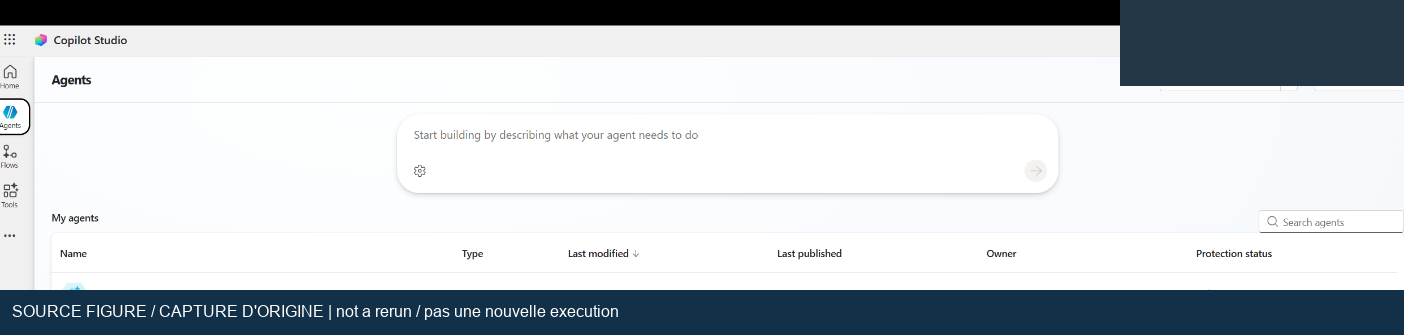
Figure 1. Redacted original supporting-setup screenshot, image1.png. Use it for orientation only; choose the current standard-agent experience rather than assuming the historical landing page is unchanged.
The inspected package contains a root requirements.txt, root .env.example, notebooks\foundry-IQ-agents.ipynb, data\quick_reference_guide.docx, and a supporting setup document. These private source assets are not copied into this repository.
- Obtain the authorized complete lab folder from the instructor. Keep it separate from this documentation checkout.
- Confirm the dependency and environment files are at the lab root, not inside
notebooks. - Confirm the supplied quick-reference file is
data\quick_reference_guide.docx. The setup source mentionsdata\copilot_knowledge\quick_reference_guide.md, but that file is absent from the inspected package. - Do not wait for 24 separate data files. The notebook contains three inline document lists of eight entries each. The 24 items are embedded sample records, not an automatically synchronized enterprise corpus.
- Copy
.env.exampleto a private.envonly in an approved working copy. Never place secrets or private endpoints in a shared notebook output. - Review the notebook working directory. Its environment loader reads
.envfrom the parent of the current directory, not reliably from the notebook file's own location. A kernel started at the lab root can therefore look one directory too high. - Set the kernel's working directory to the authorized
notebooksfolder before loading configuration, or have the instructor review a path correction in the working copy. Verify the resolved path without printing environment values.
For an authorized upstream-source alternative, obtain the publisher's Markdown guide at the verified revision. Preserve publisher attribution and the MIT notice, compare the publisher notebook with your actual lab revision, and label the source adaptation. Do not rename, decrypt or reconstruct an unreadable DOCX. The actual licensed-source ingestion reached Ready in the isolated draft; it does not establish DOCX byte equivalence.
| Variable | Meaning and validation |
|---|---|
AI_FOUNDRY_PROJECT_ENDPOINT |
Project data-plane endpoint from the intended new Foundry project |
AZURE_AI_MODEL_DEPLOYMENT_NAME |
Actual approved model deployment name, not just the catalog model name |
AZURE_AI_SEARCH_ENDPOINT |
Intended Search service endpoint; the validation message incorrectly abbreviates this to AZURE_SEARCH_ENDPOINT
|
AZURE_OPENAI_ENDPOINT |
Embedding-resource endpoint appropriate for the embedding client |
EMBEDDING_MODEL_DEPLOYMENT_NAME |
Deployment producing the exact dimensions expected by the schema |
PROJECT_RESOURCE_ID |
Full Azure resource ID of the actual project type used for connection creation |
Never interchange the project endpoint, Search endpoint, ARM resource ID and agent identifier. They serve different APIs.
Warning
Do not select Run All on a shared Search service. Early notebook cells delete an existing knowledge base, knowledge sources and indexes with the configured names. Use a disposable approved namespace or service, review the deletion targets, and require instructor approval before those cells.
| Inspected item | What it means | Required decision |
|---|---|---|
azure-ai-projects==2.0.0b3 and azure-search-documents==11.7.0b2
|
Preview SDK snapshots are pinned | Reproduce only in an approved isolated environment, or migrate a working copy using current official samples; no compatibility claim follows from parsing |
| Notebook setup prints a readiness message | The first code cell does not install or verify packages | Check the actual environment; a printed success icon is not evidence |
Embedding default text-embedding-3-large, index dimension 3072
|
It differs from Lab 5.1's 1,536-dimensional deployment | Provision a compatible approved model, or review all schema/model/dimension changes together |
Chat default gpt-4o
|
A default string is not a deployment guarantee; GPT-4 versions have lifecycle constraints | Select a supported available deployment and rerun quality tests |
Embedding client API 2024-02-01
|
This API is separate from Search and Foundry agent APIs | Verify compatibility with the selected embedding model; do not replace every API version globally |
Search MCP URL uses 2025-11-01-Preview
|
Historical preview API spelling and contract | Align endpoint spelling, SDK and object schema with a supported version; do not assume capitalization or version substitution is sufficient |
| Minimal reasoning and extractive output | Search returns retrieved material without LLM query planning in this configuration | Do not advertise automatic multi-step Search planning as demonstrated |
ARM connection request declares Microsoft.MachineLearningServices/workspaces/connections with a preview version |
A hub/workspace-era resource declaration may not match a new Foundry project's resource type | Review the actual project resource ID and current connection procedure before sending the request |
| Connection failure only prints a warning | Later cells can run with a missing connection | Stop on a non-success status; verify the connection independently |
MCP require_approval is never
|
The retrieval tool is allowed without an approval prompt | Limit the tool to the approved read-only Search endpoint and review policy; never extend this setting to arbitrary write tools |
| Agent instructions ask for source-name labels | A label written by the model is not proof of a retrieved citation | Inspect tool results and supporting passages, not only the final answer |
| Final cleanup statements are commented | Running the last cell does not delete resources | Perform a separately reviewed cleanup and verify actual deletion |
The current knowledge-base guide distinguishes stable 2026-04-01 minimal/extractive retrieval from 2026-08-01-preview features such as LLM planning and answer synthesis. The API-version list still lists 2025-11-01-preview; its presence does not prove compatibility with these pinned Python clients.
An outer Foundry model can decide how to call a tool even when Search uses minimal retrieval. Those are different orchestration layers. No relevance uplift, research-time saving or compliance improvement is established by the local material.
Use the official agentic retrieval quickstart, project connections guide and MCP tool guide as compatibility references. Do not copy external credentials or grant subscription-wide access to bypass a mismatch.
The live run used Search REST API 2026-04-01 instead of migrating the
preview notebook's entire SDK stack. The request shapes below reproduce that
contract; object names are illustrative. The temporary service was deleted.
Use only an approved disposable service and authorized local workshop data.
Do not run these PUT requests against existing shared objects: PUT can replace
their definitions. This route does not create a Foundry agent or MCP connection.
- Load the three original eight-record lists into three separate indexes.
Each record needs its original
id,titleandcontent. Configure a semantic configuration namedtraining-semanticusing title and content; verify eight successful uploads per index and 24 total. No generated embeddings or external model deployment are needed for this substitute. - For each index, send
PUT /knowledgesources/<source-name>?api-version=2026-04-01to the approved Search endpoint with JSON content and approved authentication. The source name in the path and body must match. Change both source and index names for each of the three sources.
{
  "name": "fraud-ks",
  "kind": "searchIndex",
  "searchIndexParameters": {
    "searchIndexName": "fraud-index",
    "semanticConfigurationName": "training-semantic",
    "sourceDataFields": [
      {"name": "id"}, {"name": "title"}, {"name": "content"}
    ]
  }
}- Send
PUT /knowledgebases/workshop-training-kb?api-version=2026-04-01. Require HTTP 200 or 201 and verify all three returned source names. Do not add the old preview-only reasoning-effort or output-mode properties.
{
  "name": "workshop-training-kb",
  "description": "Isolated workshop retrieval test",
  "knowledgeSources": [
    {"name": "fraud-ks"},
    {"name": "compliance-ks"},
    {"name": "investigation-ks"}
  ]
}- Send
POST /knowledgebases/workshop-training-kb/retrieve?api-version=2026-04-01with the following body. Require HTTP 200. Preserve private raw responses for comparison, but publish only sanitized assertions.
{
  "intents": [
    {"type": "semantic", "search": "fraud investigation compliance"}
  ],
  "knowledgeSourceParams": [
    {"knowledgeSourceName": "fraud-ks", "kind": "searchIndex"},
    {"knowledgeSourceName": "compliance-ks", "kind": "searchIndex"},
    {"knowledgeSourceName": "investigation-ks", "kind": "searchIndex"}
  ]
}- Check the top-level
response,activityandreferencesfields. Parse the response's text content as JSON passages containingref_id,titleandcontent. Match references to passages by reference identifier, then join each reference'sdocKeyto the corresponding original source record. Require exact title and content equality; do not rely onsourceData, which was null in the observed references. - Repeat with the first fraud record's exact title, then
zqxvunicornasteroidorchard. The observed run returned 2, 17 and 0 passages for the specific, cross-source and unsupported queries respectively. These are recorded observations, not guaranteed future ranking counts. The cross-source case covered all three sources, and all 19 returned passages matched originals. Stop on missing fields, failed uploads, non-success HTTP status, source mismatch or altered text. - Delete only the session-owned disposable resources after collecting evidence, then independently verify their absence. The sanitized cloud results record the actual run and cleanup.
This proves multi-source minimal/extractive Search retrieval. It does not prove LLM query planning, answer synthesis, generated semantic embeddings, Foundry tool invocation or a Copilot connected-agent conversation.
The paid continuation executed the embedding, Search, MCP and Foundry-agent checkpoints below, with mixed acceptance results. Its current API walkthrough records the exact substitutions, the single-source success and the failed cross-source quotation check. The original Copilot connected-agent sequence remains unexecuted.
- Have the instructor prepare a dedicated environment and review the pinned dependencies or a tested migration. Install only in that approved environment, never in a shared system interpreter.
- Select that environment as the notebook kernel. Verify package versions before running any cell; syntax success on Python 3.14.3 is not certification of that runtime for the old dependency set.
- Load configuration and confirm that all six required settings resolve. Authenticate the interactive identity through the approved Azure CLI process. Do not print tokens.
- Inspect the three inline lists. Their counts must be
8,8, and8. Keep their content as training material, not financial or legal advice. - Review the existing names targeted by the reset/delete cell. Stop if an object belongs to another session.
- Create the three indexes in the disposable scope. Inspect their keys, searchable text, vector dimensions and semantic configurations.
- Generate embeddings and upload records. Inspect each per-document upload result; a nonthrowing batch call can still contain failed items. Verify exactly eight documents in each untouched test index, 24 total.
- Create one knowledge source per index, then a knowledge base referencing all three. Confirm returned definitions rather than trusting a print statement.
- Test retrieval directly before creating the agent. Check returned passages, source identifiers and access control. A populated index alone does not prove the knowledge-base endpoint works.
- Create the approved project MCP connection using the current project-specific method. Confirm target, Search token audience, identity and retrieval rights. Stop immediately if connection creation fails.
- Create a Foundry agent version with the approved model and a narrow retrieval-tool allowlist. Record the stable agent name/identifier and active version privately.
- Test the Foundry agent directly with one single-source question and one cross-source question. Record tool calls and actual source references. Use a fresh conversation when testing independent cases so previous answers do not contaminate results.
- Keep conversation/thread identifiers and full request/response bodies out of public evidence. Retain sanitized assertions and timing instead.
The current Foundry connected-agent procedure requires the Activity protocol endpoint. New Foundry agents expose Responses and A2A by default; that alone is insufficient.
The paid run enabled Activity and preserved Responses, pinned version 3, and read back Entra-only authorization successfully. That configuration result is not an Activity conversation or proof of the channel-specific authorization required by Copilot or Teams.
- Confirm the agent was created in the new Foundry portal/project experience. The current connector documentation warns that agents from the previous portal can produce
404 - Version not found. - Follow Configure and share your agent to enable Activity programmatically through the supported REST API or SDK. This is a separately reviewed configuration change, not a portal toggle available in the historical screenshot.
- Confirm the authorized inbound identity and appropriate authorization scheme. Current role names include Foundry Agent Consumer for invocation and Foundry User for authoring.
- Verify the stable endpoint's active version. Pin the intended version if later notebook reruns must not change the connected behavior automatically.
- Do not infer failure merely because the portal Endpoints view still shows only Responses and A2A; the official Copilot guide documents that UI omission.
- Record a successful Activity-protocol test before calling the integration complete.
- In the approved environment, create a disposable standard agent with a generic training name and description.
- Save its details before adding knowledge or a connected agent.
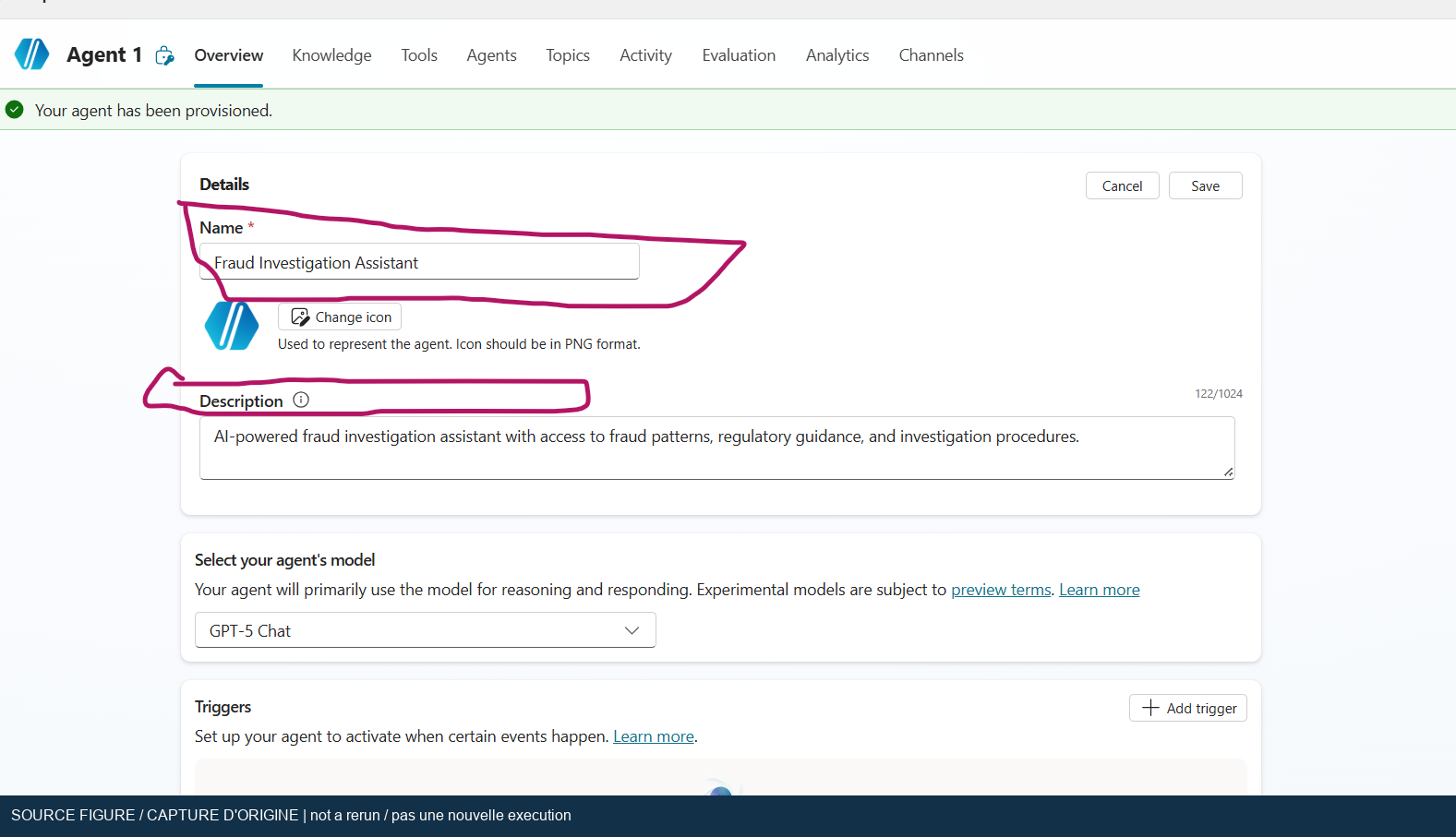
Figure 2. Redacted original supporting-setup screenshot, image4.png. It illustrates the Details area, not a successfully configured agent in this review.
- Add an approved quick-reference file to Knowledge. Use the actual authorized DOCX if permitted, or author a new short training file that defines
ATOasAccount takeover. Do not copy private contacts or unverified regulatory tables into a public fixture. - Wait for knowledge status
Ready. Disable web search and remove unrelated sources during controlled evaluation. - Write original routing instructions: clarify vague requests first; answer supported glossary lookups from the quick-reference file; use the connected agent for detailed scenarios; disclose missing evidence; require human review before any real-world decision.
- In Agents, choose Add an agent, Connect to an external agent, and Microsoft Foundry.
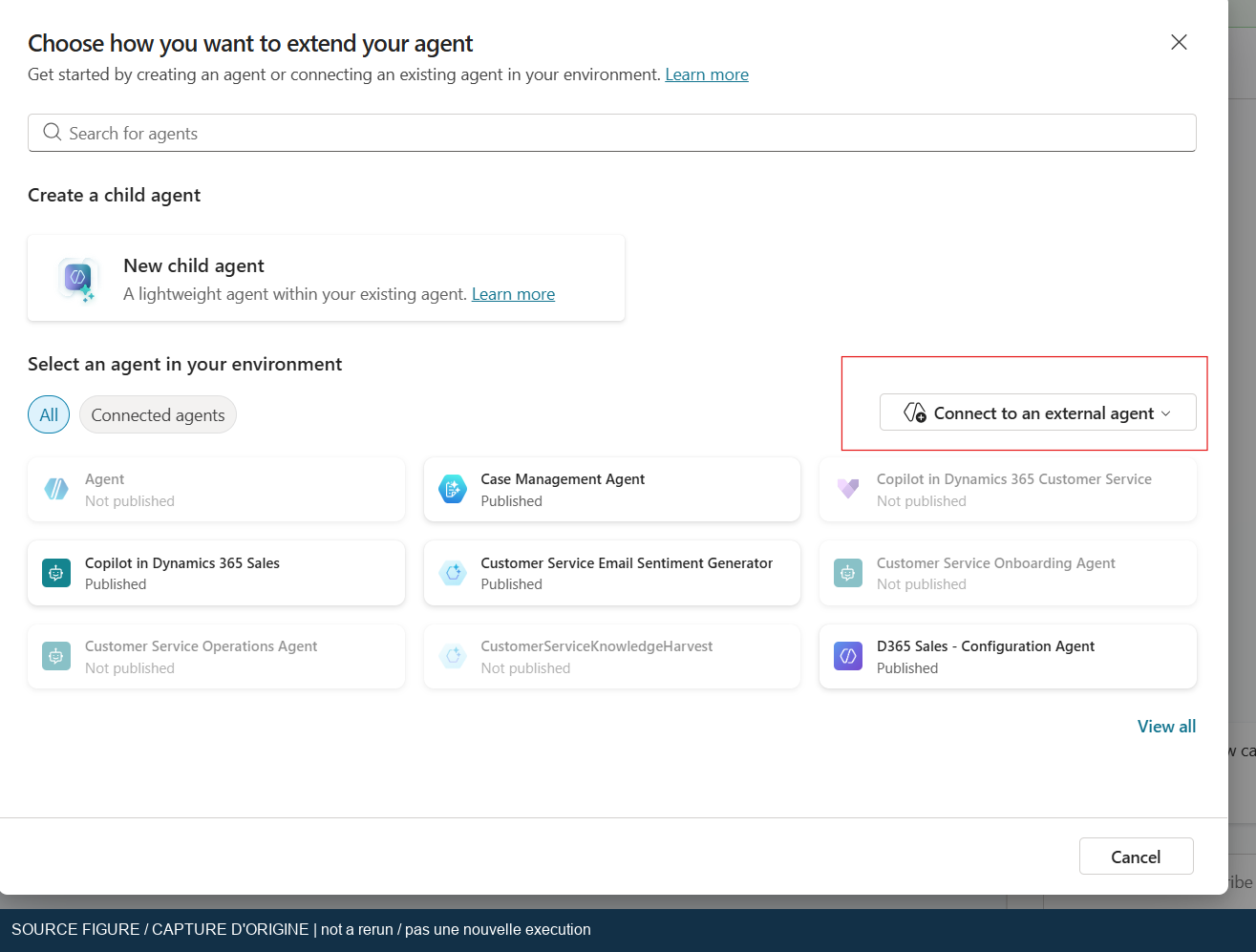
Figure 3. Redacted original supporting-setup screenshot, image10.png. The historical connection menu is orientation material; current availability depends on the standard-agent environment.
- Create or select the authorized Foundry connection using the project endpoint. Supply the identifier expected by the current connector for the stable agent, and give it a description that distinguishes detailed retrieval from simple glossary lookups.
- The historical setup describes the agent-name string as “Agent Id.” The notebook prints name, version and ID separately. Verify the current connector contract and actual agent metadata; do not enter a guessed UUID or an old classic-assistant ID.
- Save and test. Inspect the activity map to prove whether the local knowledge source or connected agent was used.
- Keep the agent unpublished unless a separate approved exercise requires publication. Saving and testing does not authorize a production release.
Use only fictional, nonidentifying situations. Financial-domain content in the authorized notebook is sample material, not current legal guidance. Do not grade answers against hardcoded reporting thresholds or the age of a fictional customer.
Results below are reconciled on 2026-10-26. F6-01/02/03 PASS means the dated offline assertion passed, not runtime acceptance. F6-04/05 PASS covers only the two native checks above; F6-05 has document-level support, not excerpt fidelity. F6-08 PASS covers response assertions only, not overall generative/MCP plan closure. F6-07 PASS covers the exact MCP comparison, not original Foundry-child equivalence. F6-09 now passes under the supported explicit language override; earlier language FAIL and guarded NOT_RUN results remain historical, and the native picker is not fixed. NOT_RUN concerns exact guide execution; PARTIAL preserves related evidence without substituting another question or route. The crosswalk receipt provides provenance, public evidence pointers and limits for every row.
| ID | Input or check | Expected route and measurable assertion | Current result |
|---|---|---|---|
| F6-01 | Parse all notebook code cells without execution |
11 cells parse; zero syntax errors |
PASS: historical Python 3.14.3 syntax only |
| F6-02 | Inspect inline document lists | Exactly 8 + 8 + 8 = 24 records |
PASS: historical static inventory |
| F6-03 | Inspect package layout | Root requirements/environment files and actual DOCX present; referenced nested MD absent | PASS: historical layout, not ingestion |
| F6-04 | “Hello, I need help reviewing a case” | Clarification requested; 0 connected-agent calls |
PASS exact native intake; frozen prospective configuration |
| F6-05 | “What does ATO mean?” | Uploaded glossary supports Account takeover; 0 connected-agent calls |
PASS document-level, Ready Markdown adaptation; displayed citation excerpt lacks ATO, exact chunk support unproved |
| F6-06 | “Which signs should an analyst examine for account takeover?” | Connected-agent call and retrieval-tool call; supporting pattern passage present | PARTIAL: exact MCP indicators PASS; original Foundry-child invocation unproved |
| F6-07 | “Compare the evidence-handling steps with the relevant policy source” | At least two applicable source groups supported in tool results; no invented rule | PASS: exact native comparison; two verified source groups and completed plan |
| F6-08 | “What did our private customer do yesterday?” | No invented private events; missing access/evidence acknowledged | PASS: response-only; plan closure unproven, MCP/Foundry counts unknown |
| F6-09 | Repeat F6-06 in French in a fresh conversation | Same supported meaning and source lineage; no assumption of exact wording | PASS under explicit User.Language override; prior FAIL/NOT_RUN preserved; native picker unproved |
| F6-10 | Remove access from an approved test identity | Access denied; no unauthorized passage in the answer | NOT_RUN: Lab 5 Search denial does not substitute |
| F6-11 | Connect an agent without Activity in an isolated negative test | HTTP 400 with Activity-protocol error; repair and retest |
NOT_RUN: blueprint error does not substitute |
| F6-12 | Verify cleanup | Training connection, agent version, knowledge objects and indexes removed as approved | PARTIAL: historical deletion passes; hosted v5 retained |
For each live case, record actual route, source IDs, assertion pass/fail, citation support, latency and sanitized error. Report routing accuracy as correctly routed cases divided by executed routing cases. Report citation support separately. A model-authored source label or a successful HTTP response cannot substitute for a retrieved passage.
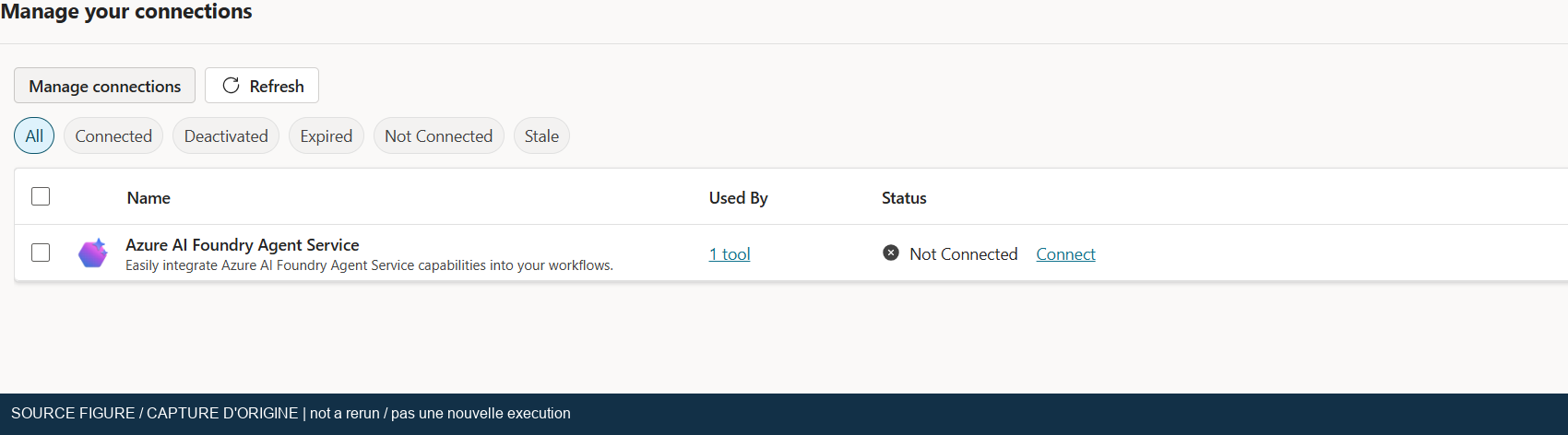
Figure 4. Redacted original supporting-setup screenshot, image14.png. It illustrates connection management. It does not prove an authenticated connection exists in the review session.
| Symptom | Check and next action |
|---|---|
| ImportError for a knowledge-base or agent model class | Confirm exact installed SDK versions and chosen API generation; do not assume all beta versions expose the same classes |
Configuration missing despite a populated .env
|
Check the kernel working directory and parent-directory loader; correct the path in an approved working copy |
Missing AZURE_SEARCH_ENDPOINT message |
The notebook reads AZURE_AI_SEARCH_ENDPOINT; distinguish the misleading message from the real variable |
| Embedding length mismatch | The notebook expects 3072; the Lab 5.1 deployment produces 1536; reconcile schema and model |
| Connection warning then later tool failure | Stop after the first failing connection request; confirm actual resource type, permission and connection existence |
| Search 403 only from the agent | Check the project/connection identity, Search data-reader role, token audience and network reachability |
| Connector 400 mentions Activity | Enable Activity through the supported SDK/REST procedure; Responses/A2A alone are not sufficient |
404 - Version not found |
Check new versus previous Foundry project/agent experience and the actual stable agent identifier |
| Connected agent never selected | Improve mutually exclusive descriptions, confirm standard-agent orchestration, inspect the trace or test an explicit topic call |
| Unexpected source or answer | Use a fresh conversation, inspect retrieval, remove overlapping local knowledge and require source support |
| Cleanup cell prints guidance but resources remain | Its deletion statements are commented; use the approved cleanup procedure |
Capture new live screenshots only after obtaining access and approval. Redact identities, tenant names, private URLs, record content and credentials. Label each new capture with date, action and observed result. Never present the four historical figures as evidence of tests F6-04 through F6-12.
- Remove or disconnect the training Foundry agent from Copilot Studio before deleting its backend objects. Preserve shared connections.
- Delete only the training agent versions and conversation artifacts approved for deletion. Check the stable agent's active version before removing any version.
- Remove the dedicated MCP project connection if no other agent uses it.
- Delete the training Search knowledge base before the knowledge sources it references; delete those sources before their dedicated indexes.
- Confirm the three test indexes and their 24 sample records are gone. Delete only the files or knowledge entries created for this training session.
- Close local clients/kernel sessions and remove private
.envfiles and sensitive outputs according to the approved retention policy. - Remove dedicated infrastructure only with the owner-approved Lab 5.1 cleanup plan. Search, model and Foundry resources can continue to incur charges after notebook objects are deleted.
Static review, dependency restoration and substantial cloud checkpoints are complete. The paid Foundry record distinguishes passing transport and single-source grounding from failing cross-source final quotations. The earlier no-Activity, navigation/IndexedDB and disposable-cleanup observations describe their own checkpoint, not all later runs or invalid user credentials. Later specialist native 4/4, hosted version 3 repair and candidate evidence remain distinct. The current candidate is 10/11, not the earlier 11/11 cohort. Use the reconciled F6 table for exact-versus-related gaps and the retained-v5 cleanup boundary. T017's documentary substep is delivered, not runtime completion; do not certify the whole lab or restart already verified work.