Repository navigation
Problem statement
On 21 September 2026 the US vehicle-safety regulator, NHTSA, opened an investigation into crashes of cars driven by openpilot on comma devices. Eighteen days later, on 9 October, LionDriver made its first commit. This page is the problem LionDriver was started to work on. It explains and links; the facts and the analysis live in field case FI-2026-001, where they are reviewed.
Important
A Preliminary Evaluation is not a finding of defect. No crash in it has been reconstructed, and nothing on this page says why any one crash happened.
NHTSA's Office of Defects Investigation opened Preliminary Evaluation PE26007, "Crashes involving comma.ai driving automation products". It covers the comma three, 3X and four devices and the openpilot software, about 30,000 units. In five crashes, a car with a comma device "reportedly struck stopped or slowly moving vehicles within the same travel lane". Three people died and eleven more were injured. ODI confirmed the system was on or engaged in several of the crashes, and its first look suggests it "may not have adequately detected or responded to the in-lane vehicles".
The resume is held unaltered in the repository:
INOA-PE26007-17274.pdf.
Every fact in this section is quoted from it, and the case report marks each one as verified against it.

The crash pattern: the first two scenes in NHTSA's words, the third a late reveal the root cause analysis examines.
From the FI-2026-001 problem statement, drawn by
fig_fi001_problem.py.
LionDriver keeps openpilot's driving stack: the same perception, the same planner, the same collision warning and the same driver monitoring. NHTSA has said that when a fork is involved in a crash it will look at "the shared components between openpilot and the fork". LionDriver is such a fork. The case report sets out what is shared, file by file: applicability.
A crash into a vehicle stopped in the lane needs three independent protections to fail together: openpilot's own braking, the driver, and the car's stock emergency braking. The root cause analysis read the code LionDriver inherits and found a weakness in each. One of them, the collision warning, depends on the same perception as openpilot's braking, so the two can fail together.
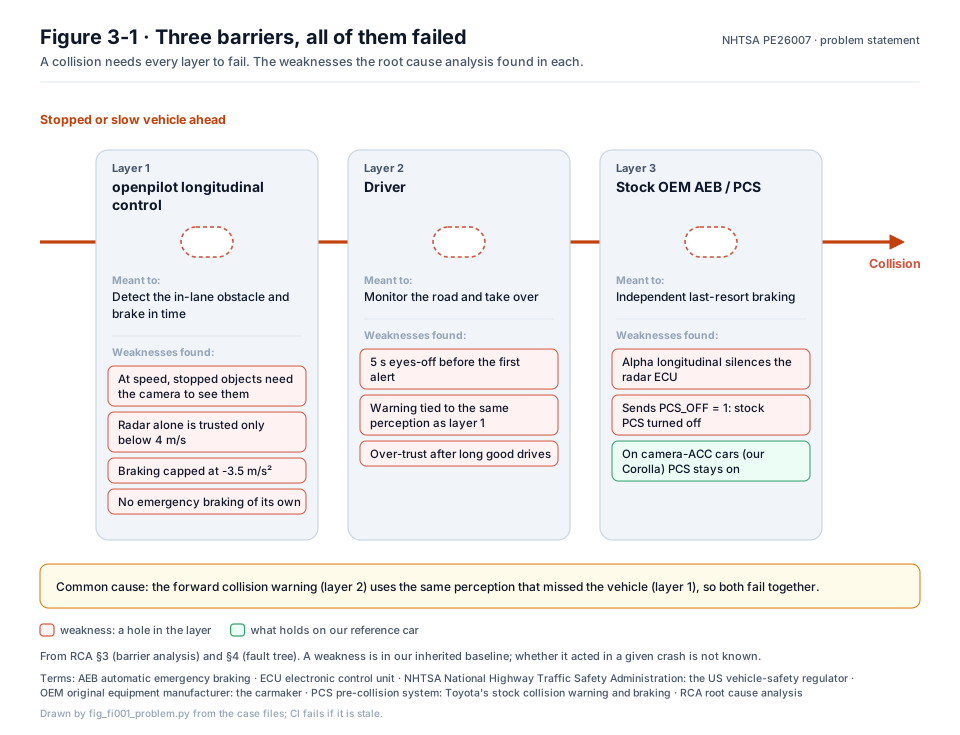
The three layers and their weaknesses, from the root cause analysis (RCA §3).
Underneath is a gap of method, not just of code. Stopped vehicles in the lane were a documented upstream limitation, so the user was told about them and nothing was engineered against them. No requirement set how far ahead a stopped vehicle must be detected, or how hard the car must brake for one. Driver-monitoring timings were tuned to avoid nuisance alerts, not set from how fast the hazard develops.
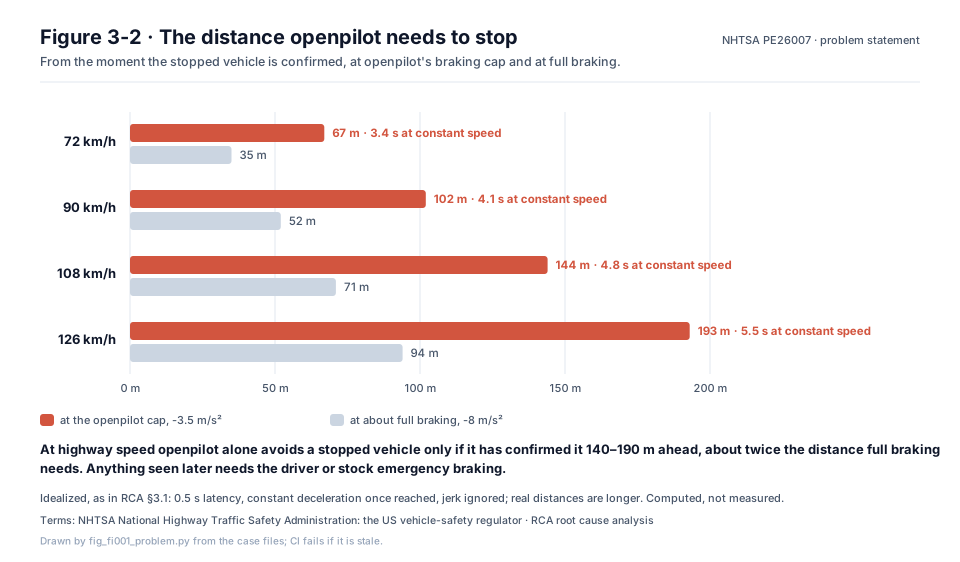
What openpilot's braking cap costs in distance, idealized and computed, not measured (RCA §3.1).
LionDriver puts the engineering record around the code that openpilot does not have. The pages in this wiki walk through each part:
| The gap | What LionDriver does | Read |
|---|---|---|
| A hazard handled only by telling the user | Analyse the hazard and set a safety goal for it, with requirements and tests that can fail | From hazard to test |
| The system can be right in its own terms and still not be safe enough | Look for the conditions in which it is not, such as a stopped vehicle revealed late, and validate against them | SOTIF and ISO 26262 |
| No argument that the protections are enough | A safety case published as it is built, with its evidence and its counter-evidence | What is a safety case? |
| Crashes found by the regulator first | Field monitoring from intake to root cause to corrective action | After release, Reporting a safety concern |
What is in place for this case, and what is still open, is listed on the
problem statement.
The corrective actions, with their root causes and verification, are in
CORRECTIVE-ACTIONS.md.
- FI-2026-001 problem statement: the full page, with the is / is-not table and what is still unknown.
- Case report: facts, applicability and containment.
- Root cause analysis: barriers, fault tree, unsafe control actions, 5-Why.