Mobs
See Spawn mechanics for the complete light, habitat, distance, population and unloading rules.
Rivet Reach has three hostile creatures and persistent passive Chickens. The hostile species below use the encounter system; the Rustback beetle warns you before attacking. Chickens have their own feeding, breeding, growth and egg-laying lifecycle.
| Creature | Where and when | Behaviour | Health | Hit damage | Defeat drop |
|---|---|---|---|---|---|
| Rustback beetle | Dark surface terrain | Warns when approached; attacks if you stay or strike it; climbs walls | 12 | 2 | None |
| Dusk prowler | Dark surface terrain at night | Pursues a visible player and bites | 18 | 3 | None |
| Floater | Dark, covered underground caves, day or night | Hovers above the ground and punches | 16 | 3 | One Floater Rock |
Damage values are before the player's armor. These creatures do not destroy blocks or raid machinery. A wall can obstruct an attack, but beetles can climb supported walls.
Creatures have a surface, underground or combined habitat and a list of blocks they may spawn on. A suitable floor must support the whole creature, with clear space above it. Habitat and ground requirements are shared by hostile creatures and passive chickens.
The hostile species above can spawn on grass, dirt, stone, sand, sandstone, snow, red clay, cobblestone or planks within their habitat. Chickens spawn on surface grass in daylight with light levels 9–15.
All current hostile creatures require light level 7 or lower immediately above their supporting ground. Level 8 or higher prevents new spawns. Daylight and nearby placed torches, powered Workshop Lamps and lava contribute to this level. Light must reach the ground; walls can leave dark pockets.
Light the floor of underground rooms to prevent new Floaters there. Existing creatures can still enter a lit area, and lighting does not remove them. Holding a torch only lights the view; place it to protect the surrounding ground. Chickens use their own habitat, support-block and light requirements.
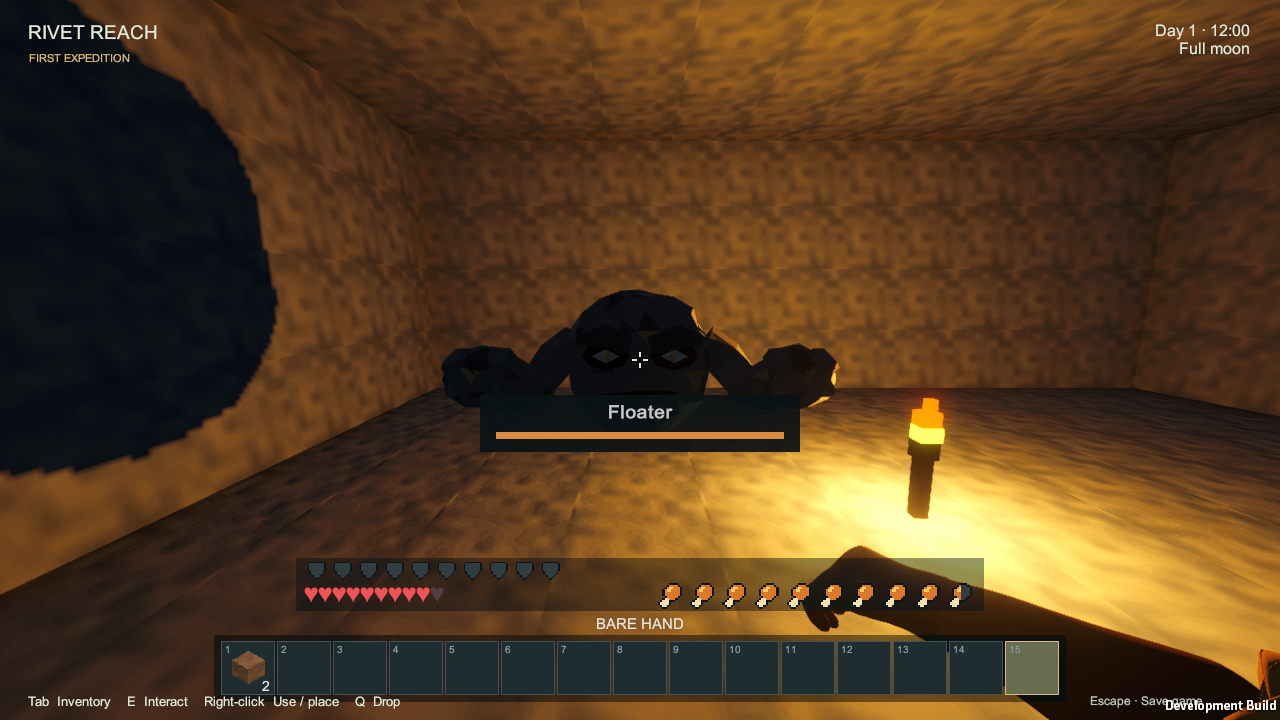
Verification capture, September 13, 2026: this floor measures level 12 and rejects new natural spawns. An explicitly placed Floater remains alive in the lit room.
New hostile encounters appear around you on supported, loaded terrain, outside the protected area around the initial world spawn. Natural spawns need a three-dimensional distance of 24–48 blocks from you and stay outside 16 blocks horizontally from the initial spawn. Attempts run every two seconds over at most eight candidate columns, avoiding unobstructed camera view. The natural population is capped at 14 (up to eight beetles, six prowlers and four Floaters). Cage spawners have separate five-mob allowances. Night runs from 18:00 until 06:00. Dawn stops new prowler spawns; it does not remove creatures that already exist. Floaters spawn only in sufficiently dark caves, independently of the surface clock.
Aim at a creature and hold the attack/mining button within melee reach. Its name and health bar appear when targeted. Your selected item's attack damage applies; swords deal more damage than bare hands. Attacking a creature takes precedence over mining the block behind it.
Watch for the preparation animation before a bite or punch. Back away or put solid terrain between you and the attack before it lands. Equipment armor and the normal health/death rules apply.
Save/Load retains existing hostile creature identity, health and intent. Hostiles stop thinking and rendering beyond 68 blocks. They are removed without loot beyond 112 blocks or when their chunk unloads; this applies to both natural and cage-spawned hostiles. Chickens persist when distant or unloaded, with their growth and egg timers paused. Pausing stops both systems.
For persistent passive animals, see Chickens. Their growth and egg timers pause when distant; hostile despawning never removes them.