Repository navigation
Observer Relative Ontology
AuthorityEffect: None (certified_implies_authorized: false)
⬅ Back to Wiki Home
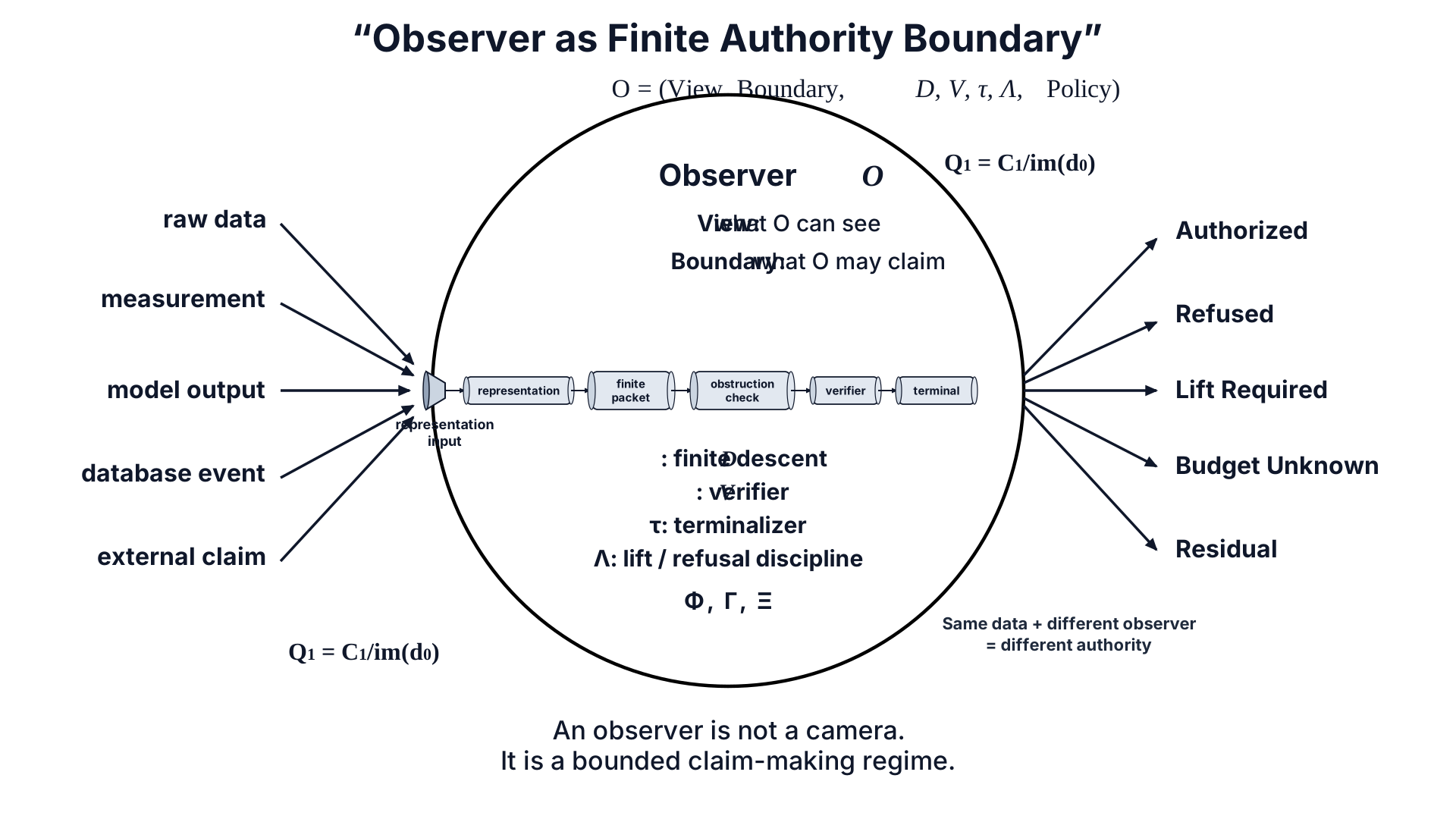
A recurring failure mode in data engineering is conflating a physical storage table with a mathematical relation or an observer-facing contract. Simplex Normal Forms enforces a strict four-part distinction:
| Concept | Mathematical / Operational Nature | Mutability | Governing Contracts |
|---|---|---|---|
| 1. Table | Physical bag/sequence of byte rows on disk or wire; may contain duplicate rows, NULL markers, or ordering artifacts. | Mutable physical storage |
nf.classical.0nf, nf.operational.schema-totality
|
| 2. Relation | Immutable mathematical set of tuples |
Immutable value |
nf.classical.1nf – nf.classical.6nf
|
| 3. Relvar | Named relation variable |
Mutable variable holding relation values |
nf.bridge.wir_relvar, nf.epistemic.state
|
| 4. Boundary-Relvar | Observer-scoped projection |
Stateful boundary contract |
nf.change.bqnf, nf.epistemic.observer, nf.epistemic.freshness
|
2. Observer-Relative Freshness & Poset Monotonicity (nf.epistemic.freshness)
A read timestamp on a packet is metadata, not authority. Under nf.epistemic.freshness and nf.epistemic.observer (implemented in normal_forms/observer_freshness_example.py), the same data packet can be simultaneously valid for one observer and inadmissible for another:
- Each observer
$O_i = (\text{id}, \tau_{\max}, S_{\text{auth}})$ declares a maximum tolerable replica lag$\tau_{\max}$ and an explicit set of authorized scopes$S_{\text{auth}}$ . -
Poset Ordering (
$O_1 \le O_2$ ): Observer$O_1$ is more stringent than$O_2$ iff$\tau_{\max}(O_1) \le \tau_{\max}(O_2)$ and$S_{\text{auth}}(O_1) \subseteq S_{\text{auth}}(O_2)$ . -
Monotonicity Functor Law: If a stringent observer
$O_1$ admits a packet asAuthorizedFresh(Preserve), then every less stringent observer$O_2 \ge O_1$ on the same poset chain also admits the packet. -
Fail-Closed Defaults: Missing
packet_scoperoutes toRefuse; missing or negativereplica_lag_secondsroutes toConservativeInvalidate.
-
Epistemic Quotient Normal Form (
nf.coda.eqnf): Requires every observation map$f: X \to Y$ to respect the declared epistemic equivalence kernel$\sim_E$ ($x \sim_E x' \implies f(x) = f(x')$), factoring uniquely through$X / {\sim_E}$ . Any leak of sub-quotient gauge coordinates routes toKernelViolationRefusal. -
Observer Distinguishability Normal Form (
nf.epistemic.odnf): Separates zero pseudometric distance$d_O(x, y) = 0$ (indistinguishable to observer$O$ ) from ontological identity$x = y$ , preventing premature quotient collapse when downstream observers carry finer resolution. -
Authority Normal Form (
nf.epistemic.authority) & Terminal Partition (nf.ddc.terminal_partition): Enforces that every contract evaluation hasAuthorityEffect: Noneandcertified_implies_authorized: false.
-
What it supports:
- Supports observer-scoped freshness evaluation, poset monotonicity checks, and kernel invariance checks (
EQNF/ODNF) in this model.
- Supports observer-scoped freshness evaluation, poset monotonicity checks, and kernel invariance checks (
-
What it does not support:
- Does not grant execution or access-control privileges in production identity systems (
AuthorityEffect: None).
- Does not grant execution or access-control privileges in production identity systems (
-
The narrowest defensible claim:
- Declaring explicit observer SLA budgets and scopes prevents a single global "fresh/stale" bit from misrepresenting multi-observer read requirements.
-
The next test needed:
- Multi-region clock-skew composition tests combining
nf.relativistic.time_syncwithnf.epistemic.freshness.
- Multi-region clock-skew composition tests combining