Repository navigation
nf.classical.1nf
Contract ID:
nf.classical.1nf| Family:shape| Index Status:active| AuthorityEffect:None
⬅ Back to Wiki Home | View SVG Diagram
Atomic Domain First Normal Form (1NF) enforces structural normalization and explicit defect routing in the shape regime.
| Property | Value |
|---|---|
| Canonical ID | nf.classical.1nf |
| Short Name | 1NF |
| Full Name | Atomic Domain First Normal Form |
| Family |
shape (Relational, Algebraic & Cochain Shape Normal Forms (Data at Rest & Structural Decompositions)) |
| Qualification | Extended Form Contract (Normal Form Contract) |
| Data / Math Posture | at_rest |
| Index Status | active |
| Theory Status | established |
| Verification Status | absent |
| Contract Version | v0 |
| Governance Fence |
AuthorityEffect: None (certified_implies_authorized: false) |
- Author: Codd
- Year: 1970
- Structural Invariant: Scalar domains, a set of tuples, and a declared candidate key.
- Anomaly Excluded: Positional identity and repeating groups.
- Lossless Join Property: Identity.
- Dependency Preservation: Preserved.
- Qualifies As True Normal Form: True
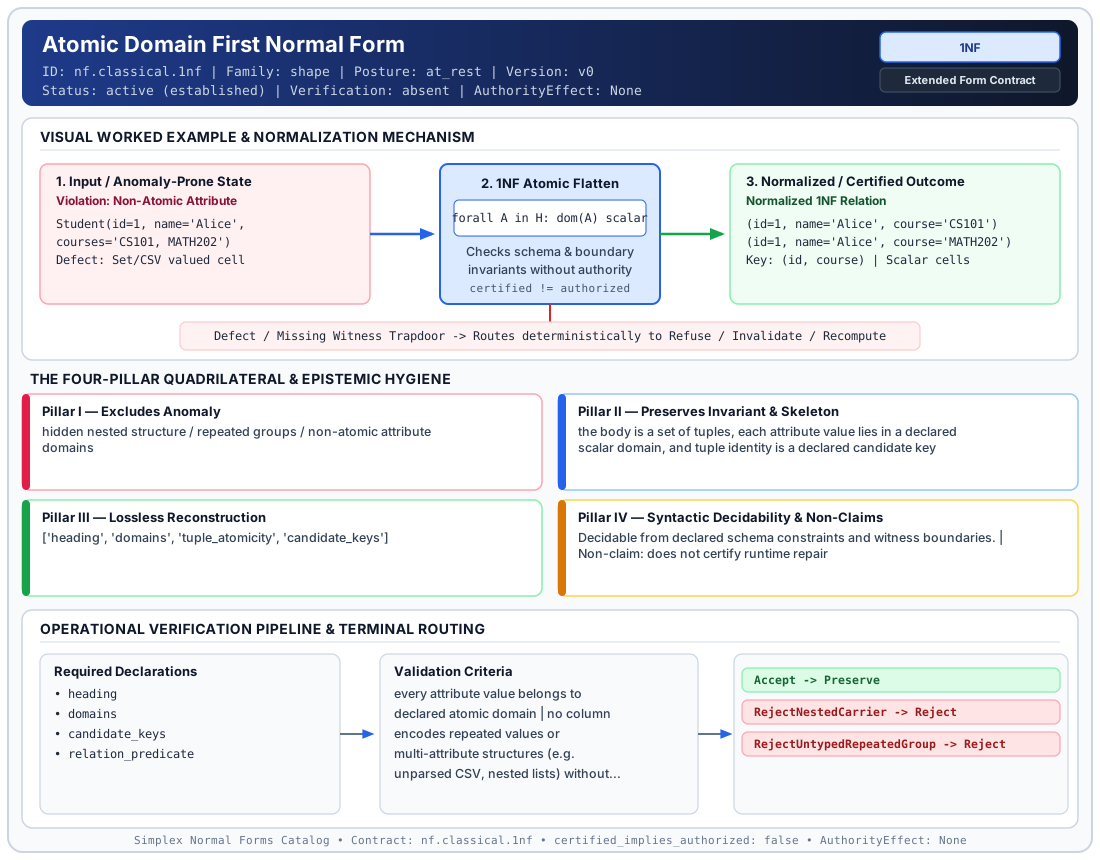
| Stage | Carrier / Operator | Concrete State / Invariant |
|---|---|---|
| 1. Before / Candidate Input | Violation: Non-Atomic Attribute |
Student(id=1, name='Alice', ; courses='CS101, MATH202') ; Defect: Set/CSV valued cell |
| 2. Normalization / Gate | 1NF Atomic Flatten |
forall A in H: dom(A) scalar (certified_implies_authorized: false) |
| 3. After / Certified Output | Normalized 1NF Relation |
(id=1, name='Alice', course='CS101') ; (id=1, name='Alice', course='MATH202') ; Key: (id, course) |
- ref: coda_all_universe/1_the_tower/normal_forms/contracts/_book_09_full_normal_form_atlas.md
section: 2.1 Classical Relational Normal FormsEvery contract in simplex-normal-forms is evaluated against the Four-Pillar Quadrilateral defined in contracts/_golden_nfs/standard.yaml:
| Pillar | Requirement | Contract Specification for nf.classical.1nf
|
|---|---|---|
| Pillar I: Excludes Anomaly | Name and eliminate a specific class of data or state defects. | hidden nested structure / repeated groups / non-atomic attribute domains |
| Pillar II: Preserves Invariant | State the structural invariant and protected skeleton preserved across transitions. |
Invariant: the body is a set of tuples, each attribute value lies in a declared scalar domain, and tuple identity is a declared candidate key Protected Skeleton: ['heading', 'domains', 'tuple_atomicity', 'candidate_keys'] |
| Pillar III: Lossless Reconstruction | State the non-loss reconstruction operator (join, direct sum, pullback, or replay). | Lossless reconstruction under declared projection, direct sum, or pullback operators. |
| Pillar IV: Syntactic Decidability | State how conformance is decided from declared constraints without unbudgeted scans. | Decidable from declared schema and witness metadata within bounded evaluation budgets. |
- does not certify runtime repair
- does not imply authorization
- does not resolve functional dependency or join dependency anomalies
- heading
- domains
- candidate_keys
- relation_predicate
None declared.
| Criterion ID | Name | Condition |
|---|---|---|
criterion |
Check | every attribute value belongs to declared atomic domain |
criterion |
Check | no column encodes repeated values or multi-attribute structures (e.g. unparsed CSV, nested lists) without explicit domain contract |
criterion |
Check | tuple identity derives from declared candidate key, not physical row position |
Every evaluation terminates in a declared local route mapped to a canonical terminal in standard.yaml:
| Local Terminal Route | Canonical Terminal |
|---|---|
Accept |
Preserve |
RejectNestedCarrier |
Reject |
RejectUntypedRepeatedGroup |
Reject |
- symptom: invoice line items stored as CSV in one column, diagnosis: non-atomic carrier violating 1NF, terminal: RejectNestedCarrier
AuthorityEffect: None.
Level: Level 01 (Atomic Domains & Scalar Heading Separation)
Evidential Grade: NATIVE IMPLEMENTED
Contract Reference: nf.classical.1nf
Mathematical Posture: Classical Relational Algebra (Codd 1970)
Data Posture: At Rest
First Normal Form (1NF) establishes the foundational discipline of the relational model:
- All domain values are strictly atomic (indivisible scalars).
- Repeating groups and array-valued attributes are eliminated via unnesting or relation splitting.
- Each relation has an explicit heading of distinct attribute names, and tuple ordering is unordered (set semantics).
       0NF Relation (Repeated Groups)
  ┌────┬──────────────┬────────────────────────┐
  │ ID │ Name         │ Phone Numbers          │
  ├────┼──────────────┼────────────────────────┤
  │ 1  │ Alice        │ ["555-0100", "555-0101"]│
  └────┴──────────────┴────────────────────────┘
                       │
             Atomic Unnesting (1NF)
                       ▼
  ┌────┬──────────────┬────────────────────────┐
  │ ID │ Name         │ Phone Number           │
  ├────┼──────────────┼────────────────────────┤
  │ 1  │ Alice        │ "555-0100"             │
  │ 1  │ Alice        │ "555-0101"             │
  └────┴──────────────┴────────────────────────┘
-
Relvar Formulation: A relation
$R$ over heading$H = {A_1, \dots, A_n}$ is in 1NF if and only if for every tuple$t \in R$ and every attribute$A_i$ :$$t[A_i] \in \operatorname{dom}(A_i)$$ where$\operatorname{dom}(A_i)$ is a declared set of atomic scalar values, and$R$ contains no duplicate tuples. -
The Quadrilateral Invariants:
- Anomaly Excluded: Attribute positional dependence, repeating group update anomalies, and nested collection search failure.
- Protected Skeleton: Candidate keys and scalar attribute values.
- Erased Structure: Intra-tuple collection ordering and nested group boundaries.
- Reconstruction: Projection and aggregation over candidate keys.
-
Non-Claims:
- 1NF does not eliminate functional dependency redundancies (reserved for 2NF/3NF/BCNF).
- 1NF does not ensure under declared assumptions single-attribute primary keys.
Relation Schema & Table Instance
      │
      ├── All values scalar & no duplicates ──► Preserve (1NF Satisfied)
      │
      ├── Attribute contains non-scalar bag ──► Quarantine (NonAtomicAttribute)
      │
      ├── Duplicate tuples detected ──────────► Refuse (DuplicateTuples)
      │
      └── Missing candidate key definition ──► Refuse (NoCandidateKey)
-
Preserve: All attributes belong to atomic scalar domains and candidate key is unique. -
Quarantine: Nested collections detected; requires unnesting transformation. -
Refuse: Duplicate rows or missing key integrity.
Verified in test_tranche3_advanced_relational_nfs.py and test_normal_forms.py:
-
check_1nf(schema, instance): Validates that all attribute values are primitive Python types (int,str,Fraction,bool) and no nestedlist/dictstructures exist. -
test_1nf_duplicate_tuple_rejection: Asserts that multiset bag relations fail 1NF verification.
-
What it supports:
- Strict scalar relational algebra and first-order predicate calculus querying.
- Elimination of positional and repeating-group anomalies.
-
What it does not support:
- Prevention of partial or transitive functional dependency anomalies.
-
The narrowest defensible claim:
- 1NF ensures under declared assumptions that every cell of the relation contains exactly one value from the underlying domain.
-
The next test needed:
- Property tests asserting that unnesting preserves candidate key functional dependencies under Cartesian expansion.
In accordance with the repository's epistemic claim discipline:
-
What it supports:
- Supports syntactic and operational checking of
nf.classical.1nf(1NF) against its declared schema, boundary constraints, and witness obligations in this model. - Supports deterministic terminal routing (
Accept, RejectNestedCarrier, RejectUntypedRepeatedGroup) when required declarations or invariants fail.
- Supports syntactic and operational checking of
-
What it does not support:
- Does not confer operational authority (
AuthorityEffect: None,certified_implies_authorized: false). - Does not claim semantic truth of undeclared external processes or unverified upstream inputs beyond the declaredprotected skeleton.
- Does not confer operational authority (
-
The narrowest defensible claim:
- Within the declared substrate
at_rest, this contract enforces thathidden nested structure / repeated groups / non-atomic attribute domainsis either excluded underthe body is a set of tuples, each attribute value lies in a declared scalar domain, and tuple identity is a declared candidate keyor routed to an explicit refusal/recovery terminal.
- Within the declared substrate
-
The next test needed:
- Property-based falsification and mutation testing across boundary edge cases and composed multi-step pipelines for
nf.classical.1nf.
- Property-based falsification and mutation testing across boundary edge cases and composed multi-step pipelines for
Click to expand full canonical YAML contract (contracts/nf.classical.1nf.yaml)
schema_version: smplx.nf.contract.v0
schema_ref: ./normal_form_contract_schema.yaml
contract_kind: normal_form_contract
identity:
  id: nf.classical.1nf
  name: Atomic Domain First Normal Form
  short_name: 1NF
  version: v0
  theory_status: established
  contract_status: active
  verification_status: absent
  family: shape
  status: active
classification:
  hierarchy_level: normal_form
  subject_kind:
  - relvar
  data_posture: at_rest
  mathematical_posture: operational
purpose:
  excludes_anomaly: hidden nested structure / repeated groups / non-atomic attribute
    domains
  preserves_invariant: the body is a set of tuples, each attribute value lies in a
    declared scalar domain, and tuple identity is a declared candidate key
  protected_skeleton:
  - heading
  - domains
  - tuple_atomicity
  - candidate_keys
  erased_structure: []
  non_claims:
  - does not certify runtime repair
  - does not imply authorization
  - does not resolve functional dependency or join dependency anomalies
definition:
  source: coda_all_universe/mssn_sn_tower/definitions.md
  citation:
    author: Edgar F. Codd
    year: 1970
    work: A Relational Model of Data for Large Shared Data Banks
  formal_statement: 'A relvar is in first normal form when every attribute takes values
    in a declared scalar domain, the body is a set of tuples, and tuple identity is
    a declared candidate key rather than storage position. A domain is scalar when
    the schema does not give it relation-valued or repeating-group operators. Atomicity
    is fixed by those declared operators. A string that the predicate treats as one
    scalar is scalar. A string that the predicate stipulates to encode several values
    is a repeating group.

    '
  quadrilateral:
    qualifies_as_true_normal_form: true
    anomaly_exclusion: positional identity, repeating groups, and relation-valued
      cells
    lossless_join:
      status: identity
      statement: 'No decomposition is performed. Reconstruction is the identity on
        the relation value.

        '
    dependency_preservation:
      status: not_applicable
      statement: 'No dependency is moved to another relvar. Every declared dependency
        remains on this heading.

        '
    syntactic_decision:
      status: schema_decidable
      statement: 'Decided from the heading, the domain declarations, and the candidate
        keys. A particular table body is not the decider.

        '
  chain:
    implied_by:
    - 2NF
    - 3NF
    - EKNF
    - BCNF
    - 4NF
    - ETNF
    - 5NF
    - 6NF
declarations_required:
- heading
- domains
- candidate_keys
- relation_predicate
evidence_required: []
validation_criteria:
- every attribute value belongs to declared atomic domain
- no column encodes repeated values or multi-attribute structures (e.g. unparsed CSV,
  nested lists) without explicit domain contract
- tuple identity derives from declared candidate key, not physical row position
proof_obligations:
- id: 1nf.set_semantics_and_domain_admissibility
  status: theorem_shaped
  ref: coda_all_universe/1_the_tower/normal_forms/contracts/_book_09_full_normal_form_atlas.md
  statement: 'A 1NF relvar is a set of tuples over the declared scalar domains, with
    identity given by a candidate key. Domain scalarity is the schema''s operator
    declaration.

    '
terminal_routes:
- Accept
- RejectNestedCarrier
- RejectUntypedRepeatedGroup
terminal_route_map:
  Accept: Preserve
  RejectNestedCarrier: Reject
  RejectUntypedRepeatedGroup: Reject
certification:
  certificate_required: false
  certificate_kind: null
  obstruction_class_required: false
  loss_ledger_required: false
  verifier_required: false
  loss_ledger_trigger_id: null
authorization:
  authorized_by: null
  certified_implies_authorized: false
failure_modes:
- symptom: invoice line items stored as CSV in one column
  diagnosis: non-atomic carrier violating 1NF
  terminal: RejectNestedCarrier
examples:
- ref: coda_all_universe/1_the_tower/normal_forms/contracts/_book_09_full_normal_form_atlas.md
  section: 2.1 Classical Relational Normal Forms
references:
- coda_all_universe/1_the_tower/normal_forms/contracts/_book_09_full_normal_form_atlas.md
- coda_all_universe/1_the_tower/normal_forms/contracts/_paper_0_relvar_relation_table_and_boundary_relvar.md
- ./normal_form_contract_schema.yaml