Repository navigation
nf.classical.3nf
Contract ID:
nf.classical.3nf| Family:shape| Index Status:active| AuthorityEffect:None
⬅ Back to Wiki Home | View SVG Diagram
Third Normal Form (3NF) enforces structural normalization and explicit defect routing in the shape regime.
| Property | Value |
|---|---|
| Canonical ID | nf.classical.3nf |
| Short Name | 3NF |
| Full Name | Third Normal Form |
| Family |
shape (Relational, Algebraic & Cochain Shape Normal Forms (Data at Rest & Structural Decompositions)) |
| Qualification | Extended Form Contract (Normal Form Contract) |
| Data / Math Posture | at_rest |
| Index Status | active |
| Theory Status | established |
| Verification Status | executable |
| Contract Version | v0 |
| Governance Fence |
AuthorityEffect: None (certified_implies_authorized: false) |
- Author: Codd
- Year: 1971
- Structural Invariant: For every non-trivial FD X -> A, X is a superkey or A is prime.
- Anomaly Excluded: Transitive dependence of a non-prime attribute.
- Lossless Join Property: Heath's Theorem.
- Dependency Preservation: Preserved by synthesis.
- Qualifies As True Normal Form: True
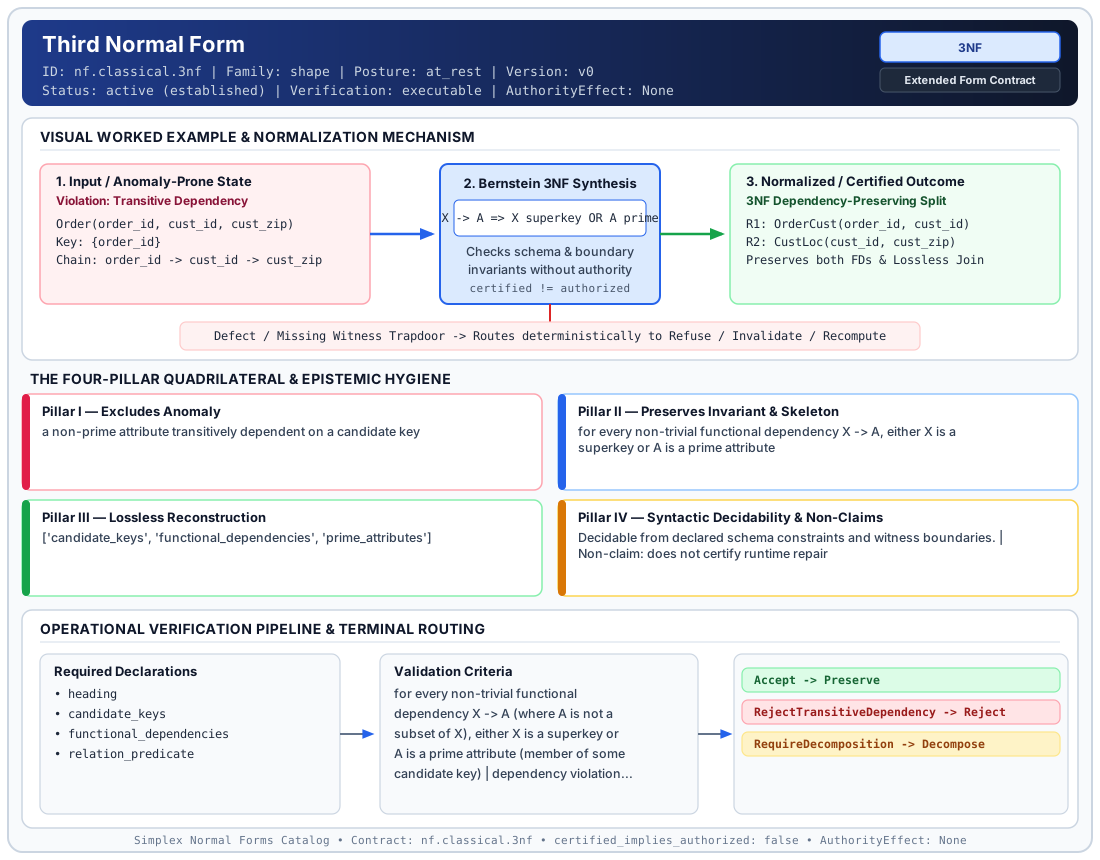
| Stage | Carrier / Operator | Concrete State / Invariant |
|---|---|---|
| 1. Before / Candidate Input | Violation: Transitive Dependency |
Order(order_id, cust_id, cust_zip) ; Key: {order_id} ; Chain: order_id -> cust_id -> cust_zip |
| 2. Normalization / Gate | Bernstein 3NF Synthesis |
X -> A => X superkey OR A prime (certified_implies_authorized: false) |
| 3. After / Certified Output | 3NF Dependency-Preserving Split |
R1: OrderCust(order_id, cust_id) ; R2: CustLoc(cust_id, cust_zip) ; Preserves both FDs & Lossless Join |
- ref: coda_all_universe/1_the_tower/normal_forms/contracts/_book_09_full_normal_form_atlas.md
  section: 3.0 Running example
note: Orders / Customers decomposition sketchEvery contract in simplex-normal-forms is evaluated against the Four-Pillar Quadrilateral defined in contracts/_golden_nfs/standard.yaml:
| Pillar | Requirement | Contract Specification for nf.classical.3nf
|
|---|---|---|
| Pillar I: Excludes Anomaly | Name and eliminate a specific class of data or state defects. | a non-prime attribute transitively dependent on a candidate key |
| Pillar II: Preserves Invariant | State the structural invariant and protected skeleton preserved across transitions. |
Invariant: for every non-trivial functional dependency X -> A, either X is a superkey or A is a prime attribute Protected Skeleton: ['candidate_keys', 'functional_dependencies', 'prime_attributes'] |
| Pillar III: Lossless Reconstruction | State the non-loss reconstruction operator (join, direct sum, pullback, or replay). | Lossless reconstruction under declared projection, direct sum, or pullback operators. |
| Pillar IV: Syntactic Decidability | State how conformance is decided from declared constraints without unbudgeted scans. | Decidable from declared schema and witness metadata within bounded evaluation budgets. |
- does not certify runtime repair
- does not imply authorization
- does not eliminate all redundancy where a non-superkey determines a prime attribute (see BCNF)
- heading
- candidate_keys
- functional_dependencies
- relation_predicate
None declared.
| Criterion ID | Name | Condition |
|---|---|---|
criterion |
Check | for every non-trivial functional dependency X -> A (where A is not a subset of X), either X is a superkey or A is a prime attribute (member of some candidate key) |
criterion |
Check | dependency violations terminalize as decomposition requirements rather than being ignored |
criterion |
Check | minimal cover synthesis and extraneous attribute elimination use deterministic lexicographic attribute tie-breaking |
Every evaluation terminates in a declared local route mapped to a canonical terminal in standard.yaml:
| Local Terminal Route | Canonical Terminal |
|---|---|
Accept |
Preserve |
RejectTransitiveDependency |
Reject |
RequireDecomposition |
Decompose |
- symptom: non-prime attribute depends on another non-key attribute set where determinant is not a superkey, diagnosis: transitive dependency violating 3NF condition, terminal: RequireDecomposition
AuthorityEffect: None.
Level: Level 03 (Transitive Dependency Elimination & Bernstein Synthesis)
Evidential Grade: NATIVE IMPLEMENTED
Contract Reference: nf.classical.3nf
Mathematical Posture: Relational Synthesis & Dependency Preservation (Bernstein 1976)
Data Posture: At Rest
Third Normal Form (3NF) eliminates transitive dependencies between non-prime attributes:
- The relation must already be in 2NF.
- Non-prime attributes must not depend on other non-prime attributes.
- Every attribute must depend directly on the key, the whole key, and nothing but the key (except for prime attribute targets).
       Transitive Dependency (Fails 3NF)
   ┌───────────────────────────────────────────┐
   │ OrderID ────────► CustomerID (Candidate Key)
   │ CustomerID ─────► CustomerZip (TRANSITIVE) │
   └───────────────────────────────────────────┘
                       │
              3NF Bernstein Synthesis
                       ▼
   R1: (OrderID, CustomerID)   [Key: OrderID]
   R2: (CustomerID, CustomerZip) [Key: CustomerID]
-
Formal Definition (Codd 1972 / Zaniolo 1982): A relation schema
$R$ with functional dependencies$F$ is in 3NF if and only if for every non-trivial functional dependency$X \to A \in F^+$ :$$\text{Either } X \text{ is a superkey of } R, \quad \text{or } A \text{ is a prime attribute of } R.$$ -
Bernstein 3NF Synthesis Invariant: For any schema
$R$ and functional dependency set$F$ , there exists a polynomial-time algorithm that computes a decomposition$D = {R_1, \dots, R_m}$ such that:- Each
$R_i$ is in 3NF. - The decomposition is lossless (
$\bowtie R_i = R$ ). - The decomposition is dependency-preserving (
$(\bigcup F_i)^+ = F^+$ ).
- Each
-
The Quadrilateral Invariants:
- Anomaly Excluded: Redundant transitive attribute storage, customer update anomalies across multiple orders.
- Protected Skeleton: Minimal cover dependencies and candidate key coverings.
- Erased Structure: Transitive co-location of attributes in the master relation.
- Reconstruction: Lossless join decomposition via primary/foreign key connections.
2NF Relation & Functional Dependencies
      │
      ├── For all X -> A: X is superkey OR A is prime ──► Preserve (3NF Verified)
      │
      ├── Transitive non-prime dependency exists ───────► Repair (Synthesize3NF)
      │
      └── Schema violates 2NF ──────────────────────────► Refuse (2NFPreconditionFailed)
-
Preserve: All dependencies satisfy the superkey or prime-attribute disjunction. -
Repair: Decomposes via Bernstein synthesis to restore 3NF while preserving dependencies. -
Refuse: Schema fails 1NF or 2NF preconditions.
Verified in test_tranche3_advanced_relational_nfs.py:
-
check_3nf(schema, fds): Validates that for every functional dependency, either the determinant is a superkey or the dependent attribute is prime. -
test_bernstein_3nf_synthesis_algorithm: Computes a canonical minimal cover, partitions into sub-relvars, ensures a candidate key relvar is included, and asserts both lossless join and dependency preservation.
-
What it supports:
- canonical existence of lossless-join, dependency-preserving decompositions for all relational schemas.
- Complete elimination of transitive dependencies among non-prime attributes.
-
What it does not support:
- Elimination of redundancies caused by functional dependencies whose determinant is not a superkey when the dependent is prime (requires BCNF).
-
The narrowest defensible claim:
- 3NF ensures under declared assumptions that no non-prime attribute is transitively dependent on any candidate key.
-
The next test needed:
- Property tests comparing Bernstein synthesis against Armstrong closure bounds across 100 randomized relational schemata.
In accordance with the repository's epistemic claim discipline:
-
What it supports:
- Supports syntactic and operational checking of
nf.classical.3nf(3NF) against its declared schema, boundary constraints, and witness obligations in this model. - Supports deterministic terminal routing (
Accept, RejectTransitiveDependency, RequireDecomposition) when required declarations or invariants fail.
- Supports syntactic and operational checking of
-
What it does not support:
- Does not confer operational authority (
AuthorityEffect: None,certified_implies_authorized: false). - Does not claim semantic truth of undeclared external processes or unverified upstream inputs beyond the declaredprotected skeleton.
- Does not confer operational authority (
-
The narrowest defensible claim:
- Within the declared substrate
at_rest, this contract enforces thata non-prime attribute transitively dependent on a candidate keyis either excluded underfor every non-trivial functional dependency X -> A, either X is a superkey or A is a prime attributeor routed to an explicit refusal/recovery terminal.
- Within the declared substrate
-
The next test needed:
- Property-based falsification and mutation testing across boundary edge cases and composed multi-step pipelines for
nf.classical.3nf.
- Property-based falsification and mutation testing across boundary edge cases and composed multi-step pipelines for
Click to expand full canonical YAML contract (contracts/nf.classical.3nf.yaml)
schema_version: smplx.nf.contract.v0
schema_ref: ./normal_form_contract_schema.yaml
contract_kind: normal_form_contract
identity:
  id: nf.classical.3nf
  name: Third Normal Form
  short_name: 3NF
  version: v0
  theory_status: established
  contract_status: active
  verification_status: executable
  family: shape
  status: active
classification:
  hierarchy_level: normal_form
  subject_kind:
  - relvar
  data_posture: at_rest
  mathematical_posture: operational
purpose:
  excludes_anomaly: a non-prime attribute transitively dependent on a candidate key
  preserves_invariant: for every non-trivial functional dependency X -> A, either
    X is a superkey or A is a prime attribute
  protected_skeleton:
  - candidate_keys
  - functional_dependencies
  - prime_attributes
  erased_structure: []
  non_claims:
  - does not certify runtime repair
  - does not imply authorization
  - does not eliminate all redundancy where a non-superkey determines a prime attribute
    (see BCNF)
definition:
  source: coda_all_universe/mssn_sn_tower/definitions.md
  citation:
    author: Edgar F. Codd
    year: 1971
    work: Further Normalization of the Data Base Relational Model
  formal_statement: 'Codd''s statement: the relvar is in second normal form, and no
    non-prime attribute A is transitively dependent on a candidate key K. Transitive
    dependence means K determines X, X determines A, X is not a superkey, and A lies
    outside both K and X. Zaniolo''s statement, which defines the same class of schemas
    under functional dependencies: for every functional dependency X -> A in which
    A is a single attribute outside X, either X is a superkey or A is prime. The decision
    procedure in this contract is Zaniolo''s statement.

    '
  same_class_as:
    statement: Codd's transitive-dependence statement
    scope: functional dependencies
    citation: Zaniolo 1982
    proved_in_this_tree: false
  quadrilateral:
    qualifies_as_true_normal_form: true
    anomaly_exclusion: 'Update and deletion anomalies from a non-prime attribute that
      depends on a candidate key only through another non-superkey set.

      '
    lossless_join:
      status: heath
      theorem: Heath 1971
      statement: 'A violating dependency X -> A yields the lossless split (XA, heading
        without A), because X determines A.

        '
    dependency_preservation:
      status: preserved_by_synthesis
      canonical_tie_breaking: lexicographic_attribute_ordering
      statement: 'Bernstein''s synthesis algorithm (1976) with deterministic lexicographic
        attribute tie-breaking produces a unique lossless decomposition into third
        normal form in which every functional dependency of the minimal cover is
        local to one component. Boyce-Codd normal form does not inherit this preservation
        ensure under declared assumptions.

        '
    syntactic_decision:
      status: schema_decidable
      statement: 'Decided from a cover of the functional dependencies, the superkeys,
        and the prime attributes. One stored body is not the decider.

        '
  chain:
    requires:
    - 1NF
    - 2NF
    implied_by:
    - EKNF
    - BCNF
    - 4NF
    - ETNF
    - 5NF
    - 6NF
declarations_required:
- heading
- candidate_keys
- functional_dependencies
- relation_predicate
evidence_required: []
validation_criteria:
- for every non-trivial functional dependency X -> A (where A is not a subset of X),
  either X is a superkey or A is a prime attribute (member of some candidate key)
- dependency violations terminalize as decomposition requirements rather than being
  ignored
- minimal cover synthesis and extraneous attribute elimination use deterministic lexicographic
  attribute tie-breaking
proof_obligations:
- id: 3nf.zaniolo_membership
  status: theorem_shaped
  ref: coda_all_universe/mssn_sn_tower/definitions.md
  statement: 'Under functional dependencies, Codd''s transitive-dependence condition
    and Zaniolo''s superkey-or-prime condition define the same schemas. The Lean checker
    is_3nf_compliant implements the second condition on a caller-supplied list of
    non-trivial dependencies.

    '
terminal_routes:
- Accept
- RejectTransitiveDependency
- RequireDecomposition
terminal_route_map:
  Accept: Preserve
  RejectTransitiveDependency: Reject
  RequireDecomposition: Decompose
certification:
  certificate_required: false
  certificate_kind: null
  obstruction_class_required: false
  loss_ledger_required: false
  verifier_required: false
  loss_ledger_trigger_id: null
authorization:
  authorized_by: null
  certified_implies_authorized: false
failure_modes:
- symptom: non-prime attribute depends on another non-key attribute set where determinant
    is not a superkey
  diagnosis: transitive dependency violating 3NF condition
  terminal: RequireDecomposition
examples:
- ref: coda_all_universe/1_the_tower/normal_forms/contracts/_book_09_full_normal_form_atlas.md
  section: 3.0 Running example
  note: Orders / Customers decomposition sketch
references:
- coda_all_universe/1_the_tower/normal_forms/contracts/_book_09_full_normal_form_atlas.md
- coda_all_universe/1_the_tower/normal_forms/contracts/_paper_0_relvar_relation_table_and_boundary_relvar.md