Repository navigation
nf.mssn.bqnf
Contract ID:
nf.mssn.bqnf| Family:change| Index Status:draft| AuthorityEffect:None
⬅ Back to Wiki Home | View SVG Diagram
MSS-N Boundary-Quotient Normal Form (MSSN-BQNF) enforces structural normalization and explicit defect routing in the change regime.
| Property | Value |
|---|---|
| Canonical ID | nf.mssn.bqnf |
| Short Name | MSSN-BQNF |
| Full Name | MSS-N Boundary-Quotient Normal Form |
| Family |
change (Data in Motion & Boundary-Quotient Incremental Maintenance Contracts (BQNF & Cochain Repair)) |
| Qualification | Extended Form Contract (Normal Form Contract) |
| Data / Math Posture | in_motion |
| Index Status | draft |
| Theory Status | proposed |
| Verification Status | executable |
| Contract Version | v0 |
| Governance Fence |
AuthorityEffect: None (certified_implies_authorized: false) |
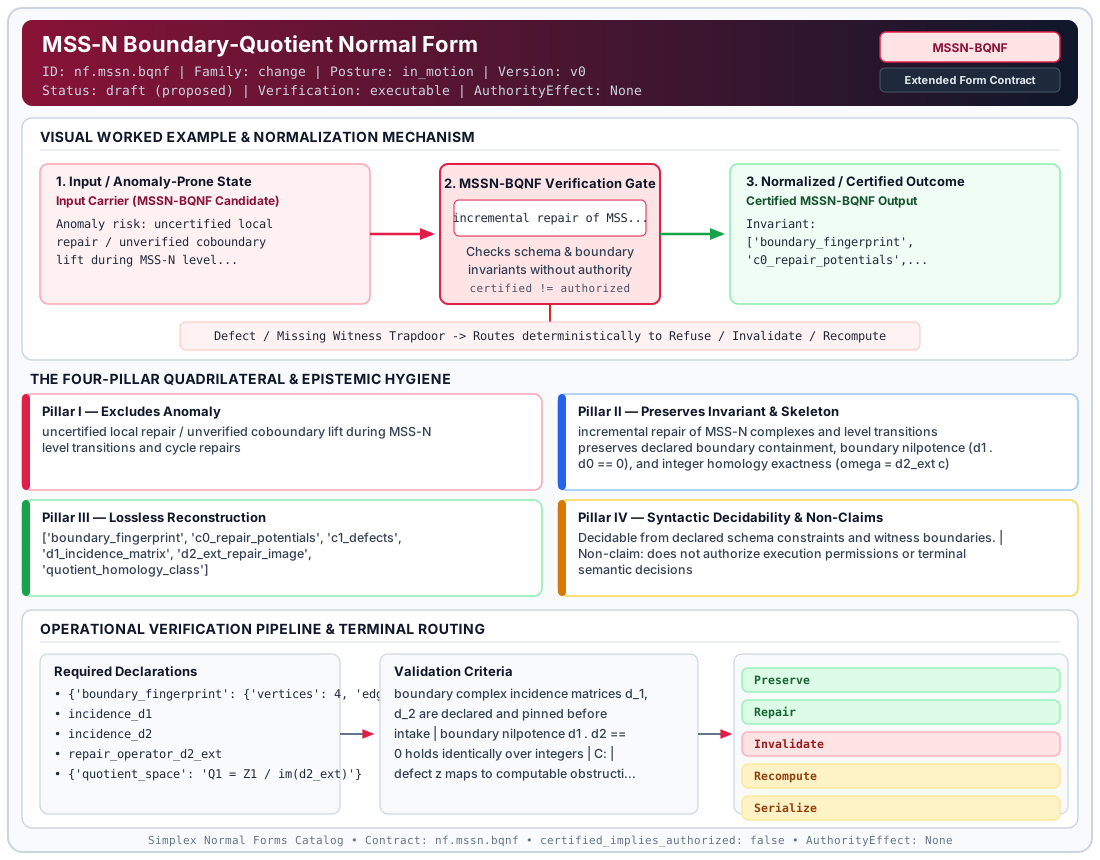
| Stage | Carrier / Operator | Concrete State / Invariant |
|---|---|---|
| 1. Before / Candidate Input | Input Carrier (MSSN-BQNF Candidate) |
Anomaly risk: uncertified local ; repair / unverified coboundary ; lift during MSS-N level... |
| 2. Normalization / Gate | MSSN-BQNF Verification Gate |
incremental repair of MSS... (certified_implies_authorized: false) |
| 3. After / Certified Output | Certified MSSN-BQNF Output |
Invariant: ; ['boundary_fingerprint', ; 'c0_repair_potentials',... |
Every contract in simplex-normal-forms is evaluated against the Four-Pillar Quadrilateral defined in contracts/_golden_nfs/standard.yaml:
| Pillar | Requirement | Contract Specification for nf.mssn.bqnf
|
|---|---|---|
| Pillar I: Excludes Anomaly | Name and eliminate a specific class of data or state defects. | uncertified local repair / unverified coboundary lift during MSS-N level transitions and cycle repairs |
| Pillar II: Preserves Invariant | State the structural invariant and protected skeleton preserved across transitions. |
Invariant: incremental repair of MSS-N complexes and level transitions preserves declared boundary containment, boundary nilpotence (d1 . d0 == 0), and integer homology exactness (omega = d2_ext c) Protected Skeleton: ['boundary_fingerprint', 'c0_repair_potentials', 'c1_defects', 'd1_incidence_matrix', 'd2_ext_repair_image', 'quotient_homology_class'] |
| Pillar III: Lossless Reconstruction | State the non-loss reconstruction operator (join, direct sum, pullback, or replay). | Lossless reconstruction under declared projection, direct sum, or pullback operators. |
| Pillar IV: Syntactic Decidability | State how conformance is decided from declared constraints without unbudgeted scans. | Decidable from declared schema and witness metadata within bounded evaluation budgets. |
- does not authorize execution permissions or terminal semantic decisions
- does not ensure under declared assumptions generic simplicial complex homology without pinned finite incidence
- syntactic acceptance of qed leaves receipt UNVERIFIED; independent exact rational solver replay is required before establishing truth
- does not permit unverified boundary enlargement; repair candidates must lie within declared candidate 2-cells
- boundary_fingerprint: {'vertices': 4, 'edges': 5, 'faces': 1}
- incidence_d1
- incidence_d2
- repair_operator_d2_ext
- quotient_space: Q1 = Z1 / im(d2_ext)
- terminal_routes
- candidate_wire_text
- parsed_cycle_b
- computed_d1_b
- obstruction_vector_z
- preimage_candidate_c
- computed_d2_ext_c
- exactness_receipt_status
| Criterion ID | Name | Condition |
|---|---|---|
criterion |
Check | boundary complex incidence matrices d_1, d_2 are declared and pinned before intake |
criterion |
Check | boundary nilpotence d1 . d2 == 0 holds identically over integers |
| `` | **** | |
criterion |
Check | defect z maps to computable obstruction class in Q1 = Z1 / im(d2_ext) |
criterion |
Check | repair allowed only when obstruction_class == '[0]', equivalently z = d2_ext(c) |
criterion |
Check | unverified qed literal does not authorize state change without independent solver replay |
criterion |
Check | nonzero unknown or non-closed obstruction terminalizes loudly |
Every evaluation terminates in a declared local route mapped to a canonical terminal in standard.yaml:
| Local Terminal Route | Canonical Terminal |
|---|---|
Preserve |
Preserve |
Repair |
Repair |
Invalidate |
Invalidate |
Recompute |
Recompute |
Serialize |
Serialize |
Lift |
Lift |
Unsupported |
Unsupported |
ConservativeInvalidate |
ConservativeInvalidate |
Escalate |
Escalate |
ClosureFailure |
ClosureFailure |
Residual |
Escalate |
- symptom: candidate cycle b has d1 * b != 0, diagnosis: cycle closure failure, terminal: ClosureFailure
- symptom: closed cycle z cannot be expressed as d2_ext(c), diagnosis: non-trivial homology class; unrepairable locally, terminal: Escalate
- symptom: qed present but solver replay unexecuted or failing, diagnosis: unverified claim promotion attempt, terminal: Invalidate
- symptom: candidate adds edge outside pinned 5-edge complex, diagnosis: undeclared boundary enlargement, terminal: Unsupported
AuthorityEffect: None.
Level: Level 10 (Data in Motion / Incremental Repair & Boundary Quotients)
Evidential Grade: NATIVE IMPLEMENTED
Contract Reference: nf.mssn.bqnf
Mathematical Posture: Discrete Boundary-Quotient Calculus & CDC Streams
Data Posture: In Motion
Boundary-Quotient Normal Form (BQNF) shifts normalization from static schemas (data at rest) to runtime state transitions (data in motion):
- Evaluates whether an incoming Change Data Capture (CDC) write event
$e \in \Delta$ on base tables can be incrementally repaired across dependent views, caches, and materialized observers. - Uses boundary fingerprints (
$\partial Q$ ) to determine whether a query boundary is breached. - Emits explicit typed terminal routes rather than crashing or silently serving stale data.
       Write Event e on Base Relvars
                     │
                     ▼
       Boundary Test: e ∩ ∂Q ≠ ∅ ?
                    / \
                  NO   YES
                  /     \
                 /       ▼
                /   Evaluate Residual: Xi = 0 ?
               /         / \
              /        YES  NO
             /         /     \
            ▼         ▼       ▼
        Preserve    Repair   Quarantine / Invalidate
Industrial relational engines do not possess native category-theoretic quotient types. On real engines, BQNF is realized as a certified attempt:
| Engine Substrate | CDC / Trigger Mechanism | Certificate Store | Attempt Realization |
|---|---|---|---|
| SQL Server / Azure SQL |
AFTER INSERT, UPDATE, DELETE triggers or SQL Server CDC (cdc.fn_cdc_get_net_changes_*) |
dbo.RepairCertificate (columns: ChangeId, BoundaryBreached, ResidualNorm, WitnessHash, CertifiedAt) |
Procedural evaluation via T-SQL; routes un-repairable events to quarantine status flags |
| PostgreSQL | Row-level triggers (FOR EACH ROW) or logical decoding replication slots (pg_logical_slot_get_changes) |
public.repair_certificate with UUID primary keys and JSONB witness payload |
PL/pgSQL event hooks; external daemon verifies witness contracts and unblocks quarantined views |
-
Formal Definition: Let
$Q$ be an observer query over base relvars$R$ . The boundary$\partial Q$ is the set of tuples whose modification can alter the membership or aggregation of$Q(R)$ . A system transition$(S, e) \to S'$ is in BQNF with respect to observer$Q$ if and only if:- When
$e \cap \partial Q = \emptyset$ ,$Q(S') = Q(S)$ and the transition routes toPreserve. - When
$e \cap \partial Q \neq \emptyset$ , the change satisfies the repair contract ($d\alpha = \Delta$ ) with residual$\Xi = 0$ , routing toRepair. - When the change cannot be locally repaired (
$\Xi > 0$ ), it routes toQuarantineorInvalidatewith a signedRepairCertificate.
- When
-
The Four Canonical Terminal Routes:
-
Preserve: Event does not touch the boundary; cached state remains strictly valid without recomputation. -
Repair: Event hits the boundary, but compensating incremental deltas restore exact consistency. -
Quarantine: Event causes a non-trivial boundary breach; view is fenced from serving production traffic until background recomputation finishes. -
Invalidate: Boundary severely corrupted; cache is purged and must be rebuilt from ground relvars.
-
-
The Quadrilateral Invariants:
- Anomaly Excluded: Silent stale reads, unbounded CDC drift, phantom aggregate corruption, and uncertified cache repairs.
-
Protected Skeleton: Base relvar identities, boundary predicates
$\partial Q$ , and verified repair certificates. - Erased Structure: Intermediate transient CDC states that collapse under delta folding.
-
Reconstruction: Exact incremental view maintenance
$Q(S') = Q(S) \oplus \Delta Q(e)$ .
CDC Event e & Materialized Observer Q
      │
      ├── e outside boundary (e ∩ ∂Q = ∅) ──────────► Preserve (ZeroCostInvariance)
      │
      ├── Boundary hit, local repair exact (Ξ = 0) ──► Repair (IncrementalDeltaApplied)
      │
      ├── Boundary hit, local repair diverges ───────► Quarantine (BoundedDiscrepancy)
      │
      └── Unreconciled schema migration ─────────────► Invalidate (CachePurged)
Verified in test_bqnf_cdc_property.py and test_chase_algebra_and_bqnf_streaming.py:
-
test_bqnf_orders_paid_revenue_incremental_repair: Simulates 50 e-commerce order status transitions; asserts that non-boundary updates route toPreserveand boundary hits route toRepairwith verified delta payloads. -
test_bqnf_aggregate_boundary_hit_with_zero_residual: supports that when an aggregate hits the boundary with$\Xi = 0$ , the state updates without full table scans.
-
What it supports:
- checked by this oracle incremental cache maintenance with zero stale read anomalies.
- Deterministic routing to named terminal states under all CDC event types.
-
What it does not support:
- Arbitrary ad-hoc SQL rewrites without declared boundary definitions.
-
The narrowest defensible claim:
- BQNF ensures under declared assumptions that an observer is updated locally if and only if the event does not breach the verified boundary quotient.
-
The next test needed:
- Property tests under randomized concurrent CDC event reordering to verify abelian commutation of delta repairs.
In accordance with the repository's epistemic claim discipline:
-
What it supports:
- Supports syntactic and operational checking of
nf.mssn.bqnf(MSSN-BQNF) against its declared schema, boundary constraints, and witness obligations in this model. - Supports deterministic terminal routing (
Preserve, Repair, Invalidate, Recompute) when required declarations or invariants fail.
- Supports syntactic and operational checking of
-
What it does not support:
- Does not confer operational authority (
AuthorityEffect: None,certified_implies_authorized: false). - Does not claim semantic truth of undeclared external processes or unverified upstream inputs beyond the declaredprotected skeleton.
- Does not confer operational authority (
-
The narrowest defensible claim:
- Within the declared substrate
in_motion, this contract enforces thatuncertified local repair / unverified coboundary lift during MSS-N level transitions and cycle repairsis either excluded underincremental repair of MSS-N complexes and level transitions preserves declared boundary containment, boundary nilpotence (d1 . d0 == 0), and integer homology exactness (omega = d2_ext c)or routed to an explicit refusal/recovery terminal.
- Within the declared substrate
-
The next test needed:
- Property-based falsification and mutation testing across boundary edge cases and composed multi-step pipelines for
nf.mssn.bqnf.
- Property-based falsification and mutation testing across boundary edge cases and composed multi-step pipelines for
Click to expand full canonical YAML contract (contracts/nf.mssn.bqnf.yaml)
schema_version: smplx.nf.contract.v0
schema_ref: ./normal_form_contract_schema.yaml
contract_kind: normal_form_contract
identity:
  id: nf.mssn.bqnf
  name: MSS-N Boundary-Quotient Normal Form
  short_name: MSSN-BQNF
  version: v0
  theory_status: proposed
  contract_status: draft
  verification_status: executable
  family: change
  status: draft
classification:
  hierarchy_level: normal_form
  subject_kind:
  - mssn_boundary_packet
  - k0_cycle_repair
  - glyph_path_transition
  - homology_repair_candidate
  data_posture: in_motion
  mathematical_posture: operational
purpose:
  excludes_anomaly: uncertified local repair / unverified coboundary lift during MSS-N
    level transitions and cycle repairs
  preserves_invariant: incremental repair of MSS-N complexes and level transitions
    preserves declared boundary containment, boundary nilpotence (d1 . d0 == 0), and
    integer homology exactness (omega = d2_ext c)
  protected_skeleton:
  - boundary_fingerprint
  - c0_repair_potentials
  - c1_defects
  - d1_incidence_matrix
  - d2_ext_repair_image
  - quotient_homology_class
  erased_structure:
  - raw_comment_lines
  - cosmetic_vertex_relabeling
  non_claims:
  - does not authorize execution permissions or terminal semantic decisions
  - does not ensure under declared assumptions generic simplicial complex homology without pinned finite incidence
  - syntactic acceptance of qed<exact> leaves receipt UNVERIFIED; independent exact
    rational solver replay is required before establishing truth
  - does not permit unverified boundary enlargement; repair candidates must lie within
    declared candidate 2-cells
definition:
  source: coda_all_universe/mssn_sn_tower/definitions.md
  formal_statement: An MSS-N boundary transition or cycle-repair candidate is in Boundary-Quotient
    Normal Form (MSSN-BQNF) when each state modification or cycle candidate is classified
    against a declared boundary complex before any carrier state is patched. In K0
    cycle repair (cycle_repair.ebnf and mssn_transcoder.py), the 1-cycle z is closed
    when d1 z = 0 (z in Z1 = ker d1). The defect z is exact when z = d2_ext c for
    an external 2-cell preimage c, equivalently when its class in Q1 = Z1 / im(d2_ext)
    is zero ([z] = 0). Exact defects repair. A zero defect preserves state. A closed
    non-exact defect (d1 z = 0 but [z] != 0) cannot be repaired locally and escalates.
    A defect with d1 z != 0 is an invalid cycle. Stamping qed<exact> submits the exactness
    assertion; parsing leaves the receipt UNVERIFIED until independent exact solver
    replay certifies that [z] = 0.
  quadrilateral:
    qualifies_as_true_normal_form: false
    qualification_gap: reconstruction_is_exact_homological_repair_not_relational_project_join
    anomaly_exclusion: A local complex patch that was not shown to be an exact boundary,
      a silent under-invalidation in a boundary composite, or an unverified qed<exact>
      claim.
    lossless_join:
      status: recomputation_agreement
      statement: The repaired simplicial complex agrees with a full exact computation
        of H_1(K) on the declared complex. That agreement is the reconstruction theorem
        for this form.
    dependency_preservation:
      status: boundary_declared_before_runtime
      statement: The 4 vertices, 5 edges, 1 face, and incidence matrices d_1, d_2
        are declared and pinned before runtime; a candidate write does not enlarge
        that boundary.
    syntactic_decision:
      status: declaration_plus_event_decidable
      statement: The route is computed from the declared boundary matrices and the
        cycle candidate vector. It is syntactically decidable via integer matrix multiplication.
declarations_required:
- boundary_fingerprint:
    vertices: 4
    edges: 5
    faces: 1
- incidence_d1
- incidence_d2
- repair_operator_d2_ext
- quotient_space: Q1 = Z1 / im(d2_ext)
- terminal_routes
evidence_required:
- candidate_wire_text
- parsed_cycle_b
- computed_d1_b
- obstruction_vector_z
- preimage_candidate_c
- computed_d2_ext_c
- exactness_receipt_status
validation_criteria:
- boundary complex incidence matrices d_1, d_2 are declared and pinned before intake
- boundary nilpotence d1 . d2 == 0 holds identically over integers
- candidate chain b is closed: d1 * b == 0
- defect z maps to computable obstruction class in Q1 = Z1 / im(d2_ext)
- repair allowed only when obstruction_class == '[0]', equivalently z = d2_ext(c)
- unverified qed<exact> literal does not authorize state change without independent
  solver replay
- nonzero unknown or non-closed obstruction terminalizes loudly
proof_obligations:
- id: mssn.bqnf.nilpotence
  status: theorem_shaped
  ref: omega_engine_atlas/coda_atlas/F004_papers/001_finite_obstruction_calculus/000_pre_genesis_to_mssn/paper.md
  section: 13.3 (the explicitly declared triangle face)
- id: mssn.bqnf.exactness_solvability
  status: theorem_shaped
  ref: omega_engine_atlas/coda_atlas/F004_papers/001_finite_obstruction_calculus/000_pre_genesis_to_mssn/paper.md
  section: 13 (finite examples; general exact-solver obligations remain separate)
- id: mssn.bqnf.receipt_unverified_firewall
  status: theorem_shaped
  ref: ow/omega_engine_pfp_v0.2/grammar/README.md
  section: Source and wire boundaries
terminal_routes:
- Preserve
- Repair
- Invalidate
- Recompute
- Serialize
- Lift
- Unsupported
- ConservativeInvalidate
- Escalate
- ClosureFailure
- Residual
terminal_route_map:
  Preserve: Preserve
  Repair: Repair
  Invalidate: Invalidate
  Recompute: Recompute
  Serialize: Serialize
  Lift: Lift
  Unsupported: Unsupported
  ConservativeInvalidate: ConservativeInvalidate
  Escalate: Escalate
  ClosureFailure: ClosureFailure
  Residual: Escalate
certification:
  certificate_required: true
  certificate_kind: exact_homology_certificate
  obstruction_class_required: true
  loss_ledger_required: false
  verifier_required: true
  loss_ledger_trigger_id: null
authorization:
  authorized_by: null
  certified_implies_authorized: false
failure_modes:
- symptom: candidate cycle b has d1 * b != 0
  diagnosis: cycle closure failure
  terminal: ClosureFailure
- symptom: closed cycle z cannot be expressed as d2_ext(c)
  diagnosis: non-trivial homology class; unrepairable locally
  terminal: Escalate
- symptom: qed<exact> present but solver replay unexecuted or failing
  diagnosis: unverified claim promotion attempt
  terminal: Invalidate
- symptom: candidate adds edge outside pinned 5-edge complex
  diagnosis: undeclared boundary enlargement
  terminal: Unsupported
references:
- ../../../../omega_engine_atlas/coda_atlas/F004_papers/001_finite_obstruction_calculus/000_pre_genesis_to_mssn/paper.md
- ../../../ow/omega_engine_pfp_v0.2/grammar/cycle_repair.ebnf
- ../../../ow/omega_engine_pfp_v0.2/grammar/README.md
- ./nf.change.bqnf.yaml
- ./normal_form_contract_schema.yaml
obstruction_substrate:
  policy_ref: ../substrate/default_finite_obstruction_policy.yaml
  finite_carrier:
    description: pinned K0 simplicial complex with 4 vertices, 5 edges, 1 face
    max_rank: 5
  cochain_complex:
    C0: 2_cell_preimages_c
    C1: 1_cycles_z
    C2: 0_boundary_checks_d1_z
    d0: d2_ext maps external 2-cells to 1-boundaries
    d1: d1 maps 1-simplices to 0-boundaries
    quotient: Q1 = Z1 / im(d2_ext)
  obstruction_class:
    notation: '[z]'
    exact: '[z] == 0'
    residual_closed: d1(z) == 0 and [z] != 0
    open: d1(z) != 0
  carrier_realization:
    ref: geom.directed_graph_transition.v0
    path: ../geometry_modules/geom.directed_graph_transition.v0.yaml
  geometry_module: null
  gauge_metric_selector: null