Repository navigation
nf.derivation.lsnf
Contract ID:
nf.derivation.lsnf| Family:derivation| Index Status:draft| AuthorityEffect:None
⬅ Back to Wiki Home | View SVG Diagram
Lawful Skeletal Filtration Normal Form (LSNF) enforces structural normalization and explicit defect routing in the derivation regime.
| Property | Value |
|---|---|
| Canonical ID | nf.derivation.lsnf |
| Short Name | LSNF |
| Full Name | Lawful Skeletal Filtration Normal Form |
| Family |
derivation (MSS-N Tower Algebraic Derivation, Split Extension-Retraction & Obstruction Contracts) |
| Qualification | Extended Form Contract (Normal Form Contract) |
| Data / Math Posture | in_motion |
| Index Status | draft |
| Theory Status | established |
| Verification Status | absent |
| Contract Version | v0 |
| Governance Fence |
AuthorityEffect: None (certified_implies_authorized: false) |
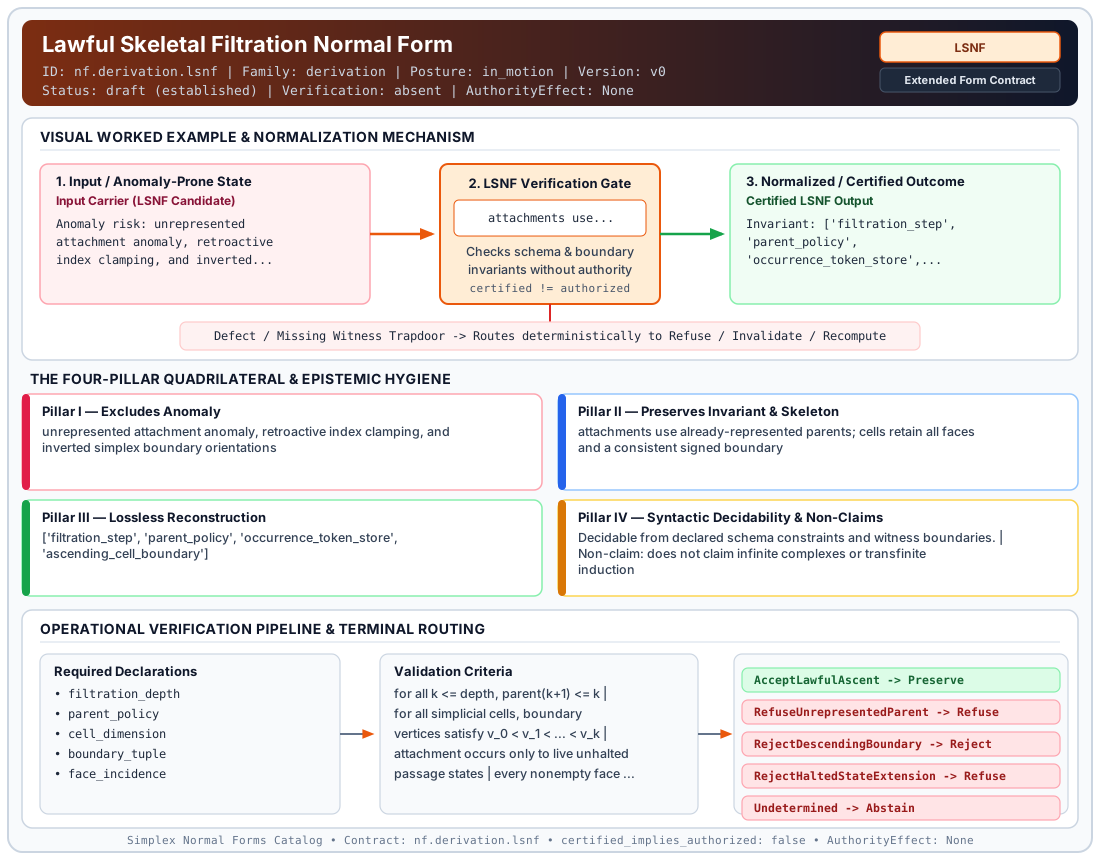
| Stage | Carrier / Operator | Concrete State / Invariant |
|---|---|---|
| 1. Before / Candidate Input | Input Carrier (LSNF Candidate) |
Anomaly risk: unrepresented ; attachment anomaly, retroactive ; index clamping, and inverted... |
| 2. Normalization / Gate | LSNF Verification Gate |
attachments use... (certified_implies_authorized: false) |
| 3. After / Certified Output | Certified LSNF Output |
Invariant: ['filtration_step', ; 'parent_policy', ; 'occurrence_token_store',... |
- ref: https://github.com/dbccpage/19L57G1/blob/f1d56c010e6ba10a3b9418bd7cc5953c067250f2/lean4/Derivation/AttachmentLadder.lean
  section: lean4/Derivation/AttachmentLadder.lean
note: lawful_to policy check and shell_guardEvery contract in simplex-normal-forms is evaluated against the Four-Pillar Quadrilateral defined in contracts/_golden_nfs/standard.yaml:
| Pillar | Requirement | Contract Specification for nf.derivation.lsnf
|
|---|---|---|
| Pillar I: Excludes Anomaly | Name and eliminate a specific class of data or state defects. | unrepresented attachment anomaly, retroactive index clamping, and inverted simplex boundary orientations |
| Pillar II: Preserves Invariant | State the structural invariant and protected skeleton preserved across transitions. |
Invariant: attachments use already-represented parents; cells retain all faces and a consistent signed boundary Protected Skeleton: ['filtration_step', 'parent_policy', 'occurrence_token_store', 'ascending_cell_boundary'] |
| Pillar III: Lossless Reconstruction | State the non-loss reconstruction operator (join, direct sum, pullback, or replay). | Lossless reconstruction under declared projection, direct sum, or pullback operators. |
| Pillar IV: Syntactic Decidability | State how conformance is decided from declared constraints without unbudgeted scans. | Decidable from declared schema and witness metadata within bounded evaluation budgets. |
- does not claim infinite complexes or transfinite induction
- does not derive manifold differential forms or smooth curvatures
- does not synthesize attachments without an explicit parent policy
- does not imply operational authority
- filtration_depth
- parent_policy
- cell_dimension
- boundary_tuple
- face_incidence
- boundary_orientation_convention
- lawfulness_certificate
- ascent_proof_receipt
- post_state_audit
| Criterion ID | Name | Condition |
|---|---|---|
criterion |
Check | for all k <= depth, parent(k+1) <= k |
criterion |
Check | for all simplicial cells, boundary vertices satisfy v_0 < v_1 < ... < v_k |
criterion |
Check | attachment occurs only to live unhalted passage states |
criterion |
Check | every nonempty face of every declared cell is present |
criterion |
Check | the declared signed boundary matrices compose to zero; ascending vertices alone are insufficient |
Every evaluation terminates in a declared local route mapped to a canonical terminal in standard.yaml:
| Local Terminal Route | Canonical Terminal |
|---|---|
AcceptLawfulAscent |
Preserve |
RefuseUnrepresentedParent |
Refuse |
RejectDescendingBoundary |
Reject |
RejectHaltedStateExtension |
Refuse |
Undetermined |
Abstain |
- symptom: child node k+1 specifies parent index exceeding k, diagnosis: attachment refers to an unrepresented future node, terminal: RefuseUnrepresentedParent
- symptom: cell boundary tuple is not strictly ascending, diagnosis: boundary vertices violate canonical ascending orientation, terminal: RejectDescendingBoundary
In accordance with the repository's epistemic claim discipline:
-
What it supports:
- Supports syntactic and operational checking of
nf.derivation.lsnf(LSNF) against its declared schema, boundary constraints, and witness obligations in this model. - Supports deterministic terminal routing (
AcceptLawfulAscent, RefuseUnrepresentedParent, RejectDescendingBoundary, RejectHaltedStateExtension) when required declarations or invariants fail.
- Supports syntactic and operational checking of
-
What it does not support:
- Does not confer operational authority (
AuthorityEffect: None,certified_implies_authorized: false). - Does not claim semantic truth of undeclared external processes or unverified upstream inputs beyond the declaredprotected skeleton.
- Does not confer operational authority (
-
The narrowest defensible claim:
- Within the declared substrate
in_motion, this contract enforces thatunrepresented attachment anomaly, retroactive index clamping, and inverted simplex boundary orientationsis either excluded underattachments use already-represented parents; cells retain all faces and a consistent signed boundaryor routed to an explicit refusal/recovery terminal.
- Within the declared substrate
-
The next test needed:
- Property-based falsification and mutation testing across boundary edge cases and composed multi-step pipelines for
nf.derivation.lsnf.
- Property-based falsification and mutation testing across boundary edge cases and composed multi-step pipelines for
Click to expand full canonical YAML contract (contracts/nf.derivation.lsnf.yaml)
# Draft declaration: no bound local contract evaluator is supplied; upstream mathematics and schema checks are separate evidence.
schema_version: smplx.nf.contract.v0
contract_kind: form_contract
identity:
  id: nf.derivation.lsnf
  name: Lawful Skeletal Filtration Normal Form
  short_name: LSNF
  version: v0
  status: draft
  family: derivation
  theory_status: established
  contract_status: draft
  verification_status: absent
classification:
  hierarchy_level: form
  subject_kind:
  - skeletal_filtration
  - attachment_ladder
  - simplicial_boundary
  data_posture: in_motion
  mathematical_posture: operational
purpose:
  excludes_anomaly: unrepresented attachment anomaly, retroactive index clamping, and inverted simplex
    boundary orientations
  preserves_invariant: attachments use already-represented parents; cells retain all faces and a consistent
    signed boundary
  protected_skeleton:
  - filtration_step
  - parent_policy
  - occurrence_token_store
  - ascending_cell_boundary
  erased_structure:
  - retroactive_clamping_heuristics
  non_claims:
  - does not claim infinite complexes or transfinite induction
  - does not derive manifold differential forms or smooth curvatures
  - does not synthesize attachments without an explicit parent policy
  - does not imply operational authority
quadrilateral:
  qualifies_as_true_normal_form: false
  qualification_gap: no_project_join_theorem
  anomaly_exclusion: future parent references, missing faces, repeated vertices, and inconsistent orientation
    signs
  lossless_join:
    status: filtration_replay_reconstruction
    statement: the complete skeletal complex is reconstructed losslessly by replaying the lawful UpFamily
      attachment blocks from genesis
  dependency_preservation:
    status: predecessor_dependency_preserved
    statement: parent availability is checked locally at step k without inspecting future extensions
  syntactic_decision:
    status: declaration_decidable
    statement: finite parent and vertex-index checks plus face closure and signed incidence verification
declarations_required:
- filtration_depth
- parent_policy
- cell_dimension
- boundary_tuple
- face_incidence
- boundary_orientation_convention
evidence_required:
- lawfulness_certificate
- ascent_proof_receipt
- post_state_audit
validation_criteria:
- for all k <= depth, parent(k+1) <= k
- for all simplicial cells, boundary vertices satisfy v_0 < v_1 < ... < v_k
- attachment occurs only to live unhalted passage states
- every nonempty face of every declared cell is present
- the declared signed boundary matrices compose to zero; ascending vertices alone are insufficient
terminal_routes:
- AcceptLawfulAscent
- RefuseUnrepresentedParent
- RejectDescendingBoundary
- RejectHaltedStateExtension
- Undetermined
terminal_route_map:
  AcceptLawfulAscent: Preserve
  RefuseUnrepresentedParent: Refuse
  RejectDescendingBoundary: Reject
  RejectHaltedStateExtension: Refuse
  Undetermined: Abstain
certification:
  certificate_required: true
  certificate_kind: skeletal_filtration_certificate
  obstruction_class_required: false
  loss_ledger_required: false
  verifier_required: true
authorization:
  authorized_by: null
  certified_implies_authorized: false
failure_modes:
- symptom: child node k+1 specifies parent index exceeding k
  diagnosis: attachment refers to an unrepresented future node
  terminal: RefuseUnrepresentedParent
- symptom: cell boundary tuple is not strictly ascending
  diagnosis: boundary vertices violate canonical ascending orientation
  terminal: RejectDescendingBoundary
examples:
- ref: https://github.com/dbccpage/19L57G1/blob/f1d56c010e6ba10a3b9418bd7cc5953c067250f2/lean4/Derivation/AttachmentLadder.lean
  section: lean4/Derivation/AttachmentLadder.lean
  note: lawful_to policy check and shell_guard
references:
- https://github.com/dbccpage/19L57G1/blob/f1d56c010e6ba10a3b9418bd7cc5953c067250f2/docs/GENESIS_CLOSEOUT.md
- ./README.md