Repository navigation
nf.recursion.asrf
Contract ID:
nf.recursion.asrf| Family:recursion| Index Status:draft| AuthorityEffect:None
⬅ Back to Wiki Home | View SVG Diagram
Autopoietic Self-Reference Refusal Form (ASRF) enforces structural normalization and explicit defect routing in the recursion regime.
| Property | Value |
|---|---|
| Canonical ID | nf.recursion.asrf |
| Short Name | ASRF |
| Full Name | Autopoietic Self-Reference Refusal Form |
| Family |
recursion (Autopoietic Self-Reference Refusal & Caller-Verifier Separation (ASRF)) |
| Qualification | Extended Form Contract (Normal Form Contract) |
| Data / Math Posture | in_motion |
| Index Status | draft |
| Theory Status | proposed |
| Verification Status | absent |
| Contract Version | v0 |
| Governance Fence |
AuthorityEffect: None (certified_implies_authorized: false) |
- Levels: Level 20
- Spec Files: ['20_grammar.md', '20_math.md']
- Anomaly Excluded: Self-referential infinite loops and counterfeit verification where an agent attempts to certify its own state.
- Preserved Invariant: System enforces caller-verifier non-identity (callerHash != targetHash) emitting GodelBreak refusal.
- Lossless Reconstruction: Refusal state cleanly separates valid grounded evaluations from self-referential loops.
- Claim Hygiene Note: Caller-verifier hash inequality verifies distinct identity labels, but does not support causal independence without authenticated actor bindings and execution isolation.
- Nomenclature Note: Renamed from Autopoietic Cohomology Normal Form (ACNF) to eliminate cohomology misnomer; computes no cohomology groups.
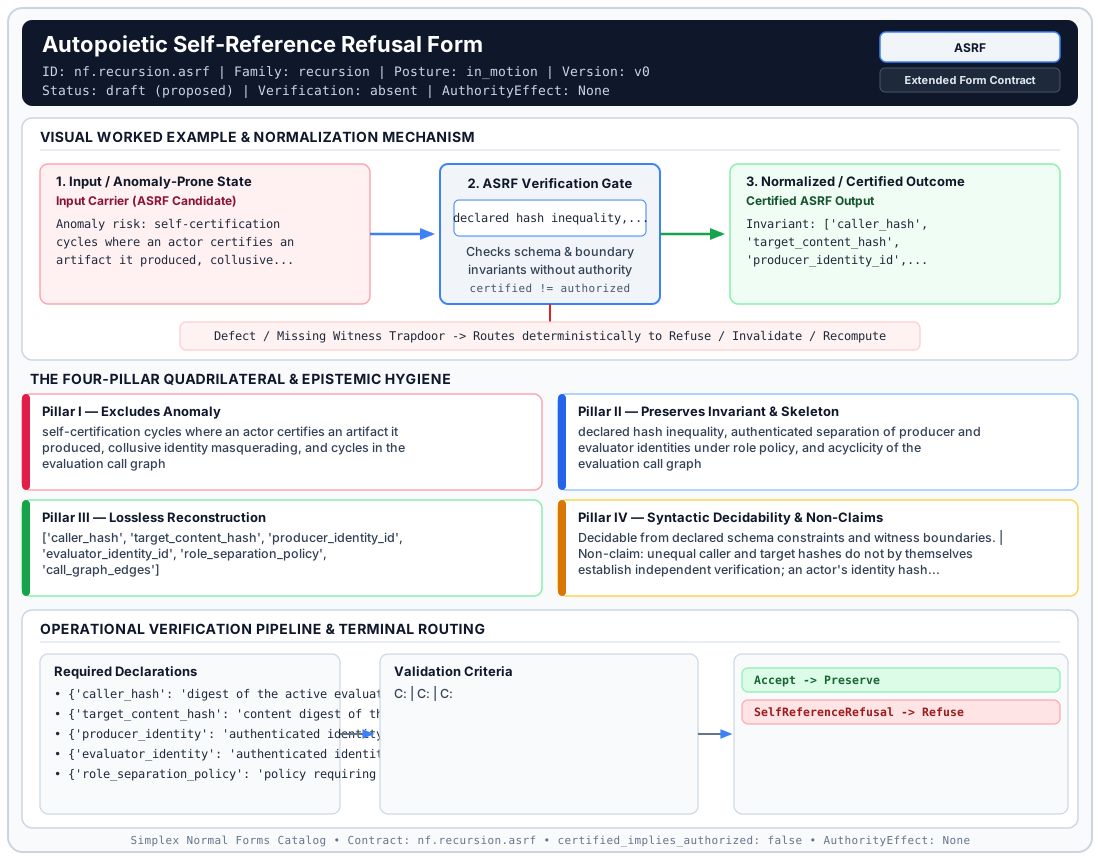
| Stage | Carrier / Operator | Concrete State / Invariant |
|---|---|---|
| 1. Before / Candidate Input | Input Carrier (ASRF Candidate) |
Anomaly risk: self-certification ; cycles where an actor certifies an ; artifact it produced, collusive... |
| 2. Normalization / Gate | ASRF Verification Gate |
declared hash inequality,... (certified_implies_authorized: false) |
| 3. After / Certified Output | Certified ASRF Output |
Invariant: ['caller_hash', ; 'target_content_hash', ; 'producer_identity_id',... |
Every contract in simplex-normal-forms is evaluated against the Four-Pillar Quadrilateral defined in contracts/_golden_nfs/standard.yaml:
| Pillar | Requirement | Contract Specification for nf.recursion.asrf
|
|---|---|---|
| Pillar I: Excludes Anomaly | Name and eliminate a specific class of data or state defects. | self-certification cycles where an actor certifies an artifact it produced, collusive identity masquerading, and cycles in the evaluation call graph |
| Pillar II: Preserves Invariant | State the structural invariant and protected skeleton preserved across transitions. |
Invariant: declared hash inequality, authenticated separation of producer and evaluator identities under role policy, and acyclicity of the evaluation call graph Protected Skeleton: ['caller_hash', 'target_content_hash', 'producer_identity_id', 'evaluator_identity_id', 'role_separation_policy', 'call_graph_edges'] |
| Pillar III: Lossless Reconstruction | State the non-loss reconstruction operator (join, direct sum, pullback, or replay). | Lossless reconstruction under declared projection, direct sum, or pullback operators. |
| Pillar IV: Syntactic Decidability | State how conformance is decided from declared constraints without unbudgeted scans. | Decidable from declared schema and witness metadata within bounded evaluation budgets. |
- unequal caller and target hashes do not by themselves establish independent verification; an actor's identity hash naturally differs from an artifact's content hash even when the same actor produced and evaluated it
- this contract is an evaluator guard verifying declared hash inequality, authenticated producer/evaluator identity distinctness, and call-graph acyclicity; it does not constitute an incompleteness theorem or compute any cohomology group
- does not imply authorization
- caller_hash: digest of the active evaluating entity
- target_content_hash: content digest of the evaluated artifact
- producer_identity: authenticated identity that generated the artifact
- evaluator_identity: authenticated identity executing the evaluation
- role_separation_policy: policy requiring producer_identity != evaluator_identity
- call_graph: directed graph of evaluation invocations
- caller_identity_signature: string
- producer_identity_id: string
- evaluator_identity_id: string
- producer_evaluator_distinct: boolean
- caller_hash_value: string
- target_content_hash_value: string
- call_graph_edges: list
- acyclicity_verified: boolean
| Criterion ID | Name | Condition |
|---|---|---|
| `` | **** | |
| `` | **** | |
| `` | **** |
Every evaluation terminates in a declared local route mapped to a canonical terminal in standard.yaml:
| Local Terminal Route | Canonical Terminal |
|---|---|
Accept |
Preserve |
SelfReferenceRefusal |
Refuse |
- symptom: caller hash equals target hash, or call graph contains cycle, diagnosis: direct or cyclical self-certification attempt, terminal: SelfReferenceRefusal
- symptom: producer identity equals evaluator identity, diagnosis: violation of separation of duties policy, terminal: SelfReferenceRefusal
In accordance with the repository's epistemic claim discipline:
-
What it supports:
- Supports syntactic and operational checking of
nf.recursion.asrf(ASRF) against its declared schema, boundary constraints, and witness obligations in this model. - Supports deterministic terminal routing (
Accept, SelfReferenceRefusal) when required declarations or invariants fail.
- Supports syntactic and operational checking of
-
What it does not support:
- Does not confer operational authority (
AuthorityEffect: None,certified_implies_authorized: false). - Does not claim semantic truth of undeclared external processes or unverified upstream inputs beyond the declaredprotected skeleton.
- Does not confer operational authority (
-
The narrowest defensible claim:
- Within the declared substrate
in_motion, this contract enforces thatself-certification cycles where an actor certifies an artifact it produced, collusive identity masquerading, and cycles in the evaluation call graphis either excluded underdeclared hash inequality, authenticated separation of producer and evaluator identities under role policy, and acyclicity of the evaluation call graphor routed to an explicit refusal/recovery terminal.
- Within the declared substrate
-
The next test needed:
- Property-based falsification and mutation testing across boundary edge cases and composed multi-step pipelines for
nf.recursion.asrf.
- Property-based falsification and mutation testing across boundary edge cases and composed multi-step pipelines for
Click to expand full canonical YAML contract (contracts/nf.recursion.asrf.yaml)
schema_version: smplx.nf.contract.v0
schema_ref: ./normal_form_contract_schema.yaml
contract_kind: form_contract
identity:
  id: nf.recursion.asrf
  name: Autopoietic Self-Reference Refusal Form
  short_name: ASRF
  version: v0
  theory_status: proposed
  contract_status: draft
  verification_status: absent
  family: recursion
  status: draft
classification:
  hierarchy_level: form
  subject_kind:
  - caller_identity
  - verification_target
  data_posture: in_motion
  mathematical_posture: operational
purpose:
  excludes_anomaly: self-certification cycles where an actor certifies an artifact
    it produced, collusive identity masquerading, and cycles in the evaluation call graph
  preserves_invariant: declared hash inequality, authenticated separation of producer
    and evaluator identities under role policy, and acyclicity of the evaluation call graph
  protected_skeleton:
  - caller_hash
  - target_content_hash
  - producer_identity_id
  - evaluator_identity_id
  - role_separation_policy
  - call_graph_edges
  erased_structure: []
  non_claims:
  - unequal caller and target hashes do not by themselves establish independent verification;
    an actor's identity hash naturally differs from an artifact's content hash even
    when the same actor produced and evaluated it
  - this contract is an evaluator guard verifying declared hash inequality, authenticated
    producer/evaluator identity distinctness, and call-graph acyclicity; it does not
    constitute an incompleteness theorem or compute any cohomology group
  - does not imply authorization
declarations_required:
- caller_hash: digest of the active evaluating entity
- target_content_hash: content digest of the evaluated artifact
- producer_identity: authenticated identity that generated the artifact
- evaluator_identity: authenticated identity executing the evaluation
- role_separation_policy: policy requiring producer_identity != evaluator_identity
- call_graph: directed graph of evaluation invocations
evidence_required:
- caller_identity_signature: string
- producer_identity_id: string
- evaluator_identity_id: string
- producer_evaluator_distinct: boolean
- caller_hash_value: string
- target_content_hash_value: string
- call_graph_edges: list
- acyclicity_verified: boolean
validation_criteria:
- hash_distinctness: caller hash differs strictly from target content hash
- role_separation: producer identity differs from evaluator identity under authenticated policy
- call_graph_acyclicity: declared call graph contains no directed cycle connecting caller, producer, and target
terminal_routes:
- Accept
- SelfReferenceRefusal
terminal_route_map:
  Accept: Preserve
  SelfReferenceRefusal: Refuse
extensions:
  condition_to_local_route_map:
    all_distinct_and_acyclic: Accept
    caller_target_hash_equal_or_cycle: SelfReferenceRefusal
    producer_equals_evaluator: SelfReferenceRefusal
certification:
  certificate_required: false
  certificate_kind: null
  obstruction_class_required: false
  loss_ledger_required: false
  verifier_required: false
  loss_ledger_trigger_id: null
authorization:
  authorized_by: null
  certified_implies_authorized: false
failure_modes:
- symptom: caller hash equals target hash, or call graph contains cycle
  diagnosis: direct or cyclical self-certification attempt
  terminal: SelfReferenceRefusal
- symptom: producer identity equals evaluator identity
  diagnosis: violation of separation of duties policy
  terminal: SelfReferenceRefusal
definition:
  source: coda_all_universe/mssn_sn_tower/definitions.md
  section: '3.7'
  formal_statement: Evaluator guard recording caller hash, target hash, and authenticated
    producer/evaluator identities. The step is preserved when producer and evaluator
    differ, hashes differ, and the call graph is acyclic. Self-cycles and unseparated
    roles route to refusal.
  quadrilateral:
    qualifies_as_true_normal_form: false
    qualification_gap: self_reference_cycle_refusal_is_an_evaluator_guard_not_a_relational_project_join_theorem
    qualifies_as_extended_form: true
    anomaly_exclusion: self-certification of a generated state
    lossless_join:
      status: refusal_separated
      statement: refused self-cycles are stored as refusals and are not folded into
        the admitted evaluations
    dependency_preservation:
      status: hash_inequality_retained
      statement: an admitted step keeps caller hash different from target hash and
        producer different from evaluator
    syntactic_decision:
      status: declaration_decidable
      statement: the check verifies declared identities, hashes, and call-graph acyclicity