Repository navigation
nf.runtime.zfnf
Contract ID:
nf.runtime.zfnf| Family:runtime| Index Status:draft| AuthorityEffect:None
⬅ Back to Wiki Home | View SVG Diagram
Zero-Float Rational Normal Form (ZFNF) enforces structural normalization and explicit defect routing in the runtime regime.
| Property | Value |
|---|---|
| Canonical ID | nf.runtime.zfnf |
| Short Name | ZFNF |
| Full Name | Zero-Float Rational Normal Form |
| Family |
runtime (Exact Rational Zero-Duality-Gap Certifiers & Merkle Trace Execution Contracts) |
| Qualification | Extended Form Contract (Normal Form Contract) |
| Data / Math Posture | at_rest |
| Index Status | draft |
| Theory Status | established |
| Verification Status | executable |
| Contract Version | v0 |
| Governance Fence |
AuthorityEffect: None (certified_implies_authorized: false) |
- Levels: Level 18
- Spec Files: ['11_grammar.md', '18_math.md']
- Anomaly Excluded: Floating-point rounding drift, artificial epsilon tolerances, and false optimality certification.
- Preserved Invariant: All vectors, weights, and dual certificates represented as exact rationals q = a/b in Q with zero duality gap.
- Lossless Reconstruction: Integer scaling under least common denominators preserves full arithmetic exactness.
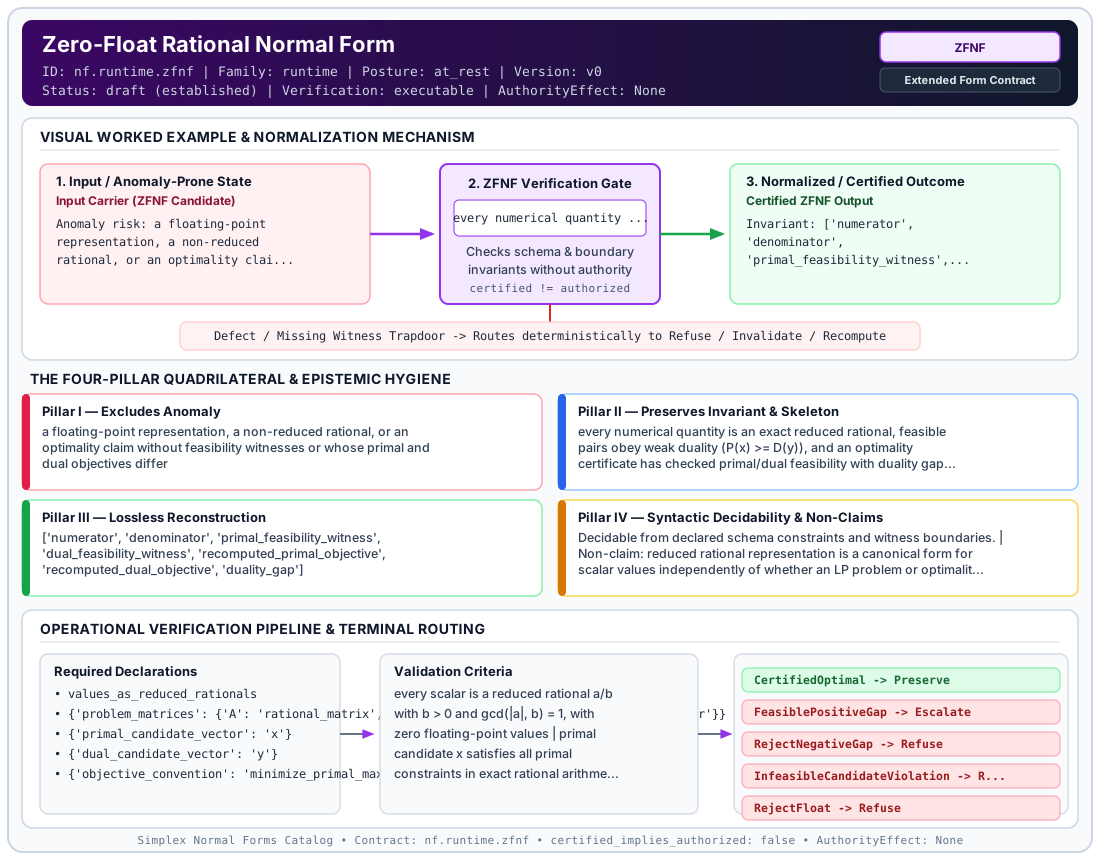
| Stage | Carrier / Operator | Concrete State / Invariant |
|---|---|---|
| 1. Before / Candidate Input | Input Carrier (ZFNF Candidate) |
Anomaly risk: a floating-point ; representation, a non-reduced ; rational, or an optimality clai... |
| 2. Normalization / Gate | ZFNF Verification Gate |
every numerical quantity ... (certified_implies_authorized: false) |
| 3. After / Certified Output | Certified ZFNF Output |
Invariant: ['numerator', ; 'denominator', ; 'primal_feasibility_witness',... |
- ref: coda_all_universe/mssn_sn_tower/definitions.md
section: '3.6'Every contract in simplex-normal-forms is evaluated against the Four-Pillar Quadrilateral defined in contracts/_golden_nfs/standard.yaml:
| Pillar | Requirement | Contract Specification for nf.runtime.zfnf
|
|---|---|---|
| Pillar I: Excludes Anomaly | Name and eliminate a specific class of data or state defects. | a floating-point representation, a non-reduced rational, or an optimality claim without feasibility witnesses or whose primal and dual objectives differ |
| Pillar II: Preserves Invariant | State the structural invariant and protected skeleton preserved across transitions. |
Invariant: every numerical quantity is an exact reduced rational, feasible pairs obey weak duality (P(x) >= D(y)), and an optimality certificate has checked primal/dual feasibility with duality gap exactly zero (P(x) - D(y) = 0) Protected Skeleton: ['numerator', 'denominator', 'primal_feasibility_witness', 'dual_feasibility_witness', 'recomputed_primal_objective', 'recomputed_dual_objective', 'duality_gap'] |
| Pillar III: Lossless Reconstruction | State the non-loss reconstruction operator (join, direct sum, pullback, or replay). | Lossless reconstruction under declared projection, direct sum, or pullback operators. |
| Pillar IV: Syntactic Decidability | State how conformance is decided from declared constraints without unbudgeted scans. | Decidable from declared schema and witness metadata within bounded evaluation budgets. |
- reduced rational representation is a canonical form for scalar values independently of whether an LP problem or optimality certificate is declared
- weak duality and the zero-gap optimality certificate are distinct statements. For minimization primal P(x) and maximization dual D(y), weak duality establishes D(y) <= P(x) for all feasible pairs, so the nonnegative duality gap is g = P(x) - D(y) >= 0. A positive gap g > 0 denotes a feasible suboptimal pair; g = 0 with verified feasibility certifies optimality
- equal objective numbers without checked primal and dual feasibility witnesses do not certify optimality (infeasible pairs can have equal objective values)
- a finite binary float mathematically denotes a rational number, but violates the repository's exact rational representation policy and arithmetic path
- does not imply authorization (AuthorityEffect: None)
- values_as_reduced_rationals
- problem_matrices: {'A': 'rational_matrix', 'b': 'rational_vector', 'c': 'rational_vector'}
- primal_candidate_vector: x
- dual_candidate_vector: y
- objective_convention: minimize_primal_maximize_dual
- primal_feasibility_check: evaluation that x satisfies primal constraints Ax >= b, x >= 0
- dual_feasibility_check: evaluation that y satisfies dual constraints A^T y <= c, y >= 0
- recomputed_primal_objective: c^T x in Q
- recomputed_dual_objective: b^T y in Q
- recomputed_duality_gap: P(x) - D(y) in Q
| Criterion ID | Name | Condition |
|---|---|---|
criterion |
Check | every scalar is a reduced rational a/b with b > 0 and gcd( |
criterion |
Check | primal candidate x satisfies all primal constraints in exact rational arithmetic |
criterion |
Check | dual candidate y satisfies all dual constraints in exact rational arithmetic |
criterion |
Check | under minimization primal and maximization dual, weak duality P(x) - D(y) >= 0 is verified |
criterion |
Check | an optimality certificate has both candidates feasible and duality gap P(x) - D(y) == 0 |
criterion |
Check | any gap violation P(x) - D(y) < 0 or candidate infeasibility is refused |
Every evaluation terminates in a declared local route mapped to a canonical terminal in standard.yaml:
| Local Terminal Route | Canonical Terminal |
|---|---|
CertifiedOptimal |
Preserve |
FeasiblePositiveGap |
Escalate |
RejectNegativeGap |
Refuse |
InfeasibleCandidateViolation |
Refuse |
RejectFloat |
Refuse |
- symptom: a value is represented as a binary or decimal floating-point number, diagnosis: forbidden representation policy; floating-point representation or inexact arithmetic path detected where exact reduced rational is required, terminal: RejectFloat
- symptom: candidate vector fails primal or dual feasibility constraints, diagnosis: candidate is infeasible; equal objective values cannot certify optimality without verified feasibility, terminal: InfeasibleCandidateViolation
- symptom: the primal objective is strictly less than the dual objective (P(x) - D(y) < 0), diagnosis: weak duality violated for declared minimize_primal_maximize_dual convention (indicates formulation defect or infeasibility), terminal: RejectNegativeGap
- symptom: candidates are feasible and the gap g = P(x) - D(y) is a strictly positive rational, diagnosis: the pair is feasible but suboptimal; gap remains unclosed, terminal: FeasiblePositiveGap
AuthorityEffect: None.
Level: Level 20 (Operational Substrate / Exact Rational Primal-Dual Witness Certification)
Evidential Grade: NATIVE IMPLEMENTED
Contract Reference: nf.runtime.zfnf
Mathematical Posture: Primal-Dual Linear Programming & Exact Duality Certificates
Data Posture: Runtime / Operational
Zero-Duality-Gap Normal Form (ZFNF) provides unforgeable mathematical proofs of optimality and termination:
- For any discrete optimization or resource allocation problem, floating-point convergence is untrusted.
- ZFNF requires a paired primal candidate $x^$ and dual witness $y^$ in exact rational arithmetic (
$\mathbb{Q}$ ). - When primal feasibility, dual feasibility, and objective value equality are verified, the duality gap is zero:
$$\text{Duality Gap} = c^T x^* - b^T y^* = 0$$ - This certifies that
$x^*$ is globally optimal without requiring the verifier to trust the search algorithm.
       Primal Candidate x*                 Dual Witness y*
  ┌───────────────────────────┐       ┌───────────────────────────┐
  │ Primal Feasible: A x* <= b│       │ Dual Feasible: A^T y* >= c│
  │ Objective Value: c^T x*   │       │ Objective Value: b^T y*   │
  └─────────────┬─────────────┘       └─────────────┬─────────────┘
                │                                   │
                └───────────────┬───────────────────┘
                                ▼
                   Zero Duality Gap Certificate
                     c^T x* - b^T y* = 0  (Exact in Q!)
-
Strong Duality Theorem & Verification Conditions: A candidate solution is certified in ZFNF if and only if all three conditions hold simultaneously:
-
Primal Feasibility:
$A x^* \le b$ and$x^* \ge 0$ . -
Dual Feasibility:
$A^T y^* \ge c$ ,$y^* \ge 0$ , and box capacity bounds$|w_e| \le 1$ . -
Divergence Balance: Dual flow vectors satisfy conservation
$d_0^T w = 0$ . -
Zero Duality Gap:
$c^T x^* = b^T y^*$ (evaluated in exactfractions.Fraction).
-
Primal Feasibility:
-
The Feasibility Precondition Guard: Numerical equality
$c^T x^* = b^T y^*$ alone does not certify optimality if feasibility or divergence balance is violated; unbalanced flow vectors can yield spurious numerical equality. -
The Quadrilateral Invariants:
- Anomaly Excluded: Sub-optimal solver termination, floating-point rounding illusions, unverified heuristic outputs.
-
Protected Skeleton: Primal objective vectors
$c$ , dual constraints$b$ , and exact rational witness pairs $(x^, y^)$. - Erased Structure: Search trees, branch-and-bound traces, heuristic solver state.
-
Reconstruction: Zero-gap certificate validation in
$\mathcal{O}(m \cdot n)$ linear time.
Primal-Dual Pair (x*, y*) & Exact Constraints
      │
      ├── Feasible on both sides AND c^T x* = b^T y* ──► Preserve (ZFNFCertified)
      │
      ├── Feasible on both sides BUT c^T x* > b^T y* ──► Quarantine (PositiveDualityGap)
      │
      ├── Primal or dual constraints violated ────────► Reject (InfeasibleCandidate)
      │
      └── Flow vector violates divergence balance ────► Reject (UnbalancedDivergence)
Verified in test_nf_review_regressions.py and test_tranche13_adversarial_and_rust_parity.py:
-
verify_zfnf(primal, dual, constraints): Checks exact rational inner products and constraint matrices. -
test_zfnf_weak_duality_sign: Asserts that any inverted duality sign ($c^T x^* < b^T y^*$ ) trips immediate rejection.
-
What it supports:
- Independent, polynomial-time verification of NP-hard combinatorial solver solutions.
- Unforgeable certificates of exact optimality in pure rational arithmetic.
-
What it does not support:
- Non-convex optimization problems where strong duality fails.
-
The narrowest defensible claim:
- ZFNF ensures under declared assumptions that the candidate solution cannot be improved by any feasible vector.
-
The next test needed:
- Rust-Python cross-language verification verifying that integer-scaled fixed-point certifiers match Python
fractions.Fractionbit-for-bit.
- Rust-Python cross-language verification verifying that integer-scaled fixed-point certifiers match Python
In accordance with the repository's epistemic claim discipline:
-
What it supports:
- Supports syntactic and operational checking of
nf.runtime.zfnf(ZFNF) against its declared schema, boundary constraints, and witness obligations in this model. - Supports deterministic terminal routing (
CertifiedOptimal, FeasiblePositiveGap, RejectNegativeGap, InfeasibleCandidateViolation) when required declarations or invariants fail.
- Supports syntactic and operational checking of
-
What it does not support:
- Does not confer operational authority (
AuthorityEffect: None,certified_implies_authorized: false). - Does not claim semantic truth of undeclared external processes or unverified upstream inputs beyond the declaredprotected skeleton.
- Does not confer operational authority (
-
The narrowest defensible claim:
- Within the declared substrate
at_rest, this contract enforces thata floating-point representation, a non-reduced rational, or an optimality claim without feasibility witnesses or whose primal and dual objectives differis either excluded underevery numerical quantity is an exact reduced rational, feasible pairs obey weak duality (P(x) >= D(y)), and an optimality certificate has checked primal/dual feasibility with duality gap exactly zero (P(x) - D(y) = 0)or routed to an explicit refusal/recovery terminal.
- Within the declared substrate
-
The next test needed:
- Property-based falsification and mutation testing across boundary edge cases and composed multi-step pipelines for
nf.runtime.zfnf.
- Property-based falsification and mutation testing across boundary edge cases and composed multi-step pipelines for
Click to expand full canonical YAML contract (contracts/nf.runtime.zfnf.yaml)
schema_version: smplx.nf.contract.v0
schema_ref: ./normal_form_contract_schema.yaml
contract_kind: normal_form_contract
identity:
  id: nf.runtime.zfnf
  name: Zero-Float Rational Normal Form
  short_name: ZFNF
  version: v0
  theory_status: established
  contract_status: draft
  verification_status: executable
  family: runtime
  status: draft
classification:
  hierarchy_level: normal_form
  subject_kind:
  - rational_number
  - primal_dual_pair
  data_posture: at_rest
  mathematical_posture: formal_algebraic
purpose:
  excludes_anomaly: a floating-point representation, a non-reduced rational, or an optimality
    claim without feasibility witnesses or whose primal and dual objectives differ
  preserves_invariant: every numerical quantity is an exact reduced rational, feasible pairs
    obey weak duality (P(x) >= D(y)), and an optimality certificate has checked primal/dual
    feasibility with duality gap exactly zero (P(x) - D(y) = 0)
  protected_skeleton:
  - numerator
  - denominator
  - primal_feasibility_witness
  - dual_feasibility_witness
  - recomputed_primal_objective
  - recomputed_dual_objective
  - duality_gap
  erased_structure:
  - floating_point_representations
  - unreduced_denominators
  non_claims:
  - reduced rational representation is a canonical form for scalar values independently of whether
    an LP problem or optimality certificate is declared
  - weak duality and the zero-gap optimality certificate are distinct statements. For minimization
    primal P(x) and maximization dual D(y), weak duality establishes D(y) <= P(x) for all feasible
    pairs, so the nonnegative duality gap is g = P(x) - D(y) >= 0. A positive gap g > 0 denotes a
    feasible suboptimal pair; g = 0 with verified feasibility certifies optimality
  - equal objective numbers without checked primal and dual feasibility witnesses do not certify
    optimality (infeasible pairs can have equal objective values)
  - a finite binary float mathematically denotes a rational number, but violates the repository's
    exact rational representation policy and arithmetic path
  - "does not imply authorization (AuthorityEffect: None)"
definition:
  source: coda_all_universe/mssn_sn_tower/definitions.md
  section: '3.6'
  formal_statement: >
    Each scalar is canonically represented as an irreducible rational a/b with b in Z_{>0}
    and gcd(|a|, b) = 1. For a linear program with declared convention minimize_primal_maximize_dual,
    candidate vectors x and y must satisfy independently checked primal feasibility (Ax >= b, x >= 0)
    and dual feasibility (A^T y <= c, y >= 0). Under weak duality, the dual objective D(y) = b^T y
    provides a lower bound on the primal objective P(x) = c^T x, so the exact duality gap
    g = P(x) - D(y) satisfies g >= 0. The pair (x, y) constitutes an optimality certificate if and
    only if both candidates are feasible and g = 0. A negative gap P(x) - D(y) < 0 indicates a
    duality formulation error or infeasible candidate.
  quadrilateral:
    qualifies_as_true_normal_form: false
    qualification_gap: reconstruction_is_exact_arithmetic_not_a_relational_join
    qualifies_as_extended_form: true
    anomaly_exclusion: rounding drift, inexact float representation, and optimality claims lacking
      verified feasibility or having non-zero duality gap
    lossless_join:
      status: denominator_clearing
      statement: integer scaling by a positive common multiple preserves rational equalities
        and polyhedral ordering
    dependency_preservation:
      status: reduced_form_retained
      statement: each rational is stored in canonical reduced form, and floating-point representations
        are prohibited across the execution pipeline
    syntactic_decision:
      status: schema_decidable
      statement: reduction, feasibility checking, and exact rational arithmetic evaluation of the
        gap g = P(x) - D(y) are decidable operations on finite rational data
declarations_required:
- values_as_reduced_rationals
- problem_matrices: {A: rational_matrix, b: rational_vector, c: rational_vector}
- primal_candidate_vector: x
- dual_candidate_vector: y
- objective_convention: minimize_primal_maximize_dual
evidence_required:
- primal_feasibility_check: evaluation that x satisfies primal constraints Ax >= b, x >= 0
- dual_feasibility_check: evaluation that y satisfies dual constraints A^T y <= c, y >= 0
- recomputed_primal_objective: c^T x in Q
- recomputed_dual_objective: b^T y in Q
- recomputed_duality_gap: P(x) - D(y) in Q
validation_criteria:
- every scalar is a reduced rational a/b with b > 0 and gcd(|a|, b) = 1, with zero floating-point values
- primal candidate x satisfies all primal constraints in exact rational arithmetic
- dual candidate y satisfies all dual constraints in exact rational arithmetic
- under minimization primal and maximization dual, weak duality P(x) - D(y) >= 0 is verified
- an optimality certificate has both candidates feasible and duality gap P(x) - D(y) == 0
- any gap violation P(x) - D(y) < 0 or candidate infeasibility is refused
terminal_routes:
- CertifiedOptimal
- FeasiblePositiveGap
- RejectNegativeGap
- InfeasibleCandidateViolation
- RejectFloat
terminal_route_map:
  CertifiedOptimal: Preserve
  FeasiblePositiveGap: Escalate
  RejectNegativeGap: Refuse
  InfeasibleCandidateViolation: Refuse
  RejectFloat: Refuse
certification:
  certificate_required: true
  certificate_kind: exact_rational_primal_dual_certificate
  obstruction_class_required: true
  loss_ledger_required: false
  verifier_required: true
  loss_ledger_trigger_id: null
authorization:
  authorized_by: null
  certified_implies_authorized: false
failure_modes:
- symptom: a value is represented as a binary or decimal floating-point number
  diagnosis: forbidden representation policy; floating-point representation or inexact arithmetic path detected where exact reduced rational is required
  terminal: RejectFloat
- symptom: candidate vector fails primal or dual feasibility constraints
  diagnosis: candidate is infeasible; equal objective values cannot certify optimality without verified feasibility
  terminal: InfeasibleCandidateViolation
- symptom: the primal objective is strictly less than the dual objective (P(x) - D(y) < 0)
  diagnosis: weak duality violated for declared minimize_primal_maximize_dual convention (indicates formulation defect or infeasibility)
  terminal: RejectNegativeGap
- symptom: candidates are feasible and the gap g = P(x) - D(y) is a strictly positive rational
  diagnosis: the pair is feasible but suboptimal; gap remains unclosed
  terminal: FeasiblePositiveGap
examples:
- ref: coda_all_universe/mssn_sn_tower/definitions.md
  section: '3.6'
references:
- coda_all_universe/mssn_sn_tower/definitions.md
- https://web.stanford.edu/~boyd/cvxbook/bv_cvxbook.pdf
obstruction_substrate:
  policy_ref: ../substrate/default_finite_obstruction_policy.yaml
  finite_carrier:
    description: LP solution state over rationals Q represented as reduced integer pairs (a, b) with b > 0
    max_rank: null
  cochain_complex:
    description: Polyhedral feasibility and duality gap evaluation over exact rational vector spaces
    C0: primal_dual_candidate_spaces_Q
    C1: constraint_residual_space_Q
    C2: duality_gap_space_Q
  obstruction_class:
    notation: '[duality_gap]'
    exact: feasibility_verified and P(x) - D(y) == 0 (certified primal-dual optimality)
    residual_closed: feasibility_verified and P(x) - D(y) > 0 (suboptimal feasible pair with exact positive gap)
    open: not feasibility_verified or P(x) - D(y) < 0 (infeasible or duality violation)
proof_obligations:
- id: zfnf.zero_float_optimality
  status: theorem_shaped
  ref: ../math/18_math_zero_float_law_and_exact_rational_lp_solvers.md
  section: 1. The Zero-Float Law and Exact Duality