Repository navigation
nf.cochain.dhnf
Contract ID:
nf.cochain.dhnf| Family:shape| Index Status:draft| AuthorityEffect:None
⬅ Back to Wiki Home | View SVG Diagram
Discrete Hodge Normal Form (DHNF) enforces structural normalization and explicit defect routing in the shape regime.
| Property | Value |
|---|---|
| Canonical ID | nf.cochain.dhnf |
| Short Name | DHNF |
| Full Name | Discrete Hodge Normal Form |
| Family |
shape (Relational, Algebraic & Cochain Shape Normal Forms (Data at Rest & Structural Decompositions)) |
| Qualification | Extended Form Contract (Normal Form Contract) |
| Data / Math Posture | at_rest |
| Index Status | draft |
| Theory Status | established |
| Verification Status | absent |
| Contract Version | v0 |
| Governance Fence |
AuthorityEffect: None (certified_implies_authorized: false) |
- Levels: Level 17 - 18
- Spec Files: ['18_grammar.md', '17_math.md']
- Anomaly Excluded: Conflating exact gradient updates with topological loop obstructions or boundary curls.
- Preserved Invariant: Discrete 1-cochain admits unique orthogonal direct sum decomposition c = d_0 p + h + d_1^* q.
- Lossless Reconstruction: Summing exact, harmonic, and coexact components reconstructs original cochain identically.
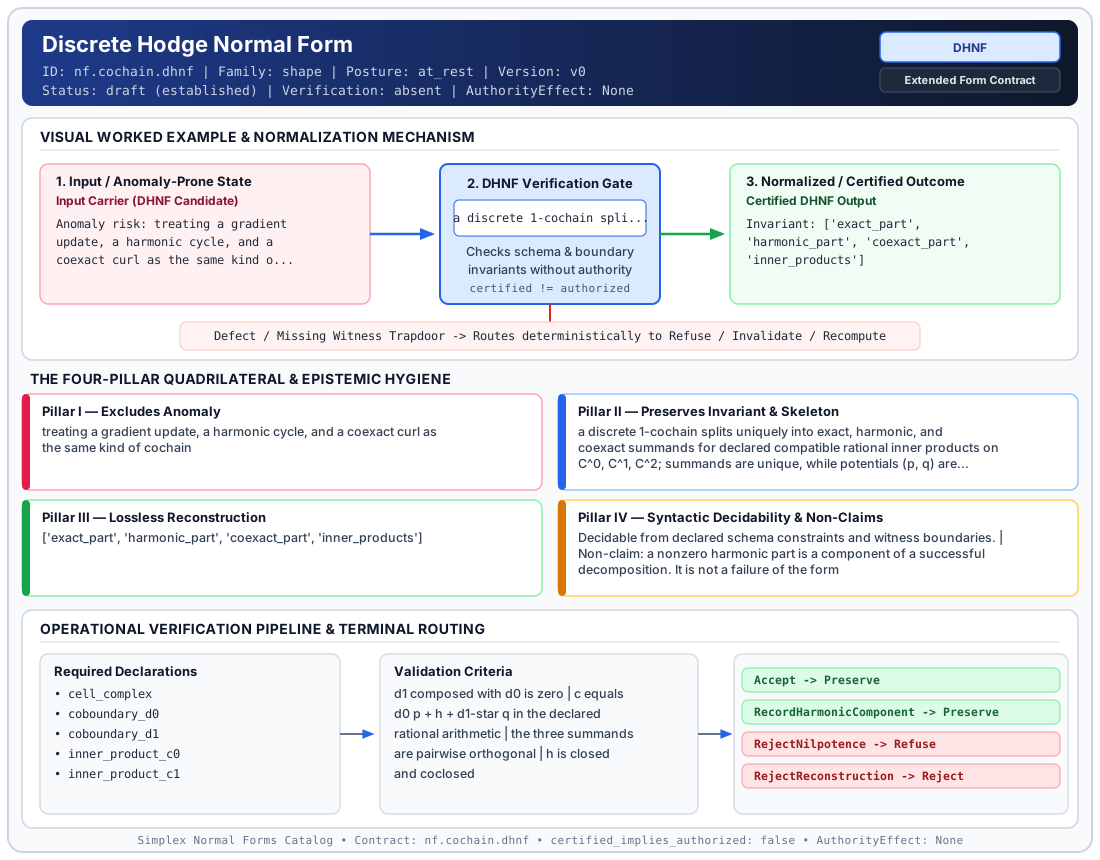
| Stage | Carrier / Operator | Concrete State / Invariant |
|---|---|---|
| 1. Before / Candidate Input | Input Carrier (DHNF Candidate) |
Anomaly risk: treating a gradient ; update, a harmonic cycle, and a ; coexact curl as the same kind o... |
| 2. Normalization / Gate | DHNF Verification Gate |
a discrete 1-cochain spli... (certified_implies_authorized: false) |
| 3. After / Certified Output | Certified DHNF Output |
Invariant: ['exact_part', ; 'harmonic_part', 'coexact_part', ; 'inner_products'] |
- ref: coda_all_universe/mssn_sn_tower/definitions.md
section: '3.5'Every contract in simplex-normal-forms is evaluated against the Four-Pillar Quadrilateral defined in contracts/_golden_nfs/standard.yaml:
| Pillar | Requirement | Contract Specification for nf.cochain.dhnf
|
|---|---|---|
| Pillar I: Excludes Anomaly | Name and eliminate a specific class of data or state defects. | treating a gradient update, a harmonic cycle, and a coexact curl as the same kind of cochain |
| Pillar II: Preserves Invariant | State the structural invariant and protected skeleton preserved across transitions. |
Invariant: a discrete 1-cochain splits uniquely into exact, harmonic, and coexact summands for declared compatible rational inner products on C^0, C^1, C^2; summands are unique, while potentials (p, q) are unique up to gauge choice Protected Skeleton: ['exact_part', 'harmonic_part', 'coexact_part', 'inner_products'] |
| Pillar III: Lossless Reconstruction | State the non-loss reconstruction operator (join, direct sum, pullback, or replay). | Lossless reconstruction under declared projection, direct sum, or pullback operators. |
| Pillar IV: Syntactic Decidability | State how conformance is decided from declared constraints without unbudgeted scans. | Decidable from declared schema and witness metadata within bounded evaluation budgets. |
- a nonzero harmonic part is a component of a successful decomposition. It is not a failure of the form
- a nonzero harmonic cochain is a residual_harmonic_class providing a canonical cohomology representative; it is not an obstruction in isolation and promotes to an obstruction only relative to a declared protected law via OBNF
- the orthogonal split is stated for a finite cell complex and declared positive definite rational inner products on C^0, C^1, C^2
- unique decomposition applies to the orthogonal summands (d0 p, h, d1* q); potentials p in C^0 and q in C^2 require a declared gauge selector for uniqueness
- this directory does not execute the decomposition
- does not imply authorization
- cell_complex
- coboundary_d0
- coboundary_d1
- inner_product_c0
- inner_product_c1
- inner_product_c2
- cochain_c
None declared.
| Criterion ID | Name | Condition |
|---|---|---|
criterion |
Check | d1 composed with d0 is zero |
criterion |
Check | c equals d0 p + h + d1-star q in the declared rational arithmetic |
criterion |
Check | the three summands are pairwise orthogonal |
criterion |
Check | h is closed and coclosed |
Every evaluation terminates in a declared local route mapped to a canonical terminal in standard.yaml:
| Local Terminal Route | Canonical Terminal |
|---|---|
Accept |
Preserve |
RecordHarmonicComponent |
Preserve |
RejectNilpotence |
Refuse |
RejectReconstruction |
Reject |
- symptom: d1 d0 != 0, diagnosis: cell complex coboundaries do not satisfy Stokes nilpotence, terminal: RejectNilpotence
- symptom: d0 p + h + d1* q does not equal c, diagnosis: decomposition remainder non-zero in rational arithmetic, terminal: RejectReconstruction
AuthorityEffect: None.
Level: Level 19 (Topological Substrate / Discrete Hodge Decomposition & Harmonic Orthogonality)
Evidential Grade: NATIVE IMPLEMENTED
Contract Reference: nf.cochain.dhnf
Mathematical Posture: Discrete Exterior Calculus & Combinatorial Hodge Theory
Data Posture: Substrate
Discrete Hodge Normal Form (DHNF) provides a canonical, unique orthogonal decomposition of discrete cochains and network flows:
- Any
$k$ -cochain$\omega \in C^k(K, \mathbb{Q})$ decomposes uniquely into three mutually orthogonal components:$$\omega = d\alpha + \delta\beta + \gamma$$ where:-
$d\alpha$ is the exact component (gradient flow / coboundary), -
$\delta\beta$ is the coexact component (solenoidal / rotational flow), -
$\gamma$ is the harmonic component ($\Delta \gamma = 0$ , representing global non-bounding topological circulation).
-
- Evaluates the combinatorial Hodge Laplacian:
$$\Delta_k = \delta_{k+1} d_k + d_{k-1} \delta_k = d_k^T d_k + d_{k-1} d_{k-1}^T$$
               Total Cochain Space C^k
  ┌─────────────────────────────────────────────────────────────┐
  │ \omega = d\alpha (Exact) ⊕ \delta\beta (Coexact) ⊕ \gamma (Harmonic)│
  └──────────────────────────────┬──────────────────────────────┘
                                 │
             Orthogonal Hodge Decomposition
                                 ▼
  d\alpha ⟂ \delta\beta ⟂ \gamma   (Mutually Orthogonal under <·,·>)
-
Orthogonal Decomposition Theorem: For any simplicial complex with inner product
$\langle u, v \rangle = u^T W v$ (where$W$ is a diagonal positive-definite weight matrix):$$\ker(\Delta_k) \cong H^k(K, \mathbb{Q})$$ Harmonic cochains correspond bijectively to the cohomology classes of the complex. -
The Tripartite Orthogonality:
$$\langle d\alpha, \delta\beta \rangle = 0, \quad \langle d\alpha, \gamma \rangle = 0, \quad \langle \delta\beta, \gamma \rangle = 0$$ -
The Quadrilateral Invariants:
- Anomaly Excluded: Conflating rotational circulation with potential gradients, undetected topological obstructions in network routing.
-
Protected Skeleton: Harmonic cohomology basis
$\gamma$ , potential fields$\alpha$ , and stream functions$\beta$ . - Erased Structure: Gauge ambiguity in exact and coexact potential definitions.
-
Reconstruction: Orthogonal sum
$d\alpha + \delta\beta + \gamma = \omega$ .
Discrete Cochain \omega & Hodge Laplacian \Delta_k
      │
      ├── Exact orthogonal decomposition verified ────► Preserve (DHNFSatisfied)
      │
      ├── Residual mass \Xi > 0 after decomposition ──► Reject (HodgeDecompositionDivergence)
      │
      └── Non-positive inner product matrix ──────────► Reject (NonPositiveGramMatrix)
Verified in test_physics_fermion_optimization_and_hodge.py:
-
verify_dhnf(complex, cochain): Solves the linear system for$\alpha, \beta, \gamma$ , verifying that$\langle d\alpha, \delta\beta \rangle = 0$ and$\Delta \gamma = 0$ with zero rational residual. - Asserts that when
$H^1(K) = 0$ (directly connected complex), the harmonic component$\gamma$ vanishes identically.
-
What it supports:
- Canonical orthogonal routing and obstruction decomposition for discrete workflows and network flows.
- Exact rational computation of discrete Helmholtz-Hodge potentials.
-
What it does not support:
- Continuous differential forms on Riemannian manifolds without triangulation discretization.
-
The narrowest defensible claim:
- DHNF provides a unique, coordinate-free orthogonal decomposition of discrete cochains on finite cell complexes.
-
The next test needed:
- Property tests verifying stability of the harmonic component
$\gamma$ under simplicial barycentric subdivision.
- Property tests verifying stability of the harmonic component
In accordance with the repository's epistemic claim discipline:
-
What it supports:
- Supports syntactic and operational checking of
nf.cochain.dhnf(DHNF) against its declared schema, boundary constraints, and witness obligations in this model. - Supports deterministic terminal routing (
Accept, RecordHarmonicComponent, RejectNilpotence, RejectReconstruction) when required declarations or invariants fail.
- Supports syntactic and operational checking of
-
What it does not support:
- Does not confer operational authority (
AuthorityEffect: None,certified_implies_authorized: false). - Does not claim semantic truth of undeclared external processes or unverified upstream inputs beyond the declaredprotected skeleton.
- Does not confer operational authority (
-
The narrowest defensible claim:
- Within the declared substrate
at_rest, this contract enforces thattreating a gradient update, a harmonic cycle, and a coexact curl as the same kind of cochainis either excluded undera discrete 1-cochain splits uniquely into exact, harmonic, and coexact summands for declared compatible rational inner products on C^0, C^1, C^2; summands are unique, while potentials (p, q) are unique up to gauge choiceor routed to an explicit refusal/recovery terminal.
- Within the declared substrate
-
The next test needed:
- Property-based falsification and mutation testing across boundary edge cases and composed multi-step pipelines for
nf.cochain.dhnf.
- Property-based falsification and mutation testing across boundary edge cases and composed multi-step pipelines for
Click to expand full canonical YAML contract (contracts/nf.cochain.dhnf.yaml)
schema_version: smplx.nf.contract.v0
schema_ref: ./normal_form_contract_schema.yaml
contract_kind: normal_form_contract
identity:
  id: nf.cochain.dhnf
  name: Discrete Hodge Normal Form
  short_name: DHNF
  version: v0
  theory_status: established
  contract_status: draft
  verification_status: absent
  family: shape
  status: draft
classification:
  hierarchy_level: normal_form
  subject_kind:
  - cochain
  - finite_cell_complex
  data_posture: at_rest
  mathematical_posture: formal_algebraic
purpose:
  excludes_anomaly: treating a gradient update, a harmonic cycle, and a coexact curl
    as the same kind of cochain
  preserves_invariant: a discrete 1-cochain splits uniquely into exact, harmonic,
    and coexact summands for declared compatible rational inner products on C^0, C^1, C^2;
    summands are unique, while potentials (p, q) are unique up to gauge choice
  protected_skeleton:
  - exact_part
  - harmonic_part
  - coexact_part
  - inner_products
  erased_structure: []
  non_claims:
  - a nonzero harmonic part is a component of a successful decomposition. It is not
    a failure of the form
  - a nonzero harmonic cochain is a residual_harmonic_class providing a canonical cohomology
    representative; it is not an obstruction in isolation and promotes to an obstruction
    only relative to a declared protected law via OBNF
  - the orthogonal split is stated for a finite cell complex and declared positive
    definite rational inner products on C^0, C^1, C^2
  - unique decomposition applies to the orthogonal summands (d0 p, h, d1* q); potentials
    p in C^0 and q in C^2 require a declared gauge selector for uniqueness
  - this directory does not execute the decomposition
  - does not imply authorization
definition:
  source: coda_all_universe/mssn_sn_tower/definitions.md
  section: '3.5'
  formal_statement: >
    On a finite cell complex with positive definite inner products on C^0, C^1, and C^2
    taking rational values, every discrete 1-cochain c admits a unique orthogonal
    decomposition c = d0 p + h + d1* q into exact, harmonic, and coexact summands, with
    p a 0-cochain, h harmonic, and q a 2-cochain. The three summands are pairwise orthogonal
    and uniquely determined. Canonical potentials p, q require a declared gauge selector.
    The harmonic summand satisfies d1 h = 0 and d0* h = 0. Adding the three summands returns
    c with no remainder in the declared rational arithmetic. Nilpotence d1 d0 = 0 is required
    of the complex.
  quadrilateral:
    qualifies_as_true_normal_form: false
    qualification_gap: reconstruction_is_the_hodge_sum_not_a_relational_join
    qualifies_as_extended_form: true
    anomaly_exclusion: conflating an exact gradient, a harmonic cycle, and a coexact
      curl
    lossless_join:
      status: direct_sum
      statement: the exact, harmonic, and coexact summands add back to c
    dependency_preservation:
      status: orthogonality_retained
      statement: each pair of summands has inner product zero, and nilpotence of the
        coboundary is retained
    syntactic_decision:
      status: decomposition_certificate
      statement: >
        The orthogonal split is computed from the declared complex, compatible inner products
        on C^0, C^1, C^2, and the cochain instance. A nonzero harmonic component is recorded
        and the decomposition remains valid.
declarations_required:
- cell_complex
- coboundary_d0
- coboundary_d1
- inner_product_c0
- inner_product_c1
- inner_product_c2
- cochain_c
evidence_required: []
validation_criteria:
- d1 composed with d0 is zero
- c equals d0 p + h + d1-star q in the declared rational arithmetic
- the three summands are pairwise orthogonal
- h is closed and coclosed
terminal_routes:
- Accept
- RecordHarmonicComponent
- RejectNilpotence
- RejectReconstruction
terminal_route_map:
  Accept: Preserve
  RecordHarmonicComponent: Preserve
  RejectNilpotence: Refuse
  RejectReconstruction: Reject
certification:
  certificate_required: false
  certificate_kind: null
  obstruction_class_required: false
  loss_ledger_required: false
  verifier_required: false
  loss_ledger_trigger_id: null
authorization:
  authorized_by: null
  certified_implies_authorized: false
failure_modes:
- symptom: d1 d0 != 0
  diagnosis: cell complex coboundaries do not satisfy Stokes nilpotence
  terminal: RejectNilpotence
- symptom: d0 p + h + d1* q does not equal c
  diagnosis: decomposition remainder non-zero in rational arithmetic
  terminal: RejectReconstruction
examples:
- ref: coda_all_universe/mssn_sn_tower/definitions.md
  section: '3.5'
references:
- coda_all_universe/mssn_sn_tower/definitions.md