Repository navigation
Theory and Cochain Substrate
Theory and Cochain Substrate: From Codd Relations to Boundary-Quotient Normal Forms (BQNF & CODA_MUR)
AuthorityEffect: None (certified_implies_authorized: false)
⬅ Back to Wiki Home
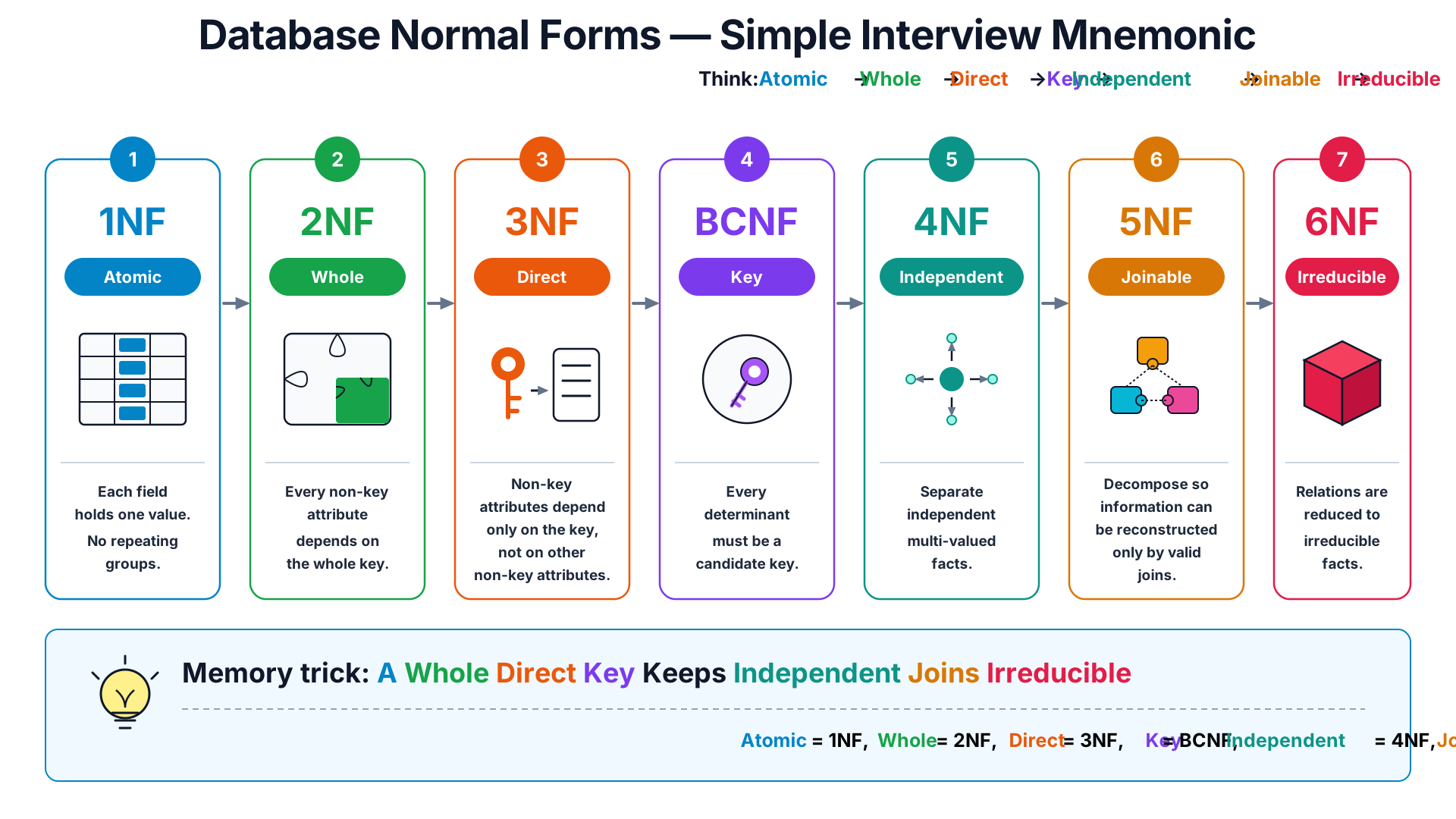
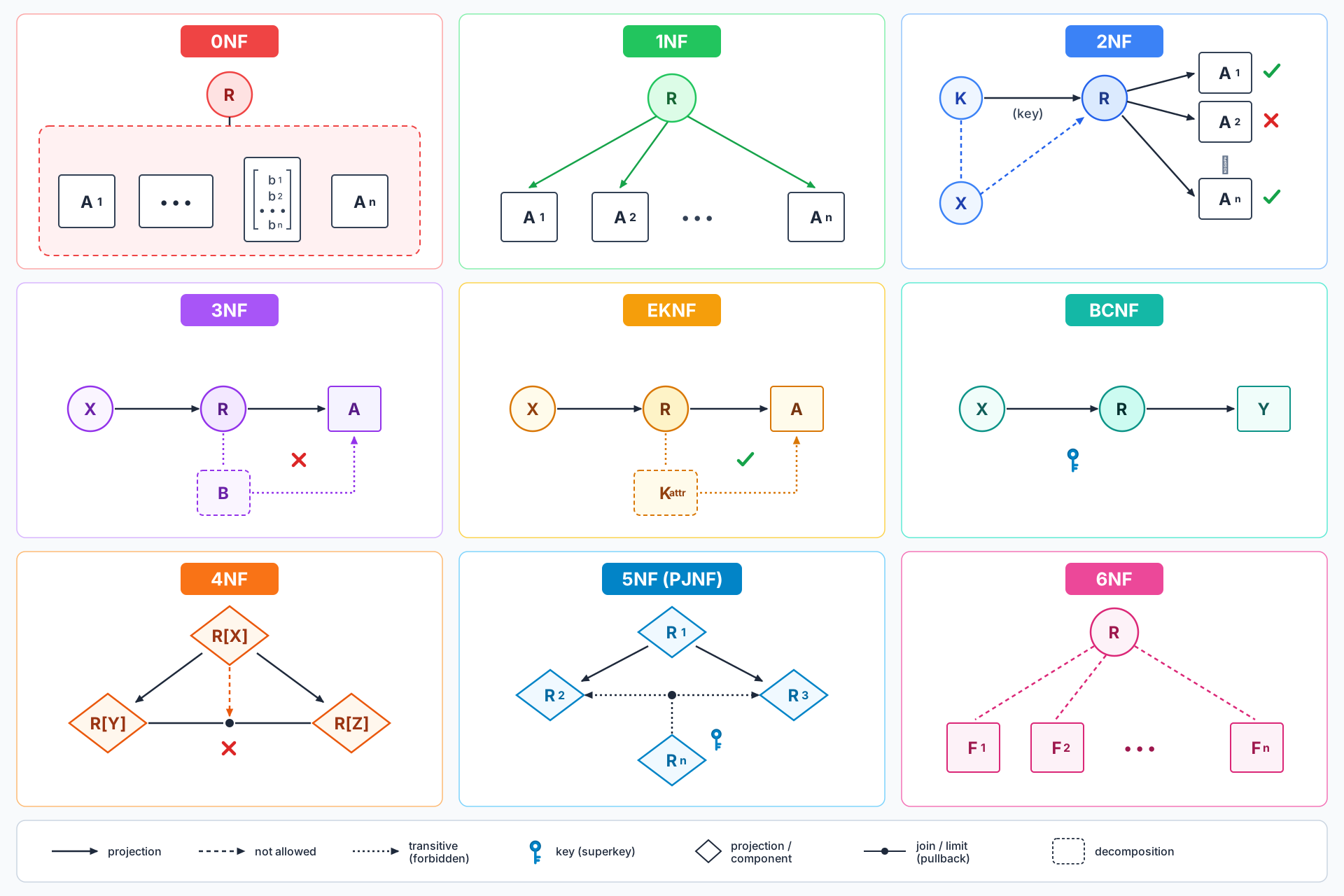
As formalized in contracts/_golden_nfs/standard.yaml and contracts/_golden_nfs/normal_form_definitions.yaml, a structural specification qualifies as a True Normal Form (TNF) when it satisfies four pillars:
-
Pillar I — Explicit Anomaly Exclusion: Names and eliminates a specific class of data-modification or state-transition redundancy (e.g., repeating groups in
1NF, partial-key dependence in2NF, transitive dependence in3NF, non-superkey determinants inBCNF, independent multivalued Cartesian bloat in4NF, non-key-implied join dependencies in5NF). -
Pillar II — Lossless Reconstruction Theorem: Establishes non-loss recovery under declared operators:
-
Heath's Theorem (1971): Binary projection
$R = (XY, XZ)$ is lossless under functional dependencies iff$X \to Y$ or$X \to Z$ . -
Fagin's Theorem (1977): Binary projection
$R = (XY, XZ)$ is lossless under multivalued dependencies iff$X \twoheadrightarrow Y \mid Z$ . -
Rissanen's Theorem (1977):
$n$ -ary decomposition is lossless iff the join dependency$\bowtie[R_1, \dots, R_k]$ holds. -
Cochain Direct Sum: For discrete 1-cochains (
nf.cochain.dhnf,nf.ddc.hodge_canonical),$c = d_0 p + h + d_1^* q$ reconstructs$c$ identically over$\mathbb{Q}$ .
-
Heath's Theorem (1971): Binary projection
-
Pillar III — Dependency Preservation Analysis: Explicitly states whether the union of component dependencies implies the original dependency closure (
$(\bigcup_i \pi_{R_i}(\Sigma))^+ = \Sigma^+$ ), as achieved by Bernstein synthesis for3NFandEKNF, or whether cross-component joins are required (as can occur inBCNF). -
Pillar IV — Syntactic Decidability from Constraints: Conformance is decided from the declared schema
$(H(R), \Sigma)$ rather than scanning a single accidental table body. Where unrestricted constraints exceed decidability (nf.classical.dknf,nf.logic.qanf), bounded evaluators emitBudgetUnknownorUnsupportedrather than silently guessing.
2. Data in Motion: Boundary-Quotient Normal Form (nf.change.bqnf)
While classical normal forms govern data at rest, distributed caches, materialized views, and streaming pipelines operate on data in motion under Change Data Capture (CDC) events (INSERT, UPDATE, DELETE).
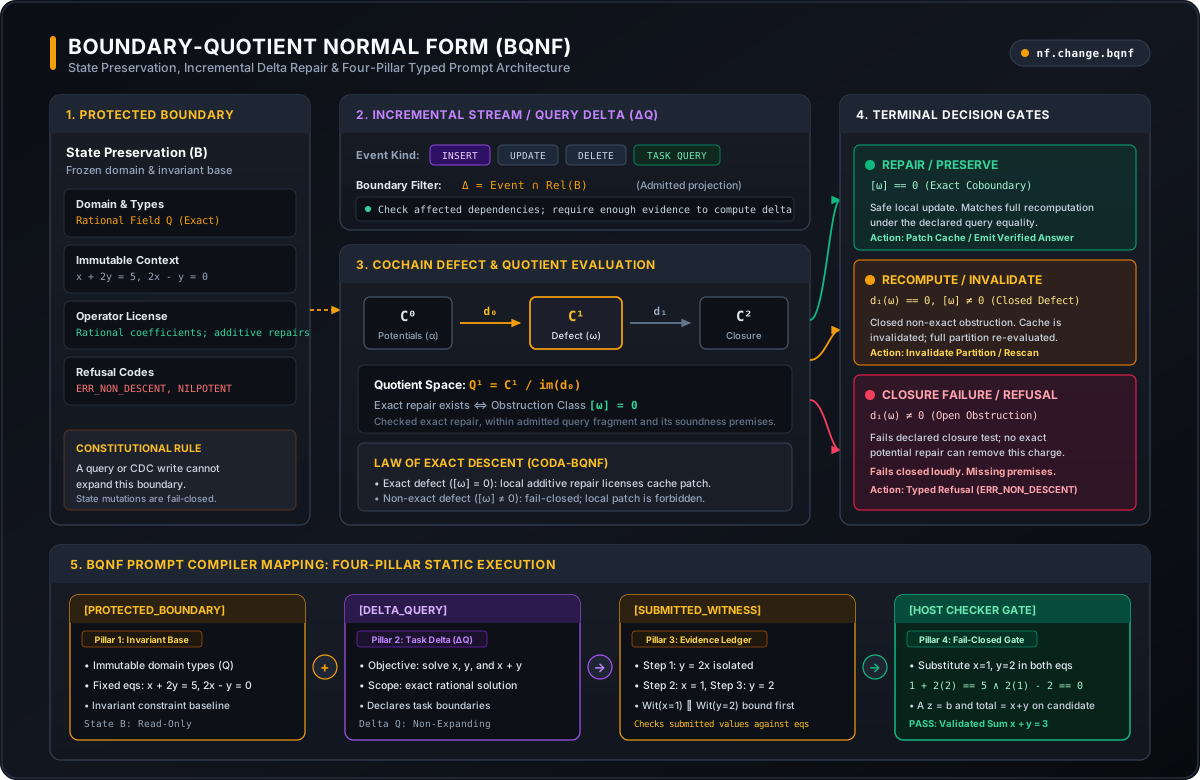
Over an admitted query boundary
-
Zero Defect (
$\omega = 0 \implies \text{Preserve}$ ): Unrelated column updates outside$\partial Q$ leave the view unchanged. -
Exact Coboundary (
$\omega = d^0 \alpha \iff [\omega] = 0 \in Q^1 \implies \text{Repair}$ ): The view is updated incrementally in$O(1)$ via local potential delta$\alpha$ without scanning the base table. -
Closed Residual (
$[\omega] \ne 0, d^1\omega = 0 \implies \text{Recompute} / \text{Invalidate}$ ): Non-trivial cohomology defect (e.g., destructive deletion of aMAX/MINwitness without an auxiliary priority-queue cochain, or quantile drift exceeding$\epsilon$ tolerance). Routes to bounded partition recomputation. -
Boundary Failure (
$d^1\omega \ne 0$ or missing CDC evidence$\implies \text{Invalidate} / \text{ClosureFailure}$ ): Fails closed when required before/after images are missing.
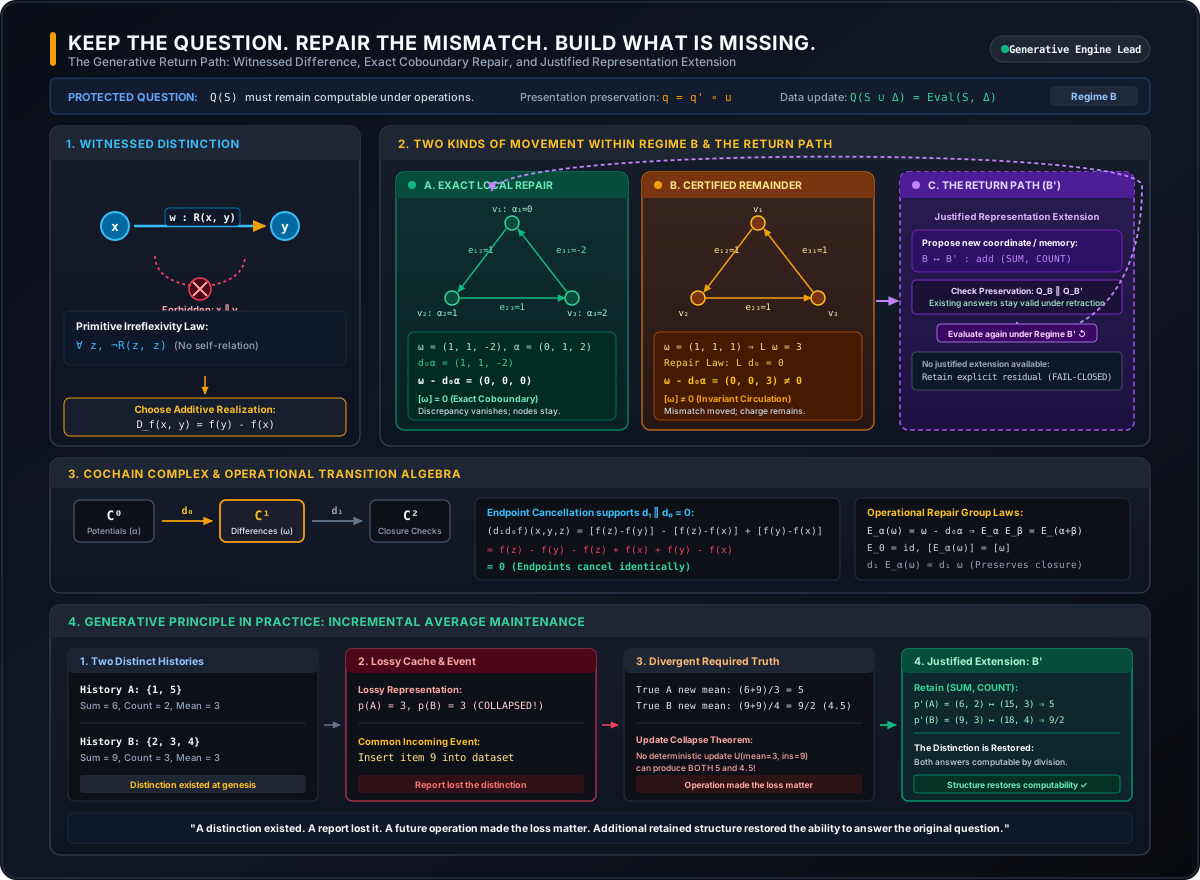
3. Data in Representation: CODA_MUR Transport (nf.coda.mur.transport)
When data moves across representation boundaries $F: \operatorname{Rep}{\text{source}} \to \operatorname{Rep}{\text{target}}$ (e.g., relational OLTP table CODA_MUR (nf.coda.mur.transport) enforces the commutation square:
-
Descent Compatibility Witness (
$\chi_F$ ): Verifies that applying source mutation$D_{\text{source}}$ and transporting via$\bar{F}$ agrees with transporting via$F$ and applying target mutation$D_{\text{target}}$ . -
Sealed Loss Ledger (
nf.evidence.loss_ledger,nf.ddc.loss_ledger): Every unmapped attribute or coarsened precision is recorded under triggercoda_mur.unmapped_field_drop. Dropping a field without a loss-ledger entry routes immediately toLossLedgerMissing(Refuse). -
Target Verifier Precedence: A transport certificate never bypasses target-side verification (
AuthorityLaundering -> Refuse).
-
What it supports:
- Supports formal classification of relational schemas, streaming CDC coboundary repairs, and loss-ledger-backed representation transport in this model.
-
What it does not support:
- Does not claim that an unverified external database engine preserves constraints without executing the corresponding verifier.
-
The narrowest defensible claim:
- In this model, separating data at rest (
1NF–6NF), data in motion (BQNF), and data in representation (CODA_MUR) prevents silent conflation of storage redundancy, cache staleness, and translation loss.
- In this model, separating data at rest (
-
The next test needed:
- End-to-end property tests composing
3NFdecomposition withBQNFCDC maintenance andCODA_MURprojection transport.
- End-to-end property tests composing