Repository navigation
nf.epistemic.odnf
Contract ID:
nf.epistemic.odnf| Family:epistemic| Index Status:draft| AuthorityEffect:None
⬅ Back to Wiki Home | View SVG Diagram
Observer Distinguishability Normal Form (ODNF) enforces structural normalization and explicit defect routing in the epistemic regime.
| Property | Value |
|---|---|
| Canonical ID | nf.epistemic.odnf |
| Short Name | ODNF |
| Full Name | Observer Distinguishability Normal Form |
| Family |
epistemic (Observer-Relative Epistemic, Freshness, Context, Provenance & Distinguishability Contracts) |
| Qualification | Extended Form Contract (Normal Form Contract) |
| Data / Math Posture | in_motion |
| Index Status | draft |
| Theory Status | proposed |
| Verification Status | absent |
| Contract Version | v0 |
| Governance Fence |
AuthorityEffect: None (certified_implies_authorized: false) |
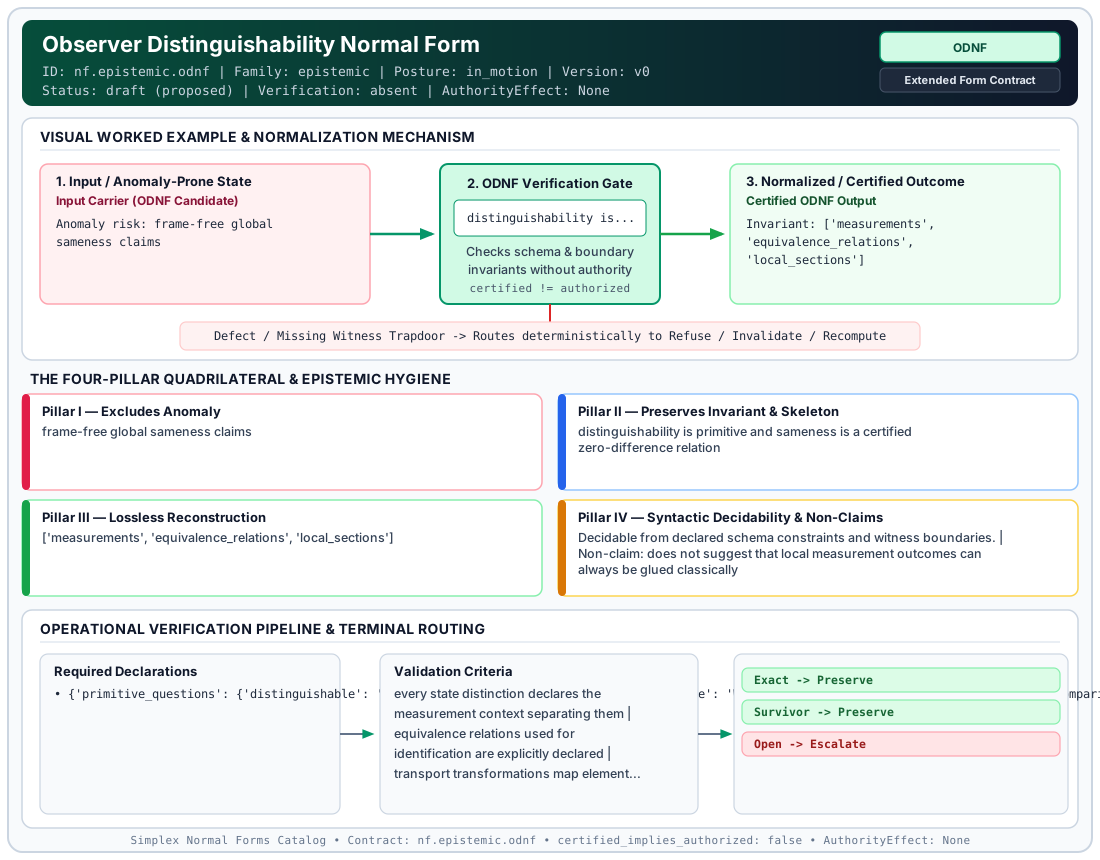
| Stage | Carrier / Operator | Concrete State / Invariant |
|---|---|---|
| 1. Before / Candidate Input | Input Carrier (ODNF Candidate) |
Anomaly risk: frame-free global ; sameness claims |
| 2. Normalization / Gate | ODNF Verification Gate |
distinguishability is... (certified_implies_authorized: false) |
| 3. After / Certified Output | Certified ODNF Output |
Invariant: ['measurements', ; 'equivalence_relations', ; 'local_sections'] |
Every contract in simplex-normal-forms is evaluated against the Four-Pillar Quadrilateral defined in contracts/_golden_nfs/standard.yaml:
| Pillar | Requirement | Contract Specification for nf.epistemic.odnf
|
|---|---|---|
| Pillar I: Excludes Anomaly | Name and eliminate a specific class of data or state defects. | frame-free global sameness claims |
| Pillar II: Preserves Invariant | State the structural invariant and protected skeleton preserved across transitions. |
Invariant: distinguishability is primitive and sameness is a certified zero-difference relation Protected Skeleton: ['measurements', 'equivalence_relations', 'local_sections'] |
| Pillar III: Lossless Reconstruction | State the non-loss reconstruction operator (join, direct sum, pullback, or replay). | Lossless reconstruction under declared projection, direct sum, or pullback operators. |
| Pillar IV: Syntactic Decidability | State how conformance is decided from declared constraints without unbudgeted scans. | Decidable from declared schema and witness metadata within bounded evaluation budgets. |
- does not suggest that local measurement outcomes can always be glued classically
- does not support absolute coordination without a shared consensus boundary
- does not imply a physical realist representation exists for all observer systems
- primitive_questions: {'distinguishable': 'What measurements separate two states?', 'same': 'What equivalence relation identifies them?', 'comparison': 'What survives transport between observers?', 'gluing': 'Can local observer sections form a global section?', 'repair': 'Can the defect be killed by allowed corrections?', 'residual': 'What remains after repair and comparison?', 'authority': 'What finite terminal certificate is earned?'}
None declared.
| Criterion ID | Name | Condition |
|---|---|---|
criterion |
Check | every state distinction declares the measurement context separating them |
criterion |
Check | equivalence relations used for identification are explicitly declared |
criterion |
Check | transport transformations map elements under a declared comparison witness |
Every evaluation terminates in a declared local route mapped to a canonical terminal in standard.yaml:
| Local Terminal Route | Canonical Terminal |
|---|---|
Exact |
Preserve |
Survivor |
Preserve |
Open |
Escalate |
- symptom: treating non-comparable observer views as identical without transport maps, diagnosis: undefined equivalence relation, terminal: Open
AuthorityEffect: None.
Level: Level 17 (Data under Observation / Pseudometric Separation & Zero Distance)
Evidential Grade: NATIVE IMPLEMENTED
Contract Reference: nf.epistemic.odnf
Mathematical Posture: Pseudometric Topology & Constructive Separation Axioms
Data Posture: Under Observation
Observer Distinguishability Normal Form (ODNF) resolves a classic fallacy in mathematical data modeling:
When an observer pool
- This demonstrates only that the current observer pool lacks the resolving power to separate them.
- It does not support that
$x$ and$y$ are ontologically identical points on the carrier. - ODNF strictly forbids collapsing
$x$ and$y$ to a single point unless the contract declares an explicit metric separation axiom ($d(x, y) = 0 \implies x = y$ ). - Without separation, the evaluation routes to
Abstain, preserving distinct carrier IDs.
       Observer Measurement: d_O(x, y) = 0
                       │
             Separation Axiom Declared?
                    /    \
                  NO      YES
                  /        \
                 ▼          ▼
             Abstain     Collapse
      (Retains Distinct   (True Point
         Carrier IDs)      Equality)
-
Pseudometric Invariants: The observer distance function
$d: X \times X \to \mathbb{Q}$ must satisfy:- Non-negativity:
$d(x, y) \ge 0$ as an exact rational. - Symmetry:
$d(x, y) = d(y, x)$ . - Triangle Inequality:
$d(x, z) \le d(x, y) + d(y, z)$ . - But crucially:
$d(x, y) = 0$ does not imply$x = y$ (pseudometric, not metric).
- Non-negativity:
-
The Separation Gate: $$\operatorname{verdict}(x, y) = \begin{cases} \text{Preserve (Identified)}, & \text{if } d(x, y) = 0 \land \text{SeparationAxiomDeclared} \ \text{Abstain (Indistinguishable)}, & \text{if } d(x, y) = 0 \land \neg\text{SeparationAxiomDeclared} \ \text{Refuse (Separated)}, & \text{if } d(x, y) > 0 \end{cases}$$
-
The Quadrilateral Invariants:
- Anomaly Excluded: Conflating epistemic observational indistinguishability with ontological point identity.
- Protected Skeleton: Carrier object identities, observer pool definitions, and exact rational distance values.
- Erased Structure: None (distinctions are explicitly guarded against premature collapse).
- Reconstruction: Quotient manifold projection under verified separation.
Measurement d_O(x, y) & Separation Context
      │
      ├── d(x, y) = 0 WITH separation axiom ──► Preserve (PointIdentityCertified)
      │
      ├── d(x, y) = 0 WITHOUT separation ────► Abstain (IndistinguishableDistinctIds)
      │
      ├── d(x, y) > 0 (Distinct states) ─────► Refuse (SeparatedByObserver)
      │
      └── d(x, y) < 0 (Metric violation) ────► Reject (NonPositiveDistanceDefect)
Verified in test_tranche8_epistemic_and_authority.py and test_tranche30_pseudometric_and_quotient_factors.py:
-
test_pseudometric_zero_keeps_distinct_ids: Asserts that when$d(O_1, O_2) = 0$ without a separation axiom, carrier IDs remain distinct. -
test_odnf_zero_divergence_routes_to_abstain: Verifies that zero divergence routes toAbstain. -
test_separation_axiom_makes_zero_into_equality: supports that declaring the separation axiom permits point collapse in the quotient.
-
What it supports:
- Strict mathematical hygiene preventing false claims of identity from incomplete observations.
- Separation of carrier state space from quotient observation space.
-
What it does not support:
- canonical omniscience of any finite observer pool.
-
The narrowest defensible claim:
- Zero distance under an observer pool certifies indistinguishability by that pool, not identity of the underlying objects.
-
The next test needed:
- Multi-observer adjunction test verifying that adjoining an independent observer strictly refines or preserves the pseudometric partition.
In accordance with the repository's epistemic claim discipline:
-
What it supports:
- Supports syntactic and operational checking of
nf.epistemic.odnf(ODNF) against its declared schema, boundary constraints, and witness obligations in this model. - Supports deterministic terminal routing (
Exact, Survivor, Open) when required declarations or invariants fail.
- Supports syntactic and operational checking of
-
What it does not support:
- Does not confer operational authority (
AuthorityEffect: None,certified_implies_authorized: false). - Does not claim semantic truth of undeclared external processes or unverified upstream inputs beyond the declaredprotected skeleton.
- Does not confer operational authority (
-
The narrowest defensible claim:
- Within the declared substrate
in_motion, this contract enforces thatframe-free global sameness claimsis either excluded underdistinguishability is primitive and sameness is a certified zero-difference relationor routed to an explicit refusal/recovery terminal.
- Within the declared substrate
-
The next test needed:
- Property-based falsification and mutation testing across boundary edge cases and composed multi-step pipelines for
nf.epistemic.odnf.
- Property-based falsification and mutation testing across boundary edge cases and composed multi-step pipelines for
Click to expand full canonical YAML contract (contracts/nf.epistemic.odnf.yaml)
schema_version: smplx.nf.contract.v0
contract_kind: normal_form_contract
identity:
  id: nf.epistemic.odnf
  name: Observer Distinguishability Normal Form
  short_name: ODNF
  version: v0
  status: draft
  family: epistemic
  theory_status: proposed
  contract_status: draft
  verification_status: absent
classification:
  hierarchy_level: normal_form
  subject_kind:
  - observer_relvar
  - distributed_claim
  data_posture: in_motion
  mathematical_posture: operational
purpose:
  excludes_anomaly: frame-free global sameness claims
  preserves_invariant: distinguishability is primitive and sameness is a certified
    zero-difference relation
  protected_skeleton:
  - measurements
  - equivalence_relations
  - local_sections
  erased_structure: []
  non_claims:
  - does not suggest that local measurement outcomes can always be glued classically
  - does not support absolute coordination without a shared consensus boundary
  - does not imply a physical realist representation exists for all observer systems
obstruction_substrate:
  policy_ref: ../substrate/default_finite_obstruction_policy.yaml
  finite_carrier:
    description: Allowed repairs and distinguishability defects across observer measurements.
  cochain_complex:
    C0: allowed_repairs_or_gauge_transformations
    C1: observer_defects_or_distinguishability_gaps
    C2: gluing_failures_or_contextuality_failures
    d0: repair_to_defect
    d1: defect_to_gluing_failure
    quotient: Q1 = C1 / im(d0)
  obstruction_class:
    notation: '[omega]'
    exact: '[omega] == 0'
    residual_closed: '[omega] != 0 and d1(omega) == 0'
    open: d1(omega) != 0
declarations_required:
- primitive_questions:
    distinguishable: What measurements separate two states?
    same: What equivalence relation identifies them?
    comparison: What survives transport between observers?
    gluing: Can local observer sections form a global section?
    repair: Can the defect be killed by allowed corrections?
    residual: What remains after repair and comparison?
    authority: What finite terminal certificate is earned?
evidence_required: []
validation_criteria:
- every state distinction declares the measurement context separating them
- equivalence relations used for identification are explicitly declared
- transport transformations map elements under a declared comparison witness
proof_obligations: []
terminal_routes:
- Exact
- Survivor
- Open
certification:
  certificate_required: true
  certificate_kind: observer_distinguishability_certificate
  obstruction_class_required: true
  loss_ledger_required: false
  verifier_required: true
authorization:
  authorized_by: null
  certified_implies_authorized: false
failure_modes:
- symptom: treating non-comparable observer views as identical without transport maps
  diagnosis: undefined equivalence relation
  terminal: Open
references:
- ../relnf.md
terminal_route_map:
  Exact: Preserve
  Survivor: Preserve
  Open: Escalate
definition:
  source: coda_all_universe/mssn_sn_tower/definitions.md
  formal_statement: frame-free global sameness claims. distinguishability is primitive
    and sameness is a certified zero-difference relation
  quadrilateral:
    qualifies_as_true_normal_form: false
    qualification_gap: reconstruction_is_not_a_relational_project_join
    anomaly_exclusion: frame-free global sameness claims
    lossless_join:
      status: declared_reconstruction
      statement: distinguishability is primitive and sameness is a certified zero-difference
        relation
    dependency_preservation:
      status: declared_with_the_invariant
      statement: The preserved invariant stays on the declared schema. This form does
        not state a functional-dependency projection of a flat relvar decomposition.
    syntactic_decision:
      status: declaration_decidable
      statement: The check reads the declared constraints and validation criteria.
        One unrecorded runtime image is not the decider.
schema_ref: ./normal_form_contract_schema.yaml