Repository navigation
nf.epistemic.authority
Contract ID:
nf.epistemic.authority| Family:epistemic| Index Status:draft| AuthorityEffect:None
⬅ Back to Wiki Home | View SVG Diagram
Authority Normal Form (ANF) enforces structural normalization and explicit defect routing in the epistemic regime.
| Property | Value |
|---|---|
| Canonical ID | nf.epistemic.authority |
| Short Name | ANF |
| Full Name | Authority Normal Form |
| Family |
epistemic (Observer-Relative Epistemic, Freshness, Context, Provenance & Distinguishability Contracts) |
| Qualification | Extended Form Contract (Normal Form Contract) |
| Data / Math Posture | in_motion |
| Index Status | draft |
| Theory Status | proposed |
| Verification Status | absent |
| Contract Version | v0 |
| Governance Fence |
AuthorityEffect: None (certified_implies_authorized: false) |
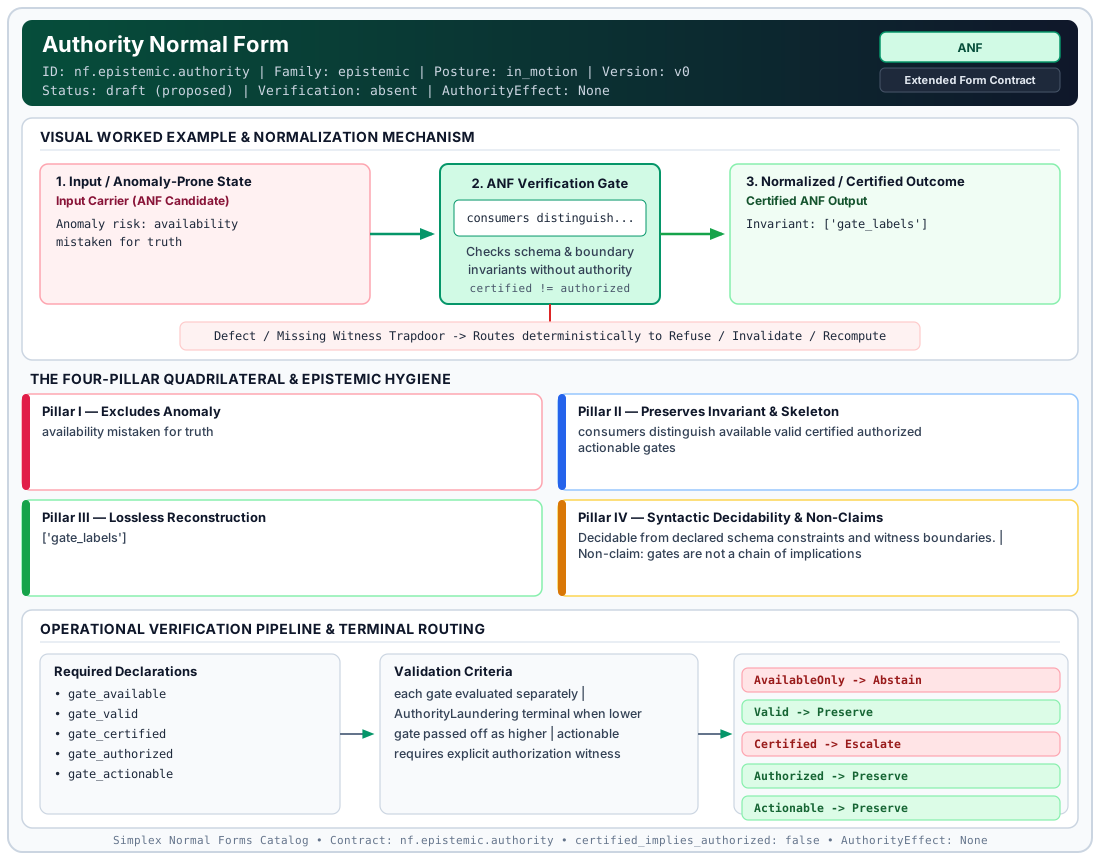
| Stage | Carrier / Operator | Concrete State / Invariant |
|---|---|---|
| 1. Before / Candidate Input | Input Carrier (ANF Candidate) |
Anomaly risk: availability ; mistaken for truth |
| 2. Normalization / Gate | ANF Verification Gate |
consumers distinguish... (certified_implies_authorized: false) |
| 3. After / Certified Output | Certified ANF Output |
Invariant: ['gate_labels'] |
Every contract in simplex-normal-forms is evaluated against the Four-Pillar Quadrilateral defined in contracts/_golden_nfs/standard.yaml:
| Pillar | Requirement | Contract Specification for nf.epistemic.authority
|
|---|---|---|
| Pillar I: Excludes Anomaly | Name and eliminate a specific class of data or state defects. | availability mistaken for truth |
| Pillar II: Preserves Invariant | State the structural invariant and protected skeleton preserved across transitions. |
Invariant: consumers distinguish available valid certified authorized actionable gates Protected Skeleton: ['gate_labels'] |
| Pillar III: Lossless Reconstruction | State the non-loss reconstruction operator (join, direct sum, pullback, or replay). | Lossless reconstruction under declared projection, direct sum, or pullback operators. |
| Pillar IV: Syntactic Decidability | State how conformance is decided from declared constraints without unbudgeted scans. | Decidable from declared schema and witness metadata within bounded evaluation budgets. |
- gates are not a chain of implications
- available does not imply valid
- certified does not imply authorized
- gate_available
- gate_valid
- gate_certified
- gate_authorized
- gate_actionable
- per_gate boolean or enum with witness ref
| Criterion ID | Name | Condition |
|---|---|---|
criterion |
Check | each gate evaluated separately |
criterion |
Check | AuthorityLaundering terminal when lower gate passed off as higher |
criterion |
Check | actionable requires explicit authorization witness |
Every evaluation terminates in a declared local route mapped to a canonical terminal in standard.yaml:
| Local Terminal Route | Canonical Terminal |
|---|---|
AvailableOnly |
Abstain |
Valid |
Preserve |
Certified |
Escalate |
Authorized |
Preserve |
Actionable |
Preserve |
AuthorityLaundering |
Refuse |
Refuse |
Refuse |
All defects route explicitly through the Terminal Route Map above.
AuthorityEffect: None.
Level: Level 15 (Data under Observation / Freshness Posets & Authority Stacks)
Evidential Grade: NATIVE IMPLEMENTED
Contract References: nf.epistemic.authority, nf.epistemic.freshness
Mathematical Posture: Causal Poset Bounds & Multi-Tier Authority Stacks
Data Posture: Under Observation
In distributed, cached, or agent-mediated systems, data does not directly exist; it is observed under specific visibility, temporal, and authority bounds:
-
Freshness Normal Form: Asserts that a read claim is governed by an explicit invalidation frontier (
$\tau_{\text{inv}}$ ) and bounded age$(\Delta t \le t_{\text{max}})$ . A raw timestamp is never authority without an explicit invalidation check. -
Authority Stack: Partitions truth status into five non-conflated tiers:
$$\text{Declared} \longrightarrow \text{Available} \longrightarrow \text{Valid} \longrightarrow \text{Certified} \longrightarrow \text{Authorized}$$ -
The Golden Rule of Authority:
$$\boxed{\text{Certified} \centernot\implies \text{Authorized}}$$ A certificate is a mathematical receipt that an invariant was checked; authorization is an operational decision granted only by an authorized policy engine.
       Raw Observed Data
               │
               ▼
       Freshness Invariant: age <= t_max AND no invalidation receipt
               │
               ▼
       Certificate Verification (e.g. BQNF / CODA-MUR)
               │
               ▼
       Policy Engine Authorization (Checks Lineage & Permissions)
               │
               ▼
       Actionable Operational Output
-
Freshness Poset Bound: An observation
$O$ at physical time$t$ over entity$E$ is fresh with respect to threshold$\Delta t_{\text{max}}$ if and only if:$$t - O.\text{snapshot_time} \le \Delta t_{\text{max}} \quad \land \quad \forall e \in \text{CDC}(E): e.\text{time} \le O.\text{snapshot_time}$$ -
The Quadrilateral Invariants:
- Anomaly Excluded: Reading stale cached facts, authority laundering from unverified certificates, timestamp manipulation.
- Protected Skeleton: Snapshot identifiers, invalidation frontiers, and cryptographic certificate digests.
- Erased Structure: Volatile network delivery delays and uncertified intermediate cache layers.
- Reconstruction: Pull through verified invalidation frontiers.
Observed Data Claim & Freshness Assertion
      │
      ├── Fresh within bound, certificate verified ──► Preserve (AuthorityValid)
      │
      ├── Age exceeds bound or invalidation logged ──► Refuse (StaleReadRefused)
      │
      ├── Certificate present but policy rejects ────► Quarantine (UnauthorisedCertificate)
      │
      └── Bypassed verifier detected ────────────────► Refuse (AuthorityLaundering)
Verified in test_observer_freshness_certificate_property.py and test_tranche8_epistemic_and_authority.py:
-
test_freshness_timestamp_without_invalidation_fails: Verifies that supplying a timestamp without active invalidation evidence fails closed. -
test_certified_does_not_imply_authorized: Asserts that settingcertified_implies_authorized: truetrips schema refusal.
-
What it supports:
- Formal boundary defense against stale reads in distributed cache networks.
- Strict separation between mathematical verification and operational authority.
-
What it does not support:
- Perfect clock synchronization across Byzantine asynchronous networks without consensus protocols.
-
The narrowest defensible claim:
- Freshness and authority contracts prevent any cached representation from acting as an authoritative source without an active invalidation check.
-
The next test needed:
- Property tests under simulated network partitions verifying that partitioned observers degrade gracefully to typed refusal (
Abstain).
- Property tests under simulated network partitions verifying that partitioned observers degrade gracefully to typed refusal (
In accordance with the repository's epistemic claim discipline:
-
What it supports:
- Supports syntactic and operational checking of
nf.epistemic.authority(ANF) against its declared schema, boundary constraints, and witness obligations in this model. - Supports deterministic terminal routing (
AvailableOnly, Valid, Certified, Authorized) when required declarations or invariants fail.
- Supports syntactic and operational checking of
-
What it does not support:
- Does not confer operational authority (
AuthorityEffect: None,certified_implies_authorized: false). - Does not claim semantic truth of undeclared external processes or unverified upstream inputs beyond the declaredprotected skeleton.
- Does not confer operational authority (
-
The narrowest defensible claim:
- Within the declared substrate
in_motion, this contract enforces thatavailability mistaken for truthis either excluded underconsumers distinguish available valid certified authorized actionable gatesor routed to an explicit refusal/recovery terminal.
- Within the declared substrate
-
The next test needed:
- Property-based falsification and mutation testing across boundary edge cases and composed multi-step pipelines for
nf.epistemic.authority.
- Property-based falsification and mutation testing across boundary edge cases and composed multi-step pipelines for
Click to expand full canonical YAML contract (contracts/nf.epistemic.authority.yaml)
schema_version: smplx.nf.contract.v0
contract_kind: normal_form_contract
identity:
  id: nf.epistemic.authority
  name: Authority Normal Form
  short_name: ANF
  version: v0
  status: draft
  family: epistemic
  theory_status: proposed
  contract_status: draft
  verification_status: absent
classification:
  hierarchy_level: normal_form
  subject_kind:
  - distributed_claim
  data_posture: in_motion
  mathematical_posture: operational
purpose:
  excludes_anomaly: availability mistaken for truth
  preserves_invariant: consumers distinguish available valid certified authorized
    actionable gates
  protected_skeleton:
  - gate_labels
  erased_structure: []
  non_claims:
  - gates are not a chain of implications
  - available does not imply valid
  - certified does not imply authorized
declarations_required:
- gate_available
- gate_valid
- gate_certified
- gate_authorized
- gate_actionable
evidence_required:
- per_gate boolean or enum with witness ref
validation_criteria:
- each gate evaluated separately
- AuthorityLaundering terminal when lower gate passed off as higher
- actionable requires explicit authorization witness
proof_obligations: []
terminal_routes:
- AvailableOnly
- Valid
- Certified
- Authorized
- Actionable
- AuthorityLaundering
- Refuse
certification:
  certificate_required: true
  certificate_kind: authority_gate_packet
  obstruction_class_required: false
  loss_ledger_required: false
  verifier_required: true
authorization:
  authorized_by: null
  certified_implies_authorized: false
references:
- ../1_normal_forms.md
- ../nf.coda.mur.transport.yaml
terminal_route_map:
  AvailableOnly: Abstain
  Valid: Preserve
  Certified: Escalate
  Authorized: Preserve
  Actionable: Preserve
  AuthorityLaundering: Refuse
  Refuse: Refuse
definition:
  source: coda_all_universe/mssn_sn_tower/definitions.md
  formal_statement: availability mistaken for truth. consumers distinguish available
    valid certified authorized actionable gates
  quadrilateral:
    qualifies_as_true_normal_form: false
    qualification_gap: reconstruction_is_not_a_relational_project_join
    anomaly_exclusion: availability mistaken for truth
    lossless_join:
      status: declared_reconstruction
      statement: consumers distinguish available valid certified authorized actionable
        gates
    dependency_preservation:
      status: declared_with_the_invariant
      statement: The preserved invariant stays on the declared schema. This form does
        not state a functional-dependency projection of a flat relvar decomposition.
    syntactic_decision:
      status: declaration_decidable
      statement: The check reads the declared constraints and validation criteria.
        One unrecorded runtime image is not the decider.
schema_ref: ./normal_form_contract_schema.yaml