Repository navigation
nf.classical.6nf
Contract ID:
nf.classical.6nf| Family:shape| Index Status:active| AuthorityEffect:None
⬅ Back to Wiki Home | View SVG Diagram
Sixth Normal Form (6NF) enforces structural normalization and explicit defect routing in the shape regime.
| Property | Value |
|---|---|
| Canonical ID | nf.classical.6nf |
| Short Name | 6NF |
| Full Name | Sixth Normal Form |
| Family |
shape (Relational, Algebraic & Cochain Shape Normal Forms (Data at Rest & Structural Decompositions)) |
| Qualification | Extended Form Contract (Normal Form Contract) |
| Data / Math Posture | at_rest |
| Index Status | active |
| Theory Status | established |
| Verification Status | executable |
| Contract Version | v0 |
| Governance Fence |
AuthorityEffect: None (certified_implies_authorized: false) |
- Author: Date, Darwen, and Lorentzos
- Year: 2002
- Structural Invariant: Relvar satisfies no non-trivial join dependencies whatsoever (completely irreducible).
- Anomaly Excluded: Non-trivial join dependencies.
- Lossless Join Property: Trivial decompositions only.
- Dependency Preservation: Preserved on irreducible binary relvars.
- Qualifies As True Normal Form: True
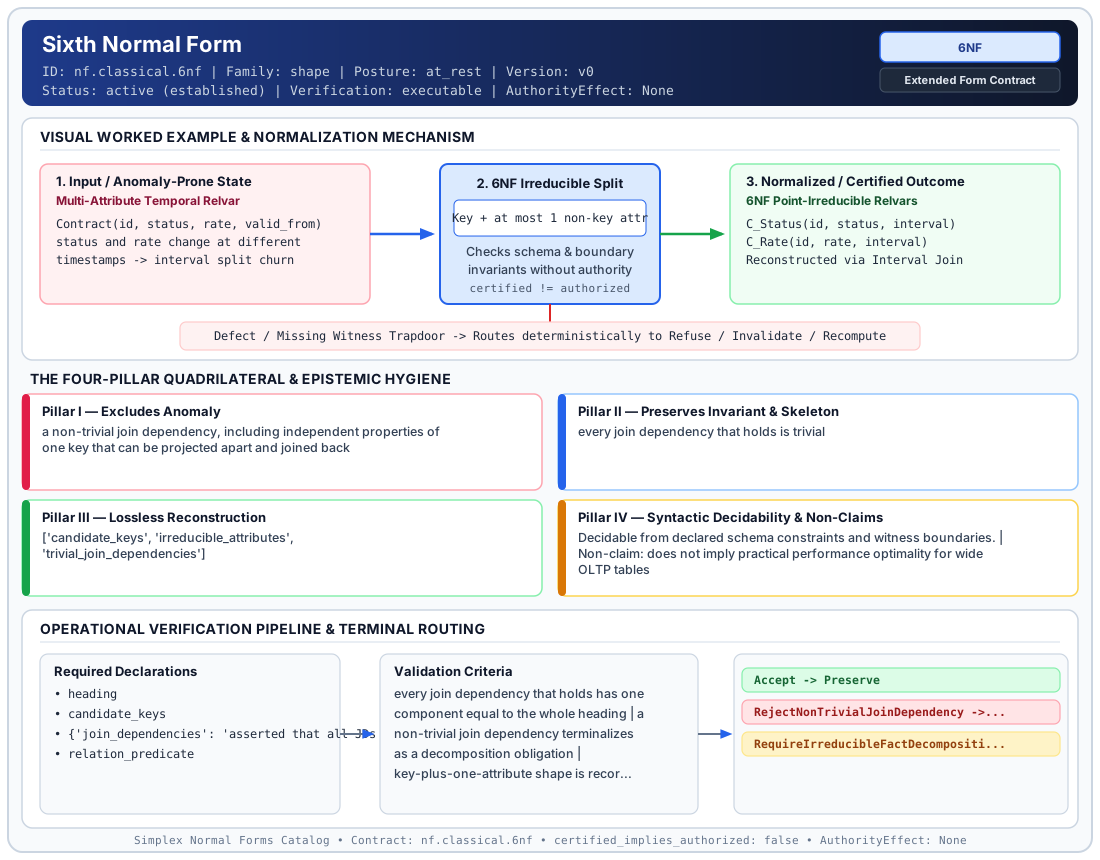
| Stage | Carrier / Operator | Concrete State / Invariant |
|---|---|---|
| 1. Before / Candidate Input | Multi-Attribute Temporal Relvar |
Contract(id, status, rate, valid_from) ; status and rate change at different ; timestamps -> interval split churn |
| 2. Normalization / Gate | 6NF Irreducible Split |
Key + at most 1 non-key attr (certified_implies_authorized: false) |
| 3. After / Certified Output | 6NF Point-Irreducible Relvars |
C_Status(id, status, interval) ; C_Rate(id, rate, interval) ; Reconstructed via Interval Join |
- ref: coda_all_universe/1_the_tower/normal_forms/contracts/_book_09_full_normal_form_atlas.md
section: 2.1 Classical Relational Normal FormsEvery contract in simplex-normal-forms is evaluated against the Four-Pillar Quadrilateral defined in contracts/_golden_nfs/standard.yaml:
| Pillar | Requirement | Contract Specification for nf.classical.6nf
|
|---|---|---|
| Pillar I: Excludes Anomaly | Name and eliminate a specific class of data or state defects. | a non-trivial join dependency, including independent properties of one key that can be projected apart and joined back |
| Pillar II: Preserves Invariant | State the structural invariant and protected skeleton preserved across transitions. |
Invariant: every join dependency that holds is trivial Protected Skeleton: ['candidate_keys', 'irreducible_attributes', 'trivial_join_dependencies'] |
| Pillar III: Lossless Reconstruction | State the non-loss reconstruction operator (join, direct sum, pullback, or replay). | Lossless reconstruction under declared projection, direct sum, or pullback operators. |
| Pillar IV: Syntactic Decidability | State how conformance is decided from declared constraints without unbudgeted scans. | Decidable from declared schema and witness metadata within bounded evaluation budgets. |
- does not imply practical performance optimality for wide OLTP tables
- does not require every production schema to decompose to 6NF
- does not certify runtime repair without cochain substrate
- does not imply authorization
- heading
- candidate_keys
- join_dependencies: asserted that all JDs are trivial
- relation_predicate
None declared.
| Criterion ID | Name | Condition |
|---|---|---|
criterion |
Check | every join dependency that holds has one component equal to the whole heading |
criterion |
Check | a non-trivial join dependency terminalizes as a decomposition obligation |
criterion |
Check | key-plus-one-attribute shape is recorded only as a sufficient pattern under a pure key constraint, and it is not accepted as the membership test |
Every evaluation terminates in a declared local route mapped to a canonical terminal in standard.yaml:
| Local Terminal Route | Canonical Terminal |
|---|---|
Accept |
Preserve |
RejectNonTrivialJoinDependency |
Reject |
RequireIrreducibleFactDecomposition |
Decompose |
- symptom: relvar contains candidate key and two non-key attributes that can be nonloss decomposed into two separate 6NF relvars, diagnosis: presence of non-trivial join dependency violating 6NF, terminal: RequireIrreducibleFactDecomposition
AuthorityEffect: None.
Level: Level 07 (Temporal Irreducibility & Lossless Interval Joins)
Evidential Grade: NATIVE IMPLEMENTED
Contract Reference: nf.classical.6nf
Mathematical Posture: Temporal Relational Theory (Date, Darwen, & Lorentzos 2002)
Data Posture: At Rest / Temporal History
Sixth Normal Form (6NF) decomposes relations to their irreducible components:
- A relation is in 6NF if and only if it satisfies no non-trivial join dependencies at all.
- Essential for temporal databases: multi-attribute temporal relvars with independent interval histories cannot be updated without creating gap and collision anomalies.
- In 6NF, each relvar consists of candidate keys, an interval, and at most one non-key attribute.
       Temporal Multi-Attribute Relvar (Fails 6NF)
  ┌────┬─────────┬────────┬─────────────────────────────┐
  │ ID │ Status  │ Salary │ Interval [From, To)         │
  ├────┼─────────┼────────┼─────────────────────────────┤
  │ 1  │ Active  │ 80,000 │ [2026-01-01, 2026-06-01)   │
  └────┴─────────┴────────┴─────────────────────────────┘
  Updating Salary on March 1 forces artificial splitting of Status!
                        │
                6NF Decomposition
                        ▼
  R1: (ID, Status, Interval)  [Irreducible]
  R2: (ID, Salary, Interval)  [Irreducible]
-
Formal Definition (Date et al. 2002): A relation schema
$R$ is in 6NF if and only if$R$ satisfies no non-trivial join dependencies. That is, the only join dependencies satisfied by$R$ are of the form$\Join[R]$ , meaning$R$ cannot be decomposed into proper projections without losing information. In practical temporal terms:$$R = K \cup {\tau} \cup {A}$$ where$K$ is the entity key,$\tau$ is a valid-time interval, and$A$ is a single non-key attribute. -
Lossless Interval-Join Invariant: Two temporal 6NF relations
$R_1(K, \tau, A)$ and$R_2(K, \tau, B)$ reconstruct the joint history via the interval join operator:$$R_1 \bowtie_{\text{interval}} R_2 = {(k, \tau_1 \cap \tau_2, a, b) : (k, \tau_1, a) \in R_1 \land (k, \tau_2, b) \in R_2 \land \tau_1 \cap \tau_2 \neq \emptyset}$$ This join is ensured under declared assumptions lossless and reconstructs the multi-attribute historical state without gap or collision artifacts. -
The Quadrilateral Invariants:
- Anomaly Excluded: Temporal update collisions, interval fragmentation, and artificial splitting of independent historical facts.
- Protected Skeleton: Independent attribute-interval histories.
- Erased Structure: Accidental coupling of distinct attribute update cadences.
-
Reconstruction: Interval-intersection natural join
$\bowtie_{\text{interval}}$ .
5NF Relation & Temporal Intervals
      │
      ├── Satisfies only trivial JDs (at most 1 non-key attr) ──► Preserve (6NF Verified)
      │
      ├── Multiple independent temporal attributes exist ──────► Repair (6NFDecomposeToUnary)
      │
      └── Schema fails 5NF preconditions ──────────────────────► Refuse (5NFPreconditionFailed)
-
Preserve: Relation is irreducible under all project-join operations. -
Repair: Decomposes multi-attribute relation into single-attribute historical relvars. -
Refuse: 5NF preconditions failed.
Verified in test_tranche3_advanced_relational_nfs.py:
-
test_6nf_irreducible_temporal_decomposition: Confirms that decomposing temporal relvars eliminates update coupling. -
test_6nf_join_reconstruction_temporal_losslessness: supports that interval-join reconstruction restores the full historical timeline without temporal gaps.
-
What it supports:
- Elimination of all temporal update, insertion, and deletion collisions.
- Independent versioning and compaction of separate attributes.
-
What it does not support:
- Storage efficiency for non-temporal, statically updated relations (where 6NF causes excessive table proliferation).
-
The narrowest defensible claim:
- 6NF is the ultimate decomposition: every 6NF relation is irreducible.
-
The next test needed:
- Performance benchmark comparing 6NF interval joins against 3NF temporal coalescing under high-frequency writes.
In accordance with the repository's epistemic claim discipline:
-
What it supports:
- Supports syntactic and operational checking of
nf.classical.6nf(6NF) against its declared schema, boundary constraints, and witness obligations in this model. - Supports deterministic terminal routing (
Accept, RejectNonTrivialJoinDependency, RequireIrreducibleFactDecomposition) when required declarations or invariants fail.
- Supports syntactic and operational checking of
-
What it does not support:
- Does not confer operational authority (
AuthorityEffect: None,certified_implies_authorized: false). - Does not claim semantic truth of undeclared external processes or unverified upstream inputs beyond the declaredprotected skeleton.
- Does not confer operational authority (
-
The narrowest defensible claim:
- Within the declared substrate
at_rest, this contract enforces thata non-trivial join dependency, including independent properties of one key that can be projected apart and joined backis either excluded underevery join dependency that holds is trivialor routed to an explicit refusal/recovery terminal.
- Within the declared substrate
-
The next test needed:
- Property-based falsification and mutation testing across boundary edge cases and composed multi-step pipelines for
nf.classical.6nf.
- Property-based falsification and mutation testing across boundary edge cases and composed multi-step pipelines for
Click to expand full canonical YAML contract (contracts/nf.classical.6nf.yaml)
schema_version: smplx.nf.contract.v0
schema_ref: ./normal_form_contract_schema.yaml
contract_kind: normal_form_contract
identity:
  id: nf.classical.6nf
  name: Sixth Normal Form
  short_name: 6NF
  version: v0
  theory_status: established
  contract_status: active
  verification_status: executable
  family: shape
  status: active
classification:
  hierarchy_level: normal_form
  subject_kind:
  - relvar
  data_posture: at_rest
  mathematical_posture: operational
purpose:
  excludes_anomaly: a non-trivial join dependency, including independent properties
    of one key that can be projected apart and joined back
  preserves_invariant: every join dependency that holds is trivial
  protected_skeleton:
  - candidate_keys
  - irreducible_attributes
  - trivial_join_dependencies
  erased_structure: []
  non_claims:
  - does not imply practical performance optimality for wide OLTP tables
  - does not require every production schema to decompose to 6NF
  - does not certify runtime repair without cochain substrate
  - does not imply authorization
definition:
  source: coda_all_universe/mssn_sn_tower/definitions.md
  citation:
    authors: C. J. Date, Hugh Darwen, and Nikos A. Lorentzos
    year: 2002
    work: Temporal Data and the Relational Model
  formal_statement: 'A relvar is in sixth normal form when it satisfies no non-trivial
    join dependency. Equivalently, every lossless decomposition has a component whose
    heading is the whole heading. The form is aimed at independent properties of one
    key, including properties that vary over distinct temporal intervals.

    '
  binary_fact_shape:
    statement: 'A heading that is one candidate key plus a single attribute outside
      that key satisfies the form when the key constraint is the only constraint,
      because there is no second attribute with which to build a non-trivial join
      dependency.

      '
    defines_membership: false
    note: 'A wider heading can still satisfy the form when a further constraint blocks
      every non-trivial join dependency. An all-key heading can still fail the form
      when a non-trivial join dependency holds among the key attributes.

      '
  quadrilateral:
    qualifies_as_true_normal_form: true
    anomaly_exclusion: 'Independent facts, including distinct interval properties
      of one key, that a non-trivial join dependency can separate.

      '
    lossless_join:
      status: trivial_decompositions_only
      statement: 'The only lossless decompositions are the trivial ones. There is
        no non-trivial project-join reconstruction because no non-trivial join dependency
        holds.

        '
    dependency_preservation:
      status: not_applicable
      statement: 'There is no non-trivial decomposition across which a dependency
        would have to be preserved. Constraints that are not join dependencies are
        outside this form. Domain-key normal form is the separate test for those constraints.

        '
    syntactic_decision:
      status: schema_decidable_for_a_finite_jd_cover
      statement: 'Decided by showing that every join dependency implied by the declared
        cover is trivial. One stored body is not the decider. The shape "key plus
        one other attribute" is not a substitute for that check.

        '
  chain:
    requires:
    - 5NF
    implied_by: []
declarations_required:
- heading
- candidate_keys
- join_dependencies: asserted that all JDs are trivial
- relation_predicate
evidence_required: []
validation_criteria:
- every join dependency that holds has one component equal to the whole heading
- a non-trivial join dependency terminalizes as a decomposition obligation
- key-plus-one-attribute shape is recorded only as a sufficient pattern under a pure
  key constraint, and it is not accepted as the membership test
proof_obligations:
- id: 6nf.trivial_jd_characterization
  status: theorem_shaped
  ref: coda_all_universe/mssn_sn_tower/definitions.md
  statement: 'A relvar is in sixth normal form when every join dependency it satisfies
    is trivial.

    '
terminal_routes:
- Accept
- RejectNonTrivialJoinDependency
- RequireIrreducibleFactDecomposition
terminal_route_map:
  Accept: Preserve
  RejectNonTrivialJoinDependency: Reject
  RequireIrreducibleFactDecomposition: Decompose
certification:
  certificate_required: false
  certificate_kind: null
  obstruction_class_required: false
  loss_ledger_required: false
  verifier_required: false
  loss_ledger_trigger_id: null
authorization:
  authorized_by: null
  certified_implies_authorized: false
failure_modes:
- symptom: relvar contains candidate key and two non-key attributes that can be nonloss
    decomposed into two separate 6NF relvars
  diagnosis: presence of non-trivial join dependency violating 6NF
  terminal: RequireIrreducibleFactDecomposition
examples:
- ref: coda_all_universe/1_the_tower/normal_forms/contracts/_book_09_full_normal_form_atlas.md
  section: 2.1 Classical Relational Normal Forms
references:
- coda_all_universe/1_the_tower/normal_forms/contracts/_book_09_full_normal_form_atlas.md
- coda_all_universe/1_the_tower/normal_forms/contracts/_paper_0_relvar_relation_table_and_boundary_relvar.md