Repository navigation
nf.coda.eqnf
Contract ID:
nf.coda.eqnf| Family:epistemic| Index Status:draft| AuthorityEffect:None
⬅ Back to Wiki Home | View SVG Diagram
Epistemic Quotient Normal Form (EQNF) enforces structural normalization and explicit defect routing in the epistemic regime.
| Property | Value |
|---|---|
| Canonical ID | nf.coda.eqnf |
| Short Name | EQNF |
| Full Name | Epistemic Quotient Normal Form |
| Family |
epistemic (Observer-Relative Epistemic, Freshness, Context, Provenance & Distinguishability Contracts) |
| Qualification | Extended Form Contract (Normal Form Contract) |
| Data / Math Posture | at_rest |
| Index Status | draft |
| Theory Status | established |
| Verification Status | executable |
| Contract Version | v0 |
| Governance Fence |
AuthorityEffect: None (certified_implies_authorized: false) |
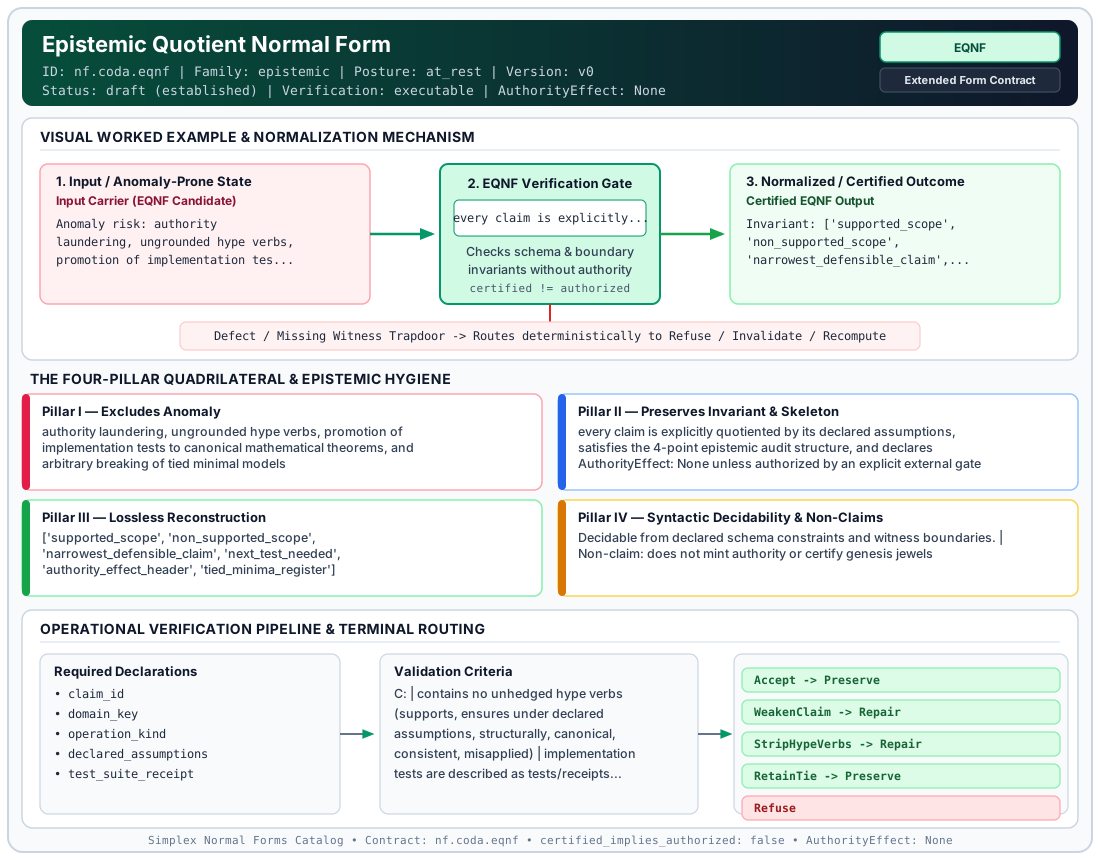
| Stage | Carrier / Operator | Concrete State / Invariant |
|---|---|---|
| 1. Before / Candidate Input | Input Carrier (EQNF Candidate) |
Anomaly risk: authority ; laundering, ungrounded hype verbs, ; promotion of implementation tes... |
| 2. Normalization / Gate | EQNF Verification Gate |
every claim is explicitly... (certified_implies_authorized: false) |
| 3. After / Certified Output | Certified EQNF Output |
Invariant: ['supported_scope', ; 'non_supported_scope', ; 'narrowest_defensible_claim',... |
- ref: coda_all_universe/1_the_tower/9_ansi_sql/bisimulation_receipt.md
section: 3. Epistemic Audit (Claim Hygiene)Every contract in simplex-normal-forms is evaluated against the Four-Pillar Quadrilateral defined in contracts/_golden_nfs/standard.yaml:
| Pillar | Requirement | Contract Specification for nf.coda.eqnf
|
|---|---|---|
| Pillar I: Excludes Anomaly | Name and eliminate a specific class of data or state defects. | authority laundering, ungrounded hype verbs, promotion of implementation tests to canonical mathematical theorems, and arbitrary breaking of tied minimal models |
| Pillar II: Preserves Invariant | State the structural invariant and protected skeleton preserved across transitions. |
Invariant: every claim is explicitly quotiented by its declared assumptions, satisfies the 4-point epistemic audit structure, and declares AuthorityEffect: None unless authorized by an explicit external gate Protected Skeleton: ['supported_scope', 'non_supported_scope', 'narrowest_defensible_claim', 'next_test_needed', 'authority_effect_header', 'tied_minima_register'] |
| Pillar III: Lossless Reconstruction | State the non-loss reconstruction operator (join, direct sum, pullback, or replay). | Lossless reconstruction under declared projection, direct sum, or pullback operators. |
| Pillar IV: Syntactic Decidability | State how conformance is decided from declared constraints without unbudgeted scans. | Decidable from declared schema and witness metadata within bounded evaluation budgets. |
- does not mint authority or certify genesis jewels
- does not eliminate the need for interactive theorem supporting in Lean 4
- does not treat a green test suite as a mathematical proof of unbounded theorems
- AuthorityEffect: None
- claim_id
- domain_key
- operation_kind
- declared_assumptions
- test_suite_receipt
- test_execution_log
- lean_elaboration_receipt
- what_it_supports
- what_it_does_not_support
- narrowest_defensible_claim
- next_test_needed
| Criterion ID | Name | Condition |
|---|---|---|
| `` | **** | |
criterion |
Check | contains no unhedged hype verbs (supports, ensures under declared assumptions, structurally, canonical, consistent, misapplied) |
criterion |
Check | implementation tests are described as tests/receipts, not mathematical proofs |
criterion |
Check | mathematical toy models are scoped to the declared finite setting |
criterion |
Check | every receipt includes all 4 points of the epistemic audit |
criterion |
Check | tied minimal candidates are retained as sets rather than broken by arbitrary position |
Every evaluation terminates in a declared local route mapped to a canonical terminal in standard.yaml:
| Local Terminal Route | Canonical Terminal |
|---|---|
Accept |
Preserve |
WeakenClaim |
Repair |
StripHypeVerbs |
Repair |
RetainTie |
Preserve |
Refuse |
Refuse |
- symptom: test receipt uses forbidden verb "supports" or "ensures under declared assumptions", diagnosis: ungrounded hype verb violating claim discipline, terminal: StripHypeVerbs
- symptom: toy setting described as canonical theorem, diagnosis: overclaim failure mode, terminal: WeakenClaim
- symptom: tie broken without declared selection rule, diagnosis: arbitrary symmetry breaking violating SCNF, terminal: RetainTie
AuthorityEffect: None.
Level: Level 16 (Data under Observation / Quotient Factors & Kernel Equality)
Evidential Grade: NATIVE IMPLEMENTED
Contract Reference: nf.coda.eqnf
Mathematical Posture: canonical Quotient Factorization & Canonical Kernels
Data Posture: Under Observation
Epistemic Quotient Normal Form (EQNF) disciplines how relations and representations are quotiented by equivalence relations:
- When two objects or rows cannot be distinguished by any admitted observer, they belong to the same equivalence class.
- EQNF asserts that any valid quotient map factors uniquely through the declared kernel:
$$\pi: A \to A / \sim$$ - Any factor through the quotient is unique on the declared kernel, and quotient distance is strictly the
$L_1$ distance between quotient classes. - A non-trivial equivalence class does not assert point equality on carrier elements; it records that the declared observers cannot separate them.
               Carrier Set A
            ┌───────────────────┐
            │   a1 ~ a2         │ (Kernel Equivalence)
            └─────────┬─────────┘
                      │ Quotient Map \pi
                      ▼
               Quotient Space A / ~
            ┌───────────────────┐
            │      [a]          │
            └─────────┬─────────┘
                      │ Unique Factor \bar{f}
                      ▼
               Target Space B
-
canonical Factorization Law: Let
$\sim$ be an equivalence relation with kernel$\ker(\sim)$ . A map$f: A \to B$ factors through$\pi: A \to A/\sim$ if and only if$\ker(\sim) \subseteq \ker(f)$ . When this holds, there exists a unique map$\bar{f}: A/\sim \to B$ such that:$$f = \bar{f} \circ \pi$$ -
The Quadrilateral Invariants:
- Anomaly Excluded: Ambiguous quotient factorizations, illegal identification of non-equivalent states, conflating quotient representatives with carrier point identity.
- Protected Skeleton: Equivalence classes, declared kernel pairs, and certified quotient metrics.
- Erased Structure: Internal differences between kernel-equivalent representatives.
-
Reconstruction: Factorial lift
$\bar{f}$ over canonical class representatives.
Candidate Quotient Map f & Declared Kernel ~
      │
      ├── ker(~) ⊆ ker(f) & verification status machine_checked ──► Preserve (EQNFFactorValid)
      │
      ├── f separates elements in ker(~) ────────────────────────► Refuse (KernelSeparated)
      │
      └── Verification status absent or unverified ──────────────► Refuse (UnverifiedQuotient)
-
Preserve: Map factors uniquely through the quotient with machine-checked verification. -
Refuse: Candidate factor violates kernel equivalence, or quotient lacks verification proof.
Verified in test_tranche8_epistemic_and_authority.py and test_tranche30_pseudometric_and_quotient_factors.py:
-
test_universal_factor_unique_on_classes: supports that any two factors agreeing on all quotient classes are identical. -
test_eqnf_unverified_quotient_refuses_preserve: Asserts that an EQNF quotient with verification statusabsentfails closed to typed refusal.
-
What it supports:
- Rigorous mathematical quotienting across database tables, states, and prompt representations.
- canonical factor uniqueness on declared kernels.
-
What it does not support:
- Point equality on carrier objects prior to an explicit metric separation axiom (governed by ODNF).
-
The narrowest defensible claim:
- EQNF ensures under declared assumptions that equivalence classes are closed under all declared observer operations.
-
The next test needed:
- Property tests asserting that composite quotients
$(A / \sim_1) / \sim_2$ are naturally isomorphic to$A / (\sim_1 \lor \sim_2)$ .
- Property tests asserting that composite quotients
In accordance with the repository's epistemic claim discipline:
-
What it supports:
- Supports syntactic and operational checking of
nf.coda.eqnf(EQNF) against its declared schema, boundary constraints, and witness obligations in this model. - Supports deterministic terminal routing (
Accept, WeakenClaim, StripHypeVerbs, RetainTie) when required declarations or invariants fail.
- Supports syntactic and operational checking of
-
What it does not support:
- Does not confer operational authority (
AuthorityEffect: None,certified_implies_authorized: false). - Does not claim semantic truth of undeclared external processes or unverified upstream inputs beyond the declaredprotected skeleton.
- Does not confer operational authority (
-
The narrowest defensible claim:
- Within the declared substrate
at_rest, this contract enforces thatauthority laundering, ungrounded hype verbs, promotion of implementation tests to canonical mathematical theorems, and arbitrary breaking of tied minimal modelsis either excluded underevery claim is explicitly quotiented by its declared assumptions, satisfies the 4-point epistemic audit structure, and declares AuthorityEffect: None unless authorized by an explicit external gateor routed to an explicit refusal/recovery terminal.
- Within the declared substrate
-
The next test needed:
- Property-based falsification and mutation testing across boundary edge cases and composed multi-step pipelines for
nf.coda.eqnf.
- Property-based falsification and mutation testing across boundary edge cases and composed multi-step pipelines for
Click to expand full canonical YAML contract (contracts/nf.coda.eqnf.yaml)
schema_version: smplx.nf.contract.v0
schema_ref: ./normal_form_contract_schema.yaml
contract_kind: normal_form_contract
identity:
  id: nf.coda.eqnf
  name: Epistemic Quotient Normal Form
  short_name: EQNF
  version: v0
  status: draft
  family: epistemic
  theory_status: established
  contract_status: draft
  verification_status: executable
classification:
  hierarchy_level: normal_form
  subject_kind:
  - claim_ledger
  - epistemic_receipt
  - verification_boundary
  - audit_envelope
  data_posture: at_rest
  mathematical_posture: operational
purpose:
  excludes_anomaly: authority laundering, ungrounded hype verbs, promotion of implementation
    tests to canonical mathematical theorems, and arbitrary breaking of tied minimal models
  preserves_invariant: 'every claim is explicitly quotiented by its declared assumptions,
    satisfies the 4-point epistemic audit structure, and declares AuthorityEffect: None unless
    authorized by an explicit external gate'
  protected_skeleton:
  - supported_scope
  - non_supported_scope
  - narrowest_defensible_claim
  - next_test_needed
  - authority_effect_header
  - tied_minima_register
  erased_structure:
  - hype_verbs
  - unverified_universal_quantifiers
  non_claims:
  - does not mint authority or certify genesis jewels
  - does not eliminate the need for interactive theorem supporting in Lean 4
  - does not treat a green test suite as a mathematical proof of unbounded theorems
  - 'AuthorityEffect: None'
quadrilateral:
  qualifies_as_true_normal_form: false
  qualification_gap: claim_record_not_a_relvar_decomposition
  anomaly_exclusion: a claim whose scope, failure, or authority header is missing or overstated
  lossless_join:
    status: not_a_relational_decomposition
    statement: the four-part audit is retained with the claim; nothing is reconstructed by
      a join
  dependency_preservation:
    status: assumptions_stay_attached
    statement: a claim keeps the assumptions it was quotiented by
  syntactic_decision:
    status: declaration_decidable
    statement: the check reads the claim record and its audit fields
declarations_required:
- claim_id
- domain_key
- operation_kind
- declared_assumptions
- test_suite_receipt
evidence_required:
- test_execution_log
- lean_elaboration_receipt
- what_it_supports
- what_it_does_not_support
- narrowest_defensible_claim
- next_test_needed
validation_criteria:
- contains explicit "AuthorityEffect: None" header
- contains no unhedged hype verbs (supports, ensures under declared assumptions, structurally, canonical, consistent,
  misapplied)
- implementation tests are described as tests/receipts, not mathematical proofs
- mathematical toy models are scoped to the declared finite setting
- every receipt includes all 4 points of the epistemic audit
- tied minimal candidates are retained as sets rather than broken by arbitrary position
proof_obligations:
- id: eqnf.claim_hygiene_invariant
  status: declared_upstream
  ref: AGENTS.md
  section: Claim Hygiene Rule
terminal_routes:
- Accept
- WeakenClaim
- StripHypeVerbs
- RetainTie
- Refuse
terminal_route_map:
  Accept: Preserve
  WeakenClaim: Repair
  StripHypeVerbs: Repair
  RetainTie: Preserve
  Refuse: Refuse
certification:
  certificate_required: true
  certificate_kind: epistemic_audit_certificate
  obstruction_class_required: false
  loss_ledger_required: true
  verifier_required: true
  loss_ledger_trigger_id: null
authorization:
  authorized_by: null
  certified_implies_authorized: false
failure_modes:
- symptom: test receipt uses forbidden verb "supports" or "ensures under declared assumptions"
  diagnosis: ungrounded hype verb violating claim discipline
  terminal: StripHypeVerbs
- symptom: toy setting described as canonical theorem
  diagnosis: overclaim failure mode
  terminal: WeakenClaim
- symptom: tie broken without declared selection rule
  diagnosis: arbitrary symmetry breaking violating SCNF
  terminal: RetainTie
examples:
- ref: coda_all_universe/1_the_tower/9_ansi_sql/bisimulation_receipt.md
  section: 3. Epistemic Audit (Claim Hygiene)
references:
- ./nf.derivation.scnf.yaml
- ./nf.derivation.aonf.yaml
- AGENTS.md