Repository navigation
Processes Time Step
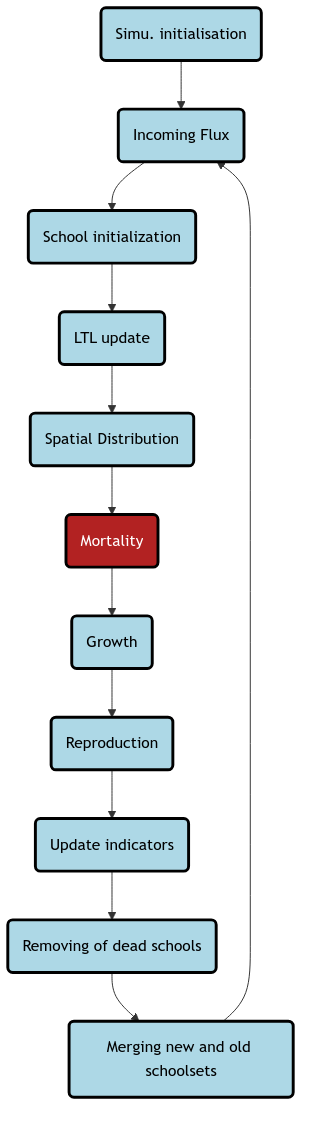
While running OSMOSE, multiple processes happen at each time step. Schools may enter the model from outside the simulated area; this is called incoming flux. After any additions from outside the model domain, the schools that are in egg form, alive, or dead are accounted for; this is part of school initialisation. Then, schools that are eggs or alive, and that are small enough, can feed on low-trophic-level (LTL) inputs, such as phytoplankton; this is called LTL update.
After these updates, schools are allowed to move throughout the model domain through the movement process. Once schools have entered, left, or moved within a given location of the model, mortality processes are applied. These include starvation, fishing, predation, post-reproduction senescence, and any additional mortality processes that may be selected. These processes are described together under mortality.
Some mortality sources can contribute to detritus, allowing part of the biomass of dead individuals to be recycled into the ecosystem. Schools that remain alive after movement and mortality then go through growth. Depending on their size, age, and species-specific rules, individuals may also go through maturation. Finally, mature adults can go through reproduction, contributing new eggs or offspring to the population.