Linear Fresnel design
CyI owns a Linear Fresnel Facility (LFR) integrated on a roof in the built-environment. The primary optics is made of 288 mirrors of dimensions 0.32 m x 2 m each, of reflectivity 0.924. The global reflective area is 184.32 m2. The receiver is made of 8 absorber tubes under vacuum in series. Often the mirrors of the primary reflector are not strictly parabolic. In practice they are mold as portions of large cylinders which radius is twice the focus of the desired parabolic cylinder. Cylindrical mirrors are indeed common in LFRs as they are cheaper to manufacture than parabolic ones. In Tonatiuh they were directly modelled directly with cylinder shape while in Tonatiuh++ this is can be achieved with elliptic function setting an infinite focus distance on the axis of rotation (10^6 m in practice). In Tonatiuh++, the facet and the primary shifts can be directly computed while Tonatiuh requires prior calculations in order to fix the axis of rotation compared to the center of the cylinder. As Tonatiuh++ offers the possibility to compute directly analytic functions for the 3 axis, the shape of the secondary optics can be better interpolated, while with the former version, the only parabolic, i.e. order 2 was available. In this specific case this has helped to interpolate better the shape of the mirror of the secondary optics. The absorber is enclosed inside a vacuum pipe in borosilicate. Usually this pipe would be modeled as a transparent surface within Tonatiuh, while in Tonatiuh++ the Fresnel (Unpolarized) material can be selected for the outer and inner surfaces of the tube, leading to more accurate results.
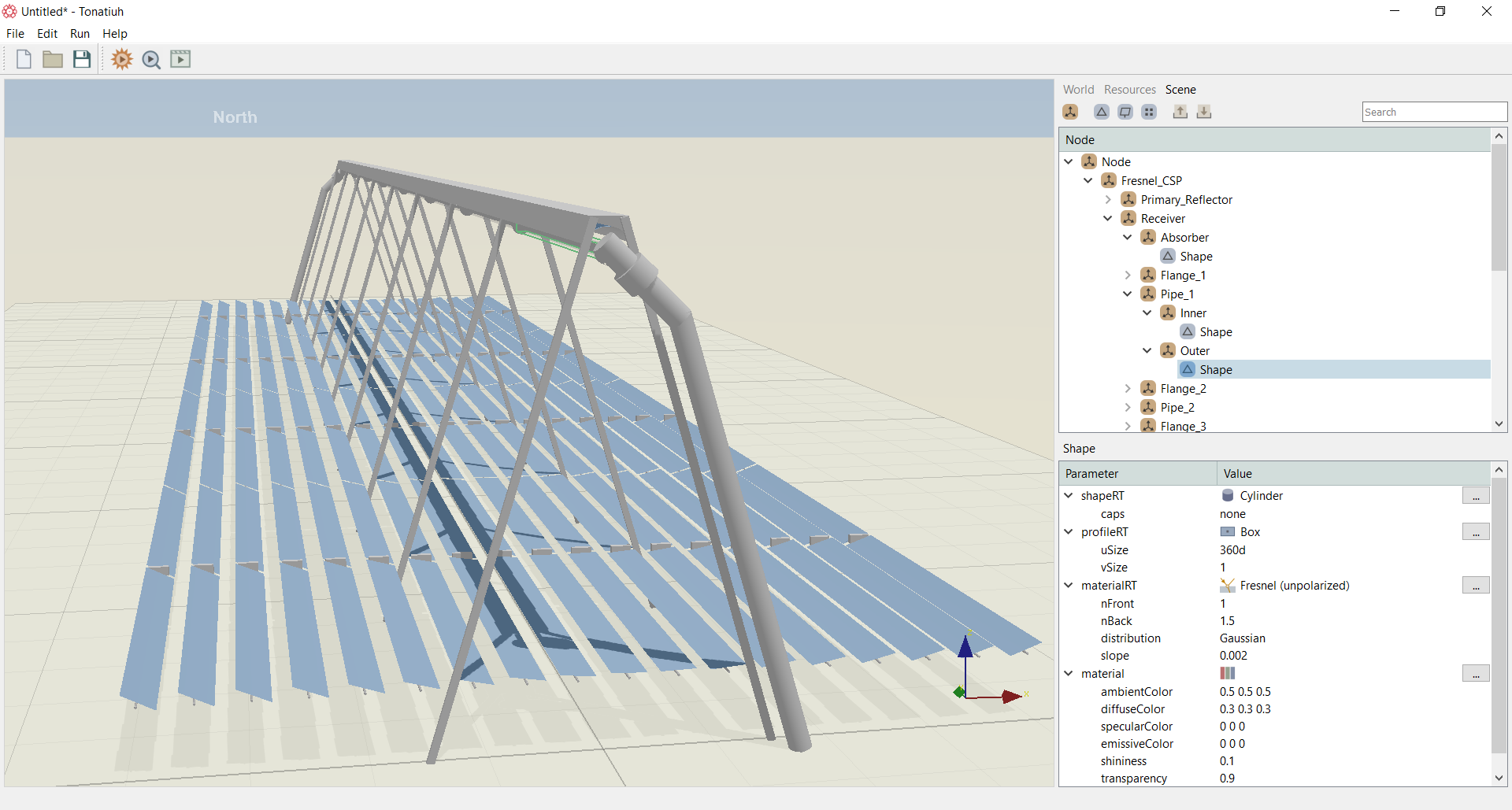
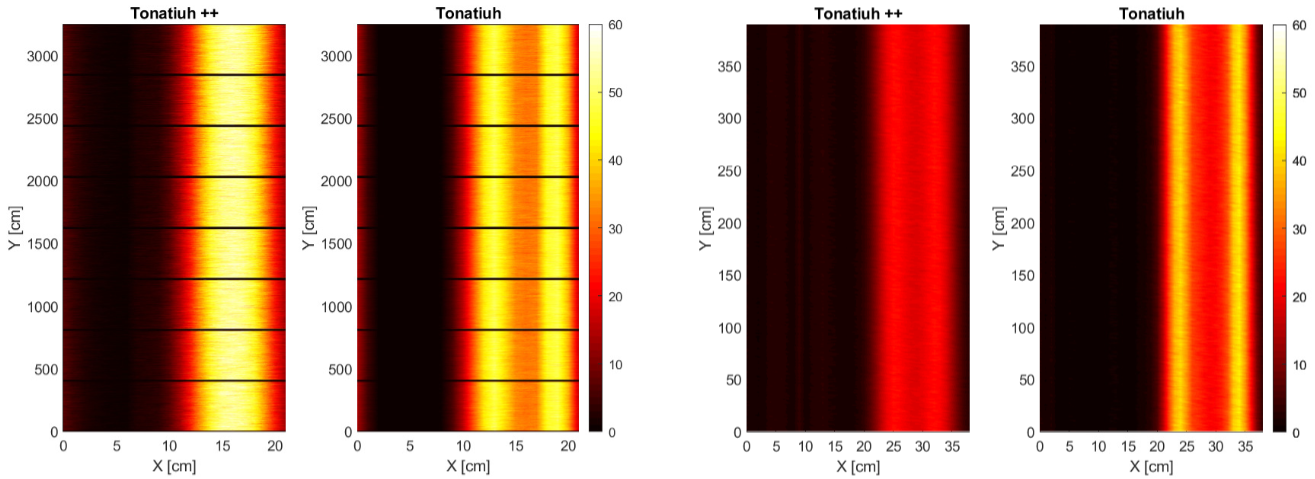
Figure below shows a comparison between simulations of the same facility with Tonatiuh and Tonatiuh++ to highlight the effect of the different materials. The Figure displays the flux on the absorber outer wall with Tonatiuh++ and Tonatiuh, while DNI was fixed to 1 (W.m^2) and the sun at zenith position. On both images, the half cylinder that faces the secondary optics receives almost no rays, pointing out its poor efficiency. The part that faces the primary reflector is enlighten. The main difference that can be observed is that on Tonatiuh++, the flux is mainly concentrated in the bottom, while with Tonatiuh, the flux is concentrated on 2 main strips. The radiation received on the absorber is 131.3 W with Tonatiuh++ and 138.4 W with Tonatiuh (+5%).
The above example is included in the examples folder of the Tonatiuh++ installation directory. A how to video in shown below on how to recreate the LFR.