Repository navigation
Privacy
Private by architecture, not by promise. There's no account and no server of ours. Recording, transcription (including live transcription) and storage all run on your computer.
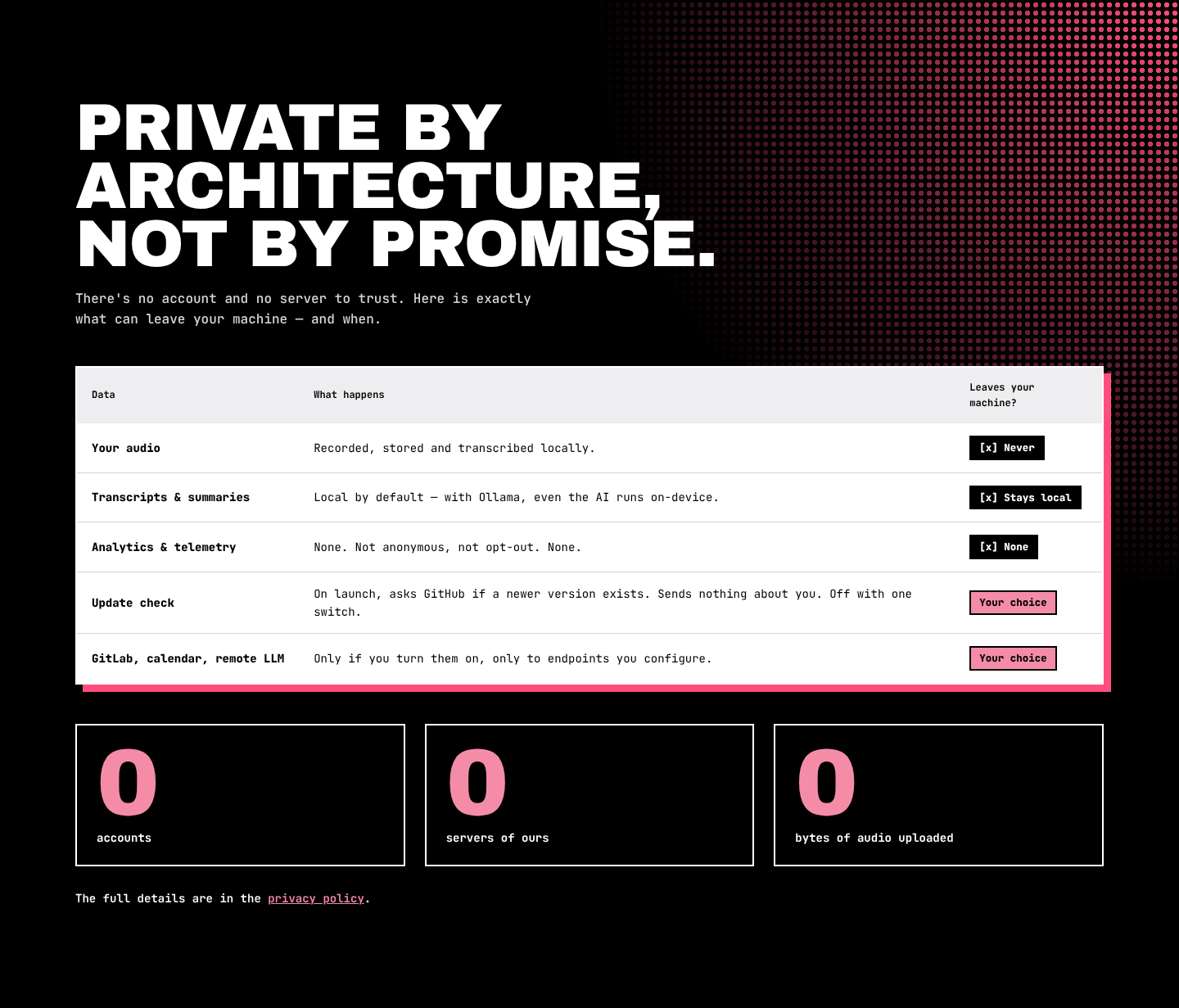
The app connects to the network only when you do something that needs it:
| What | When | Where |
|---|---|---|
| Speech model download | You click Download / Set up transcription | Hugging Face (ggerganov/whisper.cpp) |
| Update check | You click Check for updates, or you turned on the launch check | GitHub Releases |
| GitLab sharing | You click Upload, Test connection or create issues | Your GitLab server |
| Company calendar | You open Calendar, test, detect or approve an event | Your calendar server |
| LLM summary | You click Summarize. Ollama stays local; API / Open WebUI / OpenCode / Claude Code send the transcript text to that provider. | The endpoint you configured |
Audio is never uploaded. Integrations send text only.
- No analytics, telemetry or crash reports. Not anonymous, not opt-out: none.
- No accounts.
- The built-in whisper.cpp is built without its network features (
WHISPER_CURL=OFF,GGML_RPC=OFF, no server). - The recording engine (
cpal+libopus) talks only to your OS sound service (WASAPI, CoreAudio, PulseAudio/PipeWire). - An automated test (
src/privacy.test.tsin the app repository) fails if the code gains a new way to reach the network.
The OS web view (WebView2 / WebKit) follows your operating system's own diagnostic-data settings.
GitLab tokens, calendar passwords and LLM API keys are stored only on this device, in the app's local storage.
The landing page uses cookieless Vercel Web Analytics and reads public release data from GitHub. It stores nothing on your device. See Legal Pages and Analytics and Download Counts.