Repository navigation
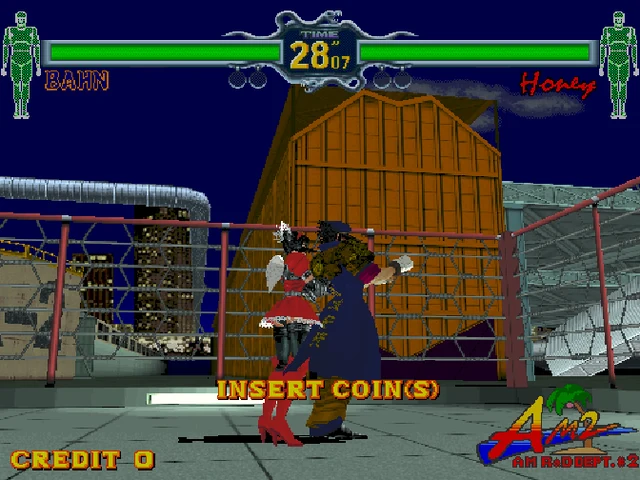
Sega Model 2 and 3
Sega's 3D arcade boards of the 1990s: Model 2 (Daytona USA, Virtua Fighter 2, The House of the Dead, Sega Rally) and Model 3 (Scud Race, Virtua Fighter 3, Daytona USA 2), both in Keisho. It was called SM2-Emu until November 2026, and Model 3 used to be Supermodel.
| Board | Emulator | Folder | Sets | Memory and save states |
|---|---|---|---|---|
| Model 2 (2, 2A, 2B, 2C) | Keisho | ~/roms/model2 |
MAME sets | ~/nvram/model2 |
| Model 3 | Keisho | ~/roms/model3 |
MAME sets | ~/nvram/model3 |
Both open in their own Xorg at 640x240 at 57.524 Hz on a 15 kHz tube (the boards' refresh), stretched to fill it, or 496x384 interlaced with Interlaced hacks (Interlaced, colour and scanlines). Both have link play between cabinets: Daytona USA, Scud Race and more (Linked cabinets).
Keisho comes in the image, as a FliperOS package that the updates keep current. Build the newest in Setup > Games > Emulators & Games > Keisho builds the project's latest code on the cabinet, with FliperOS's patch.
- From a frontend: the Model 2 and Model 3 screens open the game straight away.
- From the desktop's Games > Model 2 or Games > Model 3: a terminal lists the
.zipfiles of that folder by their names; Enter opens one, Esc exits. A set that can't be loaded stays on that screen, with the missing chip named.
Sets: chips are matched by CRC32, so a zip has to be a MAME set; one made only for the old Model 2 Emulator can miss a chip. Daytona USA, Desert Tank and Virtua Cop also need MAME's I/O boards (model1io.zip, model1io2.zip) next to them, which the ROM Cleaner brings. A clone finds its parent's chips in the same folder.
Controls: a gamepad is read by button position, with the keyboard live beside it (5 and 6 insert coins, 1 and 2 start, the arrows and Z X C V are player 1). The panel's button mapping is the same for Model 2 and Model 3. F9 quits; F10 is the emulator's own settings menu, readable at 640x240. coin + button 1 opens it too.
Video: Vulkan or OpenGL. Like Flycast and Dolphin, Keisho follows the video card's driver: Vulkan on amdgpu, OpenGL on the others (radeon has no Vulkan). The first launch writes graphics_backend to keisho.ini, and switching the driver in Setup > Video Setup switches it again. A choice made in F10 stays. If the card has no Vulkan, Keisho falls back to OpenGL by itself. It needs OpenGL 4.3 or Vulkan 1.3.
Game outputs: it publishes the lamps, the recoil, ammunition and life of the gun games (Model 2 and Model 3), the round wins of the Model 2 fighting games (for the versus score) and the credits, on TCP port 8000 (DIY hardware).
Speed: Model 1 and 2 run on one CPU core; FliperOS's speed work on the geometry coprocessors is part of the emulator since 0.9.41 (on the cabinet's i3-540: 0.93× to 2.34× on The House of the Dead, 0.71× to 1.65× on Last Bronx, 0.85× to 2.84× on Fighting Vipers). Model 3's PowerPC runs through a JIT, and each frame is drawn on a second thread. Model 3 in Keisho has not been timed on the cabinet's i3-540 yet (Supermodel needed its PowerPC slowed to 75 MHz there). On a Core i7-870 (2.93 GHz) Fighting Vipers 2 holds 57.5 Hz in light scenes and dips to 48 to 52 Hz in heavy ones, because the PowerPC and the sound boards share one thread: CPU and speed has the timing and the Turbo Boost setting.
The update to Keisho removes the Supermodel package once Keisho is installed. The <set>.nv files in ~/nvram/model3 stay: Keisho reads Supermodel's NVRAM format, so high scores, settings and link roles carry over. The frontend screen Supermodel is now Model 3: its play counts move with it, and favourites stay. A frontend that still has the old supermodel command opens the game in Keisho.
- The package
fliperos-keisho(packaging/packages/fliperos-keisho.sh) builds a fixed commit with Vulkan and OpenGL and the patches inpackaging/patches/keisho: the light gun keeps the last position that saw the screen over a missed beam. It installs/usr/local/bin/keishoand/usr/local/share/keisho/games.xml. -
fliperos-model2andfliperos-model3(the same script, the name picks the system) open a game for the frontends withexec, so the wrapper waits for it. They pass both ROM folders; Model 3 gets--nvram ~/nvram/model3, Model 2 uses Keisho's ownnvram_dir, whichfliperos-romslinks to~/nvram/model2. -
fliperos-x11-runwrites to~/.config/keisho/keisho.inion each launch:aspect_mode = stretchwhen the mode is wider than 4:3,vsync = trueandgraphics_backendthe first time, the outputs, the light gun and the GunCon 2 buttons.lib/emulators.shswitchesgraphics_backendwhen the card's driver changes. -
fliperos-sm2emuis the desktop's game list (the quick check of a set uses a throwaway NVRAM) and moves the SM2-Emu folders (~/.config/sm2-emu,~/.local/share/sm2-emu) to Keisho's. The log is/opt/fliperos/logs/fliperos-model2.logorfliperos-model3.log.
See also: Emulators, Linked cabinets.