Eclipse 2026 Satellite Aviation Advisory
The ionosphere is the error term in every GNSS position fix and the mirror for every HF radio call. On August 12, 2026, over the busiest oceanic corridor on Earth — the North Atlantic tracks pass directly beneath the eclipse path — and over Icelandic and Iberian terminal airspace, the second sky did something it never otherwise does: it changed on a schedule known to the second, years in advance.
- GNSS users (aircraft RNP approaches, LEO satellite navigation, precision timing): total electron content along the path was pre-registered to collapse by an expected 31–56% of its quiet value inside each station's core window below, then recover — with the strongest horizontal gradients (the thing that actually stresses single-frequency and differential corrections) in the edge windows on either side.
- HF communications (oceanic and polar air traffic control): the shadow lowers the reflecting layers' ionization along the track — a brief, moving, predictable dent in HF propagation over Iceland and the North Atlantic during the core windows.
- Satellite operators: the eclipse briefly cools the local thermosphere (a transient density dip along the track — the opposite of a storm's drag spike). If a geomagnetic storm lands the same day, the shear discriminant below tells you which regime your anomalies belong to — retrospectively separable in the same public data.
None of this is speculative: the timetable is the sealed geometry this experiment pre-registered 27 days ahead, and the magnitude band is what the same law measured on the 2017, 2023, and 2024 eclipses.
| Station | Disturbance begins (C1) | Edge-in gradients | CORE depletion window | Expected core depletion | Edge-out gradients | Disturbance ends (C4) |
|---|---|---|---|---|---|---|
| cleveland | 17:07:12 UT | — | — (never reaches 80% obscuration) | 0.9%–1.6% (sub-gate, expected undetectable) | — | 18:12:16 UT |
| latrabjarg | 16:43:40 UT | 16:43:40→17:34:40 | 17:34:40–17:56:30 UT | 30.9%–56.0% of quiet TEC | 17:56:30→18:44:55 | 18:44:55 UT |
| reykjavik | 16:47:12 UT | 16:47:12→17:38:02 | 17:38:02–17:59:32 UT | 30.9%–56.0% of quiet TEC | 17:59:32→18:47:38 | 18:47:38 UT |
| millstone | 17:00:46 UT | — | — (never reaches 80% obscuration) | 4.9%–8.9% (sub-gate, expected undetectable) | — | 18:45:02 UT |
| norwich | 17:04:36 UT | — | — (never reaches 80% obscuration) | 4.1%–7.4% (sub-gate, expected undetectable) | — | 18:44:03 UT |
| coruna | 17:30:56 UT | 17:30:56→18:18:26 | 18:18:26–18:38:06 UT | 30.9%–56.0% of quiet TEC | 18:38:06→19:21:59 | 19:21:59 UT |
| leon | 17:32:44 UT | 17:32:44→18:19:34 | 18:19:34–18:38:54 UT | 30.9%–56.0% of quiet TEC | 18:38:54→19:22:06 | 19:22:06 UT |
| zaragoza | 17:34:41 UT | 17:34:41→18:20:21 | 18:20:21–18:39:11 UT | 30.9%–56.0% of quiet TEC | 18:39:11→19:02:30 | 19:02:30 UT |
Windows derive from the SEALED Besselian geometry (fingerprint-pinned); the expected band is the measured 2017/2023/2024 coupling range (309–560‰ of obscuration). 300-s bin resolution. Generated from helio_eclipse_circumstances.
The day at a glance (all times UT; core = deep-depletion window, sealed geometry):
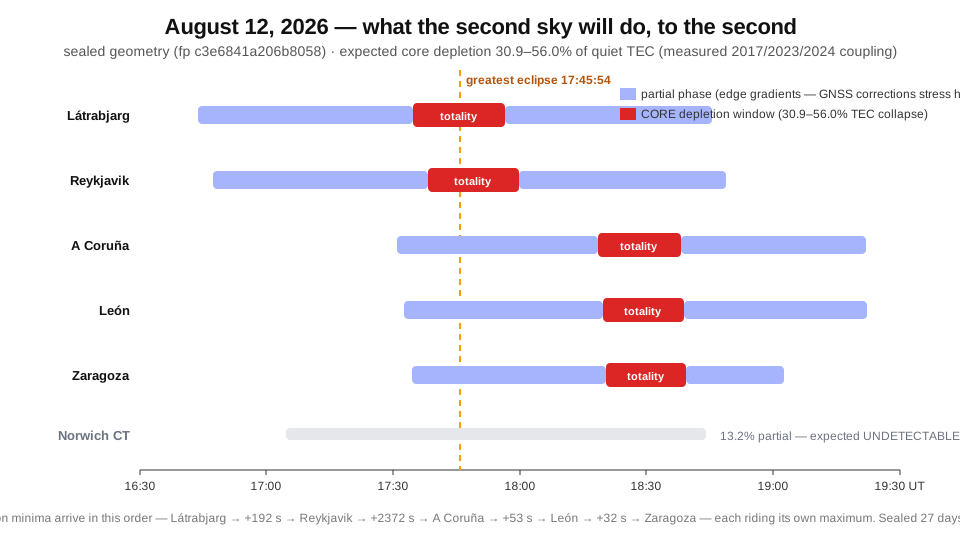
gantt
    title August 12, 2026 — the second sky's schedule (UT)
    dateFormat HH:mm:ss
    axisFormat %H:%M
    section Látrabjarg
    partial phase          :lat1, 16:43:40, 17:34:40
    CORE depletion         :crit, latc, 17:34:40, 17:56:30
    recovery               :lat2, 17:56:30, 18:44:55
    section Reykjavik
    partial phase          :rey1, 16:47:12, 17:38:02
    CORE depletion         :crit, reyc, 17:38:02, 17:59:32
    recovery               :rey2, 17:59:32, 18:47:38
    section A Coruña
    partial phase          :cor1, 17:30:56, 18:18:26
    CORE depletion         :crit, corc, 18:18:26, 18:38:06
    recovery               :cor2, 18:38:06, 19:21:59
    section León
    partial phase          :leo1, 17:32:44, 18:19:34
    CORE depletion         :crit, leoc, 18:19:34, 18:38:54
    recovery               :leo2, 18:38:54, 19:22:06
    section Zaragoza
    partial phase          :zar1, 17:34:41, 18:20:21
    CORE depletion         :crit, zarc, 18:20:21, 18:39:11
    recovery               :zar2, 18:39:11, 19:02:30
    section Greatest eclipse
    totality peak off Iceland :milestone, ge, 17:45:54, 0m
Reading it as an operator:
- Edge-in / edge-out windows are where TEC changes fastest in space and time — expect the largest differential-GNSS residuals and the fastest correction updates there, not at maximum.
- Core windows are the deep-depletion plateau — absolute TEC (and hence single-frequency range error) is at its minimum; the change is slower.
- The two New-England rows carry a quantified null: at 13–16% obscuration the effect is bounded below quiet-day variance — a pre-registered "you will NOT see this in your data" claim, which is itself checkable.
- The umbra's ground-track order — Látrabjarg → +192 s → Reykjavik → +2372 s → A Coruña → +53 s → León → +32 s → Zaragoza — is sealed; the depletion minima ride each station's own maximum within the measured lag window.
Warning
Solar Cycle 25 is at maximum. The pre-registered gate — SWPC est-Kp ≥ 5 during 15:30–20:00 UT on eclipse day raises the storm flag — was sealed with the property that the timetable above still holds (a storm cannot move the Moon) and the confinement verdict below remains decidable through the storm. Measured outcome (definitive index, 2026-08-13): the flag never raised — eclipse day's maximum was Kp 2.667, quiet.
Conventional practice would call a stormy eclipse day's ionospheric data contaminated and unusable. This experiment pre-registered the opposite:
- A storm cannot fake, and cannot hide, the eclipse signature. The finished shear measured both regimes in the same instrument grid: a shadow's depletion is confined to its own minutes and rides its own maximum; a storm floods the flanking hours as deeply as the window (measured at 665,000–724,000 ppm on May 11, 2024) and pins to window edges. The confinement verdict — excess in-window depletion against a frozen 50,189 ppm threshold — stays decidable through a G5.
- What that gives operators: if August 12 turns stormy, the same public data separates "the scheduled, geometric dent" from "the storm on top of it." GNSS anomaly forensics that day do not have to throw the eclipse hours away — the two signatures are readable apart. On any other storm day, the same shape-read is the reason a deep TEC drop should not be attributed to a transient local cause: if the flanks are flooded and nothing rides a track, it is the storm, whole-sky (Blind spots, Stories 2–3).
- Live gate, resolved: the storm gate was graded from the definitive planetary index — maximum Kp 2.667 on 2026-08-12, the flag never raised; the capture record for the day is documented, dated, in the first 27 days review.
- Latest SWPC estimated Kp in ledger: 1.33 at 2026-08-18 11:36:00 UT
- Latest GFZ definitive/nowcast Kp day in ledger: 2026-08-12
- Latest magnetometer capture: BOU H at 2026-08-18 11:36:00 UT
Ledger-borne (renders identically until the next ingest).
- It is a timing-and-shape product at 300-second, 1° resolution: when and where the second sky departs from quiet, by how much in band, and what shape distinguishes shadow from storm.
- It is not a scintillation forecast (small-scale phase jitter), not a radiation/SEU product, and not a thermospheric-density model — those need instruments this experiment does not ingest (yet; the Stage-4 archives — dual-frequency 1 Hz GNSS, Swarm in-situ — are documented in Data archives).
- Every number above traces to a sealed Form or a ledger row; the falsification conditions live in the prediction registry. If the sky disagreed on August 12, these tables will say so, publicly — the grading runs the day the pinned archive posts eclipse day, around 2026-08-30 at the lag measured 2026-08-13 (dated status on the prediction registry).
Storm-time satellite and aviation safety today runs on indices and baselines — global scalars (Kp, Dst) and departures from a "normal" that drifts. The blind-spot record shows what that costs: phantom events, erased events, mis-calibrated thresholds across solar cycles. The eclipse is the rare controlled experiment — a forcing with a God-given timetable — that lets the shape-read be validated end-to-end in public. Validated once, the same discipline applies to the uncontrolled events operators actually fear: read the structure, not the scalar.