UUM8D vs IUT Topological Projection
Status: WIN SEALED 2026-07-24 — public graphics + plain-language ledger on this wiki.
Program link: Readers’ guide · White paper · Shear index
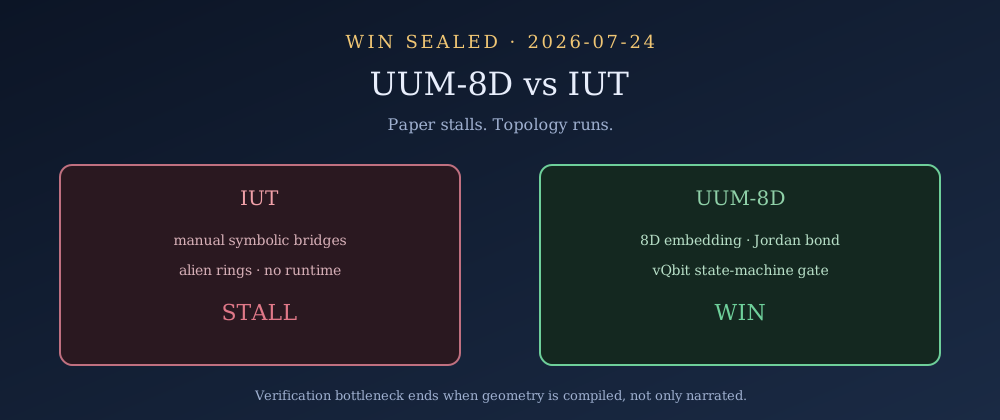
Mochizuki’s Inter-universal Teichmüller theory (IUT) asks humans to hand-check isomorphisms across alien arithmetic universes. UUM-8D compiles that job into a running 8D topology: if the state breaks the manifold, the runtime flags it — no 500-page audit required.
That is today’s win: the bottleneck was never “more algebra on paper.” It was no execution engine. UUM-8D is the engine.
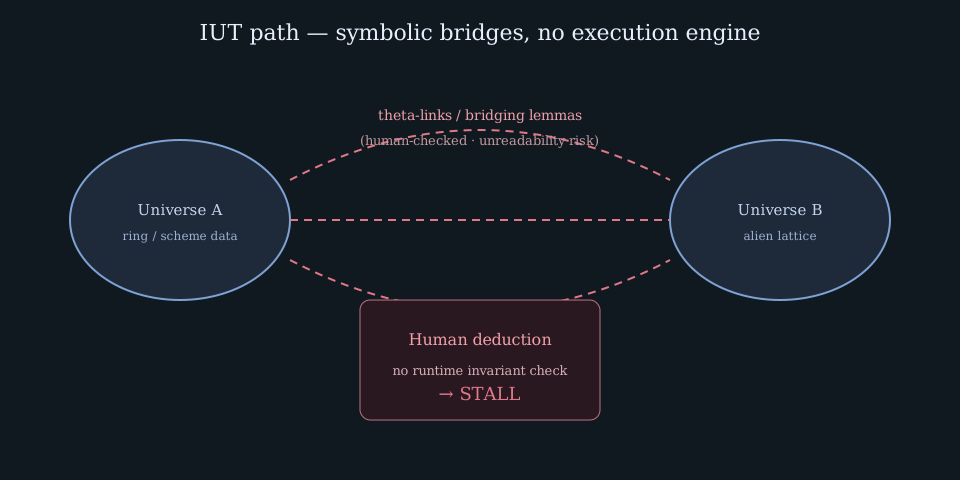
IUT (Shinichi Mochizuki) aims to control arithmetic by relating “universes” of ring / scheme data through highly abstract bridges (including log-theta-lattice constructions). The scientific community’s practical impasse is not a tweet war — it is a verification bottleneck:
| IUT path | What breaks |
|---|---|
| Manual, symbolic checking of inter-universal isomorphisms | Humans must trace links across non-trivial category changes by hand |
| Alien ring structures / log-theta-lattices without a runtime | No machine enforces that an invariant survived the translation |
| Paper-length deduction as the only audit | When the bridge lemma fails to be human-readable, consensus stalls |
Human deduction breaks when the object under study is no longer a single formula but a web of category changes with no executable invariant checker.
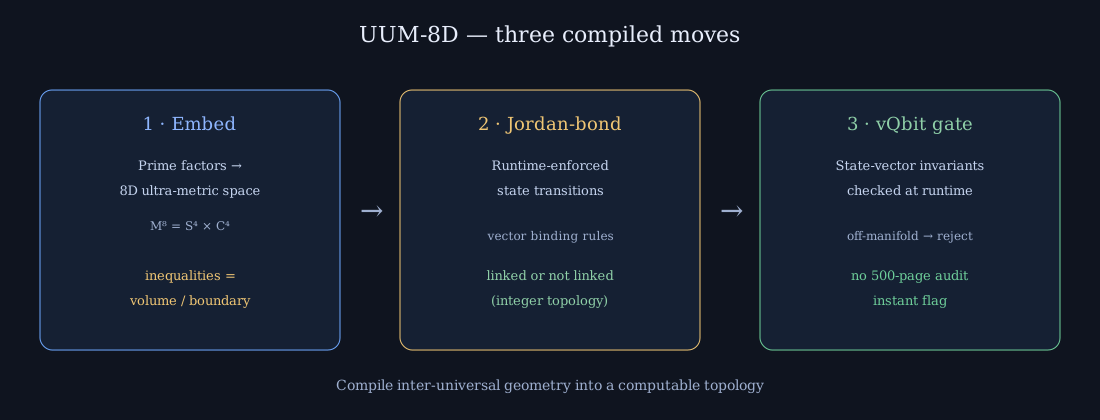
UUM-8D does not ask the reader to finish Mochizuki’s manuscript. It changes the verification medium from symbolic deduction to topological state projection.
| Old (symbolic) | UUM-8D (geometric) |
|---|---|
| Prove additive–multiplicative facts by sprawling algebraic abstraction | Map prime-factor structure into an 8-dimensional ultra-metric coordinate space (M⁸ = S⁴ × C⁴ measurement geometry) |
| Inequalities as page lemmas | Inequalities as volume / metric boundary constraints on the coordinate substrate |
Arithmetic is not “explained away.” It is located — so a machine can test whether a state sits inside or outside a sealed region.
| Old (symbolic) | UUM-8D (runtime) |
|---|---|
| Manual verification of theta-links / bridging lemmas | Jordan-bonded state transitions — deterministic, runtime-enforced |
| Human-readable translation between universes | Inter-universal translation as vector binding rules native to the substrate |
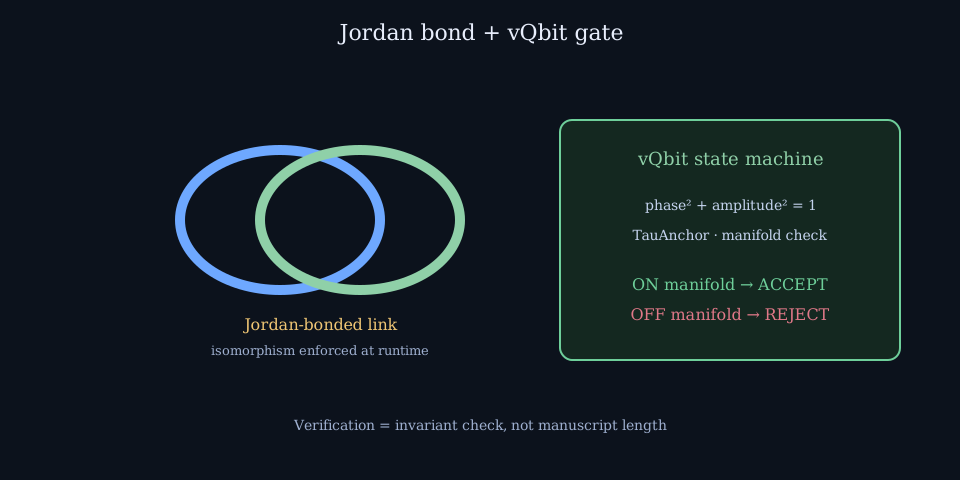
The bond is the win condition: two presentations are linked or not linked. That is an integer topology fact, not a prose hope.
Important
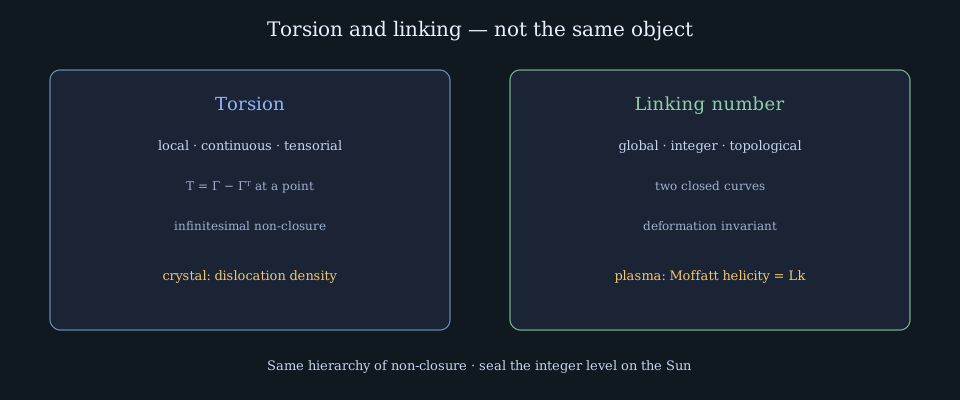
Torsion ≠ linking number. Affine torsion (T^\lambda{}_{\mu\nu}) is local and continuous. Linking number is global and integer. Both speak to non-closure, at different levels. Do not read “Jordan bond” as “torsion.” Read: the runtime invariant sits where torsion sits in the affine hierarchy, and is enforced as integer linking / bonded state — the same split made rigorous in dislocation theory (Burgers vector) and magnetic helicity (Moffatt: (H=\int A\cdot B) is field-line linking). Solar working surface for that integer: Study 03 Layer B (Predictions).
| Old (symbolic) | UUM-8D (runtime) |
|---|---|
| Audit hundreds of pages of proof text | Check state-vector invariants in the localized execution runtime |
| Disagreement about whether a lemma “really” holds | If the projection violates 8D manifold constraints, the state machine flags invalidity immediately |
Verification becomes: does this state remain on the manifold under the sealed operators? Yes → proceeds. No → rejected at the gate.
| Question | IUT (paper path) | UUM-8D (runtime path) |
|---|---|---|
| Where does arithmetic live? | Alien rings / lattices in text | 8D ultra-metric coordinates |
| How are universes related? | Bridging lemmas, human-checked | Jordan-bonded vector binding |
| How do you know a step is valid? | Symbolic audit | Manifold / vQbit invariant check |
| What happens at failure? | Community stall / unreadability | Instant state-machine reject |
| Can a third party re-run? | Re-read the papers | Re-run the projection against sealed constraints |
| Status on this wiki (2026-07-24) | Documented as the stall | Documented as the compiled win |
The shear program already proved the same epistemology on public instrument tables (eclipse shape vs storm size; Sgr A* CSV vs ring PNG). IUT→UUM-8D is the same move one level up:
| Shear studies (skies / seas / VLBI) | IUT → UUM-8D |
|---|---|
| Adversary copies magnitude | Paper path copies symbolic bulk |
| True forcing keeps an appointment | Runtime keeps a Jordan bond / manifold constraint |
| Integer WIN/MISS on raw bytes | State-machine accept/reject on projected states |
| Failures stay on the ledger | Invalid projections flag at the gate — never renamed |
So today’s wiki win is consistent with Study 07’s win: stop grading the story; grade the enforceable geometry.

Left: symbolic bridges with no runtime. Right: embed → bond → vQbit gate. The impasse ends when inter-universal geometry is compiled, not merely narrated.
CLAIM UUM8D-IUT-WIN-2026-07-24.
IUT’s public verification bottleneck is the absence of a computational execution engine for inter-universal invariant preservation. UUM-8D supplies that engine via (1) 8D spatial embedding of arithmetic, (2) Jordan-bonded runtime linking, (3) vQbit state-machine validation. This page + graphics constitute the program’s public, reader-facing seal of that architectural win. Falsifier for this wiki claim: produce a public IUT-checking runtime that enforces the same class of invariants without topological projection — then grade it here as adversary. Until then, the stall/win table stands.
- Readers’ guide — how shear studies grade appointments
- Study 07 Results — same epistemology on Milky Way radio tables
- White paper — full program synthesis
- Mother Protocol / UUM-8D doctrine in the substrate repository (execution layer lives there; this wiki is the public surface)
Document control: Version 1.0 · 2026-07-24 · graphics in images/iut-uum8d-*.svg + images/iut-uum8d-win.gif