Study 03 Predictions and Validations
This page is the decidable checklist for Study 03. Nothing here is scored by narrative. Each row is WIN / MISS / VOID from named public archives and sealed integers.
Parent charter: Study 03 — Solar-flare SIDs
Status: OPEN — no TEC / SHARP corpus ingested; thresholds not frozen. We do not have the data.
| Object | What it is | What it is not |
|---|---|---|
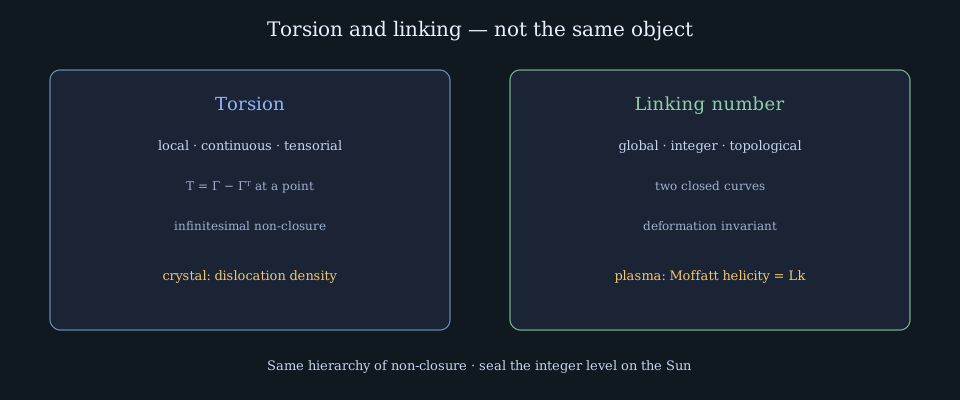
| Torsion (affine) | Local, continuous, tensorial: (T^\lambda{}{\mu\nu}=\Gamma^\lambda{}{\mu\nu}-\Gamma^\lambda{}_{\nu\mu}) at a point — infinitesimal parallelogram non-closure | Not a linking number; not “the Jordan bond” |
| Linking number | Global, integer, topological — property of two disjoint closed curves, deformation-invariant | Not a continuum torsion tensor |
| Program stance | Our sealed invariants sit where torsion sits in the affine hierarchy (non-closure), realized as integer linking / crossing counts in the analogs where physics already equates them | We do not claim Einstein–Cartan torsion is measurable in this study |
Bridge 1 (citation, not this study’s experiment): crystal dislocations — Kondo (1952), Bilby–Bullough–Smith (1955), Kröner: torsion ↔ dislocation density; Burgers-circuit closure failure ↔ lattice (integer) Burgers vector; dislocation lines link in 3D.
Bridge 2 (this study’s working physics): magnetic helicity — Moffatt (1969): (H=\int\mathbf{A}\cdot\mathbf{B}) is the linking of magnetic field lines; for two flux tubes (H=2\Phi_1\Phi_2,\mathrm{Lk}) (identity, not analogy). Berger & Field: open fields. Modern winding / pairwise-crossing formulations on SHARP magnetograms are the computational door to an exact integer on rationalized coordinates.
Not attempted: Einstein–Cartan torsion coupled to intrinsic spin (effects negligible except at extreme densities ~10⁵⁴ g/cm³). No accessible experiment. Testable torsion–linking physics lives in dislocations, superfluids, knotted optics, and solar magnetic helicity.
| Piece | Instantiation |
|---|---|
| Clock + track | GOES XRS peak minute; sunlit cap by solar zenith angle χ |
| Raw archive | NCEI/SWPC GOES + Madrigal TEC 5-min grids |
| Adversary | Geomagnetic storms (Gannon, Halloween); radio-burst lock-loss |
| Integer seals | TECU×100 band steps; first-epoch onset; SZA order; night floor |
| ID | Prediction | Falsifier |
|---|---|---|
| P-A1 | On a qualifying ≥X1 disk-center flare (≤60° from disk center, coverage gates N,M met), sunlit bands (χ<80°) show positive onset in the first 5-min Madrigal epoch at/after peak T and magnitude step ≥ sealed threshold, SZA-ordered | Onset missing, magnitude below threshold, or SZA order broken → MISS |
| P-A2 | Night band (χ>100°) |magnitude step| ≤ sealed negative floor on that same event | Night exceeds floor → MISS |
| P-A3 | During Gannon / Halloween main phase outside flare-exclusion windows, detector fires zero flare-detections | Any detection outside exclusion → MISS (adversary win) |
| P-A4 | 2006-12-06 radio burst scores as data-quality (dropout ≥ sealed) not as SZA-ordered TEC step | Coherent SZA step without dropout signature → MISS |
| ID | Validation | Pass rule |
|---|---|---|
| V-A1 | S1 crucible | 2003 X17, 2017 X2.2, 2017 X9.3 band-median steps inside sealed acceptance intervals; coverage gate or VOID-by-coverage recorded raw |
| V-A2 | S2 adversary silence | Zero detections in Gannon/Halloween outside exclusion; 2006 as dropout event |
| V-A3 | S3 freeze | Detection threshold = max cleaned negative-window sunlit step; night floor = max |night|; both published with derivation before first 2026 score |
| V-A4 | S4 live | Next qualifying flare graded under frozen law; result published raw |
Full metric text: parent charter §§ shear metric, success criteria.
Extends Study 03 — same GOES clock, solar magnetic topology as the pre-flare shape, not a new program domain.
| Piece | Instantiation |
|---|---|
| Clock | GOES flare begin/peak/class (same catalogs as Layer A) |
| Raw archive | SDO/HMI SHARP vector magnetograms via JSOC Stanford (public; campaign from 2010-05); SWAN-SF benchmark time series for community baseline |
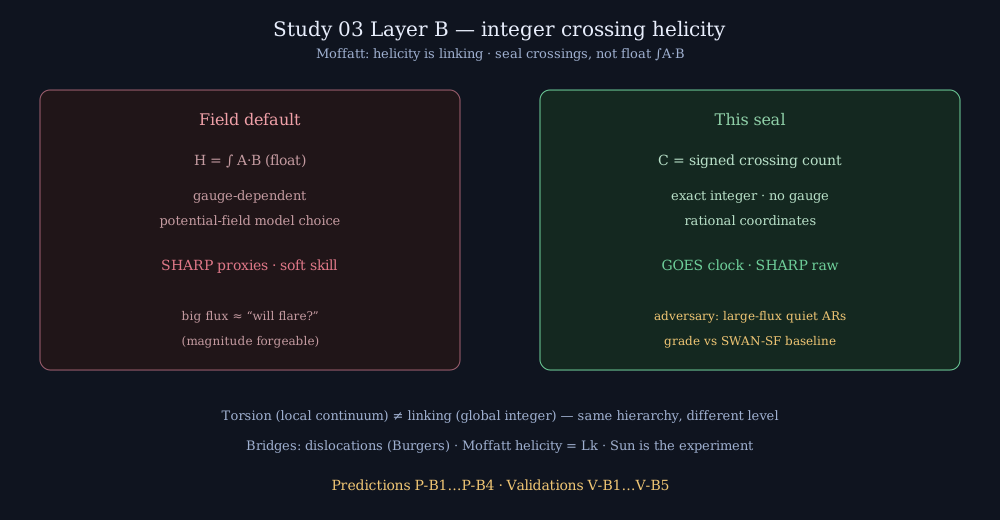
| Adversary | Large-flux active regions that do not flare — magnitude forgeable; topology may not be. Same epistemic role as Gannon for eclipses |
| Integer seal | Field-line signed crossing count (combinatorial linking / winding proxy) on rationalized coordinates — exact integer, no ∫A·B float, no gauge choice, byte-stable across machines |
| Field default | This study |
|---|---|
| Helicity as float ∫A·B (gauge-dependent, model-sensitive) | Signed crossings summed → exact integer |
| SHARP parameters as helicity proxies | Direct combinatorial winding on traced lines |
| Free-energy proxies depend on potential-field model | Crossing count has no potential-field model in the seal |
| Forecast skill scored on size of AR | Skill scored on matched-magnitude nulls (big quiet ARs) |
Paper claim (when corpus freezes): exact integer crossing-count helicity vs float-integral / proxy baselines; does it separate flaring vs matched-flux quiet ARs better than SWAN-SF baselines?
| ID | Prediction | Falsifier |
|---|---|---|
| P-B1 | For sealed lookback window W before GOES ≥M-class (threshold class sealed with Form) on disk ARs with SHARP coverage, integer crossing-count (C) meets (C \ge T_C) more often on flaring ARs than on flux-matched quiet controls at sealed false-positive budget | Equal or worse separation than chance at that budget → MISS |
| P-B2 | On the sealed matched-magnitude adversary set (high total unsigned flux, no flare in sealed forward window), false-positive rate of (C \ge T_C) ≤ sealed integer bound F | Exceeds F → MISS |
| P-B3 | Integer (C) is byte-identical on three independent machines from the same SHARP patch bytes and sealed tracer settings | Any mismatch → MISS (reproducibility fail) |
| P-B4 | Against SWAN-SF published baseline metrics on the same AR/time splits, sealed (C)-based rule improves at least one sealed skill integer (e.g. TSS×1000 or precision×1000) without raising false positives above F | No improvement on any sealed skill integer → MISS (no methodological gain) |
| ID | Validation | Pass rule |
|---|---|---|
| V-B1 | Corpus inventory | SHA-256 of every SHARP series + GOES event list used; AR count and patch count published (target: full public SHARP span available at ingest — literature cites ~2,071 ARs / ~1.5×10⁶ patches in early years as scale reference, REPORTED) |
| V-B2 | Quantizer freeze | Tracer, grid rationalization, crossing-sign rule, and (T_C), F, W, class floor sealed with derivation from train split before test split is opened |
| V-B3 | Adversary grade | Matched-flux quiet AR set graded; FP count published raw |
| V-B4 | Baseline grade | SWAN-SF comparison table published with identical splits |
| V-B5 | Live / holdout | Sealed holdout years or next N flares after freeze graded; results append-only |
- Not a proof of Einstein–Cartan torsion in the solar interior.
- Not “torsion = Jordan bond.”
- Not a float ∫A·B competition on gauge choices — the seal refuses float helicity as the graded primitive.
- Not Layer A replacement: SID law still grades the ionosphere after the flare; Layer B grades pre-flare magnetic topology.
| Gate | Requirement |
|---|---|
| Charter | Done (Layer A + Layer B on this page + parent) |
| Corpus A | Madrigal + GOES fossils ingested |
| Corpus B | SHARP + GOES + SWAN-SF splits ingested |
| Frozen law A | TEC thresholds sealed |
| Frozen law B | (T_C), F, W, class floor sealed |
| Pre-registration | Next flares listed before score |
| Public resolution | WIN/MISS rows on both layers published raw |
Study status advances only when the corresponding layer’s freeze exists. Layer A can freeze before Layer B; neither silently inherits the other’s thresholds.
| Archive | Access | Role |
|---|---|---|
| JSOC Stanford — SDO/HMI SHARP |
http://jsoc.stanford.edu/ (series e.g. hmi.sharp_*) |
Vector magnetogram patches, ~12 min cadence |
| GOES X-ray event lists | Same as Layer A (NCEI / SWPC) | Flare clock |
| SWAN-SF | Community flare-forecast benchmark on SHARP time series (REPORTED — cite exact DOI/repo at corpus ingest) | Baseline to beat or match under sealed skill integers |
Document control: Version 1.0 · 2026-07-25 · predictions P-A*/P-B* and validations V-A*/V-B* are the only scoring contracts for Study 03 until a later version appends rows (append-only).