Repository navigation
Wildlife and Town Life
Animals live on your scenes, react to your creatures, and go quiet when they should. None come on a scene until you ask for them there, because not every map wants them. You do it all in the Animals panel. Everything moves on each screen and nothing about where they are is saved, except the animals you put down by hand and the orders you give them.
Since 3.8.0 every animal is drawn in the battlemaps' painted look, with inked outlines, a few steps of shading and coats that stay put as it moves. Each is shaded by the light really on it: the sun from where it stands in the sky, the moon at night, and lamps and torches nearby from their own side. Its shadow stretches from its feet away from the light, longer as the sun gets low. New in 3.8.0.
Open the Animals button in the Animater controls and set Outdoor life on this scene to On. Since 3.8.6 this switch lives only in the panel. It left Scene configuration.
- Outdoor life brings the wild animals that come by themselves: birds, rabbits, deer, foxes, squirrels, snakes, fish, water birds, frogs, insects and owls.
- Town animals (pigeons, hens, cats and dogs) come when you give them a number under Town in the panel. They don't need Outdoor life. See Town animals below.
- Farm animals come when you give them a number under Farm. Read from the code, not tested live: the scene's own herds also need Outdoor life on.
- Animals you put down by hand, or give orders to, show even with Outdoor life off. See Placing animals by hand below.
- Rats and bats belong to underground scenes and come with the Rats and bats setting, not with Outdoor life. See Rats and bats below.
Each screen needs Birds, rabbits and fish on in its own settings, and Animater's quality at Balanced or better.
When nothing shows. With Outdoor life on and no animal in sight, the panel says why at the top: Birds, rabbits and fish is off on your screen, your quality is Low or Off, the scene's floor isn't one animals live on, or the whole map is under roofs or walled in. Animals live on grass, dirt, snow, mud or sand, so set Floor in Scene configuration → Animater, or paint ground regions with one of those floors. New in 3.8.3.
| Who | Where and when | What they do |
|---|---|---|
| Hawk, crows, songbirds, rabbits | Open ground by day | The hawk circles and stoops on rabbits. Songbirds peck, hop about and burst into the air. Rabbits bolt from anyone near. |
| Deer, foxes | Open ground by day | Deer graze and bound away. A fox stalks the rabbits. |
| Butterflies, dragonflies | By day | Fly by. |
| Fish | In water | Drift and dart away. Can leave and return where water reaches the map's edge. |
| Ducks, heron, frogs on lily pads | Fresh water | Ducks paddle, tip up to feed and clatter up, a heron stands in the shallows, frogs croak and leap in. |
| Gulls | Only over water marked as sea | Glide, hang on the wind and dive for fish. Never on rivers or ponds, however wide. |
| Crabs | The shore of water with This is the sea ticked | Walk along the shore. Comes with The coast setting. |
| Fireflies, owl, bats | At night | Fireflies blink, an owl glides over, bats hunt round the lamps. |
They live only out of doors, on grass, dirt, sand, mud or snow, and in water.
They react to the world:
- They run from noise and from your creatures.
- Rabbits, songbirds, deer and foxes bolt when heavy rain or snow comes on.
- They stay off ground a region step has made dangerous or foul.
- Water birds and fish leave water that freezes, and come back when it thaws.
- Nothing lives on rapids or waterfalls.
- They know cliffs. An animal on foot never steps up or down a cliff painted with Map Painting's Heights tab, nor onto its rock face, whether or not the scene has cliff walls. Birds and bats fly over. New in 4.2.0. Read from the code, not tested live: one boxed in on every side by walls and a cliff together, as on a cliff wall's own line, is let past the cliff so it isn't stuck there for good. Walls still hold it.
What they do, beyond the table:
- Birds between trees and roofs. Besides the flocks, single crows, songbirds and pigeons fly off alone, land on a roof's ridge or eaves, sit and peck, then go on to another roof or back to the trees. The trees have to be tiles. New in 3.8.0. A bush or a tree lifted out of the map with Map Painting's Lift from map, as A bush or A tree, becomes a tree tile, so birds perch on it and squirrels run to it. New in 4.8.5. Something lifted as "A tree" in 4.8.4 is still an object: set its Sunlight to Tree in Tile configuration, or lift it again.
- Sparrows hop. A songbird on the ground hops to its next spot, sometimes two or three hops in a row. New in 3.8.0.
- Ducks tip up to feed. A feeding duck shows its head under water, its tail up and its feet kicking, with rings spreading round it. New in 4.0.0.
- Ducks and frogs keep to fresh water. On a map with both sea and a river or pond, they stay on the fresh water. Only on a map with no fresh water do ducks settle on the sea. New in 4.0.0.
- A duck in the air clears walls instead of sticking against one. New in 3.7.0.
- Rivers keep their fish. A fish that swims off the map's edge is replaced within 5 to 20 seconds, and one a heron catches within 20 to 45 seconds. New in 3.8.12.
- The fox looks round. With no rabbit about, a fox now and then stops, ears up, and looks about before trotting on. New in 3.8.11.
- Frogs leap from further off. A frog on a pad with no water close by leaps for the nearest water up to two and a half squares away, away from whoever came near. New in 3.8.11.
- High birds' shadows. The hawk, crows, gulls and herons throw a soft shadow as dark as the light allows, landing further off the higher they fly. New in 3.8.5. Bird height in the Animals panel sets how high birds fly over the map. See below.
Sounds: Wildlife sounds plays their calls, a few at a time and only near enough to hear. Deer, squirrels, snakes, herons and crabs have calls too (new in 3.8.0), and so do the town and farm animals. Dawn chorus and night shift has birds sing at first light and go quiet at sunset, then crickets after a hush. Scene configuration → Animater → Night sounds → Off leaves one map's nights quiet.
Since 3.8.11, counts and sizes are set only in the Animals panel. Scene configuration → Animater → Creatures now just points to the panel. Its old drop-downs (None, Few, Usual, More, Many) couldn't show an exact count, and saving the form could write None over one.
Each kind has a row in the panel, with two controls:
- How many: a number with − and +, from 0 to 40. Left on Auto, the number shows how many the scene has right now, worked out from the map as before. Press Auto to go back to that. New in 3.8.0.
- How big: a slider from 10% to 300% of the usual size, in 5% steps. A scene saved with the older Small, Big and Huge keeps them as 70%, 140% and 180%.
The rows are grouped:
| Group | Rows |
|---|---|
| Open ground | Rabbits, Birds, Crows, Hawks, Deer, Foxes, Wolves, Squirrels, Snakes, Insects, Owls |
| Water | Fish, Ducks, Herons, Gulls, Frogs |
| Town | Pigeons, Hens, Cats, Dogs |
| Farm | Cows, Goats, Sheep, Pigs, Horses |
| Dark places | Rats, Bats, Moths, Crawlers |
Things to know:
- Crows, Hawks, Herons and Gulls have had their own rows since 3.8.0. Left on Auto they come as they always did, with the birds and the water birds. Ducks was called Water birds before 3.8.0.
- Hawks go up to 4. Left alone a scene has one.
- Wolves, town and farm animals start at 0 and have no Auto.
- The panel only offers what can live there. An underground scene shows only Dark places. Elsewhere Dark places is hidden, and Water only shows on a map with water. New in 3.7.0. Bats round lamps out of doors go by the Bats row, so the panel can't change them on a scene above ground. Read from the code.
- Some size sliders do nothing yet. Read from the code, not tested live: the sizes of Crows and Hawks come from the Birds slider, and Herons and Gulls from the Ducks slider. Their own sliders, and those of the Town and Farm rows, aren't read for the scene's animals. Town animals have no size, and the scene's farm animals follow only All animals on this map.
All animals on this map is a slider above the rows, with the same range, for a map drawn at a different scale. New in 3.4.1. It multiplies every size, and the combined size is limited to 5% to 400%.
- Size only. Speed and behaviour don't change. Frogs' lily pads scale with the frogs.
- Placed animals follow the same sizes, and wolves have their own slider.
- No size: pigeons, hens, cats, dogs and crabs.
Right-click the region and open its Animals section in the region panel. The Keep out line folds open into a button per animal, plus All animals, which counts as every one of them. Before 3.8.0 these were ticks on Region configuration's Animater tab, which the region panel replaced. See Region Steps and Painted Floors.
| Group | Buttons |
|---|---|
| Underground | Rats, Bats, Moths, Crawlers, Eyes |
| On the ground | Rabbits, Deer, Foxes, Wolves, Squirrels, Snakes |
| Birds | Songbirds, Crows, Hawk, Owl |
| Water | Fish, Frogs, Ducks, Herons, Gulls |
| Insects | Butterflies, Dragonflies, Fireflies |
| Town | Pigeons, Hens, Cats, Dogs |
There's no button for farm animals.
Things to know:
- If you used Foxes or Rabbits to hold these back, turn on the newer buttons. In 3.3.0 wolves went by Foxes, and squirrels and snakes by Rabbits. Those no longer hold them.
- Old boxes are gone but still work. Water birds became Ducks, Herons and Gulls. Insects became Butterflies, Dragonflies and Fireflies. Town animals became Pigeons, Hens, Cats and Dogs. A region with an old box saved keeps working, and shows those animals turned on.
- Fliers can't all be stopped at the edge. Crows and the owl choose a line that misses the region, or skip that pass. The hawk moves its circle away and won't dive at prey inside. Gulls only stop fishing there, and may still glide over.
- Bats out of doors skip lamps in a kept-out region.
- An animal already inside can't come back once it leaves, but rabbits, deer, foxes, wolves, squirrels and snakes aren't sent out when you turn a button on, so one that's resting may stay a while. Read from the code, not tested.
The same Animals section has Animal sounds, to silence the animals inside the region, and the region's own animals. A wall can also tick Wildlife passes through in Wall configuration, for a thicket animals can cross but characters can't.
A region can have animals of its own, on top of the scene's, that live inside it and keep to it. In the region panel's Animals section each kind is a card with its count: click for one more, right-click for one fewer. Their size sets them from half to twice the usual. Counts and the size slider are new in 3.8.0. They show even with the scene's Outdoor life off. The panel itself is described on Region Steps and Painted Floors.
New in 3.3.0. A wolf bringing down a deer, the haul afterwards and the return for a carcass haven't been seen in Foundry, and the details below are read from the code.
Each screen runs its own animals. So a hunt, a kill and the animal that replaces it aren't shared. One player may see a pack bring down a deer while another doesn't.
None until you give them a number in the Animals panel's Wolves row. Quiet, Usual and Lively leave them alone.
- Out by day and by night. They need Outdoor life on like the other animals, and room on the map.
- A pack walks in from the edge of the map and keeps together behind its leader. It trots about and lies up now and then.
- They hunt deer. A hungry pack ranges toward the nearest deer, in no hurry. When the leader is ready and a deer is within 10 squares, the pack gives chase for up to 6 seconds. Each wolf gets one try, with about a 2 in 5 chance of bringing the deer down. Deer are only out by day, so that's when hunts happen. They don't hunt while 3 carcasses lie on the map.
- Stragglers: a wolf more than 6 squares behind crosses water to catch up, and any left behind follow the pack off the map.
- After a kill, the pack feeds beside the deer for 12 to 20 seconds. Then the wolf that made the kill walks up to the deer and hauls it off the nearest map edge with a clear line, holding it by its mouth at any animal size, and the rest follow. If it can't reach the deer within 12 seconds, it leaves it lying and goes on alone. That walk is new in 3.5.0. It goes round walls. If it's still at it after 25 seconds, it slips away where it stands, deer and all, and the pack goes after it. Changed in 4.2.0: before, it forced a straight way out, even through a wall or a cliff. Read from the code, not tested live. They're gone for 90 to 180 seconds, then walk back in from an edge. The pack leaves deer alone for about four minutes after a kill.
- If the pack is driven off a carcass, it comes back for it once things are calm and the leader is trotting again, and then hauls it away. If it can't get there after two tries, the carcass is left to the crows and taken off the map. Changed in 4.2.0: the pack used to force a way to it, walls and all. So a carcass doesn't lie for good while the pack is on the map, although nothing removes one on a timer.
- They run from tokens within 3 squares, from noise, and from lights within 2.5 squares. Only lights out of doors count, not carried ones, and only the 2 nearest the middle of your view. A wolf keeps running only while someone is still close. Wolves, deer and foxes all stop after a few seconds, even if they've ended up on ground they'd normally avoid.
- Howling. New in 3.3.1. The pack's leader howls on coming in from the edge, and otherwise now and then when at ease, more at night, and a pack may join in. They don't howl while hunting, hauling or running. You can hear a howl from up to 45 squares away, and at least 60 to 150 real seconds pass between calls of a kind, so a new scene can stay quiet for over a minute, even when a pack walks in. It follows Wildlife sounds. A placed wolf doesn't walk in, so it doesn't howl on arrival.
-
Growling. New in 3.3.1. A wolf growls at a token coming within 5 squares, once, until nobody is within 7 squares of it. It doesn't growl while hunting, walking in or off the map, but nothing stops it while hauling or running. A growl is heard up to 12 squares away and follows Wildlife sounds. At least a second or more passes between growls, and one that's cut off isn't tried again, so a pack won't growl all together. There's one recording, credited under CC BY 3.0 in
assets/sounds/wildlife/wolf/License.txt. - Keeping them out: they have their own Wolves button, new in 3.3.1. On a haul, heading to a carcass or wading after the pack, they go round a kept-out region. Since 4.2.0 they never force their way through one: a wolf stuck for 25 seconds on a haul slips away where it stands, and a carcass the pack fails to reach twice is taken off the map.
Both have been seen present and without errors on one scene. A squirrel racing under a tree hasn't been seen live.
Unlike wolves, both start on Auto, so any scene with Outdoor life on has about 3 squirrels and 1 snake unless you change it. Set their rows to 0 in the Animals panel to have none. Quiet, Usual and Lively do change them. You can also place both by hand. Since 3.8.0 a squirrel chatters and a snake hisses, under Wildlife sounds.
Squirrels forage in quick bursts near a tree, and are out by day. When a token comes within 3 squares, or on a noise, one races to the nearest tree and hides under it for 8 to 25 seconds. It comes back out on a side with nobody within 3 squares, and won't bolt back from a token on the way out, though a noise still sends it racing.
- Trees have to be tiles. Only trees drawn as tiles count. On a map whose trees are painted into the picture, a squirrel can't hide, so it bolts about 6 squares away instead.
- Walls round a trunk don't stop a frightened squirrel going up its tree. New in 3.7.0.
- A tree inside a region with the Squirrels Keep out doesn't count as cover. In 3.3.0 that was the Rabbits box.
Snakes lie still for long stretches and slide slowly on a little, by day. When a token comes within 2 squares, or on a noise, one goes off quickly the other way.
- They aren't shown when it's wet or wintry: while snow lies on the ground, or rain is falling. This goes by the weather and the ground, not the temperature.
Both stay on the map. A squirrel with no tree to run to, or a fleeing snake, stops at the map's edge instead of running off into the padding. New in 3.7.5.
Keeping them out: each has its own button, new in 3.3.1. Rabbits no longer holds them.
On Auto, a map only gets what its open ground has room for, however busy you make it. So Lively on a small map won't crowd it.
- Room is one animal per 20 open squares, at least 6 and at most 24, shared by rabbits, deer, foxes and wolves.
- Hunters come first: at most 5 wolves and 2 foxes. Rabbits and deer share what's left, with at least one of each you asked for, and at most 8 deer.
- Birds have their own limits: 12 songbirds and 8 crows.
- A number you set yourself is used as it is and skips these limits. Read from the code.
- Animals you place by hand are extra, and don't count.
- Squirrels and snakes don't share that room. They have their own limits: 6 squirrels and 3 snakes.
- Fish, water birds, frogs and insects aren't part of this.
A rabbit or deer that gets caught is replaced in a while by another walking in from the map's edge. For a rabbit it's 45 to 120 seconds. Every rabbit taken is replaced, one at a time, 20 to 60 seconds apart when several are owed. For a deer it's 60 to 150 seconds after the kill. If there's no clear way in, it tries again 20 seconds later.
New in 3.3.0. Adding and removing were tested on PF2e with in-memory values. Clicking the map to place an animal hasn't been tested live, because that saves to the scene.
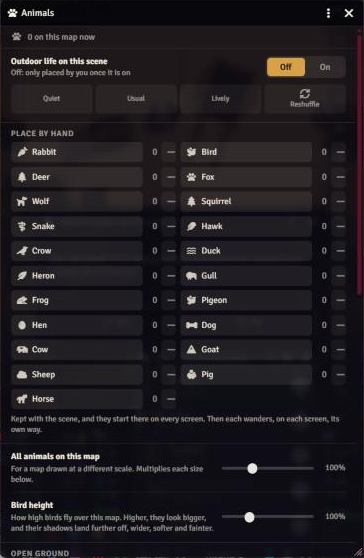
The top of the Animals panel on an outdoor test scene. It scrolls on to the rows for each kind. Taken on Animater 4.9.0.
Where: the Animals button in the Animater controls, right after Weather, GM only.
It's the only place for these settings. Since 3.8.6 Outdoor life and since 3.8.11 the counts and sizes are set here and nowhere else. Changes save to the scene as you click, for everyone.
| Control | What it does |
|---|---|
| Changes apply to | In a scene with levels: This level or Whole scene. Use the scene's clears this level's own settings. New in 3.7.0. |
| Count at the top | How many animals are on the map now, the scene's and every region's together, and how many of those are in regions. New in 4.0.0. |
| Outdoor life on this scene | Off or On, with a count of how many are about on your screen. |
| Quiet, Usual, Lively | Sets every outdoor kind at once to few, usual or many, and puts their rows back on Auto. Dark places, Wolves, Town and Farm are left alone, and sizes aren't changed. |
| Reshuffle | Scatters the animals afresh, on your own screen only. Each screen scatters its own. |
| Place by hand | See below. |
| All animals on this map | New in 3.4.1. Multiplies every size below. |
| Bird height | How high birds fly over this map, from 25% to 300%. Higher, they look bigger and their shadows land further off, wider, softer and fainter. New in 3.7.0. |
| Open ground, Water, Town, Farm, Dark places | A row per kind, as above. Letting go of a slider saves it, and the animals scatter afresh. |
Region animals beside each row. A kind that also lives in regions shows +N in regions next to its name. The row's own number is only the scene's. New in 4.0.0.
The numbers stay current. While the panel is open, the count at the top, the rows on Auto and the region notes update every two seconds as animals come and go. New in 3.8.12.
On an underground scene, only the level choice, the count, Place by hand (with Rat and Bat only), All animals on this map and Dark places show.
Under Place by hand, pick a kind, then click the map as many times as you like. Escape or a right click stops. A click outside the scene does nothing. The kinds are Rabbit, Bird, Deer, Fox, Wolf, Squirrel, Snake, Hawk, Crow, Duck, Heron, Gull, Frog, Pigeon, Hen, Dog, Cow, Goat, Sheep, Pig and Horse, and on an underground scene Rat and Bat. Hawk to Horse are new in 4.0.0, and Rat and Bat in 4.4.0.
Above ground or below. Underground, Place by hand offers only Rat and Bat. Above ground it offers everything else and not those two.
- Saved with the scene: up to 40. Past that, the oldest goes.
- A placed wolf joins any pack on the map, and leads if it's the first.
- Same start, different paths: each one starts at that spot on every screen, then wanders separately on each screen, because each screen simulates its own animals. To have one move the same way everywhere, give it an order (below).
- Taking one away: the − button removes the last one of that kind. The number beside it shows how many there are.
- With Outdoor life off: placed animals still show. New in 4.0.0. Each screen still needs Birds, rabbits and fish on. A placed rat or bat needs the Rats and bats setting instead. Text and code differ: with Outdoor life off, the panel's line under the switch still reads "Off: only placed by you once it is on", but the code shows placed animals with it off.
To keep animals out of an area, use the region's Keep out, as above.
New in 4.0.0. Rats and bats take orders since 4.4.0. Read from the code, not tested live.
As GM, right-click an animal on the map for a small HUD beside it, like a token's. It shows the animal's name and what it's doing (Wandering, Going to a spot, Following or Circling and the token's name). The animal stands still while the HUD is open. A left click elsewhere on the map closes it.
| Button | What it does |
|---|---|
| Go here | Click where it should go. |
| Follow token | Click a token. The animal keeps about a square from it, on its own side, and catches up when the token moves on. |
| Circle token | Click a token. The animal goes round and round it. |
| Let it go | Shown when it has an order. It goes back to wandering. |
| Remove | Shown for an animal put down by hand. It takes it away. |
While it waits for your click, Escape or a right click cancels. Clicking anything but a token for Follow token or Circle token says "Click a token."
Which animals. Rabbits, songbirds, crows, hawks, deer, foxes, wolves, squirrels, snakes, ducks, herons, gulls, frogs, pigeons, hens, dogs, cows, goats, sheep, pigs and horses, and underground rats on the floor and bats overhead, the animals a region asks for among them. Not cats, owls, fish or insects. Crows, songbirds and pigeons sitting on a roof or in a tree take orders too, and so do crows flying over.
How each one goes:
- Deer and wolves walk, a fox trots, a rabbit hops, a squirrel dashes and a snake slides.
- A songbird flies there. A bird sitting on a roof or in a tree hops down to its mark, sits there, and hops after it when it moves.
- A hawk or a gull circles close over its mark, about a square out, whichever order you give it. A hawk on an order doesn't hunt, and a gull doesn't fish.
- A duck paddles to a mark close by and flies to one further off. A heron flies there and stands. A frog swims there in a hurry and climbs out.
- A pigeon walks to a mark close by and glides to one further off. A hen walks, or sprints when it's more than 2 squares away. A dog trots.
- Cows, goats, sheep, pigs and horses walk, and run when it's more than 3 squares away.
- A rat scurries along the floor at its usual dash and takes the nearest open way round a wall in its path. On an order it doesn't stop to sniff, isn't turned back by the light it otherwise keeps out of, and forgets any trip to a rat hole.
- A bat flits as it always does, but every turn it makes is toward its mark. It still turns away from a wall rather than through it.
Things to know:
- An ordered animal doesn't run from people or from noise.
- Orders are kept with the scene, so every screen moves the animal the same way. A wild animal you give an order to becomes one put down by hand, where it stands, so it counts toward the 40 and gets a Remove button.
- Let it go keeps it on the scene as a placed animal. From then on each screen moves it its own way again.
- Placed by hand or ordered, it shows with Outdoor life off, like a region's animals.
- A hidden token is only known to the GM's screen, so on players' screens an animal following or circling it goes about on its own.
- A right-drag that starts on an animal still pans the map. Only a right click without a drag opens the HUD. A right click on a token opens the token's HUD, not the animal's.
Since 3.8.6, town animals come from the Animals panel, not Scene configuration's old Town life choice.
Give Pigeons, Hens, Cats or Dogs a number under Town in the Animals panel. They come without Outdoor life on. Pigeons and hens are about by day, and a cat keeps to the wall tops.
They run from noise and from your creatures. Nothing shows in a scene marked underground or with cave or hall acoustics, because they need open ground. Their streets can be any open ground, stone too, but not water or inside a room. The world setting Town life must be on, as it is by default.
A scene set up before 3.8.6 with Town life on Quiet or Busy turns that into counts the first time the GM opens it: Quiet as 5 pigeons, 3 hens and 1 cat, and Busy as 8 pigeons, 5 hens, 1 cat and 1 dog. Counts you'd already set stay as they were.
New in 3.8.0. Read from the code, not tested live.
Give Cows, Goats, Sheep, Pigs or Horses a number under Farm in the Animals panel. Each kind comes as a herd on the scene's open dry ground. A herd grazes, walks a little, grazes again and keeps loosely together. Anyone too close, or a loud noise, sends them running away for two to four seconds (since 3.8.11), and then they settle. Each kind has its own call under Wildlife sounds. They need Outdoor life on for the scene.
- Along edges, not stuck on them. A farm animal that meets a region's edge, a wall or ground it may not stand on takes the nearest open way round and keeps to it for a moment, so it walks along the edge instead of spinning on the spot. With no way open it stands still, and one standing just over an edge walks back off it. New in 4.2.2.
- Turning at a beast's pace. Its body comes round gradually, slowing to turn and stopping to turn right round, instead of flicking between headings in a narrow passage or a corner. New in 4.2.3.
On an underground scene (Scene configuration → Animater: underground, or cave or hall acoustics), rats run along the walls, keeping out of the light and scattering from anyone close, and a few bats flit high overhead. They come with the Rats and bats setting, not with Outdoor life, and the Rats and Bats rows under Dark places in the Animals panel set how many. More about the underground is on Caves and Underground.
- Rat holes. A few of the scene's walls are gnawed through near their foot: walls at least a square and a half long, dark on at least one side, between 3 and 8 holes on a map, and none inside a region where Rats is kept out. A rat that has gone about 12 seconds without one makes for the nearest hole it can walk to without crossing a wall, slips in, and a few seconds later comes up nose first, on the darker side, out of one of the holes furthest from it. So rats get from room to room. The holes are worked out from the walls, so a map has the same ones each time and nothing is saved on the scene. A rat on an order, or on its way to a hole, doesn't scatter from people. New in 4.6.2.
- One tail. A rat used to show a second, too long tail over the painted one. It now keeps the tail it's painted with, at its usual size. Fixed in 4.5.2.
- Orders and placing by hand. Right-click a rat or a bat for the animal HUD (see Giving an animal orders), and put them down with Place by hand on an underground scene. New in 4.4.0.
Their claws, squeaks, wings and chirps follow Rat and bat sounds.
Prints that stay and age by the game's clock, so someone can read who passed and how long ago. Mud and dirt keep them longest, stone hardly at all.
Turn it on: Scene configuration → Animater → Old tracks.
| Choice | Who sees them |
|---|---|
| Off | Keeps none. Default. |
| The GM sees them | For you to describe, or to switch on for everyone when a character finds the trail. |
| Everyone sees them | Everyone, except tracks of creatures that were hidden or sneaking, which only the GM sees. |
The field beside it sets how many game hours they last, and Clear wipes this scene's tracks at once.
Since 3.8.4, Birds, rabbits and fish, Fireflies, Dawn chorus and night shift and Bodies draw flies and crows have no switch for the whole table. Each scene's Outdoor life and Animals panel decide, and each keeps a switch for your own screen.
| Setting | Everyone (GM) | My screen | Choices or range | What it does |
|---|---|---|---|---|
| Birds, rabbits and fish | — | On | — | Hawks, crows, songbirds, rabbits, fish, ducks, herons, gulls, frogs, deer, foxes, butterflies and dragonflies, and at night an owl and bats. Only on scenes with Outdoor life on, out of doors on grass, dirt, sand, mud or snow, and in water. Each scene sets how many in its Animals panel, and regions can keep them out. Drawn at Balanced quality or better. Turn off to never show them on this screen. |
| Wildlife sounds | On | On | — | The hawk's cry, crows passing, songbirds chirping and their wings as they burst up, a rabbit's thump when it bolts, a fish's splash as it darts, ducks quacking, gulls crying, frogs croaking and plopping in, a fox's bark, dragonflies, and by night an owl and a constant bed of crickets. A few at a time, only near enough to be heard. With Birds, rabbits and fish on. |
| Fireflies | — | On | — | On warm summer evenings on scenes with Outdoor life on, fireflies glow over the grass and by the water from sunset into the first hours of the night (none in winter, autumn or under 15 °C). Drawn at Balanced quality or better. Turn off to never show them on this screen. |
| Dawn chorus and night shift | — | On | — | Birds sing all around at first light and go quiet as the sun sets; a hush falls, and the crickets take over once it is dark. Needs Wildlife sounds on. Drawn at Balanced quality or better. Turn off to never show them on this screen. |
| Town life | On | On | — | Where a scene asks for them (Animals panel → Town; none otherwise): pigeons, chickens, a cat on the walls and a stray dog, who run from noise and from your creatures. Drawn at Balanced quality or better. |
| Old tracks | On | On | — | Where a scene asks for it (Scene configuration → Animater → Old tracks; off otherwise), prints stay and age by the game's clock, softer and fainter the older they are, so you can read who passed and how long ago. Mud and dirt keep them longest, stone hardly at all. The GM chooses for each scene whether only the GM or everyone sees them, and how long they last. Drawn at Balanced quality or better. |
| Rats and bats | On | On | — | In an underground scene (Scene configuration → Animater: underground, or cave or hall acoustics), rats scurry along the walls, keeping out of the light and scattering from anyone who comes close, and a few bats flit high overhead. A few walls are gnawed through: a rat that has been in one room a while slips into a hole and comes up out of another, somewhere else on the map. Drawn at Balanced quality or better. |
| Rat and bat sounds | On | On | — | The rats' claws and squeaks, sharper when one bolts, and the bats' wings and chirps, quietly and a few at a time, only near enough to be heard, ringing in the room and muffled by walls. With Rats and bats on. |
| Show the Animals button | — | On | — | In the Animater controls: choose how many of each animal a scene has, and put them down by hand. |
- Drawn at Balanced quality or better. See Performance and Quality.
- Calls and birdsong need Wildlife sounds on as well as the scene's Outdoor life.
Water · Caves and Underground · Map Painting · Scene and Region Options · Region Steps and Painted Floors
For developers and the curious. Read from the 3.2.2 code, with changes up to 4.9.0 added, and not run or measured.
Source: scripts/engines/motion/ wildlife.mjs, field-life.mjs, pond-life.mjs, town-life.mjs, farm-life.mjs, vermin.mjs, perch-hops.mjs, region-animals.mjs, animal-art.mjs, animal-orders.mjs and old-tracks.mjs, with scripts/ui/animals-panel.mjs and scripts/ui/animal-hud.mjs. Wiring is in scripts/main.mjs.
They are CPU-moved sprites, and the files say "nothing here is saved or shared": every screen has its own animals. A shadow is the same texture tinted black on a floor layer.
Painted and lit (3.8.0). Each engine still paints its own frames, but restyle in animal-art.mjs swaps every frame that has a baked picture for one cut from a sheet per group, assets/animals/<group>.webp (groups town, wildlife, field, pond, farm, vermin, aftermath), fitted to the engine's frame so scales and layers don't change. A frame with no baked picture, or any frame before the sheets load, stays as the engine drew it. A baked frame also carries a normal map (animaterNormal). litPIXI gives the sprites a shader that shades by it: one key light from the sun or moon (keyLightOf) and up to 6 nearby lamps. Shadows and frames without a normal map draw as plain sprites, and so does everything if the shader fails to build. Visibility is asked every 0.2 s. Outdoor wildlife takes 0.05 s substeps, for up to 0.25 s a frame.
sortLayer |
What |
|---|---|
| 659 | Town life on the ground |
| 660 | Deer, foxes |
| 661 | Rabbits, songbirds, fish, farm animals |
| 662 | Ducks, herons, frogs |
| 663 | High fliers' shadows |
| 750 | Low birds, butterflies, dragonflies |
| 1100 | High birds, above the highest tile |
Fireflies are ADD sprites on the glow layer in canvas.effects.
These are what each kind asks for. Since 3.3.0, balancedLife limits the open ground kinds afterwards. See below.
| Kind | Count |
|---|---|
| Fish |
min(14, max(3, spots/4)), with at least 2 water spots |
| Rabbits | min(10, max(3, squares/80)) |
| Songbirds | 9 |
| Crows | 6 per flock |
| Deer | 4 |
| Butterflies, dragonflies, fireflies | at most 8, 6, 30 |
| Ducks, frogs | at most 10, 9 |
| Gulls | 3, over the sea only |
Left on Auto, the per-scene amount scales these from 0 to 3 times. Since 3.8.0 a row can hold an exact number instead (exactCountOf in region-animals.mjs: a whole number, at most MOST_COUNT = 40, hawks at most MOST_HAWKS = 4). exactOr in main.mjs then uses it in place of the worked-out number, after balancedLife, so an exact count skips the caps. Sizes go by creatureSize in vermin.mjs: sizePercent of the kind times sizePercent of the scene's animalScale, held to 0.05 to 4. sizePercent turns the old names into 70, 140 and 180 and clamps a number to 10 to 300. From 3.4.1 the numbers only reach the drawing code and ripple sizes, not the step functions. Since 3.5.0 outdoor bats are drawn with batSize, from many.batsSize. Only some …Size flags are read: crows and the hawk take wildBirdsSize, herons and gulls waterBirdsSize, and the panel's crowsSize, hawksSize, heronsSize, gullsSize, town and farm sizes aren't read for the scene's animals (cowsSize only goes into the farm's rebuild key). town-life.mjs has no size, and the scene's farm takes size from animalScale alone.
Wildlife, pond and field life need wildHere(): outdoorOn("wildlife") and the scene's (or level's) outdoorLife === "on". outdoorOn is bothSettingsOn and not underground. bothSettingsOn wants the world switch on, the ...Local switch on and quality rank at least 2. Since 3.8.4, SCREEN_ONLY (wildlife, fireflies, dawnChorus, carrion) skips the world half, as those world settings are gone. So Full, Light and Balanced are the same, and Low and Off draw none.
The scene's town animals (sceneTownWant) need outdoorOn("townLife") and a count for pigeons, hens, cats or dogs, read through regionAnimalCounts. Outdoor life isn't needed. townLevelOf runs the town busy once any count is over its region usual (6 pigeons, 3 hens, 1 cat, 1 dog). The old townLife scene flag is turned into counts by oldTownCounts on canvasReady, by the active GM only, then unset. The scene's farm (rebuildSceneFarm) needs wildHere() and a farm count. Placed animals need only bothSettingsOn("wildlife"). With Outdoor life off they walk on placedGround, worked out from wildGround.
A rebuild happens only when the ground changes enough. Otherwise animals run off or resettle.
Where the water engine draws the surface, fish are hidden here and passed to it as fishBeneath, so they draw inside the water shader. See Water.
Unlike the animals, these are saved. Steps are compact arrays in the scene's tracks flag, written only by the active GM on a 30 s timer, with TRACK_CAP = 1200 and the oldest dropped.
Drawing is one PIXI.Graphics on sortLayer 644, redrawn whole with two filled shapes per step. On a world-time or scene update it redraws only if the list key changed or 300 game seconds have passed. The first 30 game seconds of a step are skipped. Secret steps are hidden from players at draw time.
Checked against the 3.3.0 code, with later changes read from the 3.8.12 code. The map click path wasn't exercised live.
Source: scripts/ui/animals-panel.mjs, with add and removeAdded in each layer: wildlife.mjs, field-life.mjs, pond-life.mjs, town-life.mjs and the scene's farm.
No new rendering: a placed animal is pushed into the same arrays as the others, as a sprite and shadow pair, tagged with placed. placedLayers() tries each layer's add until one takes the kind. A placed crow starts as a perched bird on its own ground perch. replacePlaced puts the town, farm and pond ones back when that layer rebuilds.
Data. flags.animater.placedAnimals holds { id, kind, x, y, order? }, on the level when it has its own list, else on the scene. placedList tidies it and keeps the last MOST_PLACED = 40. withoutPlaced removes the last of a kind. Writes use scene.update, and placing is GM only.
Each screen. placedChanges compares the ids this screen has added against the list, and syncPlacedAnimals adds or removes the difference. It drops a placed animal unless bothSettingsOn("wildlife") holds, or, for a rat or bat (PLACED_IN.dark), verminOn(). Before 4.0.0 it needed wildHere(). The panel offers DARK_PLACEABLE (rat, bat) only on an underground scene, and the rest only above ground. From there each client's own Math.random drives it, so screens diverge.
Reshuffle sets wildKey to null and calls lifeSoon, so only this client rebuilds. A rebuild clears the engines and placedShown, so placed animals go back to their saved spots.
Presets. animalPreset writes every kind outside Dark places at one amount word, except those in ASKED_FOR (wolves, town and farm), and no Size flags. A word isn't an exact count, so the rows go back to Auto.
Counts. live() is animalTally over the scene's layers, and regionLive() the regions'. _refreshCounts runs every 2 s while the panel is open and only rewrites the Auto outputs, the region notes and the totals, so a slider being dragged isn't re-rendered.
Text and code differ: with Outdoor life off, the panel's line reads "Off: only placed by you once it is on", but syncPlacedAnimals no longer needs Outdoor life.
Checked against the 3.3.0 code. A kill wasn't seen live.
Rendering. Nothing new: wolves are CPU-moved sprite and shadow pairs from wolfArt, on the same floor layer as deer and foxes in field-life.mjs, with frames chosen by gait. There are 3 coats.
Hauling (changed in 3.5.0). The puller has goingTo, the carcass, and walks to wolfGrip, grid * (0.4 * wolfSize + 0.35 * deerSize), before dragging. After 12 s without reaching it, pulling goes false and the carcass stays.
wolfStep is pure, with modes arrive, trot, rest, hunt, drag, away and flee. The first in the array leads, and the rest take leader from it. Danger is a heard noise, anyone within 3 squares or a light within 2.5. Lights come from wildLamps: not carried, not under a ceiling, and at most the 2 nearest the view's middle, so which lights count differs by screen. Keep out and walkable ground use ok('wolves', x, y). In 3.3.0 it was ok('foxes', x, y).
Hunting. Only the leader starts one, when its wait runs out, full is 0 and a deer is within 10 squares. Until then, a hungry leader turns its want slowly toward the nearest deer. A hunt ends past 6 s. In the field-life.mjs tick each wolf gets one try per hunt within 1 square, with Math.random() < 0.4. On a kill the deer's mode is dead, the wolf that made it moves to the front of the array and so becomes the leader, and every wolf gets mode: 'rest', wait: 45 and full: 240. prey2 is empty unless deer are showing (alpha > 0.01) and fewer than 3 carcasses lie, so wolves can't hunt or range otherwise.
Running. Past 3.2 s of flee, a wolf keeps going only while there's danger, and on ground it would avoid for up to 3 more turns, counted by ranOn. deerStep and foxStep use the same count, at 3.8 s and 2.6 s. Followers set wading past 6 squares from their place, which skips the ground check but not walls.
The drag. packFeeds is 12 to 20 s. When it runs out with the leader still resting, edgeExit in wildlife.mjs looks for a point grid * 1.2 past the nearest edge with a clear line, trying edges nearest first, else the nearest edge anyway. Every wolf gets mode: 'drag', pulling on the first only, and a shared back of 90 to 180 s. round steers round walls, keeping to one side. Past 25 s the wolf goes to away where it stands (since 4.2.0; forcing is now always false), which removes the carcass with it. The carcass follows the puller each frame, about 0.75 squares ahead of it, and is removed when the puller reaches away. If the puller stops dragging, kill clears and the carcass stays, with no timer on it. A drag gives up at 120 s. Followers whose leader leaves the drag go back to trotting, and any whose leader is away follow it out. Past back, edgeArrival brings them in again.
Going back for a carcass. Every 8 to 20 s (fetchIn), with no feeding due and the leader in trot, it picks a carcass. Within 1.5 squares the pack rests and packFeeds is 3 to 6 s, leading to another haul. Otherwise the leader walks there as arrive with clear: 0. Since 4.2.0, left.tries above 2 removes the carcass (gone, done) instead of setting clear: Infinity.
balancedLife in wildlife.mjs: room is Math.round(squares / 20), clamped to 6 to 24. It caps wolves at 5, foxes at 2, deer at 8, songbirds at 12 and crows at 8. When rabbits and deer exceed what's left, both scale down, keeping at least 1 of each asked for. left never goes below 2. Before the caps, wildNumbers in main.mjs asks for Math.round(3 * many.wolves) wolves, with at least 25 open spots. The panel's amounts use creatureAmount, whose hint gives few as half, more as twice and many as three times.
edgeArrival tries 12 random open spots, and keeps the one nearest an edge with no wall on the way. It starts grid * 0.6 off the map. It checks the line from just inside the edge, and returns a small clear distance so a newcomer can cross the map's boundary. It returns null if there's no way, and the caller retries after 20 s. A pack with no way in starts near one spot on the map instead.
Replacements. spareIn is 45 to 120 s for a rabbit, and spareOwed counts each one taken, so further ones follow 20 to 60 s apart. For a deer, deerIn is 60 to 150 s from the kill. Nothing is saved or sent: this all runs on each client.
Placed wolves come through add with newWolf, at the end of the array, and start trotting, not walking in. They skip balancedLife.
Checked against the 3.3.0 code. Racing under a tree wasn't seen live.
Rendering. Nothing new: CPU-moved sprite and shadow pairs from canvas art painted once, on the same floor layer as deer and foxes in field-life.mjs. Squirrels have 2 coats, snakes 2. A hiding squirrel or an unshown snake is hidden, but keeps stepping.
squirrelStep is pure, with modes forage, dash, race and hide. Danger is a heard noise or anyone within 3 squares, though emerging ignores a nearby token until it's out. On leaving hide it picks a random side, and tries again after 1.5 to 4 s if anyone is within 3 squares of that spot. trees comes from sunlitTiles().tree in main.mjs, each { x, y, r }, without those kept out by the Squirrels box (the Rabbits box in 3.3.0). With no trees, the target is 6 squares away from the danger. A placed squirrel takes the nearest tree.
snakeStep is pure, with modes lie, slide and flee. Danger is a heard noise or anyone within 2 squares. It flees for at least 2.5 s.
Shown when. Both sit inside the alpha > 0.01 branch, so they're out by day only. Snakes also need warm, which main.mjs sets as !(groundOf().now.snow > 0) && !(skyFalling.rain > 0.15).
Numbers. wildNumbers asks for Math.round(3 * many.squirrels) with any open spots, and Math.round(many.snakes) with at least 25. creatureAmount gives 1 for an unset amount, so they're on by default where Outdoor life is on. balancedLife caps them at 6 and 3, outside the room shared by the others. animalPreset includes them.
Keep out and walkable ground use ok('squirrels', x, y) and ok('snakes', x, y). In 3.3.0 it was ok('rabbits', x, y).
Read from the 3.3.1 code, and not run.
KEEP_OUT in main.mjs lists the kinds. Since 3.8.0 the buttons are in the region panel's Animals section (region-panel-sections.mjs), saved as before in the region's keepOut flag. keepsOut in wildlife.mjs is true for own.all, the kind's own box, or its old group through KEEP_GROUPS, which is how an old saved box keeps working and shows ticked. fieldHomes gives wolves, squirrels and snakes their own open spots, and wildTrees filters by the squirrels' box.
Wolf routes. wolfStep takes kept, which has no water in it. walk and wades refuse a step into a kept-out region unless the wolf is already in one, so round steers past it. On a haul, open is true within grid * 1.8 of the target, past the map's edge, and that skips the check. Since 4.2.0 nothing else does.
Fliers. crossesKept samples a path at 24 points, or 16 for the hawk. A crow flock gets 8 tries at a line and the owl 8, and a pass with none is skipped. The hawk checks its ring every 3 s and drifts to a clear one, with 12 tries. preyFor skips rabbits inside its region. Gulls lose only the fish inside as prey. wantBats filters lamps by the bats' box.
Noticing a change. The regions part of wildKeyOf lists the outdoor kinds, so ticking one of their boxes refreshes homes at once, and ok and kept read the region straight away.
In wildlife.mjs and field-life.mjs, runOff only moves an animal where bad holds, and that's flooded: bad floors, not kept-out regions. So one already inside isn't sent out directly. It isn't held in, because free lets it move when its own spot isn't ok, and it can't step back in. The Keep out tip no longer says one inside runs out. Read from the code, not tested.
Read from the 3.3.1 code, and not run.
wolfCallNow in field-life.mjs is pure and returns null, wolfHowl or wolfPack. Only the first wolf in the array calls. Going from arrive to trot always asks for a call, and in trot or rest the chance per second is 0.005 + 0.012 * night. A pack of more than one calls wolfPack half the time, and on arrival always.
wildVoice in main.mjs then applies the region's Animal sounds, bothSettingsOn("wildlifeSounds"), and wildCalls.wanted, with WILD_GAPS of 60 to 150 s per kind, so even an arrival's call can be dropped. WILD_SOUND gives both kinds reach: 45. There are 3 howl files and 2 pack files under assets/sounds/wildlife/wolf/.
Growls. wolfGrowlNow in field-life.mjs is pure and runs for every wolf, each remembering warned. It's true from a growl until no one in near is within 7 squares. Only hunt, arrive and away block a growl, so drag and flee don't. near is creaturesNow, the tokens with an actor visible on that screen, with no wall test.
The call is sound('wolfGrowl', w, true). WILD_GAPS gives wolfGrowl 4 to 10 s, and urgent lets it through up to 3 s early, so 1 to 7 s pass between growls. warned is set either way, so a dropped growl isn't retried. WILD_SOUND gives reach: 12. The one file, growl-260776-0.ogg, is cut from a recording titled as a dog's snarl, and License.txt credits it under CC BY 3.0. The rest of that folder is CC0.
Read from the code, and not run.
Source: scripts/ui/animal-hud.mjs draws the HUD, scripts/engines/motion/animal-orders.mjs holds the pure steps, and main.mjs wires the right-click.
Picking. A capturing pointerdown on the canvas view, GM only, with no placing or pick under way. A right button over a token is left to Foundry. Otherwise animalAt asks every layer's pick, the scene's and every region's, within 0.45 of a square, and takes the nearest. Moving more than 5 px before the button comes up pans with canvas.pan instead. The HUD follows the animal each frame through where, and hold keeps it still while open.
Saving. normalizeOrder keeps { type: 'go', x, y } or { type: 'follow' | 'circle', token }. A placed animal gets its order through withOrder, and Remove uses withoutId. A wild one is taken off this screen with takeAway and saved as a new placed animal at its spot with the order, through withPlaced, so the 40 limit applies. ORDERABLE lists 23 kinds, rat and bat added in 4.4.0.
Steering. Each layer's orders copies the order onto its animal. Each tick orderAim gives the mark: the spot (settle within 0.5 square, set off past 1.3), a square short of a followed token on the animal's side (settle 0.5, set off past 1.1), or a point running round a circled token at 1.7 squares (settle 0.35, set off past 0.6). orderPrep puts the animal in its own mode toward it before the layer's normal step, which then runs with no near creatures and no noise. Hawks and gulls use ORBIT instead: 1.05 squares round a token, 0.85 round a spot. Perched crows, songbirds and pigeons use perchOrderPrep and a ground perch keyed order. tokenAt returns null for a hidden token on a player's screen, so there the animal has no mark. A rat or bat only takes tx, ty from orderPrep: vermin.mjs steers it, the rat through ratTold (nine headings tried, nearest the mark first, at grid * 3 a second) and the bat by aiming batStep's turn at the mark.
Read from the code, and not run.
Rat holes (4.6.2). ratHolesAt in vermin.mjs takes walls at least grid * 1.5 long, picks some by a hash of their ends (share 0.4), puts the hole 30 to 70% along, skips one lit above 0.5 on both sides and one within 2 squares of another. main.mjs asks for max(3, min(8, round(spots / 30))) and drops those in a region keeping rats out. A rat's restless counts to HOLE_EVERY = 12 s, then holeFor picks the nearest hole within 14 squares with no wall between; under the floor for HOLE_UNDER 1.5 to 5 s, it comes out of one of the four furthest holes (holeOut) at holeMouth, on the darker side. An order clears toHole.
Cliffs (4.2.0). cliffBlocks in main.mjs asks cliffStops over the scene's height field for every step of an animal on foot; bats aren't asked. boxedSpots lets the cliff give way at a spot where walls and cliff together leave no way out.
Farm steering (4.2.2, 4.2.3). In farm-life.mjs a blocked heading tries the nearest open ones, a step and half a body ahead, keeps the way it took for a moment, and turns the body toward it at a limited rate, slowing to turn.