Prototyping: Wine Marketplace & Recommendation Algorithm
For the first, unbuilt prototype, we initially wanted to get some kind of prototype in front of people in the wine industry to gauge reactions and get input on what would be most useful to them to connect buyers and sellers. We also wanted to validate the need on both sides. Ultimately, though, outside of a simple napkin sketch which we both showed and described during our calls, this prototype was never built using code.
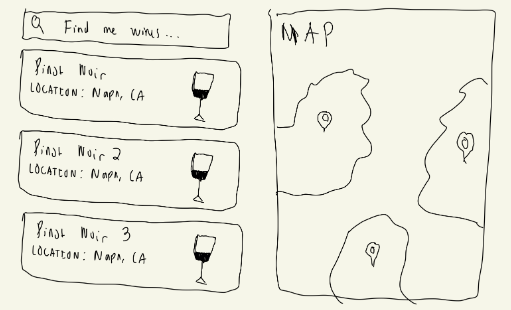
Given some initial interest in a recommendation algorithm for wine, we also wanted to play around with creating a simple MVP. This MVP took in a natural language query of a wine people might want (i.e., "give me a wine that goes well with gouda cheese...") and then would return a list of wines with details on where to learn more. Once again, the high-level rationale for this prototype was to present it to folks in the wine space and gauge any initial interest.

The tech stack, which is described more in our document about the book recommendation algorithm, is as follows:
- Index lots of wine reviews + other data. We think using a popular site like CellarTracker will be good to start off with, and we can easily expand to more sources.
- Chunk and encode data into embeddings. There are existing embeddings models (OpenAI), chunking libraries (Langchain), and vector databases (Chroma) that we can use to make this efficient.
- Upon a user's query, find relevant embeddings, and prompt the model with similar embeddings. We will intend to use low cost ChatGPT API.
- Build a simple frontend around everything. We can do this with a package like Streamlit and expand into more sophisticated frontend after validation.
We talked to around 10 people in the wine space, from financiers, to vineyard owners, to folks who were Masters of Wine. After all of the calls, we learned a lot about the wine space and decided to pivot away from it. Here were some takeaways:
- We found the wine space to be generally hard. There's a lot of regulation, and each state has its own laws about how distribution works. Especially in California, there are magnitudes more vineyards compared to distributors. Given the amount of manpower and cost required to set up a relationship with a vineyard, most distributors, then, only work with larger vineyards. Most people also don't buy wine online, but in-person, which has a larger impact on our next bullet point
- We also found that restaurants traditionally had a stronger need for our marketplace compared to vineyards. While starting a vineyard is hard, starting a restaurant is even harder, and many of these places wanted an almost 40% markdown from the prices vineyards sell their wines. It also didn't seem hard for wines to get themselves into restaurants as a result of this dynamic. Thus, going into the future, most revenue seems to be in the direct-to-consumer (D2C) space as opposed to more B2B.
- Finally, we found that recommendation was a hit. Even outside of demoing our platform to different users, we found that some folks even nudged towards the concept of recommendation (one person even mentioned how he wanted a "Pandora for wine") without us prompting them to do so.
All of this is to say: we felt as though it made more sense to pivot away from the wine space, and instead look towards our ideas of recommendation, instead.