Repository navigation
Myth: Dragons & The Dragons' Dogma
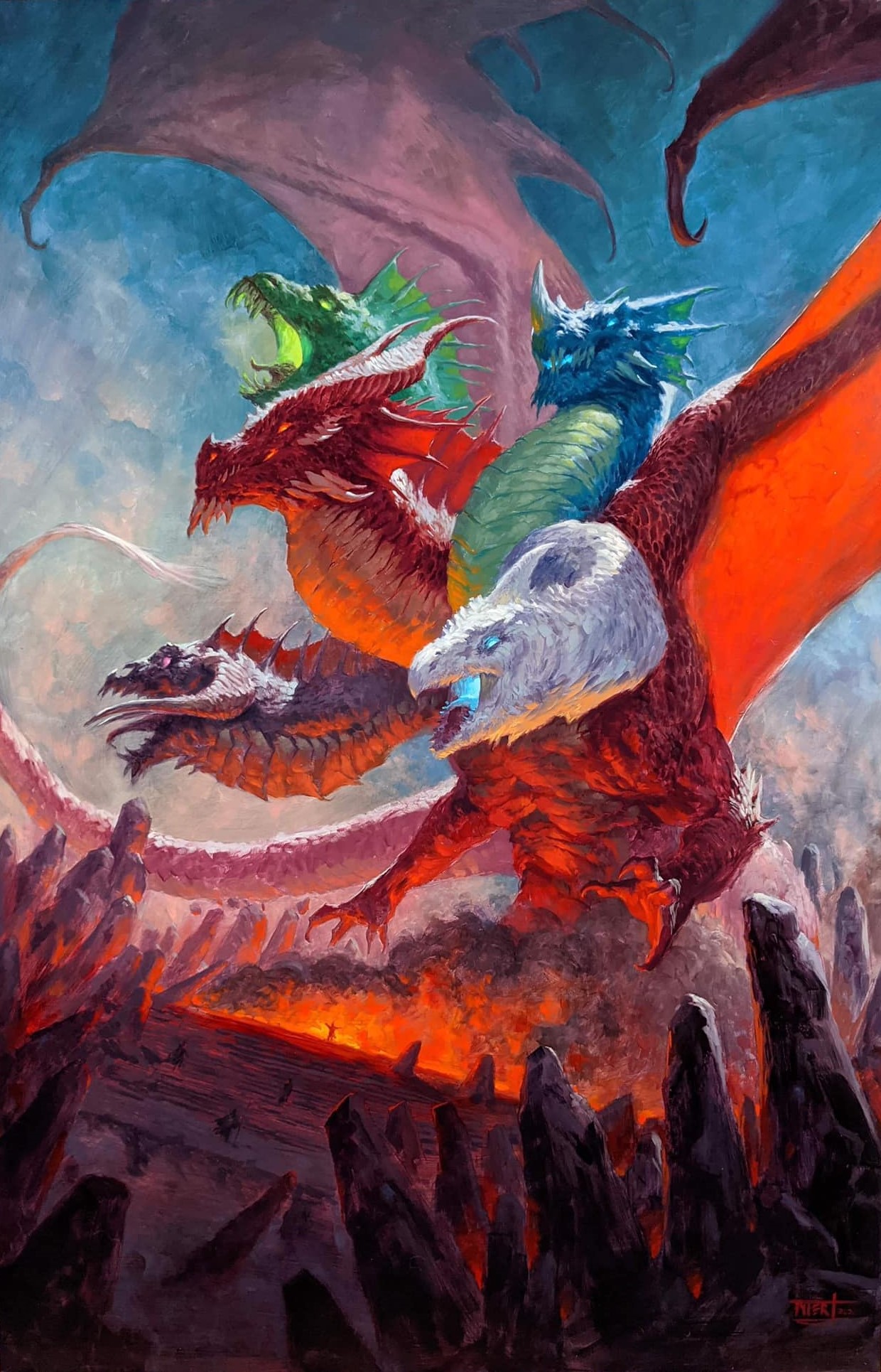
Nietzsche's Übermensch, Jung's Individuation, Sartre's radical freedom.
Dragons are the ultimate individuated beings. Creatures whose will has completely overcome constraint. They are pure manifestations of self-actualized transcendence, each a vision of personal divinity.
Every dragon sees itself as a sovereign axis around which the world turns.
Their hoards are not just wealth, but symbols of personal achievement, embodiments of meaning as self-defined.
Metallic Dragons lean toward benevolent transcendence, helping others unlock their will.
Chromatic Dragons reflect will corrupted by ego. Domination as a form of transcendence.
Dragons may resist becoming gods, as gods are bound by the wills of others. Dragons are bound only by their own.
Ancient dragons are worshiped as gods despite themselves.
Some are advisors, others tyrants, some seekers of absolute solitude, each one a philosophical challenge made flesh.
Dragons are not mere monsters; they are events of mythic consequence. They are ancient, powerful, and unknowably complex beings whose existence shapes the fabric of the world. Each dragon is more than a creature: it is a meme, an archetype, a manifestation of human will and fear, of the stories that give reality shape. They are meaning-givers, sometimes gods, sometimes cataclysms, always transcendent.
A dragon is not a kind of creature. It is something a person becomes.
A person carries the potential to overcome the culture that made them and arrive at a self that is genuinely their own. When that happens the change is not spiritual only: realisation actualises the body. What they understood themselves to be, they become.
Many have tried to understand this process. Traditions meet here and say the same thing from opposite ends.
- Daoist ziran, the self-so, the sage who needs no rule because nothing in them pulls against the way.
- Nietzsche's become what you are: the overcoming of inherited values by someone who can finally author their own.
The word for it is Ascending. Literal when they fly off.
Note:
- Ascending: It is the same word the Way of the Ascendant Dragon monks use. Not an accident.
The Dragons refer to the secret of self-realization as the "Dragons' Dogma". It is an ironic name indeed, as the Tripitaka's Scroll: It's an empty dogma. Only when you understand there is nothing on the scroll, nothing sacred, nothing dogmatic... then you can start writing your own code.
It is a strange secret, for it is not kept very tightly. Some dragons try to communicate this to their followers, but the seekers of masters (like Nietzsche's slaves) do not accept this in their hearts. When an individual understands the Dogma, then they become a Dragon Egg. They have started becoming a dragon themselves. In the end, only dragons truly know the Dogma.
Dragons reproduce through culture, memory, trauma, and awe. A single sighting may birth generations of myths. The story of a dragon changes the people who tell it. And that story in turn changes the next dragon born of it.
To see a dragon is to be changed.
Where gods demand faith, dragons inspire belief. Where magic shapes the world, dragons are shaped by belief the same way dragons shape myth in turn. As such, every dragon carries its own ideological gravity, reshaping mortal lives and regional truths.
Not a bloodline, not a species, not a reward. A dwarf who spends ninety years on one gem may Ascend through the obsession itself, because the obsession was the only thing in that life that was truly theirs. Seen from outside this looks like a curse, and the clan would describe it that way.
The shape is inherited even when the self is not. An Ascending produces the dragon that person was always carrying, assembled from eons of myth and everything they ever thought a dragon was: a wyrm, a drake, a kirin, a Long, a winged and impossible lizard. No two traditions produce the same silhouette and none of them is the real one. The self is authored; the vocabulary of the self is not.
That loop runs both ways. A single sighting births generations of myth. The story changes the people who tell it, and that story changes the next dragon born out of it.
Transcendence is not a moral achievement. An Ascended dragon owes nothing, and is not kind in any way that serves others. They simply live without friction.
- The hoard is the meaning, not the gold but the power. Not the books but the knowledge. Not the gems but the beauty.
- Some come back down. A dragon whose real self is interested in politics, or a guild, or a bloodline, will resume a humanoid shape and run one. The shape is a tool once you are past needing it to be a self.
- They resist godhood, because gods are bound by the wills of others and a dragon is bound only by its own. They get worshipped anyway.
Each type of dragon is an echo of a philosophical position. These names are not a biological classification, but a movement in the Dogma:
"Fire belongs to all."
- Represent the flame of innovation and rebellion.
- Givers of forbidden knowledge. Inspire mortals to rise above gods.
- Bring civilization through struggle. Often hated by gods.
- Appear in myths where power is stolen, not granted.
- Can be mentors, tyrants, or martyrs.
"The truth must burn."
- Embody the philosophy of cosmic pessimism, or liberation from illusion.
- Apocalyptic: bring truth as devastation.
- May view their destruction as mercy, or cleansing of stagnation.
- Philosophical kin to Mainländer, Nietzsche, and bring forth existential crisis.
- Rarely speak in mortal terms, and use poetic language often.
"To ride the wind is to know the way."
- Embody non-interventionist wisdom and the fluidity of Dao.
- Rarely violent. Prefer parables and weather to swords.
- Appear as masters of the forces of nature: storm, wind, rivers...
- Aid those who live with harmony, punish arrogance.
- Their hoards are understanding, not gold. Usually grimoires, scrolls, and items of great power
"Become what you are."
- Catalysts for personal evolution. Face them to be transformed.
- Symbolize eternal recurrence, the will to power.
- Every choice near them carries immense weight.
- A Nietzschean dragon may be your enemy, ally, or future self.
- Killing one may turn you into what it was.
"The story is everything."
- The living embodiment of narrative power.
- Shape reality through storytelling.
- Heroes exist because of them.
- Can trap mortals in endless fables or lift them into legend.
- They are the source of the classic "princess in the tower" and the dragon that guards the end of the world.
Being misunderstood is load-bearing. Nietzsche has been misread for as long as he has been read, and so is this, in-world. Never write a scene in which somebody explains it correctly and is believed. A character may suspect. A character may be right. Nobody gets confirmation.
Consequences of Dragon Existence
- Sociopolitical: Kingdoms form religions, cults, or militaries around dragons. Some societies are ruled by draconic mandates.
- Magical: Areas near dragons warp with mythic resonance. Reality bends to the dragon's nature.
- Psychological: Mortals exposed to dragon presence may suffer or transcend. Dreams, fears, ambitions are amplified.
- Memetic Spread: A dragon need not act directly to change the world. The story of a dragon is more powerful than its breath.
Dragon Hoards Not all hoards are gold. Each hoard carries an important meaning for the dragon:
- Promethean hoards: blueprints, secrets, forbidden spells.
- Mainlander hoards: forbidden books, crypts of renown heroes, ruins of great kingdoms.
- Laozian hoards: True Names (spells of the grates power), knowledge of historic events, magic items of great power or significance.
- Nietzschean hoards: swords of paladins, great weapons of legendary heroes, crowns of kings of old.
- Mythopoeic hoards: relics of stories, tablets of records, monuments, ancient artifacts.
Using Dragons in Your Campaign
- Introduce them slowly: a shadow, a dream, a myth.
- The story precedes the dragon.
- Let their presence ripple before the creature is seen.
- Use them as catalysts for change, not just encounters.
- Make slaying a dragon a moral, personal, and social event.
- Never make a dragon a simple beast. They should haunt the world.
Optional Mechanics: The Dragon's Shadow Every dragon leaves a metaphysical shadow behind, affecting the region it inhabits.
- Promethean: Fires spread, revolts spark, mad inventions thrive.
- Mainlander: Dreams become bleak but honest, lies burn away.
- Laozian: Storms whisper truths, balance returns.
- Nietzschean: People feel drawn to challenge fate.
- Mythopoeic: Travelers vanish into legends, and everyone remembers a different version.
Dragon-worship is not a cargo cult. The correct parallel is Christianity and Buddhism: neither rarely produces another Joshua or another Siddhartha, and both are full of people imitating a transcendence they have not had. Both also produced schisms, wars and tensions. That is not a filter placed between mortals and illumination. It is simply the tragic general condition of any living religion, and it does not make the practice fraudulent or the practitioners fools.
In this setting the shape is closest to an imperial cult with a monastic strand: observance, hierarchy, and rite at the level of the state, with a genuine contemplative tradition running through it, and ordinary personal spirituality alongside both.
Dragon Cultists are the failure case, and they fail on the philosophy rather than on sincerity: a self authored to someone else's specification is precisely the thing that has to be overcome. They are the movement that worships the man who despised movements.
Dragonborn descend from dragons, are shaped like them, and live near enough to speak with them. They built a civilisation of rules by observing beings who were following none, which is why their society is codified, grandiose and outward-facing: every value arrived by watching somebody else.
The cost is real. Expectation crushes people, and a hardness gets demanded of their own. So is the good: cohesion, service, a house that will not let you fall, and the warrior in the garden who watches the trees blossom and does not need to be anywhere else.
And maybe they are not the ones who missed it. Proximity is an advantage. Of every people in the setting, the dragonborn are arguably best placed to Ascend for real, because they are nearest the thing and can ask it questions. Whether any of them does or understands is another matter.
Draconic Flight at level 5 is the tell. An adventuring dragonborn sprouts wings that the ones who stayed home do not. Leaving, and becoming something of your own out there, is the first flicker of the real thing: a mini-Ascension, earned by starting to be true to yourself. Nobody in-world would know tha, except dragons themselves.

Dragons, as apex predators and magical entities, have a profound and multifaceted impact on the ecosystems they inhabit. Their influence extends beyond their immediate hunting grounds, shaping the landscape, the behavior of other species, and the flow of natural resources.
- Predatory Dominance
- Dragons are at the top of the food chain, with few, if any, natural predators. Their presence significantly impacts the population dynamics of other species, particularly large herbivores and lesser predators. The fear of a dragon’s presence can cause migrations or behavioral changes in prey species, leading to overgrazing or overpopulation in areas where dragons are less active.
- Territorial Influence
- Dragons often claim vast territories as their own, which they fiercely defend. These territories become zones of reduced human and humanoid activity, where the natural environment can flourish without interference, or conversely, where the land becomes barren due to the dragon’s destructive nature. The presence of a dragon can lead to the development of unique ecological niches, where only the most resilient species thrive.
- Elemental Alterations
- Dragons, especially chromatic ones, often embody elemental forces. A red dragon’s lair might be surrounded by scorched earth and bubbling lava pools, while a green dragon’s forest might be saturated with toxic fumes. These elemental influences can create microenvironments that harbor specialized flora and fauna, adapted to the unique conditions imposed by the dragon’s presence.
- Magical Residue
- Dragons are inherently magical creatures, and their very presence can warp the fabric of reality around them. Areas frequented by dragons might exhibit wild magic zones, where spells behave unpredictably, or might give rise to magical anomalies such as spontaneous portals, enchanted flora, or cursed land. The magical aura of a dragon can also imbue local wildlife with heightened abilities or mutations, leading to the emergence of new, dragon-kin species.
Dragons are not merely powerful beasts; they are intelligent beings with complex motivations, desires, and relationships with other sentient species. Their presence profoundly influences the social, political, and economic landscapes of the world. Some dragons hide their power with mortal forms, others adopt the mythical persona they manifested. Some even live as beasts, passionate for the hunt, as that was their true nature. Some may have even forgotten their mortal form, living their full lives as drakes. When a dragon adopts the nature of the myth openly, some pattern emerge around them.
- Dragons often exert influence over nearby civilizations, either through direct domination or as powerful allies. A dragon might rule over a region as a tyrant, demanding tribute from nearby towns and cities, or it could act as a protector, using its immense power to maintain peace and order in exchange for worship or other forms of reverence. The political dynamics between dragons and humanoid leaders can shape entire regions, influencing wars, trade agreements, and alliances.
- Dragons are deeply embedded in the cultural consciousness of many societies. In some cultures, they are revered as gods or ancestors, with elaborate rituals and festivals dedicated to their honor. In others, they are feared as harbingers of destruction, with entire mythologies built around their wrath and the heroes who slay them. The presence of a dragon can also give rise to cults or secret societies that either worship the dragon or seek to control its power for their own ends.
- The hoards of treasure that dragons accumulate are legendary, and their presence can dramatically alter local economies. Nearby towns might become centers of wealth and trade, with adventurers flocking to the area in search of the dragon’s riches. Conversely, the dragon’s predations can impoverish a region, as trade routes are disrupted, and settlements are abandoned due to fear. The dragon’s lair might also become a site of pilgrimage or a lucrative destination for treasure hunters, bringing both wealth and danger to the region.
- The presence of a dragon can also influence social structures within nearby societies. Those who have the dragon’s favor, whether through alliances, trade, or magical pacts, might rise to positions of power and influence, creating new social hierarchies. On the other hand, those who oppose the dragon or fail to meet its demands might find themselves marginalized or destroyed. The dragon’s influence can also extend to criminal organizations or mercenary groups, who might see the dragon as either a patron or a target.
- Dragons are often seen as valuable but dangerous allies in the broader geopolitical landscape. Kingdoms might seek to form alliances with a dragon, offering tribute or land in exchange for the dragon’s protection or support in wars. These alliances can shift the balance of power between rival nations, as the dragon’s involvement in a conflict can turn the tide of war. Conversely, the presence of a dragon might force neighboring kingdoms into an uneasy peace, united by the common threat or opportunity the dragon represents. Diplomatic relations with a dragon require careful negotiation, as offending such a powerful entity could lead to catastrophic consequences.
- Dragons, especially ancient ones, often embody certain ideals or philosophies, such as greed, wisdom, or chaos. Their presence can inspire religious movements or philosophical schools of thought. A dragon known for its wisdom might become a living oracle, consulted by sages and kings, while a dragon representing chaos could inspire cults that embrace destruction and anarchy. The dragon’s existence forces societies to confront the nature of power, mortality, and the relationship between mortals and the divine.
- Dragons, especially older ones, are often vast repositories of knowledge, having lived through countless ages and witnessed the rise and fall of empires. Scholars and wizards might seek out a dragon’s counsel or try to decipher the ancient tomes and artifacts it hoards. In some cases, dragons might even establish schools of magic or philosophy, teaching chosen mortals the secrets they’ve guarded for centuries. The dragon’s influence can thus shape the intellectual and academic currents of an entire era.
- The areas controlled by a dragon often become no-man’s lands, with borders defined by the dragon’s influence. These regions may be subject to special laws or decrees set by the dragon, and crossing into these territories might require paying homage or tribute to avoid incurring the dragon’s wrath. The dragon’s environmental influence—whether it be causing volcanic eruptions, blizzards, or droughts—can also determine the livelihood of surrounding areas, influencing agriculture, trade, and settlement patterns.
- The presence of a dragon often creates an entire sub-economy driven by adventurers and mercenaries. Taverns, blacksmiths, potion brewers, and other merchants might thrive in areas near a dragon’s lair, providing goods and services to those daring enough to confront the beast. Guilds might form with the specific purpose of slaying or negotiating with dragons, leading to the rise of professional dragon hunters whose reputations can rival that of kings.
- Dragons often have complex relationships with other sentient species, including other dragons. These relationships can influence broader inter-species dynamics, especially in regions where dragons are particularly powerful or numerous. A dragon might ally with or subjugate groups of orcs, giants, or other monstrous races, using them as foot soldiers or servants. Alternatively, a dragon’s hatred for a particular species (such as dwarves or elves) could incite long-standing conflicts, influencing the politics and social relations between those races for generations.
In the world of D&D, dragons are not merely fearsome beasts but pivotal forces that shape both the natural world and the societies that dwell within it. Their presence reverberates through every level of existence, from the ecological balance of the wilderness to the intricate power dynamics of kingdoms and empires. Understanding the role of dragons through the lens of Ecosociology provides a richer and more nuanced perspective on how these legendary creatures influence the world around them, making them central figures in the ongoing narrative of life and civilization.
A dragon is not a challenge to be overcome. It is a question asked in fire, thunder, or silence. The answer is never easy, but always meaningful.
Dare not just to fight the dragon. Dare to understand it.
- Never explain it on the page.
- A dragon owes nobody anything. Not a mentor, unless mentoring happens to be its special interest.
- The dragonborn are not a joke, and not a failure. Play the dignity, the cost and the nearness together.
- No east/west split. Every silhouette is one tradition's answer.