Repository navigation
Species: Aasimar

An Aasimar is a mortal who carries within them a Spark from the Celestial Realm. The Spark is a link to something perfect. The source of the Aasimar power, and also the measuring bar. But the Aasimar is mortal, imperfect, and is, therefor, always short from perfection. Aasimars cannot be an angels, but people who have to live.
The presentation to the player:

Angels, Muses, Constellations, Celestials... different cultures call your people by different names. Truth is, you never lived among them. You are mortal, and you are part of one of the many cultures of the world. But you also have something in you from the Higher Planes. Your aspect resembles your mortal side, but you also have tells from your heavenly origin: Talaria, small vestigial wings, and Aureola, a barely perceptible shining halo around your head. You can hide them or empower them depending on your emotional state.
All Celestials are inclined towards a higher ideal: Justice, Sacrifice, Freedom... Think about which ideal can inspire {name} and guide their path as an adventurer.
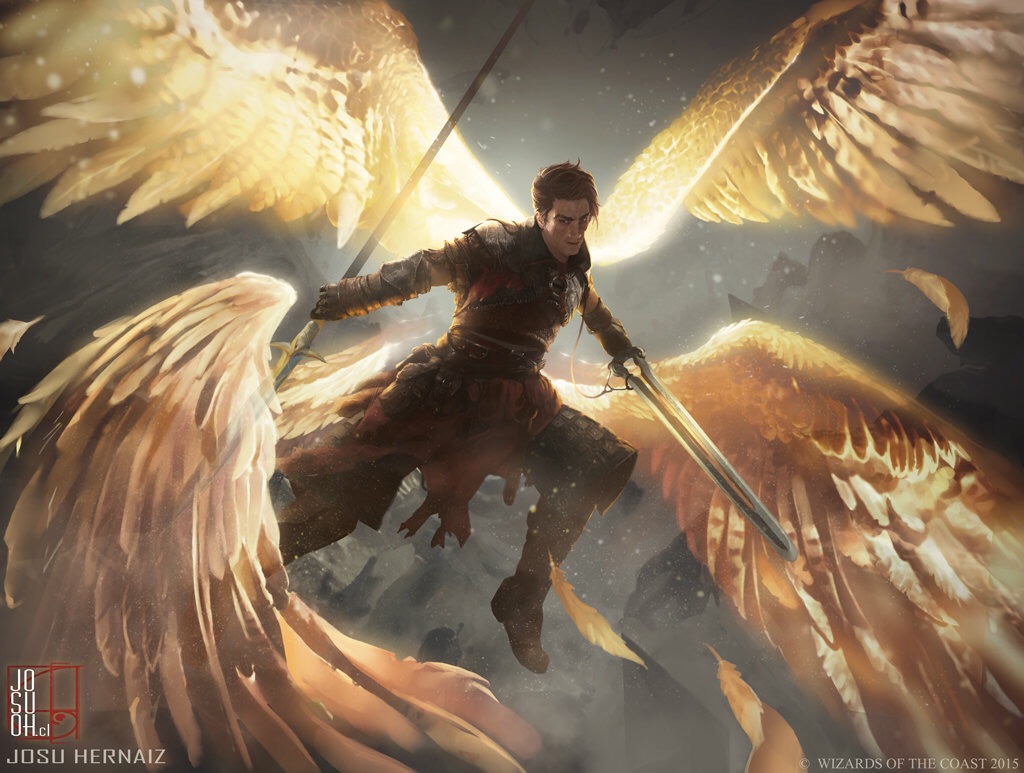
Generated text. One of the best features of the app. It makes each aasimar unique and characteristic in physical and evocative form at the same time.
It presents:
- Talaria as the small wings hidden as apparel, based on Hermes and Kairos small wings.
- Aureola. A shining circle or crown around the head.
- A color relationship to the ideals. Two for a complex but easy reading. Metalic colors for the wings, and gemstones for the halo.
- A specific Ideal Celestial as a lineage.
- It never mentions the specific Ideals, leaving the interpretation free for the player. It may inspire a more complex reading than a simple combination.
Example:
Your talaria and aureola resemble the traits of the Angel Barakiel, so you may belong to its lineage. At your heels you carry talaria that catch the light like verdigris, barred across with red iron, and folded they pass for the straps of your sandals. Your aureola is a star of many points, set like a compass rose, and it glows like aquamarine shading into ruby. It twinkles when you run, and beats when you fly.
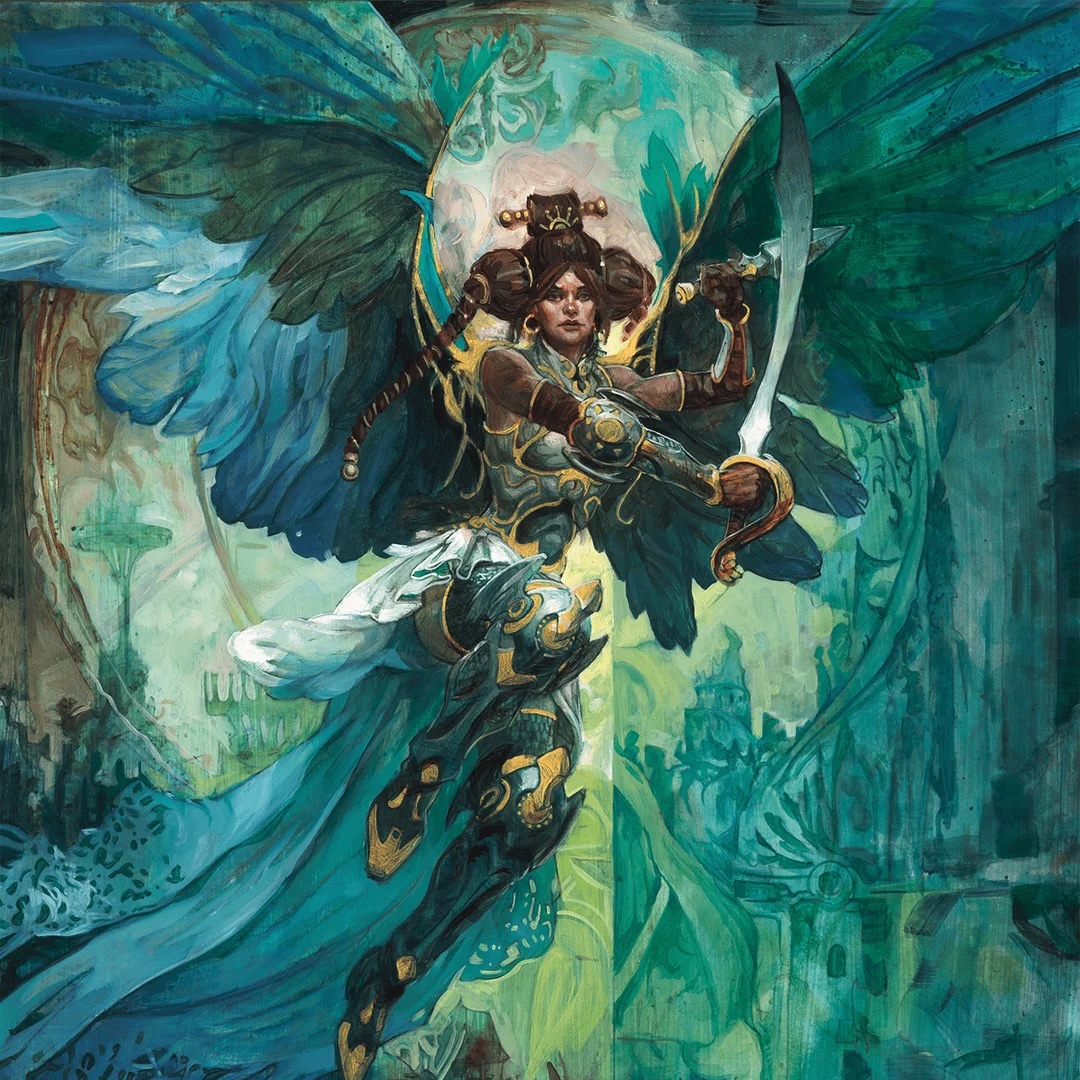
📗🌟 The metal dresses the talaria, the gem is what the aureola glows like, the form is the aureola's shape, and the tell is the one thing that aureola does. All four are assigned by the spark: this table is the whole of what the Ideal decides. The tell never names the Ideal it belongs to.
| 📗 Ideal | Aureola form | Metal | Gem | Tell | Muse |
|---|---|---|---|---|---|
| Justice | a circle perfectly round from wherever anyone stands | black iron | onyx | It dims when you are not being honest. | History (Clio) |
| Mercy | a glow with no edge, light that fades | gold | amber | When someone near you is afraid, it sends a cold feeling down your spine. | Sacred Song (Polihimnia) |
| Sacrifice | a broken ring, with an arc of it missing | red iron | ruby | It darkens for a moment whenever you see someone die. | Tragedy (Melpomene) |
| Truth | a ring of small lights, each orbiting on its own | silver | diamond | It falls into chaos when you feel anything strongly, good or bad. | Astronomy (Urania) |
| Freedom | a star of many points, set like a compass rose | verdigris | aquamarine | It twinkles when you run, and beats when you fly. | Dance (Terpsicore) |
| Beauty | slow waves of colour, one running after another | pearl | opal | It beats once when you look at something you find beautiful. | Love Poetry (Erato) |
| Hope | a band crowning your temples | tin | moonstone | It is faint when you wake up, but brighter as you get tired. | Comedy (Talia) |
| Honor | a standing flame that burns without moving | bronze | jade | Its colour changes with your mood. | Epic Tales (Calliope) |
| Harmony | rotating triangles with perfect proportions | brass | quartz | It stutters when you are in pain, of body or of mind. | Lyric & Flute (Euterpe) |
A Spark is the celestial side of the Aasimar, and it comes from two Ideals selected at uniform random from the list. The same ideal may be selected twice.
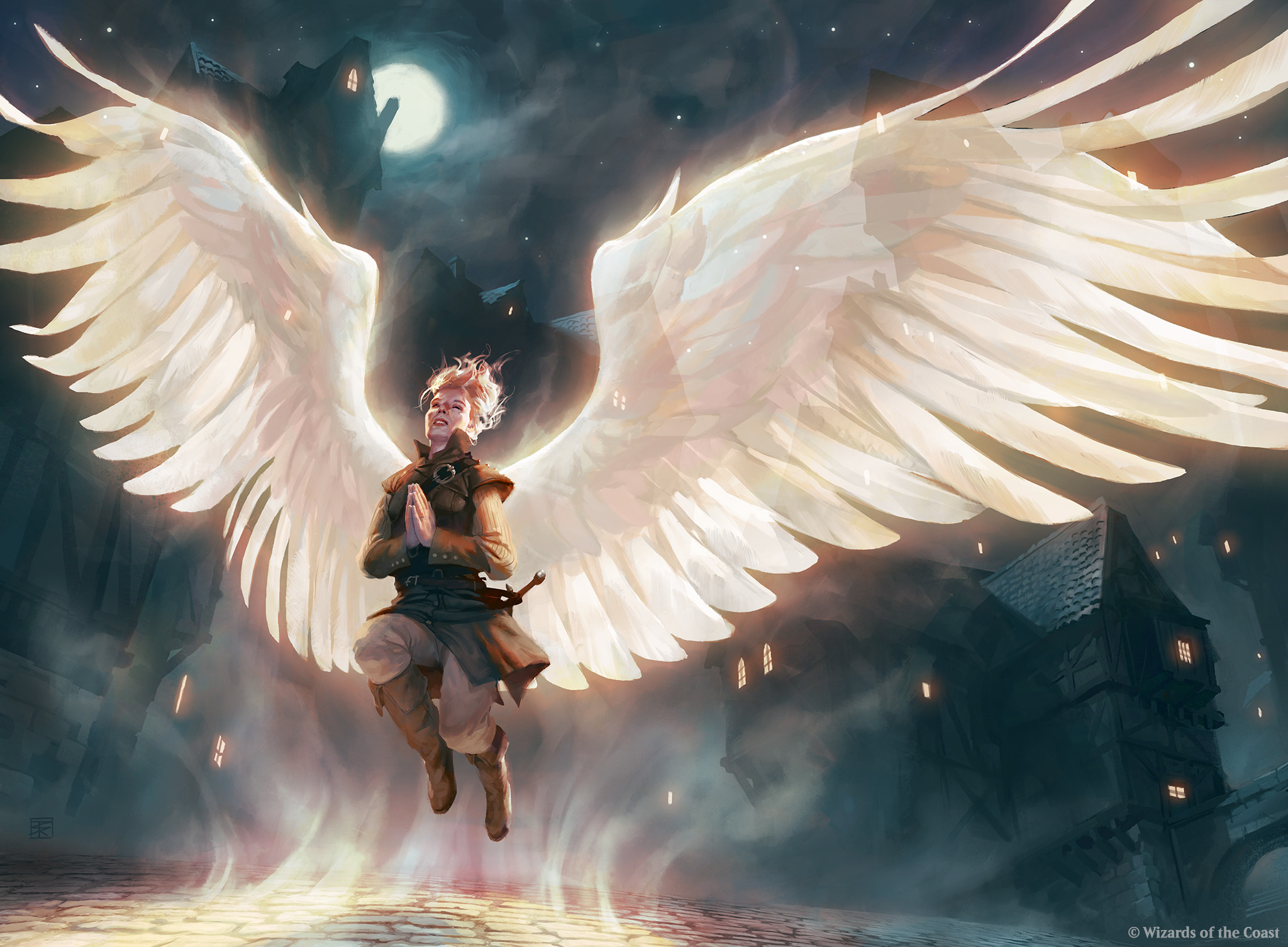
📘 Talaria are the small wings that greek gods like hermes and kairos have. For Aasimar, these are small and vestigial of their celestial origin. They may lie in places like the arms and the legs, and the back. They must always carry weight, as when unfolded by the level 3 transformation, where they grow into magnificent wings of great power.
📘🎲 Where they sit, and what they pass for folded. Rule: A wing may only sit where a wing could reasonably take a body's weight: nothing on the face, nothing on the front side.
| Perch | Folded, it passes for |
|---|---|
| your wrists | a pair of bracelets |
| your forearms | wound bracers |
| your shoulders | a mantle clasp |
| your shoulder blades | the seams of a toga |
| the small of your back | a wide sash |
| the base of your spine | a belted overskirt |
| your ankles | anklets |
| your heels | the straps of your sandals |
📗🎲 How the metals wear. The metals are the spark's; the arrangement is not. With two Ideals the two metals share one pair of wings, seven ways:
- {a} on the back and {b} beneath ·
- {a} at the base, running to {b} at the tips ·
- {a}, every feather edged in {b} ·
- {a}, barred across with {b}
- {a}, speckled with {b} ·
- {a} above, and {b} that only shows when they open
- {a} with one band of {b} across them.
With one Ideal, four ways:
- {a} ·
- {a}, darker at the tips ·
- {a}, paler underneath ·
- {a} all the way through.
Each entry is the rule itself as presented to the player in the app, complete enough to resolve at a table. Not a summary and not a cross-reference. Bullets indicate chips. ENTRIES NEED FLAVOR TEXT, in italics and separate.
- 📙 Creature Type Humanoid (Celestial).
Added Celestial subtype, as that is the core of the fantasy. Internally, an Aasimar should trigger Celestial tags.
- 📕 Size Medium or Small. [Proportion is 90% Medium, 10% Small.]
- 📕 Speed 30 feet.
📕 Darkvision. You can see in Dim Light within 60 feet as if it were Bright Light. In Darkness within that range you see as if it were Dim Light: you have Disadvantage on Wisdom (Perception) checks that rely on sight, and you discern colors there only as shades of gray.
📘 Darkness cannot hide the truth from you.
- Darkvision: 60 ft
📕 Celestial Resistance. You have Resistance to Necrotic damage and Radiant damage.
📘 Life flows through you. Death passes over you.
- 📕 Resistances += {Radiant, Necrotic}
📕 Healing Hands. As a Magic Action, you touch a creature and roll {PB}d4. The creature regains a number of Hit Points equal to the total rolled. Once you use this trait, you can't use it again until you finish a Long Rest.
📘 Life finds your way.
📕 Light Bearer. You know the Light cantrip. Charisma is your Spellcasting Ability for it.
📘 There is always a spark of light inside of you. Relentless.
📕 Celestial Revelation (level 3+). You can transform as a Bonus Action, using one of the three options below and choosing the option each time you transform. The transformation lasts 1 minute or until you end it (no action required). Once you transform, you can't do so again until you finish a Long Rest.
Once on each of your turns before the transformation ends, you can deal extra damage equal to your Proficiency Bonus (+{PB}) to one target when you deal damage to it with an attack or a spell, of the type named by the option you chose.
📘 Be not afraid, for you bear a star.
📙 Talarian Wings [renames Heavenly Wings]: You spread your talaria into fully grown wings. Until the transformation ends you have a Fly Speed equal to your Speed. Your extra damage is Radiant.
📘 You spread your wings to show your true self.
📕 Inner Radiance: Your eyes shine brightly and your halo grows into a bright aurora. For the duration you shed Bright Light in a 10-foot radius and Dim Light for an additional 10 feet, and at the end of each of your turns each creature within 10 feet of you takes {PB} Radiant damage. Your extra damage is Radiant.
📘 Your inner spark becomes an aurora of pure light.
📕 Necrotic Shroud: Your eyes briefly become pools of darkness and your aureola collapses like a Dark Sun. Creatures other than your allies within 10 feet of you must succeed on a Charisma Saving Throw (DC {8 + PB + CHA}) or have the Frightened condition until the end of your next turn. Your extra damage is Necrotic.
📘 The brighter the light, the darker the shadow.

📘 Celestials are emanations from the Platonic World of Forms. Perfect Ideals. Aasimars have a spark, a fraction from those ideals, as part of them.
📗 The spark is a constant, not an inheritance. An Aasimar is part of the sky and walks among mortals as one. They are continuously both Mortal and Celestial. A spark cannot be taken away. Is identity. Is soul-bound.
📘 The problem the rules set. The Revelation is the demanding one. It forces a single body that can sprout wings, shed searing light and terrify a room, and that must pick between them at each transformation.
📘 Our answer is one source: the spark. The spark is a connection to the stellar realm, and it brings two changes onto the carrier (as well as the aesthetic choices of the player):
- The talaria: small vestigial wings sitting only where a wing could take a body's weight, each folding away as a seam. They carry the colors of the spark. Reminiscent of Hermes and Kairos winged feet.
- The aureola: a halo, in a shape the spark lends, whose shine resembles a gem. Typical in christian art, but with themed variations.
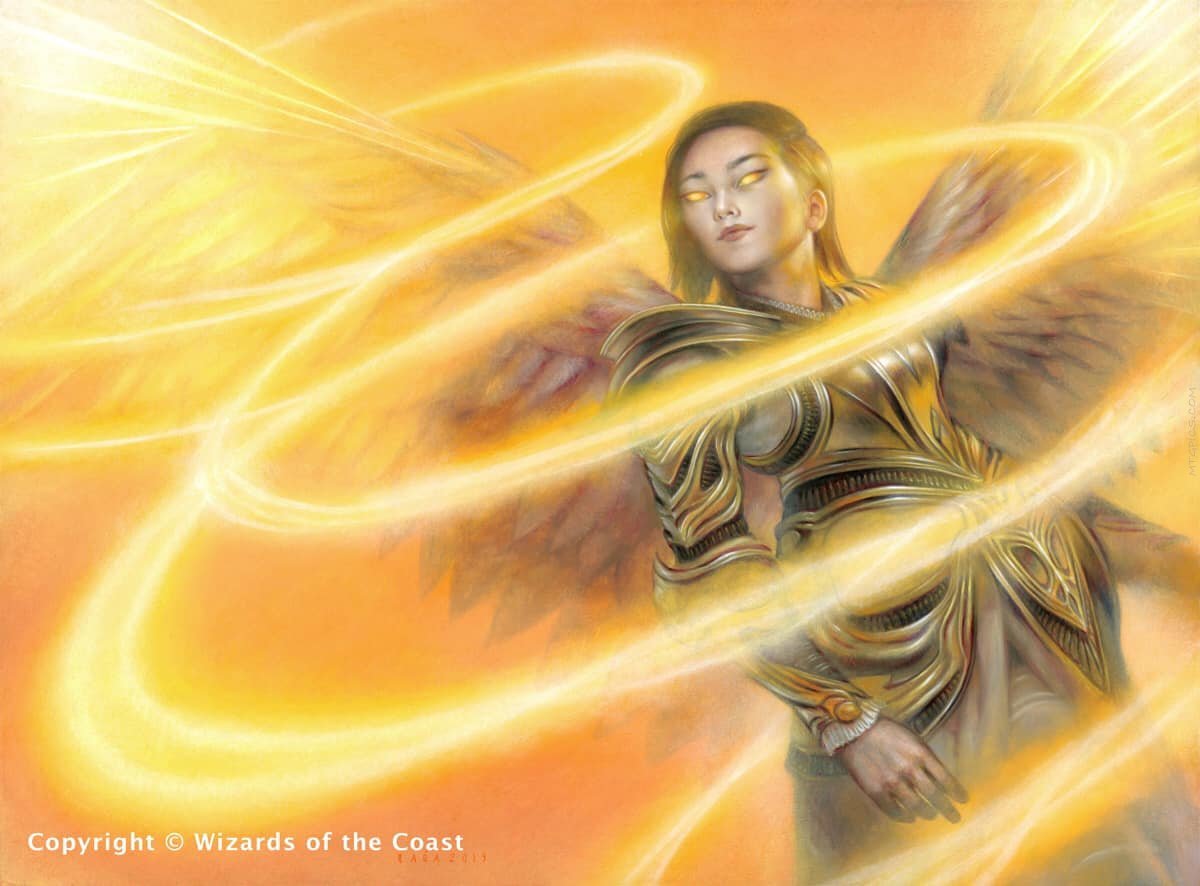
📘 Between them the two account for the wings that grow, the light that blazes and the darkness that collapses, so the three Revelation options belong to one body rather than being three unrelated powers.
📗 The Descent is an ancestor read off the sky, and it is never confirmed.
📗 Celestial Observation. The Aasimar produce astrologers. Here the charts are not divination, they are observation, and to observe means both to watch and to keep. An Aasimar following the sky is not superstitious. They are checking on family, and the family is visible most nights. This is the one habit the species generates on its own, and it costs nothing to give a character.
📗 The spark sets a bar the mortal cannot clear. An Ideal cannot bend, cannot compromise and cannot love the one who carries it. The aureola reports on fidelity rather than goodness, so a tyrant may keep a perfect ring. That gap between the fixed thing and the person carrying it is the drama every Aasimar starts with, and it needs no villain.
For the Celestials themselves, their Virtue, their plans and their use as antagonists, see Celestials.
🌟 Assigned by the spark, and tabled once above: the metal the talaria catch, the stone the aureola glows like, the aureola's form, and its tell. One row per Ideal, and a mixed descent splits them.
🎲 Drawn at random, and saying nothing about the Ideal: where on the body the talaria sit, how two metals share one pair of wings, which ancestor the marks are read as, and which of the four sentence patterns the entry is written in.
| What | Where | State |
|---|---|---|
| Species entry | AtlasActorLudi/SpeciesKit/Aasimar/__init__.py |
Shipping. Closes on an open invitation, which stays (§10). |
| The Ideals, the Descents, the mark | SpeciesKit/Aasimar/Map_of_Ideals.py |
Shipping. Belongs to a shared CelestialKit once QST-0050 lands. |
| Traits and their lines | SpeciesKit/Aasimar/resolution.py |
Shipping, and matching this page. All eight lines are wired: Darkvision, Celestial Resistance, Healing Hands, Light Bearer, Celestial Revelation, and one on each of the three Revelation options. Darkvision prints its rule with its line, not a bare chip. |
| Names | AtlasNomina/Races/Celestial.py |
Celestial bodies from every language: a deliberate mosaic. |
| Culture keys |
athens, vatican, sangha; legend crusader
|
The subculture's own three, kept (§4). |
| Prayer | Map_of_Cleric_Prayers.py |
One species line. No lines yet for the three markers. |
| Warlock patron | AtlasOfGuilds/WarlockKit.py |
Drawn from the same DESCENTS and IDEALS. To become the descent ancestor for an Aasimar (§8). |
The Aasimar and the Dragonborn are the reference kits for voice (QST-0062). A generated Aasimar entry reads, for example:
Your talaria rest at your shoulder blades and fold away as the seams of a toga, shining like verdigris, barred across with silver. Above your head, a star of many points, set like a compass rose, glowing like aquamarine shading into diamond. It twinkles when you run, and beats when you fly. These are the traits of the Sphinx Aidos, so you may belong to its lineage.
Two axes drawn apart (the wings take the metal, the halo the gem), a tell that never names the Ideal, four sentence arrangements in four voices, and an ancestor whose name is the thing it guards (Aidos is Shame, the reverence that stops a hand; the generator gave it to an Assassin, which by the loaded-names rule is a story).
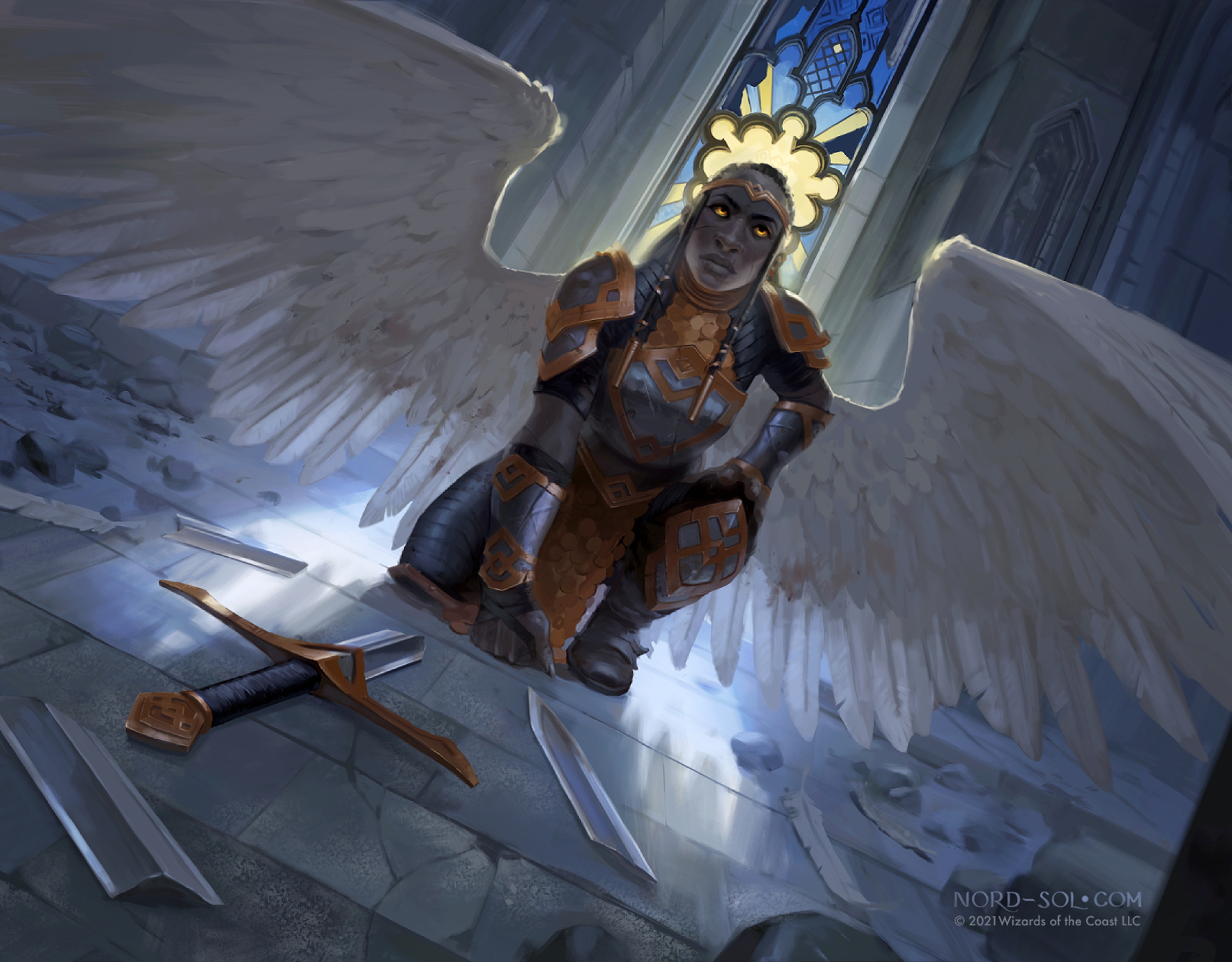
A Celestial is an Ideal with a shape: not a god and not a servant of one, but Justice itself, or Mercy, standing where mortals can see it. Celestials are emanations of the Platonic Forms, incarnated by pure collective (jungian?) belief on the goodness of the concept, and each carries a Virtue level that defines their might. An Aasimar carries a spark of one.
Note:
💡 A Celestial and a Demon both gain power from this collective belief in the same way: How good a concept is, that Celestial is more powerful. How bad a concept is, its Demon is more powerful. Same axis, different directions. Demons punish what Celestials prevent. Both are part of the same system of control. Devils, and Fallen Angels do not participate on this axis.
The spark is fixed. The Aasimar is not. The bar, the gap and the drama it creates are stated in §0. What the gap costs the person standing in it: only the Ideal is important, and you are important as an artefact of it. A mortal chooses, makes mistakes, grows and has free will; the thing measuring them does none of that. The aureola reminds them of the distance without judging it.
The Ideals are tabled in §0, with their metals, gems, aureola forms and tells. What the table does not say:
They are alignment-independent and twistable ("I claim Justice for your offence"; "Truth is what I say it is"). The list is open: a merged concept makes a new Celestial, so it is never counted and never closed. Vengeance is not an Ideal, because it belongs to the Demons' theme: Punishment.
Saints belong to the Dwarves and are a different system.
A spark comes from two Ideals, drawn as §0 states; the same Ideal coming up twice is a single descent. In a mixed descent the first lends the aureola its form, both lend the gem-like colour it glows with, and either may lend the tell. Honor's standing flame, glowing like jade shading into Beauty's opal, belongs to that pair and to nobody else at the table.
The spark shapes the vessel The Aasimar is not a human with wings. The body is a biological actualisation apt for the spark it carries: the greenish or bluish skin of the published art, the talaria, the aureola, and perhaps other features pushed toward the "ideal being". This is a physical inheritance, and the species law permits it: that law guards against monoculture and moral determinism, not against biology (Darkvision already settles the point; nobody culturises themselves into seeing in the dark). Self-Actualization. An aasimar can choose the expression of their wings each time. That makes them Self-Actualizing to the choices they make. The rest of their appearance and body may follow a similar principle, where their spark and self-view shape the expression of their biology. A gnome-born Aasimar is still medium size in the rules. They are not a gnome anymore.
Older readings the design team should know. The Zoroastrian Amesha Spentas (Truth, Good Mind, Dominion, Devotion, Wholeness, Immortality) are personified principles attending the highest god: the closest historical model for an Ideal with a shape. The fravashi, the pre-existing higher self that each person is said to carry, is the closest model for the spark. Neither is directly named on the page nor directly ported into the system. Just inspiration sources.
What §0 settles and this chapter does not repeat. The talaria and their perches, the plumages, and every Ideal's metal, gem, aureola form and tell. One thing sits outside that table: the metals nod at the Dwarven soul-metals and confirm nothing, which is deliberate DM space (§7).
The aureola has a second well. In the yogic map the halo is the crown centre made visible, the thousand-petalled lotus drawn above the head; sangha reaches india at 2, so the Aasimar's own third marker carries the well.
The tell. The nine are in §0's table, one per Ideal. Watching a halo dim tells you somebody lied, not what they descend from.
Three rules govern the tell:
- It answers to fidelity, not goodness. A tyrant whose ring stays perfect is entirely possible, and a better story than one whose halo goes out.
- It only ever says no. Socrates' daimonion never told him what to do, only what not to; the tell is a daimonion made visible. No later tell may be written as an instruction.
- Open: is the oversight internal or external? Does the Aasimar cause the halo to change, or does injustice in the room disturb it? "Do you feel a disturbance in Justice, or does injustice disturb you?" Both readings are live and the sheet must not settle it.
The square nimbus. In Roman and Byzantine art a square halo marked a living person, against the round halo of the dead saint. The Aasimar's halo is the imperfect one, the work in progress; a Celestial's is finished. A well, not a rule; it also keeps Saints (round, dead, Dwarven) apart.
Celestials do not care much about the vessel. The body is apparatus for the spark. This is a temperament, and it separates them from every people who speak of their bodies with pride (the Goliath's size, the Dwarf's beard). An aasimar may take this view by default, but some may revel (Monks, barbarians...) and focus on the vessel instead of the soul.
Decided, superseding the earlier proposal to draw a host culture for the body.
The Aasimar are recognisable and distinct wherever they are born. "An emo or
a punk is easy to see whether in Mexico or in Britain. Same symbols on
different hardware." The three culture markers (athens, vatican, sangha)
are the subculture's own, kept as they are; the gear, the vocabulary and the
manner follow them regardless of who the parents were.
Born to ordinary parents, like the Tiefling. The species entry says "you never lived among them… you are part of one of the many cultures of the world." What follows is a pull out of the birth culture, in one of several shapes, all of which work and none of which is imposed:
- Poor parents give the child to a temple; rich parents send the child to an Academy, believing they carry high potential.
- The Aasimar joins a priesthood, an international order, or a network that recognises its own on sight.
- A mother names the child with a holy name, or the grown Aasimar renames themselves with an angelic-sounding one (the name pool of celestial bodies from every language is this: Citlalli, Estrella, Whetū, Zvezdana).
- The Aasimar pushes the mortal culture aside for the myths and legends of the higher origin; or is defined by rejecting that origin. A Dwarvish Aasimar is interesting, and the choice is the player's.
- A culture inside a culture, like a priesthood class: above the local culture rather than outside it.
A privileged minority. The Tiefling is the target of hate by default; the Aasimar is a model minority: praised, expected to be great, "the rich kids", the quarterbacks and cheerleaders to the Tiefling's emo and punk. Both are minorities; one is integrated upward and one is pushed out.
The three tempers of the subculture. Athens reasons; the Vatican
consecrates; the sangha renounces. The through-line is the contemplative order
as such, wherever found (Cultural-Inspirations.md). The pensive kind's
failure mode: deliberates while the thing burns. The bodhisattva is the
sangha's figure for the Aasimar: the one who could go up and stays, the
renegade angel, the explorer of life as a path of illumination. Renunciation
is what makes the Aasimar's mortality a choice rather than a defect.
But for the aasimar the Renunciation may not have been the Aasimar's choice, but the Ideal''s.
The shared priesthood. Deep lore, never on the page: the Aasimar and the Tiefling once shared one priesthood (the Tiefling canon's crown-horns holding a flame). The Aasimar's side separated, dichotomised, and rose above the local cultures; the Tiefling's side was left holding the horns. This is the theological shift of the Tiefling canon seen from the other end, and it makes the Aasimar's privilege and the Tiefling's exclusion one event. A Character may find an inscription that says so. Nobody in authority confirms it.
Grammar. The species entry has no "we", and by the mechanism above it should not at the species level: there is no Aasimar homeland. The subculture may say "we" (the order, the academy, the temple). The Tiefling canon's claim that its entry is "the only one with no we" should be read as: the only one whose isolation is hostile. The Aasimar's is upward.

-
Athens
- the pensive philosopher.
- Plato's Cave and Ideals.
- Daedalus and Icaros.
- Minos.
- The Atlantis Mythos.
- Ancient Astronauts.
- Naval weaponry.
- Togas and greek clothing.
- Classic greek aesthetics.
- Muses
-
Vatican
- Neoclassic
- Dogma
- Authority and Calling
- Artistic depiction of Angels
- Thrones, Planetars, Angels
-
Sangha
-
Crusader in Fantasy and History
- Imperium of Men in 40k
- Arthur and the quest for the Grail
- Hamelin Piper
- Zealots
The markers. athens (the academy, the portico, the fleet), vatican
(sacerdotal Rome: office, vestment, canon), sangha (the Buddhist monastic
order of South and Southeast Asia: the khakkhara, the vajra, the dha, temple
bronze and saffron lacquer). Legend register crusader: late Arthur, the
Grail, the Temple, the pilgrim road, "a myth of election". crusader answers
to the Vatican and marches on the Levante.
Subtler influences. Zoroastrianism and the Persian angels; Manichaeism. Nietzsche's Zarathustra marks the division of heaven and hell: the departure from a Realm of Death and manifestation of Ideals (a Platonic beyond, where principles balance the world) toward a Manichaean division of Principle and Punishment, with reward notably absent: you must be good, and reward is not guaranteed. Very Catholic. In that light a Celestial is preventionist or redemptionist, where a fiend is deterrence or punishing, and the Aasimar/Tiefling separation is tainted by this prevention/punishment moral division and control. See the Celestials page for the NPC consequences, including the Celestial as a campaign's antagonist.
The sea. Athens' gear is naval: Trireme Trident, Peltast Javelin, Pelte Shield. The fishing and sea imagery invites two readings at once, and both are welcome as wells:
- The fishermen and the fish: the register of a founder's followers, apostles and nets. It sits naturally on the Vatican key.
- Atlantis, which is Plato's own myth: the Celestials as the sea-people from before, with a faint "ancient astronauts" shimmer (Celestials are, after all, celestial: stars, planets, constellations). This connects the Aasimar to Minoan culture and enriches the Athens/Sparta split with the rest of the Greek world: Chios and Ionia, Alexandria, Rhodes.
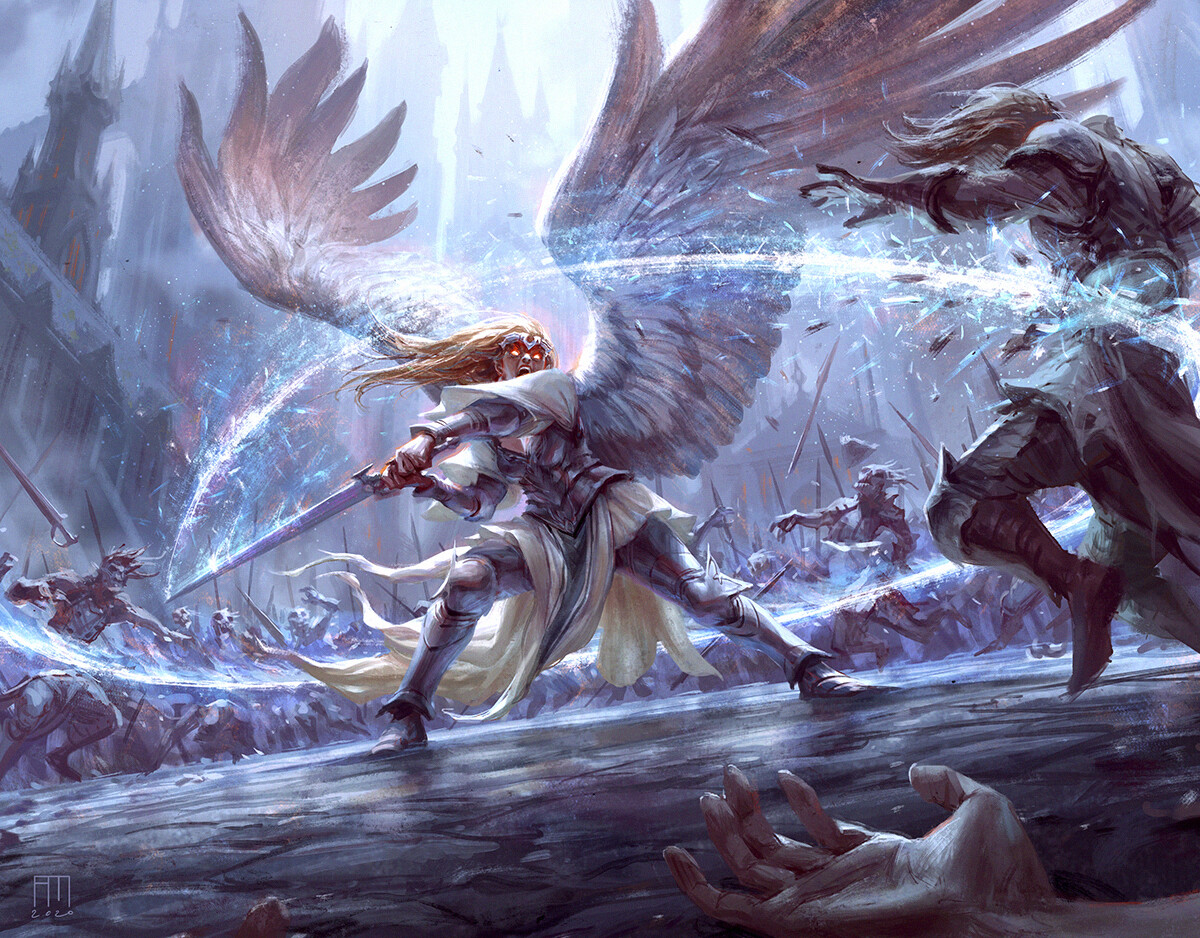
The Iliad's gods among men. An Aasimar drinks from the Iliad's image of gods and heroes walking on the field and striking in the war. The Odyssey belongs to the Goliaths; or the Trojans are the Titans, and the Trojan War is a war of Celestials and Titans for the heavens, which the Goliath entry already suggests ("the gods took the heavens and the songs; the First Ones kept the world"). Rhodes is another Greek culture available to the Giants. This is the one place where the two peoples' myths are the same war seen from two camps.
The stars are Arabic. Vega, Altair, Deneb, Rigel: the star-names in the Descents were given by the people the crusader register marches against. An Aasimar of the Star Altair carries a Levantine name into a crusader's harness. Never on the page; a DM's gift.
Lucifer is a Celestial, unfallen. The Planetars carry the Greek names of the wandering stars and the Latin morning star is among them. In this setting the fall is a reading (Tiefling canon), and the morning star never fell. Keep him in the pool; never comment. Another reading is that a Fallen Planetar or an "angel" (common term for celestials in generals, as most people only see angels, not thrones or planetars.) is not automatically a demon or devil. Just a Satan (adversary), and the Fallen may still serve an ideal. I could see a Planetar of Freedom revelling against the whole plan of controlling the morality of mortals. And both Devils and Fallen Angels being "the imaginary axis" to the controlling paradigm, where they are maybe good or bad, but free people from the simple machiavellian reading of morality. Maybe a Devil wants to control you, and Lucifer may want you to just be free to be yourself. This for the player must be just a reading.
Prayer. The ledger should take sayings and prayers from the Athens, Vatican and sangha wells (Delphi's "nothing in excess", the Dhammapada's "hatred is never appeased by hatred", and so on) as sayings, without importing the real-world institutions as lore.
Stated elsewhere, and not restated here. The measuring bar and the drama it creates (§2). The tell that answers to fidelity rather than goodness, so the tyrant keeps a perfect ring (§3). Every class an Aasimar takes is a different departure from the spark, and the aureola reports every departure (§8).
The Nephilim. The Abrahamic root of the half-celestial is ambivalent: "mighty men of old, men of renown", and the stated reason for the flood. The blessed reading is also a reading. It rhymes with the Tiefling's theological shift (one mechanism, opposite ends) and gives the Aasimar an unspoken history that need never be resolved.
The Greek hero. A child of the heavens is the definition of a Greek hero, and goodness is no part of the definition. Herakles kills his own children; Achilles sulks while his friends die and then drags a corpse around a city; Theseus leaves Ariadne on a beach; Jason breaks the oath the moment it stops paying. The word for what they have is aretē, excellence at being the thing you are, and it never meant virtue. The divine parent hands down capacity. What the hero is owed for it is kleos, renown, and nothing else.
That is the Nephilim verse in another language: mighty men of old, men of renown. Two traditions with no contact between them agree that mixing heaven and earth makes might, and that might is not goodness. It gives this page's oldest rule a second root, since the spark makes you more and never better, and it is the readiest argument against playing every Aasimar as a Paladin. It gives the Holy Horror below its Greek half, because a god fathers a hero for a purpose and the hero finds out late. And it gives the drama its oldest shape: the half-god is measured against the parent and comes up short, because the hero dies and the god does not. Perseus is already in the Descent roster as a Constellation, which is where that story ends. The hero is not raised into the sky for being good. He is put there for being remembered. To carry the message of the Ideal he enacted.
The Holy Horror. "He made you just to do its bidding?" A Celestial cannot love an Aasimar; it can hire one, and it can make one for the job. The crusader register is "a myth of election", and election's shadow is exactly this cosmic-plan horror: if you were chosen, the choosing was the Ideal's, and your life is the shape of somebody else's decision. An Aasimar may come to suspect that "you never lived among them" was a placement, not an accident. Nobody confirms it. The Celestial patron's briefing voice already says the true thing as a joke: "They will tell the one you crossed that it was your own free will."
Prevention and punishment. A Celestial prevents the corruption of an Ideal, or redeems toward it; a fiend deters or punishes. Neither is kind. A Celestial that tries to install an Ideal into a person, or into a party, is a legitimate antagonist, and the Inquisitor background's superior ("send them on, the gods will know their own") is what that looks like from below.
| People | The relation | Deep lore, never on the page |
|---|---|---|
| Tiefling | The mirror. One mechanism (belief makes celestials; belief makes fiends), opposite readings. Model minority against hated minority. | The shared priesthood, split by the Aasimar's side (§4). A Tiefling and an Aasimar are cousins who were told different stories about the same flame. |
| Goliath | The other people who hold Greece and Rome as identity, opposite halves. Athens against Sparta; the Vatican against the legion. | The Trojan War as Celestials against Titans (§5). Two camps, one war. |
| Dragon / Dragonborn | The fixed against the self-authored. An Ideal cannot bend; a dragon authors itself alone. | Couatl. A dragon bound to an Ideal, or an Ideal that Ascended into a dragon's shape: the Celestial Dragons. "That may be how Couatls are made." The Dragon Cultist Aasimar is one road to it. |
| Dwarf | Saints are the Dwarves' and stay there; the talaria's metals nod at the soul-metals and confirm nothing. | Two systems that look like one from a distance. The ambiguity is deliberate DM space. |
| Elf | Fixed against malleable: the Ideal against the collective Dream. | The Elves are the only people whose nature is decided by what everyone agrees to imagine; the Aasimar is a fixed ideal, only it's power being empowered by the affinity to that belief. |
| Human | Institutions. The temples and academies that take Aasimar children are mostly Human-built ("there is always a human kingdom"). | The Human Cleric's watcher is a church; the Aasimar is what the church points at. |
The Celestials' vocabulary names several classes (the project's etymologies). That is colour, not fantasy: the fantasy of each class is its own, and an Aasimar in it is one more mortal departing from a fixed thing.
| Class | The word | The Aasimar in it |
|---|---|---|
| Barbarian | barbaros, outsider: "the foreigners of heaven, the mortal with impulses and wants" | Living true to an emotion, coded as Rage. Plato's Sun against Plato's charioteer: no auriga, but a wild horse can still see the sun and run toward it. Three shapes: the Zealot for the Ideal; the deeply feeling wanderer who takes everything as a miracle; the philosopher who loves the Ideal and the wisdom to understand it. |
| Monk | monachos, the one who lives alone | The body taken as sacred, and the spark channelled through it: Focus flowing from the aureola down through the body into the fist. Not a departure: the spark embodied. Lived. |
| Cleric | klērikos, the allotted | The spark cannot love you, so the Aasimar Cleric looks for the parent the Ideal is not. The most obvious pairing and the best drama. |
| Paladin | palatinus, the Palatine guard (Rome, Byzantium) | Blood and vow both unflinching, since an oath cannot bend either. The interesting Aasimar Paladin swears an Oath against or in conflict with the Ideal, and the aureola shows the strain. |
| Warlock | convenire, diathēkē, berith: the covenant. "Form, not belief; not principle but contract." | Hired by its own blood. Decided: for an Aasimar Celestial Warlock, the patron is the descent ancestor (same Descent, same Ideal). Drama is higher with a family member; the Holy Horror (§6) is the second horror beside instrumentality. The Fiendish or GOO patron's are interesting in the sense of corruption to the ideal. "The self vs the job". |
| Sorcerer | sortiarius, the bender of fate | Independent of species, as every class is; a synergy is welcome, not required. The spark from the Ideal may have awakened something, or been a way for something else to get in. Only a Celestial-flavoured origin would draw on the spark; a draconic or shadow origin needs another explanation, and the player gives it. |
| Wizard | magi, the astronomers and intellectuals of the East | Native through Athens, and therefore flat; the interesting Aasimar Wizard is the sangha's renouncer who studies. |
| Bard | bardos, the praiser | The Muses' class. An Aasimar of Muse descent playing the Muse's own art is the one pairing where spark and profession coincide. |
| Druid | the most external to a Celestial (Caesar, Pliny) | Two readings: a keeper of balance and order from the principle inherited, or a renegade who embraces the mortal world. The Circle of Stars relates to the Celestials' own realm. |
| Ranger | saltuarius, limitanei, horoi, peripoloi: the wardens of the frontier | The Aasimar itself is a warden of the frontier between the Celestial and the mortal realms. |
| Fighter | pugnator, bellator, agonistēs, polemistēs: "the hand that holds the sword" | The justiciar. The hand of the heavens. Achilles, Heracles, the Hero: the Iliad's register of gods striking on the field. And through Athens' naval gear, a marine of the fleet rather than a hoplite. |
| Rogue | rogare, the vagabond | Rejects the calling in every incarnation but one: the Celestial Reaper. An Assassin of Sacrifice has a halo that darkens at every kill, a tally it cannot stop keeping; an Assassin of Justice who kills without a disguise keeps a perfect ring. |
| Artificer | artifex | Daedalus was Athenian: wings built for someone else. |
The Ideal's tell is the Aasimar's hook in every background, because it reports on conduct without naming the principle.
- Servant × Mercy. Mercy's chill "when someone near you is afraid"; the Servant "stood at the sideboard… Not once did anyone say a mean word to you." The Servant of Mercy felt every guest's fear, every night, and poured.
- Gambler × Justice. "Your face is good." The ring above it dims when you bluff. A Gambler who cannot bluff and wins anyway.
- Inquisitor. "There was a child… she burned." An Inquisitor whose Justice halo dims when they say "send them on"; or one who watched a superior's halo stay perfect through it: the tyrant with a perfect ring, seen from below.
- Fortune Teller × Truth. The ring scatters when you feel strongly; or the halo is what sells the reading, when contact is real.
- Spirit Medium × Sacrifice. The halo darkens for a death: how the Medium tells a haunting from the wind.
- Revolutionary × Freedom. "It twinkles when you run." The compass rose as a getaway light.
- Shadow. A light casts no shadow of its own; the Shadow Aasimar is physically consistent and nobody believes the explanation.
- Destined. "You glow." On an Aasimar, twice. Right, and everyone is tired of it.
- Exorcist. Celestial Resistance: the one who cannot be possessed, and so cannot be sure the procedure works on anyone else.
- Debunker. The Debunker with a halo, who has an explanation for it.
- Bailiff × Honor. The Badge is your aureola? The open question of §3 (internal or external oversight) lives here most sharply.
- Herald. The aureola as credential.
- Dragon Cultist. The fixed against the self-authored, in a cult: the road to a Couatl (§7).
- Stranger. Doubly from elsewhere; the old ones are the only people who might know what the halo used to mean.
Decided
- The Aasimar keep
athens,vatican,sanghaas their own culture. They are a subculture recognisable across host peoples; no host-culture draw for the body. Aasimar and Tiefling stay distinct. - The species entry's closing invitation ("Think about which ideal can inspire {name}") stays as written. The design principle (the drawn Ideal) is not the play principle; the player reads whatever they want from the mark, and an Ideal may be complex, a synthesis, or not there at all. Death of the Author.
-
Freedom's Muse is Dance (Terpsicore). Dance is an expression of freedom;
the empty
musefield was a mistake, not a design. ✅ Wired. - Darkvision is printed as an entry with a line: "Darkness cannot hide the truth from you." ✅ Wired.
-
DESCENTSkeeps one Hesperus. ✅ Wired. - A spark is two draws at uniform random, and the same Ideal may come up twice. The 2:3 weighting toward a single Ideal is deleted and not replaced (QST-0110). ✅ Wired.
- Harmony is a primary Ideal, brass and quartz, and it closes Euterpe (QST-0111). ✅ Wired.
- The talaria do not perch on the neck. The arms, the legs and the back; nothing on the face and nothing on the front side. ✅ Wired.
- Nine Medium to one Small, as the Size entry states. The draw was even until now, and it was the page's only unnoticed Size discrepancy. ✅ Wired.
- The prayer ledger takes sayings from the three wells; it does not import real-world institutions as lore.
- The species law ("taught, not inherited") guards against monoculture and moral determinism only. Physical traits are biological. The Sorcerer's "born different" is a legitimate fantasy and independent of species.
- For an Aasimar Celestial Warlock, the patron is the descent ancestor. Species-and-subclass synergies of this kind are wanted generally.
Open
- Whether
vaticanreads too modern (see,basilica,apostolicare the alternatives) and whethersanghais the right name (theravada,nalanda); fromCultural-Inspirations.md. - Three proposals stand against the lock (QST-0114): Inner Radiance still says halo where Necrotic Shroud says aureola; the 📕 on the two rewritten Revelation options, which the legend makes 📙; and whether the Descent roster is 🌟 or 🎲, which is the only one that moves the generator. The spelling, the reversed link and the dropped "one of" landed on 2026-09-11.
Rejected
- The host-culture draw for the Aasimar body.
- Any change to the closing invitation of the species entry.
- Joy as a ninth Ideal for Terpsichore (superseded by Dance as Freedom's).
- Celestials.md: the beings themselves, for the NPC generator: Ideals, Descents, temper, how they act, the Celestial as antagonist, the Couatl.
- Tiefling: the mirror; the shared priesthood; integration against exclusion.
- Goliath: Celestials against Titans; Rhodes; the Odyssey.
- Dragon canon: the Couatl as an Ideal-bound dragon.
- Bard: Dance is Freedom's; Euterpe holds Harmony.
- Sorcerer: the species law read correctly; synergy, not collision.
- QST-0050: the CelestialKit shared between players and NPCs, which this page and the Celestials page both need.
- For-Reviewers §7: how a flavour line is written, for every species. Learned here, so it left this page.
- QST-0113: where these eight lines came from, what each replaced, and the one still proposed.
- QST-0114: what is proposed against the lock. QST-0115: two leftovers in the kit that no sheet shows.