Repository navigation
Notepad Tutorial
Home › PsControls › Notepad Tutorial
📘 Start with: PsControls and PsApp, the controls and the framework these steps use.
📖 In the book: Chapter 36, Capstone: a Notepad for Windows, which explains every step in more depth. The code on this page is the book's, and it is compiled and run with every build of the book.
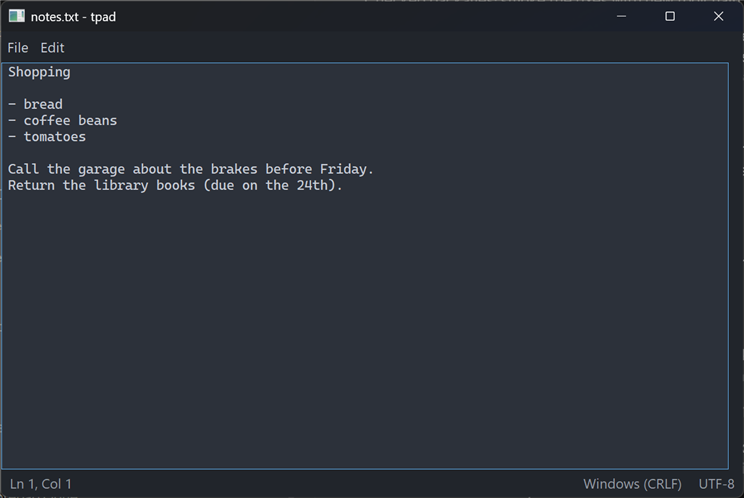
This tutorial builds tpad, a plain-text editor in the shape of Windows Notepad: a menu bar, the text, a scroll bar, a status bar with the line and column, Find, and a question before unsaved work is thrown away. It is about 800 lines of tiko, a sixth of them a self-test, and the release build is one 309 KB executable that needs nothing Windows does not already have.
tpad/
tiko.toml the package, and the target tpad
tpad.rc, tpad.manifest the manifest, compiled into the program
textfile/textfile.tiko the document: load, save, find, line and column
pad/pad.tiko the window: controls, menus, commands
tpad.tiko the program, and its self-test
textfile imports nothing from Windows, so it can be tested on Linux and macOS as well. pad is the window, and tpad.tiko starts it.
# tpad: `tiko build tpad` writes out/debug/tpad.exe
[package]
name = "tpad"
[target.tpad]
main = "tpad.tiko"
resources = ["tpad.rc"]
[target.tpad.defines]
# Every Win32 name means its W (UTF-16) form.
UNICODE = "1"UNICODE is required by PsControls: every bare Win32 name then means its UTF-16 form. tpad.rc is one line, 1 24 "tpad.manifest", and the manifest asks for per-monitor DPI awareness and version 6 of the common controls:
<?xml version="1.0" encoding="UTF-8" standalone="yes"?>
<assembly xmlns="urn:schemas-microsoft-com:asm.v1" manifestVersion="1.0"
xmlns:asmv3="urn:schemas-microsoft-com:asm.v3">
<assemblyIdentity version="1.0.0.0" processorArchitecture="*"
name="tpad" type="win32"/>
<asmv3:application>
<asmv3:windowsSettings
xmlns="http://schemas.microsoft.com/SMI/2016/WindowsSettings">
<dpiAwareness>PerMonitorV2, PerMonitor</dpiAwareness>
</asmv3:windowsSettings>
</asmv3:application>
<compatibility xmlns="urn:schemas-microsoft-com:compatibility.v1">
<application>
<!-- Windows 10 and 11 -->
<supportedOS Id="{8e0f7a12-bfb3-4fe8-b9a5-48fd50a15a9a}"/>
</application>
</compatibility>
<dependency>
<dependentAssembly>
<assemblyIdentity type="win32" name="Microsoft.Windows.Common-Controls"
version="6.0.0.0" processorArchitecture="*"
publicKeyToken="6595b64144ccf1df" language="*"/>
</dependentAssembly>
</dependency>
</assembly>The module keeps text with one LF per line break. The text control counts a line break as one character too, so an offset in a Document is an offset in the control.
#module "textfile"
#import "std/fs"
#import "std/strings"
'' Nothing here knows about windows: this module is the part of tpad
'' that compiles, and is tested, on every target.
public enum LineEnding
CrLf
Lf
end enum
'' A text file as the editor sees it. Inside, every line break is one
'' LF, so an offset into Text is an offset into the editor control,
'' which also counts a line break as one character.
public type Document
as ustring path '' "" until the first Save As
as ustring text
as LineEnding ending = LineEnding.CrLf
as boolean hasBom '' the file began with a byte-order mark
as boolean lossy '' some bytes were not UTF-8
end type
'' CR LF and a lone CR both become LF.
public function ToLf( byref s as const ustring ) as ustring
return strings.Replace( strings.Replace( s, !"\r\n", !"\n" ), _
!"\r", !"\n" )
end function
⚠️ The control does not hand back what it counts.PsTextBox_GetTextreturns every line break as CR LF, whilePsTextBox_SetSelcounts each break as one character. Search the textGetTextreturns, select the match, and the selection lands one character early for every line above it. Convert withToLffirst.
Loading and saving keep a file the way it was written: its line ending, and its byte-order mark if it had one. fs.ReadAllText removes a mark and turns bytes that are not UTF-8 into U+FFFD, so the module reads the first three bytes itself and records a lossy load. fs.WriteAtomic replaces the old file only when the new one is complete.
'' Did the file start with a byte-order mark? Only its first three
'' bytes are read.
private function StartsWithBom( byref p as const ustring ) as boolean
dim as fs.File f
if f.OpenRead( p ).IsOk( ) = false then return false
dim as ubyte b( 0 to 2 )
var got = f.Read( @b( 0 ), 3 )
if got.IsOk( ) = false then return false
dim as longint n = got.Value( )
if n >= 3 andalso b( 0 ) = &hEF andalso b( 1 ) = &hBB andalso _
b( 2 ) = &hBF then return true
return n >= 2 andalso b( 0 ) = &hFF andalso b( 1 ) = &hFE
end function
'' Reads a file into doc. Returns "" or what went wrong; on failure doc
'' is left as it was.
public function Load( byref p as const ustring, _
byref doc as Document ) as ustring
var r = fs.ReadAllText( p )
if r.IsOk( ) = false then return r.Failure( ).Message( )
dim as Document d
d.path = p
dim as ustring raw = r.Value( )
'' The first line break says how the file writes them.
dim as int32 lf = instr( raw, !"\n" ), cr = instr( raw, !"\r" )
if lf > 0 andalso cr <> lf - 1 then d.ending = LineEnding.Lf
d.text = ToLf( raw )
d.hasBom = StartsWithBom( p )
d.lossy = instr( d.text, wchr( &hFFFD ) ) > 0
doc = d
return ""
end function
'' Writes doc.text to doc.path in the file's own line ending. The old
'' file is replaced only once the new one is complete on disk.
public function Save( byref doc as Document ) as ustring
dim as ustring s = doc.text
if doc.ending = LineEnding.CrLf then
s = strings.Replace( s, !"\n", !"\r\n" )
end if
if doc.hasBom then s = wchr( &hFEFF ) & s
var r = fs.WriteAtomic( doc.path, s )
if r.IsOk( ) = false then return r.Failure( ).Message( )
return ""
end function
⚠️ fs.ReadAllBytes( p, buf, 3 )does not read three bytes. The third argument is a size limit: any larger file is refused and nothing is read. Read a prefix with aFile, asStartsWithBomdoes.
The title, the search and the status bar's numbers:
'' The file's name without its folder, or "Untitled".
public function DisplayName( byref doc as Document ) as ustring
if len( doc.path ) = 0 then return "Untitled"
dim as int32 i = len( doc.path )
do until i = 0
dim as ustring c = mid( doc.path, i, 1 )
if c = "\" orelse c = "/" then exit do
i -= 1
loop
return mid( doc.path, i + 1 )
end function
'' The title bar: "*notes.txt - tpad" while there are unsaved changes.
public function Caption( byref doc as Document, _
byval modified as boolean ) as ustring
return iif( modified, "*", "" ) & DisplayName( doc ) & " - tpad"
end function
'' The offset of the next match at or after start, wrapping around to
'' the top; -1 when there is none. Offsets count from 0, as the editor
'' control's do.
public function FindNext( byref text as const ustring, _
byref needle as const ustring, _
byval start as int32, _
byval matchCase as boolean ) as int32
if len( needle ) = 0 then return -1
dim as ustring hay = text, pin = needle
if matchCase = false then
hay = lcase( hay )
pin = lcase( pin )
end if
dim as int32 at = instr( start + 1, hay, pin )
if at = 0 then at = instr( hay, pin )
return at - 1
end function
'' The 1-based line and column of an offset, for the status bar.
public sub LineColumn( byref text as const ustring, _
byval offset as int32, _
byref ln as int32, byref col as int32 )
ln = 1
dim as int32 lineStart = 1, at = instr( text, !"\n" )
do until at = 0 orelse at > offset
ln += 1
lineStart = at + 1
at = instr( at + 1, text, !"\n" )
loop
col = offset + 2 - lineStart
end sub#module "pad"
#import "vendor/PsControls/PsApp"
#import "vendor/PsControls/PsMenuBar"
#import "vendor/PsControls/PsPopupMenu"
#import "vendor/PsControls/PsTextBox"
#import "vendor/PsControls/PsVScrollBar"
#import "vendor/PsControls/PsStatusBar"
#import "vendor/PsControls/PsMessageBox"
#import "vendor/PsControls/PsButton"
#import "vendor/PsControls/PsCheckBox"
#import "../textfile"
using PsApp
using PsTheme
using PsBufferPaint
using PsMenuBar
using PsPopupMenu
using PsTextBox
using PsVScrollBar
using PsStatusBar
using PsMessageBox
using PsButton
using PsCheckBox
using gui
'' Every command the menus and the keyboard can give.
public enum Cmd
CmdNew = 1000
CmdOpen
CmdSave
CmdSaveAs
CmdExit
CmdUndo
CmdCut
CmdCopy
CmdPaste
CmdSelectAll
CmdFind
CmdFindNext
end enum
'' The two things a person answers: a question in a message box, and
'' a file name in a file dialog. Each is reached through a pointer, so
'' a test can answer in the person's place.
public type AskProc as function( byval f as PsForm ptr, _
byref text as ustring, byval buttons as long ) as long
public type PickProc as function( byval f as PsForm ptr, _
byval saving as boolean, byref suggest as ustring ) as ustring
'' One open file and its window. The form's Tag points here.
public type Editor
as PsForm ptr form
as HWND text, scroll, status
as textfile.Document doc
as ustring findWhat
as boolean matchCase
as AskProc ask
as PickProc pick
end type
enum
IDC_BAR = 100
IDC_TEXT
IDC_SCROLL
IDC_STATUS
IDC_WHAT
IDC_CASE
end enum
'' Posted to the form after a key or a click in the text, so the
'' status bar is read once the control has moved the caret.
const WM_CARETMOVED = WM_APP + 1
function EditorOf( byval h as HWND ) as Editor ptr
return PsForm.FromHwnd( h )->Tag
end functionEverything about one window is an Editor, allocated with new, and the form's Tag points at it. A control's callback receives only the control's handle; PsForm.FromHwnd finds the form, and its Tag finds the Editor. No dim shared is needed anywhere.
ask and pick are the two places a person answers: a message box and a file dialog. They are procedure pointers so that a test can answer instead.
'' The real answers come from a person.
function AskPerson( byval f as PsForm ptr, byref text as ustring, _
byval buttons as long ) as long
return PsMessageBox_Show( f->hWindow, text, "tpad", _
iif( buttons = MBX_BTN_OK, MBX_ICON_INFO, MBX_ICON_QUESTION ), _
buttons )
end function
function PickFile( byval f as PsForm ptr, byval saving as boolean, _
byref suggest as ustring ) as ustring
if saving then
dim as CISaveFileDialog d
d.AddFileType( "Text files", "*.txt" )
d.AddFileType( "All files", "*.*" )
d.SetFileTypes( )
d.SetDefaultExtension( "txt" )
d.SetFileName( suggest )
if d.ShowSave( f->hWindow ) <> S_OK then return ""
return d.GetResultString( SIGDN_FILESYSPATH )
end if
dim as CIOpenFileDialog d
d.AddFileType( "Text files", "*.txt" )
d.AddFileType( "All files", "*.*" )
d.SetFileTypes( )
if d.ShowOpen( f->hWindow ) <> S_OK then return ""
return d.GetResultString( SIGDN_FILESYSPATH )
end functionsub BuildText( byval f as PsForm ptr, byval ed as Editor ptr )
ed->text = PsTextBox_Create( f->hWindow, IDC_TEXT, true )
PsTextBox_SetFont( ed->text, f->Font( PSFONT_MONO ) )
PsTextBox_SetLimitText( ed->text, &h7FFFFFFE )
PsTextBox_SetMargins( ed->text, f->ScaleX( 6 ), f->ScaleX( 6 ) )
'' The person typed, cut, pasted or undid something.
PsTextBox_SetChangeCallback( ed->text, _
sub( byval h as HWND )
ShowTitle( EditorOf( h ) )
ShowStatus( EditorOf( h ) )
end sub )
'' The caret may have moved: look once the control has acted.
PsTextBox_SetMessageCallback( ed->text, _
function( byval m as PSTEXTBOX_MESSAGEINFO ptr ) as boolean
select case m->uMsg
case WM_KEYDOWN, WM_KEYUP, WM_LBUTTONDOWN, WM_LBUTTONUP
PostMessageW( GetParent( m->hTextBox ), _
WM_CARETMOVED, 0, 0 )
end select
return false
end function )
f->OnMessage( WM_CARETMOVED, _
function( byval f as PsForm ptr, byval uMsg as UINT, _
byval wParam as WPARAM, byval lParam as LPARAM, _
byref result as LRESULT ) as boolean
ShowStatus( f->Tag )
return true
end function )
'' The control draws no scroll bar of its own; it tells one.
ed->scroll = PsVScrollBar_Create( f->hWindow, IDC_SCROLL )
PsTextBox_SetScrollChangedCallback( ed->text, _
sub( byval h as HWND )
dim as integer total, page, top
PsTextBox_GetVScrollInfo( h, total, page, top )
PsVScrollBar_SetRange( EditorOf( h )->scroll, total, _
page, top )
end sub )
PsVScrollBar_SetScrollCallback( ed->scroll, _
sub( byval h as HWND, byval newPos as integer )
PsTextBox_ScrollToLine( EditorOf( h )->text, newPos )
end sub )
end sub-
The change callback fires only for the person's edits. PsControls setters such as
PsTextBox_SetTextare silent. -
The message callback runs before the box acts on a key or a click, so it posts
WM_CARETMOVED. The form handles that once the caret has moved. -
The box draws no scroll bar. It reports its line count, page and top line, and a
PsVScrollBarreports where it was dragged.
sub BuildStatus( byval f as PsForm ptr, byval ed as Editor ptr )
ed->status = PsStatusBar_Create( f->hWindow, IDC_STATUS )
PsStatusBar_AddPanel( ed->status, "" ) '' Ln, Col: springs
PsStatusBar_AddPanel( ed->status, "" ) '' line ending
PsStatusBar_AddPanel( ed->status, "" ) '' encoding
PsStatusBar_SetExpandPanel( ed->status, 0 )
'' The bar lays the panels out; what is inside one, it leaves to
'' the program. Without this, the panels are blank.
PsStatusBar_SetPaintCallback( ed->status, _
sub( byval p as PSSTATUSBAR_PAINTINFO ptr )
dim as PSTHEME_COLORS t = PsApp_Instance( )->Theme( )
p->b->SetColors( t.TextDim, t.Window )
p->b->PaintRect( @p->rc )
dim as RECT r = p->rc
r.left += PsStatusBar_GetPadding( p->hStatusBar )
p->b->SetFont( PsStatusBar_GetFont( p->hStatusBar ) )
p->b->PaintText( p->wszCaption, @r, DT_LEFT )
end sub )
end sub
'' The editor's text, with one LF per line break, as textfile wants.
function TextOf( byval ed as Editor ptr ) as ustring
return textfile.ToLf( PsTextBox_GetText( ed->text ) )
end function
sub ShowTitle( byval ed as Editor ptr )
SetWindowTextW( ed->form->hWindow, textfile.Caption( ed->doc, _
PsTextBox_GetModify( ed->text ) ) )
end sub
sub ShowStatus( byval ed as Editor ptr )
dim as integer first, last
PsTextBox_GetSel( ed->text, first, last )
dim as int32 ln, col
textfile.LineColumn( TextOf( ed ), last, ln, col )
PsStatusBar_SetText( ed->status, 0, _
"Ln " & ln & ", Col " & col )
PsStatusBar_SetText( ed->status, 1, _
iif( ed->doc.ending = textfile.LineEnding.CrLf, _
"Windows (CRLF)", "Unix (LF)" ) )
PsStatusBar_SetText( ed->status, 2, _
iif( ed->doc.hasBom, "UTF-8 with BOM", "UTF-8" ) )
end sub
⚠️ APsStatusBarwith no paint callback is a blank strip. It lays the panels out and leaves their contents to you.PsStatusBar_GetTextstill returns the right text, so a test that reads the text passes while the screen shows nothing.
sub Main_OnSize( byval f as PsForm ptr, byval cx as long, _
byval cy as long )
dim as long barH = f->ScaleY( 30 ), statusH = f->ScaleY( 26 )
dim as long sbW = f->ScaleX( 14 )
dim as long textH = cy - barH - statusH
SetWindowPos( f->Item( IDC_BAR ), null, 0, 0, cx, barH, _
SWP_NOZORDER or SWP_SHOWWINDOW )
SetWindowPos( f->Item( IDC_TEXT ), null, 0, barH, cx - sbW, _
textH, SWP_NOZORDER or SWP_SHOWWINDOW )
SetWindowPos( f->Item( IDC_SCROLL ), null, cx - sbW, barH, sbW, _
textH, SWP_NOZORDER or SWP_SHOWWINDOW )
SetWindowPos( f->Item( IDC_STATUS ), null, 0, cy - statusH, cx, _
statusH, SWP_NOZORDER or SWP_SHOWWINDOW )
end subControls are created hidden and zero-sized; OnSize places and shows them. Every literal goes through ScaleX or ScaleY.
function AddMenu( byval f as PsForm ptr, byval bar as HWND, _
byref title as ustring ) as HWND
dim as long i = PsMenuBar_AddItem( bar, title, 0 )
dim as HWND m = PsPopupMenu_Create( f->hWindow )
PsMenuBar_SetDropDown( bar, i, m )
return m
end function
sub BuildMenus( byval f as PsForm ptr )
dim as HWND bar = PsMenuBar_Create( f->hWindow, IDC_BAR )
PsMenuBar_SetCommandCallback( bar, _
sub( byval h as HWND, byval id as long )
Execute( EditorOf( h ), id )
end sub )
dim as HWND m = AddMenu( f, bar, "File" )
PsPopupMenu_AddItem( m, CmdNew, "New", "Ctrl+N" )
PsPopupMenu_AddItem( m, CmdOpen, "Open...", "Ctrl+O" )
PsPopupMenu_AddItem( m, CmdSave, "Save", "Ctrl+S" )
PsPopupMenu_AddItem( m, CmdSaveAs, "Save As...", "Ctrl+Shift+S" )
PsPopupMenu_AddSeparator( m )
PsPopupMenu_AddItem( m, CmdExit, "Exit" )
m = AddMenu( f, bar, "Edit" )
PsPopupMenu_AddItem( m, CmdUndo, "Undo", "Ctrl+Z" )
PsPopupMenu_AddSeparator( m )
PsPopupMenu_AddItem( m, CmdCut, "Cut", "Ctrl+X" )
PsPopupMenu_AddItem( m, CmdCopy, "Copy", "Ctrl+C" )
PsPopupMenu_AddItem( m, CmdPaste, "Paste", "Ctrl+V" )
PsPopupMenu_AddItem( m, CmdSelectAll, "Select All", "Ctrl+A" )
PsPopupMenu_AddSeparator( m )
PsPopupMenu_AddItem( m, CmdFind, "Find...", "Ctrl+F" )
PsPopupMenu_AddItem( m, CmdFindNext, "Find Next", "F3" )
'' The text control handles Ctrl+Z, X, C, V and A itself. These are
'' the keys only tpad knows.
f->AddAccelerator( FVIRTKEY or FCONTROL, asc( "N" ), CmdNew )
f->AddAccelerator( FVIRTKEY or FCONTROL, asc( "O" ), CmdOpen )
f->AddAccelerator( FVIRTKEY or FCONTROL, asc( "S" ), CmdSave )
f->AddAccelerator( FVIRTKEY or FCONTROL or FSHIFT, asc( "S" ), _
CmdSaveAs )
f->AddAccelerator( FVIRTKEY or FCONTROL, asc( "F" ), CmdFind )
f->AddAccelerator( FVIRTKEY, VK_F3, CmdFindNext )
f->CreateAcceleratorTable( )
f->OnCommand( _
function( byval f as PsForm ptr, byval id as long, _
byval code as long, byval hCtl as HWND ) as boolean
if id < CmdNew orelse id > CmdFindNext then return false
Execute( f->Tag, id )
return true
end function )
end sub
'' The one place a command is carried out, wherever it came from.
public sub Execute( byval ed as Editor ptr, byval id as long )
select case id
case CmdNew
if MayDiscard( ed ) then
dim as textfile.Document blank
ShowDocument( ed, blank )
end if
case CmdOpen
if MayDiscard( ed ) then
dim as ustring p = ed->pick( ed->form, false, "" )
if len( p ) then OpenPath( ed, p )
end if
case CmdSave
SaveDocument( ed, false )
case CmdSaveAs
SaveDocument( ed, true )
case CmdExit
ed->form->Close( )
case CmdUndo
PsTextBox_Undo( ed->text )
case CmdCut
PsTextBox_Cut( ed->text )
case CmdCopy
PsTextBox_Copy( ed->text )
case CmdPaste
PsTextBox_Paste( ed->text )
case CmdSelectAll
PsTextBox_SelectAll( ed->text )
case CmdFind
AskWhatToFind( ed )
case CmdFindNext
if len( ed->findWhat ) then
FindAgain( ed )
else
AskWhatToFind( ed )
end if
end select
end subThe accelerator table turns Ctrl+N, Ctrl+O, Ctrl+S, Ctrl+Shift+S, Ctrl+F and F3 into commands before the text box sees them. Ctrl+Z, X, C, V and A stay out of it, because the text control handles them itself. Menus, keys and the self-test all end in the one Execute.
'' Puts doc in the window, replacing what was there.
sub ShowDocument( byval ed as Editor ptr, _
byref doc as textfile.Document )
ed->doc = doc
PsTextBox_SetText( ed->text, doc.text )
PsTextBox_SetModify( ed->text, false )
PsTextBox_SetSel( ed->text, 0, 0 )
ShowTitle( ed )
ShowStatus( ed )
end sub
'' Opens path; says why not if it cannot.
public function OpenPath( byval ed as Editor ptr, _
byref path as ustring ) as boolean
dim as textfile.Document doc
dim as ustring e = textfile.Load( path, doc )
if len( e ) then
ed->ask( ed->form, e, MBX_BTN_OK )
return false
end if
ShowDocument( ed, doc )
if doc.lossy then
ed->ask( ed->form, textfile.DisplayName( doc ) & _
" is not UTF-8. Characters that could not be read show" & _
" as U+FFFD, and saving writes them that way.", MBX_BTN_OK )
end if
return true
end function
'' Saves, asking for a name when there is none (or when asked to).
function SaveDocument( byval ed as Editor ptr, _
byval newName as boolean ) as boolean
if newName orelse len( ed->doc.path ) = 0 then
dim as ustring p = ed->pick( ed->form, true, _
textfile.DisplayName( ed->doc ) )
if len( p ) = 0 then return false
ed->doc.path = p
end if
ed->doc.text = TextOf( ed )
dim as ustring e = textfile.Save( ed->doc )
if len( e ) then
ed->ask( ed->form, e, MBX_BTN_OK )
return false
end if
PsTextBox_SetModify( ed->text, false )
ShowTitle( ed )
return true
end function
'' True when it is all right to throw the text away: it is saved,
'' the person saved it now, or said not to.
function MayDiscard( byval ed as Editor ptr ) as boolean
if PsTextBox_GetModify( ed->text ) = false then return true
select case ed->ask( ed->form, "Do you want to save changes to " & _
textfile.DisplayName( ed->doc ) & "?", _
MBX_BTN_SAVE_DONTSAVE_CANCEL )
case IDYES
return SaveDocument( ed, false )
case IDNO
return true
end select
return false
end function
sub FindAgain( byval ed as Editor ptr )
if len( ed->findWhat ) = 0 then exit sub
dim as integer first, last
PsTextBox_GetSel( ed->text, first, last )
dim as int32 at = textfile.FindNext( TextOf( ed ), ed->findWhat, _
last, ed->matchCase )
if at < 0 then
ed->ask( ed->form, "Cannot find """ & ed->findWhat & """", _
MBX_BTN_OK )
exit sub
end if
PsTextBox_SetSel( ed->text, at, at + len( ed->findWhat ) )
SendMessageW( ed->text, EM_SCROLLCARET, 0, 0 )
ShowStatus( ed )
end sub
'' The Find box: a modal form that only collects the search.
sub FindBox_OnSize( byval f as PsForm ptr, byval cx as long, _
byval cy as long )
'' Two rows, each as tall as a button: the search and its button,
'' then the option and Cancel.
dim as long pad = f->ScaleX( 12 ), bw, bh
PsButton_GetIdealSize( f->Item( IDOK ), bw, bh )
dim as long w = cx - 3 * pad - bw
SetWindowPos( f->Item( IDC_WHAT ), null, pad, pad, w, bh, _
SWP_NOZORDER or SWP_SHOWWINDOW )
SetWindowPos( f->Item( IDC_CASE ), null, pad, 2 * pad + bh, _
w, bh, SWP_NOZORDER or SWP_SHOWWINDOW )
SetWindowPos( f->Item( IDOK ), null, cx - pad - bw, pad, bw, bh, _
SWP_NOZORDER or SWP_SHOWWINDOW )
SetWindowPos( f->Item( IDCANCEL ), null, cx - pad - bw, _
2 * pad + bh, bw, bh, SWP_NOZORDER or SWP_SHOWWINDOW )
end sub
sub FindBox_Ok( byval h as HWND, byval id as long )
dim as PsForm ptr f = PsForm.FromHwnd( h )
dim as Editor ptr ed = f->Tag
ed->findWhat = PsTextBox_GetText( f->Item( IDC_WHAT ) )
ed->matchCase = PsCheckBox_GetChecked( f->Item( IDC_CASE ) )
f->EndModal( IDOK )
end sub
sub AskWhatToFind( byval ed as Editor ptr )
dim as PsForm ptr f = PsApp_Instance( )->NewForm( "Find", 420, _
150, WS_POPUP or WS_CAPTION or WS_SYSMENU or WS_CLIPCHILDREN, _
WS_EX_CONTROLPARENT or WS_EX_DLGMODALFRAME, ed->form->hWindow )
f->Tag = ed
dim as HWND hWhat = PsTextBox_Create( f->hWindow, IDC_WHAT )
PsTextBox_SetText( hWhat, ed->findWhat )
PsTextBox_SetSelectOnFocus( hWhat, true )
dim as HWND hCase = PsCheckBox_Create( f->hWindow, IDC_CASE )
PsCheckBox_SetText( hCase, "Match case" )
PsCheckBox_SetChecked( hCase, ed->matchCase )
dim as HWND hOk = PsButton_Create( f->hWindow, IDOK )
PsButton_SetText( hOk, "Find Next" )
PsButton_SetClickCallback( hOk, @FindBox_Ok )
dim as HWND hCancel = PsButton_Create( f->hWindow, IDCANCEL )
PsButton_SetText( hCancel, "Cancel" )
PsButton_SetClickCallback( hCancel, _
sub( byval h as HWND, byval id as long )
PsForm.FromHwnd( h )->EndModal( IDCANCEL )
end sub )
f->OnSize( @FindBox_OnSize )
f->SetClientSize( 420, 112 )
if f->ShowModal( ed->form->hWindow ) = IDOK then FindAgain( ed )
end sub
'' Builds the main window, with an empty, untitled document.
public function Create( byref app as PsApplication ) as Editor ptr
dim as Editor ptr ed = new Editor
ed->ask = @AskPerson
ed->pick = @PickFile
dim as PsForm ptr f = app.NewForm( "tpad", 720, 480 )
ed->form = f
f->Tag = ed
BuildMenus( f )
BuildText( f, ed )
BuildStatus( f, ed )
f->OnSize( @Main_OnSize )
'' Asked before the window closes, however it is closed.
f->OnClose( _
function( byval f as PsForm ptr ) as boolean
return MayDiscard( f->Tag )
end function )
'' A new DPI gives every control the form's UI font: put the
'' monospaced one back.
f->OnDpiChanged( _
sub( byval f as PsForm ptr, byval oldDpi as long, _
byval newDpi as long )
dim as Editor ptr ed = f->Tag
PsTextBox_SetFont( ed->text, f->Font( PSFONT_MONO ) )
end sub )
f->OnDestroy( _
sub( byval f as PsForm ptr )
delete cast( Editor ptr, f->Tag )
f->Tag = 0
end sub )
ShowTitle( ed )
ShowStatus( ed )
return ed
end functionMayDiscard asks Save, Don't Save or Cancel before New, Open or closing; returning false from OnClose keeps the window open.
⚠️ A DPI change replaces your fonts. When the window moves to a monitor at another scale, PsApp gives every control the form's UI font, the text box included. Set the monospaced font again inOnDpiChanged, asCreatedoes.
#cmdline "-s gui"
#import "./pad"
#import "std/fs"
#import "std/strings"
#import "vendor/PsControls/PsApp"
#import "vendor/PsControls/PsTextBox"
#import "vendor/PsControls/PsStatusBar"
#import "vendor/PsControls/PsMessageBox"
using PsApp
using PsTextBox
using PsStatusBar
using PsMessageBox
dim as PsApplication app
app.Init( )
dim as pad.Editor ptr ed = pad.Create( app )
if command( 1 ) = "--selftest" then end SelfTest( ed )
if len( command( 1 ) ) then pad.OpenPath( ed, command( 1 ) )
end app.Run( ed->form )-s gui means no console window. app.Run shows the main window and runs the message loop until it closes.
Build and run it from the project folder:
tiko build tpad
out/debug/tpad.exe notes.txt
The first build compiles the PsControls modules the program imports and takes a few minutes; later builds compile only what changed. tiko build tpad --profile release writes the optimised out/release/tpad.exe, 316,416 bytes. It imports only Windows' own libraries, so copying the file is the whole installation.
tpad --selftest drives the real window and prints what it saw. The message box and the file dialog are scripted through ask and pick:
'' The person, scripted: what the test answers to each question.
function ScriptedAsk( byval f as PsForm ptr, byref text as ustring, _
byval buttons as long ) as long
static as long replies( ... ) = { IDCANCEL, IDNO, IDNO }
static as int32 n
print " asked: "; text
if buttons = MBX_BTN_OK then return IDOK
n += 1
print " answered: "; iif( replies( n - 1 ) = IDNO, _
"Don't Save", "Cancel" )
return replies( n - 1 )
end function
function ScriptedPick( byval f as PsForm ptr, byval saving as boolean, _
byref suggest as ustring ) as ustring
print " picked: lf.tmp"
return "lf.tmp"
end function
'' Lets posted messages arrive, as the message loop would.
sub Pump( )
dim as MSG m
do until PeekMessageW( @m, null, 0, 0, PM_REMOVE ) = 0
TranslateMessage( @m )
DispatchMessageW( @m )
loop
end sub
'' A key, delivered where the keyboard would deliver it.
sub Press( byval ed as pad.Editor ptr, byval vk as long )
SendMessageW( PsTextBox_GetRichEditHandle( ed->text ), _
WM_KEYDOWN, vk, 0 )
Pump( )
end sub
sub Type_( byval ed as pad.Editor ptr, byref s as ustring )
for i as int32 = 1 to len( s )
SendMessageW( PsTextBox_GetRichEditHandle( ed->text ), _
WM_CHAR, asc( s, i ), 0 )
next
Pump( )
end sub
sub Report( byval ed as pad.Editor ptr )
'' Win32 fills a wstring buffer. Printed to a pipe or a file, a
'' wstring is written as raw UTF-16, so it is copied to a ustring,
'' which is written as UTF-8.
dim as wstring * 260 buffer
GetWindowTextW( ed->form->hWindow, buffer, 260 )
dim as ustring title = buffer
print " title: "; title
print " status: "; PsStatusBar_GetText( ed->status, 0 ); " | "; _
PsStatusBar_GetText( ed->status, 1 ); " | "; _
PsStatusBar_GetText( ed->status, 2 )
end sub
function SelfTest( byval ed as pad.Editor ptr ) as long
ed->ask = @ScriptedAsk
ed->pick = @ScriptedPick
fs.WriteAllText( "lf.tmp", !"one\ntwo\nthree\n" )
print "== a new window"
Report( ed )
print "== the layout, at 600 x 400"
ed->form->SetClientSize( 600, 400 )
dim as RECT client, text, bar, status
GetClientRect( ed->form->hWindow, @client )
GetWindowRect( ed->text, @text )
GetWindowRect( ed->scroll, @bar )
GetWindowRect( ed->status, @status )
print " text meets the scroll bar: "; _
cbool( text.right = bar.left )
print " text meets the status bar: "; _
cbool( text.bottom = status.top )
print " status bar is as wide as the window: "; _
cbool( status.right - status.left = client.right )
print "== File > Open"
pad.Execute( ed, pad.CmdOpen )
Report( ed )
print "== Down, Down, End, and type ""!"""
Press( ed, VK_DOWN )
Press( ed, VK_DOWN )
Press( ed, VK_END )
Type_( ed, "!" )
Report( ed )
print "== Find Next, for ""T"", twice"
ed->findWhat = "T"
pad.Execute( ed, pad.CmdFindNext )
Report( ed )
pad.Execute( ed, pad.CmdFindNext )
Report( ed )
print "== Find Next, for ""four"""
ed->findWhat = "four"
pad.Execute( ed, pad.CmdFindNext )
print "== File > Save"
pad.Execute( ed, pad.CmdSave )
Report( ed )
dim as ustring saved = fs.ReadAllText( "lf.tmp" ).Value( )
print " on disk: "; strings.Escape( saved )
print "== type, then File > New, twice"
Type_( ed, "?" )
pad.Execute( ed, pad.CmdNew )
Report( ed )
pad.Execute( ed, pad.CmdNew )
Report( ed )
print "== moved to a monitor at twice the DPI"
dim as HWND w = ed->form->hWindow
dim as long dpi = GetDpiForWindow( w )
dim as RECT r
GetWindowRect( w, @r )
SendMessageW( w, WM_DPICHANGED, MAKEWPARAM( 2 * dpi, 2 * dpi ), _
cast( LPARAM, @r ) )
print " the text is still monospaced: "; _
cbool( PsTextBox_GetFont( ed->text ) = _
ed->form->Font( PSFONT_MONO ) )
print "== type, then close the window"
Type_( ed, "x" )
ed->form->Close( )
print " window closed: "; cbool( IsWindow( w ) = 0 )
return 0
end functionIts output:
== a new window
title: Untitled - tpad
status: Ln 1, Col 1 | Windows (CRLF) | UTF-8
== the layout, at 600 x 400
text meets the scroll bar: true
text meets the status bar: true
status bar is as wide as the window: true
== File > Open
picked: lf.tmp
title: lf.tmp - tpad
status: Ln 1, Col 1 | Unix (LF) | UTF-8
== Down, Down, End, and type "!"
title: *lf.tmp - tpad
status: Ln 3, Col 7 | Unix (LF) | UTF-8
== Find Next, for "T", twice
title: *lf.tmp - tpad
status: Ln 2, Col 2 | Unix (LF) | UTF-8
title: *lf.tmp - tpad
status: Ln 3, Col 2 | Unix (LF) | UTF-8
== Find Next, for "four"
asked: Cannot find "four"
== File > Save
title: lf.tmp - tpad
status: Ln 3, Col 2 | Unix (LF) | UTF-8
on disk: one\ntwo\nthree!\n
== type, then File > New, twice
asked: Do you want to save changes to lf.tmp?
answered: Cancel
title: *lf.tmp - tpad
status: Ln 3, Col 2 | Unix (LF) | UTF-8
asked: Do you want to save changes to lf.tmp?
answered: Don't Save
title: Untitled - tpad
status: Ln 1, Col 1 | Windows (CRLF) | UTF-8
== moved to a monitor at twice the DPI
the text is still monospaced: true
== type, then close the window
asked: Do you want to save changes to Untitled?
answered: Don't Save
window closed: true
- Size the window first. A key sent to a zero-sized text box is accepted and moves nothing.
-
Print a
ustring, not awstring. Sent to a pipe or a file, awstringis written as raw UTF-16. - Look at the window too. The self-test checks commands, callbacks and files, not pixels.
- PsApp
- PsTextBox, PsStatusBar, PsMenuBar, PsMessageBox
- Notepad2 Tutorial: this program on tkControls, for Windows, Linux and macOS
- tiko build
- Filesystem