Repository navigation
Futures and options
Taiwan Futures Exchange futures and options (TAIEX futures, mini, micro, TAIEX options, single-stock futures and options). They are a separate set of books from stocks: the money is in the margin account at the futures broker, counted in contracts.
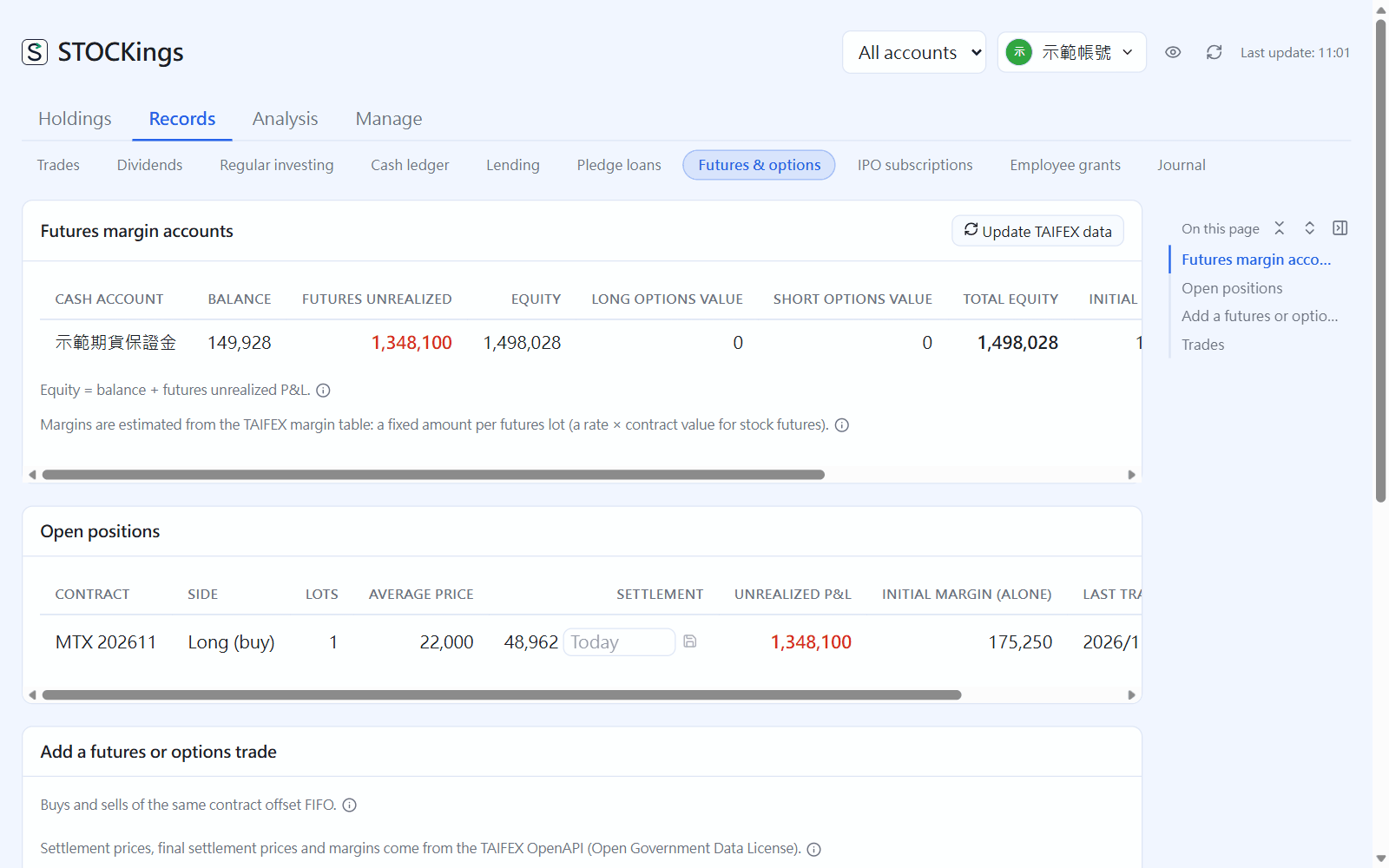
The futures margin account's equity, margin and risk indicator, with open positions below(click the image to enlarge)
- First create a futures margin account: "Manage → Accounts", add a cash account with the kind Futures margin, then transfer money into it from the settlement account (a transfer is not new principal). Futures trades can only be recorded in this kind of account
-
Record a trade: "Records → Futures & options", enter the trade date, the contract code (TX, MTX, TMF, TXO… choosing one fills in the value per point), future or call / put,
the expiry month (
202611; weekly contracts add W (Wednesday) or F (Friday) and the week, for example202611W2,202610F2), the strike for options, long or short, contracts, trade points and fee. Leave the exchange tax empty to estimate it from the rate (stock and index futures 0.002%, gold futures 0.00025%, currency futures 0.0001%, crude oil futures 0.0005%; options 0.1% of the premium, and at expiry exercise the settlement price × the matching futures rate; rounded per contract, minimum 1), and change it to match the statement - Close: a trade in the opposite direction on the same contract offsets the earliest position by FIFO. The form's Open/close follows the code on the trade report: "Auto" (default) offsets when there is an opposite position; "Open" does not offset, so one contract can hold long and short at once (options can have buyer and seller at once, and the broker's "open converted to close" handles such positions); "Close" must have enough opposite position or it is blocked (the broker would reject the order). The "Close" button on an open position fills in the opposite side, contracts and close code
- Settlement prices: opening this page fetches the daily settlement price from the TAIFEX OpenAPI automatically (once every six hours; click "Update TAIFEX data" or "Refresh quotes" on the summary card to fetch again). TAIFEX publishes only the latest day, and what is fetched is kept on this computer, so the asset trend has daily settlement prices only from the day you started using it. When it cannot be fetched you can enter one by hand on the position's row; a hand-entered price is not overwritten by TAIFEX's and is used only for your own account (other accounts on the same computer cannot see or change it). Futures with none count unrealized as 0, and options are valued at the trade price
- Expiry settlement: positions past the last trading day show "Expiry settlement". After TAIFEX announces the final settlement price, the last trading day uses the announced day and the form fills in the price: for futures the final settlement price, for options the computed in-the-money points (call = settlement − strike, put = strike − settlement, out of the money 0). Before the announcement the last trading day is estimated (the third Wednesday, for weekly contracts the nth Wednesday or Friday, ignoring holidays, marked "est") and you enter the price yourself. Expiry settlement can only close
- Margin and risk indicator (for reference only; the futures broker is what counts): the initial and maintenance margin of each position are estimated from TAIFEX's margin table — a fixed amount per contract for futures (for single-stock futures a ratio × contract value), nothing for option buyers, and for sellers premium value + max(A value − out-of-the-money value, B value), with the out-of-the-money value using the stock exchange's cash index close (as TAIFEX does; the nearby future if it has not been fetched yet). The account total applies combination reductions, matched contract by contract under TAIFEX's rules, and the screen lists the combinations it recognises: vertical spreads (short call and long put charge the strike difference × multiplier; long call and short put charge nothing), calendar spreads (max(underlying futures settlement margin × 10%, 2 × premium difference × multiplier)), futures with options (long futures with a short call, short futures with a short put, the option charging only its premium value; 1 TAIEX future with 4, 5 micro with 1), short straddles and strangles (max of both sides + the lower side's premium value + C value), and futures calendar spreads and TX/mini offsets (a simplified estimate from the TAIFEX SPAN rules: mini and micro TAIEX join the TAIEX futures group with lots scaled by multiplier, net position × TAIEX settlement margin, plus long/short lots in different months × settlement margin × 30% (TAIEX, electronics, financials; 50% for others), converted to initial and maintenance margin; used only when lower). Inter-commodity credits (TAIEX vs electronics) and SPAN for options are not counted, and the way a broker splits combinations may differ. "Initial margin (alone)" in the positions table is that position's own figure, without the combination reduction Risk indicator = total equity ÷ (initial margin + long option value − short option value). When total equity is below the maintenance margin it warns roughly how much to add, and when the risk indicator is below 25% it warns that the broker may close positions for you. Products the margin table cannot match are marked * and left out of the total
- How money is recorded (all in the futures margin account, visible in the cash ledger): closing a future records "Futures P&L"; buying an option pays and selling receives "Option premium", so closing does not record profit separately; each trade also records "Futures fee & tax". Deleting any trade recalculates profit and cash from the remaining trades
- Equity: equity = account balance + unrealized futures P&L; total equity then adds long and subtracts short option value. "Futures (equity)" in the account overview, the total assets on the summary card and the asset trend all use it, and the margin account's money is no longer listed under cash. Initial and maintenance margin and the risk indicator follow the futures broker
- Yearly P&L: one row per year with realized futures P&L, option premiums split into buyer (paid when buying to open, received when selling to close) and seller (received when selling to open, paid when buying to close), fees and tax, and the total. It goes by trade-date year on a cash basis (matching the cash ledger), so options still open count in the year the premium moved
- Individuals' futures trading income is currently exempt from income tax, so the tax summary does not list it
← Investment journal | Contents | Securities and cash accounts →