Repository navigation
Item Features
Features are what an item can do, whatever its type. A custom pouch can be a container, a book can be written in, a ring can add to your Armor Class.
When editing an item, the Features panel (above the description) lists them, in groups: Holds things, Use, Equipment and Stacking. Tick a feature to turn it on; its settings appear under it. Closed, the panel lists the features that are ticked.
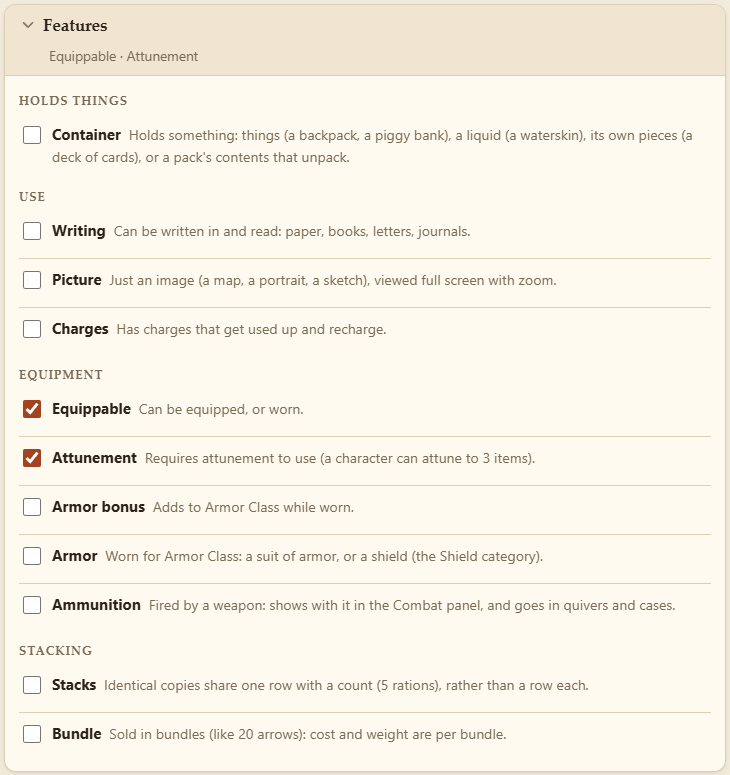
Items start with the features their template gives them (see Catalog and Custom Items): a backpack is a container, a sword is a weapon, arrows come in bundles. Some come from what the item is like too: paper can be written in. A template's always features (a weapon's Weapon) aren't in the panel: their settings are with the item's own fields.
| Feature | What it does | Settings |
|---|---|---|
| Container | Holds something: Things (see Containers), a Liquid (with a level), Its pieces (a set, like a deck of cards: see Sets and Drawing Cards) or A pack's contents (an equipment pack that unpacks into items). | Things: capacity (text and pounds), weightless contents (e.g. Bag of Holding), what it holds (anything, or only certain items, templates or names) and how many, coins kept apart, how it shows what's in it (in the inventory, only in its details, sealed), compartments (each with these options too, its outside for strapped gear among them). Liquid: capacity in pints. Pieces: what one is called, and the pieces. Pack: its contents and where they go. And for all but a pack: its actions. |
| Writing | Can be written in and read. See Writing and Pictures. | Author, and the text. |
| Picture | Just an image, viewed full screen with zoom. | The pictures. (An item has Writing or Picture, not both.) |
| Charges | Has charges that get used up and recharge. | Maximum charges, and how it recharges (e.g. 1d6+1 at dawn). |
| Equippable | Can be equipped (or worn): the sword or shield button on its row. | Where it goes, if the game system has slots (see Your Inventory). |
| Stacks | Identical copies share one row with a count (5 rations), rather than a row each. | Counts up and down in Play mode: players in Play mode can use − and + on it (ammunition, rations, potions…). |
| Bundle | Sold in bundles, like 20 arrows: cost and weight are per bundle. | Bundle size. |
| Attunement (D&D 5e) | Needs attunement to use: it can be Attuned (see Item States and Rules). | None. |
| Armor bonus (D&D 5e) | Adds to your Armor Class while worn. | The bonus. |
| Weapon (D&D 5e) | Used to attack: shows in the Combat panel. | Melee or ranged, damage, damage type, properties, magic bonus. |
| Armor (D&D 5e) | Worn for Armor Class: a suit of armor, or a shield. | Base AC, Dex modifier, Strength needed, stealth disadvantage, magic bonus. |
| Ammunition (D&D 5e) | Fired by a weapon: listed with it in the Combat panel, and goes in quivers and cases. | Magic bonus. |
Unticking a feature removes its settings from the item when you save.
The features marked D&D 5e come with that game system; other systems bring their own (see Writing a Game System).
What an item becomes when it's identified, attuned or cursed, and what happens by itself, is in Item States and Rules.