Repository navigation
Read This In Your Own Language
Pick a language at the top of this page. The site's own words change, and nothing generates them. Every visitor should be able to reach this work in the language they think in — that is the point of what follows, and it is why this is the first thing on the page rather than a footnote about infrastructure.
Here is how it works, because how it works is the whole offer. Each of the nine machines serving this
site derives a 25-language coordinate chart in memory (engine: affine.earth-topology-v1/human-text):
it reads the pinned 29,157,925-byte human-text corpus (sha256 fe5c04465205561e611392241ba2fa7f22bf955e6be514357dd18ac3d26aa770,
150,363 rows 838ef34c8983184c9ba9fa38767e5614bfbeeb736988839fc6ebceee5da3a140)
across all nine cells, and orders candidates by an exact 256-bit integer comparison (Int256) with zero
floating-point operations. An entire statement or paragraph is ingested into a single immutable state_digest, dimension 512, torsion target_langs: ["*"]) in one call. Otherwise, when a concept has no
entry in the chart, the court refuses that token and names the refusal.
Measured on the public court (2026-10-16) — one lattice digest across all nine machines, whole-state
multi-projection across 24 languages, and an explicit refusal whenever a word is absent from the chart:
book   → "libro"   chart:1
water  → "agua"    chart:1  shared:["pt"]
cat    → null      REFUSED_NO_PROJECTION:1 of 1:cat
Look at the second and third lines. Water crosses as "agua" because a spelling shared with a sibling
language (pt) is recorded as a shared diagnostic note, not a refusal (SHARED IS A NOTE, NOT A REFUSAL).
When a concept is genuinely unmapped in the chart (cat), the court returns null and names the exact token
that failed to project rather than guessing. → Study 47 — translation shear
What this does today, and what it refuses to fake. All 25 languages in the lattice are charted today —
en, ar, fr, es, ru, zh, de, pt, hi, bn, ja, ko, id, ms, sw, tr, vi, th, pl, uk, it, nl, he, fa, ur — and
whole statements, multi-sentence scientific prose, and regular English suffix inflections (MorphologicalConceptNormalizer)
project deterministically through the sealed 24 of 24 projections rendered · 0 partial · 0 refused
on canonical substrate statements). Where a token lies outside the chart and outside the morphological stemmer,
the court names the exact unprojected token in refusal_reason and falls back to the English source, marked
as such. ABSENT: any neural language model, any temperature sampling, any claim about open-ended fluency,
and any silent fallback that hides an unprojected word.
There is also a gap between reading this in your language and finding it in your language, and it is worth naming because only the first half is solved. The projection happens on your device, after the page arrives, so the text a search engine indexes is the English source. Being reachable from a search in Spanish or Hindi needs the projection to run before the page is served, not after — that is the next piece of this work and it is not built.
One law of whole numbers — 12 Swift files, 0 imports, no float — read every one of MATH's 12,500 competition problems and OpenAI's 815,632 scored answers to 500 of them (theirs): all 12,500 keys and 815,612 of the answers have one verdict each; 20 answers are longer than the room of 10,000 digits and are named, not read. Sealed twice, 26 of 26 files byte-identical; compared twice, 13 of 13; 1, 2 or 5 agents, one seal. Affine IDE 0.2.6.6 β carries it to your Mac, and it is still beta.
The release in eight figures. 12,500 MATH problems read, every key: 10,533 close to an exact value and 1,967 cannot and say why. 815,632 scored answers (theirs), every one accounted for: 815,612 hold one verdict, and 20 are longer than the room. 243,578 of 243,578 answers the law reads unequal to the key: their mark reads false on every one (theirs). 4,825 answers that hold the key's exact value, marked false (theirs). 0 weights, samples or floats in the law: nothing trained, nothing sampled, not one float. 456 figures in the IDE's six Study 56 chapters, every one traced: 374 to a census line or a sum, the rest to a labelled structural entry. 1,970 planted tampers across the 25 quantum courts, every one refused by the IDE's canvas checker. 97 of 97 release arms over 79 studies, and Franklin signed off on the disk image's own SHA-256.
MATH's key for each problem is the last boxed text of its worked solution (theirs). A text closes when the law reads it to an exact value: 8,252 keys read as whole numbers, 1,657 as fractions of two whole numbers, 523 as containers — tuples, sets and intervals, member by member — 62 as whole numbers written in another base, 32 as an assignment x = value, read as its value, 6 as wide whole numbers, by decimal-string arithmetic, and 1 as a word, by its exact bytes. Any other text cannot close, and the law says why in one sentence of its own: a root is written; pi is not a fraction of whole numbers; letters make an expression, not a value; a decimal point is how a float is written, so the law refuses the text and reads no value from it. The law does not check that a key is right: an answer equal to a key holds the key's value, whatever the key is.
| MATH type (theirs) | problems | close | cannot close |
|---|---|---|---|
| Algebra | 2,931 | 2,580 | 351 |
| Counting & Probability | 1,245 | 1,205 | 40 |
| Geometry | 1,349 | 976 | 373 |
| Intermediate Algebra | 2,198 | 1,689 | 509 |
| Number Theory | 1,409 | 1,369 | 40 |
| Prealgebra | 2,076 | 1,854 | 222 |
| Precalculus | 1,292 | 860 | 432 |
| All of MATH | 12,500 | 10,533 | 1,967 |
Why 1,967 cannot close, every one named: 595 hold a root, 383 hold letters, 265 hold pi, 256 are written with a decimal point, 165 are words, 99 hold the imaginary unit, 91 hold infinity, 71 are a container of containers, 19 lie outside the grammar, 11 are a union of sets, 6 hold a trigonometric function, 4 have no answer, 1 holds a logarithm and 1 has a comma between digit groups. 14 of the law's 19 reasons occur among MATH's keys.
Sealed blind: law v3 was designed and run without their marks. The marks had been read once before, by the earlier reading's comparison of 2026-10-07. Law v3's record was committed at 22:01:19 UTC on 2026-10-08 and checked against its own git objects at 22:03:15, 63 of 63; the v3 comparison first read their is_correct at 22:35:14. Every withheld field was flipped, 3,262,528 of them over the 815,632 scored lines, and the seal held on 5 of 5 sources.
The law's outcome beside their mark, for every one of the 815,632 answers. OpenAI's prm800k release marks each answer with a field called is_correct (theirs). The law never reads it to decide; it sets the two side by side:
| the law's outcome | their mark true (theirs) | their mark false (theirs) | answers |
|---|---|---|---|
| equal to the key | 357,359 | 4,825 | 362,184 |
| unequal to the key | 0 | 243,578 | 243,578 |
| cannot close | 75,708 | 134,142 | 209,850 |
| not read, longer than the room | 0 | 20 | 20 |
| every answer | 433,067 | 382,565 | 815,632 |
Every answer the law reads unequal to the key, their mark also reads false: 243,578 of 243,578, and true on none. 4,825 answers that hold the key's exact value are marked false (theirs), in 49 problems: 1,793 answers say 864 and are marked false, where their copy of the key reads "864 inches²" and the MATH key's value is 864; 2187/5625 is marked false where the key is 243/625. On 83 of OpenAI's 500 the key cannot close — 24 roots, 20 letters, 10 pi, 9 decimals, 7 words, 6 the imaginary unit, 4 infinity, 2 unions of sets, 1 container of containers — and the law decides none of the 134,995 answers to them; their mark reads correct on 73,200 of those (theirs), and 47,027 of the 134,995 copy the key byte for byte.
Side by side, never subtracted. Among OpenAI's own answers to each problem, the value most of them hold, counted by exact value, equals the key on 293 of the 417 problems whose key closes; the other 83 have no key value to equal. Theirs, from Let's Verify Step by Step, Figure 3, page 7, best-of-1,860: a process reward model at a share equal to 391/500, an outcome reward model at 362/500 and majority voting at 348/500, printed as shares; the paper does not say whether they count problems. Their two reward models pick by a model's score, which this study does not run. The figures stand beside each other as published.
The same bytes on every Mac. Run again after the seal, all 815,632 answers reproduced their sealed outcome. The Affine IDE ships Study 56 as 24 files, 12,165,947 bytes, each pinned by SHA-256 and verified byte for byte before a figure is drawn: the law's 21 sealed outputs (9,737,089 bytes), the rail's index of all 12,500 problems (1,153,189 bytes) and two of OpenAI's published files (theirs, 1,275,669 bytes). Every committed file of both Study 56 evidence folders matches its own SHA256SUMS: 41 of 41 and 217 of 217. Read Study 56.
Frontier models, beside the substrate: they train their models and sample them; Affine.Earth trains nothing
Frontier labs print mathematics figures built from sampled runs. OpenAI printed o1's AIME 2024 result as an average score out of 15, for one sample, for a consensus of 64 samples and for a re-ranking of 1,000 (theirs, 2024-09-12). MathArena asks every model each question 4 times and prints the average of the 4 (theirs). Asked again, the answers change: in MathArena's published AIME 2025 rows, 29 models at 4 runs each, the 4 runs did not return one answer on 465 of 870 model–problem pairs (theirs, counted by Affine.Earth from their rows). Thinking Machines Lab sent one prompt 1,000 times at temperature 0 and received 80 different completions (theirs).
Answers change even at temperature 0, where nothing is sampled. Thinking Machines Lab names the cause: kernels whose order of addition changes with batch size (theirs). Yuan and others: floating-point addition is not associative at limited precision (theirs). The substrate adds whole numbers: 1, 2 or 5 agents give the Study 56 goal one seal, c6949876a8639991.
Read by the law, OpenAI's own answers hold 33,586 different exact values across the 500 problems, and more than one value on 471 of the 500. test/algebra/2626 has 1,149 different values in 1,854 answers; on test/algebra/1004, 1,821 of its 1,860 answers hold 4, the key.
MATH and PRM800K were built to train models. MATH's own train folder holds 7,500 problems; PRM800K's 800,000 step labels trained OpenAI's process reward model, and 4,500 MATH test problems were moved into its training set (theirs, their README); the generator that wrote the 815,632 answers was finetuned on solutions to MATH's train problems (theirs). Affine.Earth trained on none of it: it read all 12,500 problems, train and test alike, as claims to decide. Frontier models in mathematics — a share over sampled runs, and one sealed reading of every key and every answer
-
Study 56 on its own stage. Three pictures — Key, all 12,500 problems as a lattice by type, level and split with the 500 test problems ringed; Samples, the 500 test problems as columns of their 815,632 answers, the sealed outcome beside
is_correct(theirs); Steps, one of phase2_test's 2,762 labelled model solutions (theirs) as a tower of its steps, which shows once phase2_test.jsonl is fetched and verified — told in six chapters in the chat. 456 figures in the chapters — 374 from a census line or a sum, the rest from a labelled structural entry — 0 untraced. - The Mathematics folder. MATH's 7 types in MATH's own order, then levels, then all 12,500 problems, 20 to a page. Pick one and it answers how the substrate read it: it closes, with its value — test/algebra/1072 closes to 243/625 — or it cannot close, with its reason in the law's own sentence: test/geometry/686 holds pi, "pi is not an integer and not a fraction of integers". A key written with a decimal is cut off and never printed. A problem's own text and MATH's answer show once MATH.tar is fetched and verified, bytes and then SHA-256.
- 25 quantum courts, each drawing its own court. Nine family pictures — rings mod N, phase wheels, the marked register, oracles, two-bit channels, exact energies, walks and words, eight-lane lattices, the key on the curve — every value from the court law's own call. The canvas checker refuses all 1,970 planted tampers across the 25. Before, all 25 drew the same protein picture.
-
A swarm of Affine IDE agents. Deterministic workers, never a language model, each owning a space of the sources in its own sandbox, sized from what the Mac reads about itself right now, never from a written number. Measured in the release tree, the Study 56 goal sealed one set of bytes,
c6949876a8639991, with 1, 2 and 5 agents. - affine-ide-agentd, signed inside the app. 21,431,792 bytes, Developer ID, hardened runtime; a child of the IDE that ends when the IDE quits.
- Plain words for every census code. Each of the law's 19 reasons a key cannot close carries the census's own sentence of why; 14 of them occur among MATH's 1,967 keys, and the Key view's legend names all 14.
- The same bytes for every observer. Every study page, court answer and fixture carries only what the law prints from SHA-pinned bytes: 308 paths, and 94 fixture rows that hold one digest across 3 calls and 2 faces.
- Proved before it ships. The release agent opened all 79 studies in the built app: 97 of 97 regression arms, and Franklin's sign-off bound to the disk image's own SHA-256.
- Notarized and stapled. Apple accepted the app and the disk image, and the ticket is stapled to both.
Each folder of the IDE's own sidebar, with one fact anyone can re-measure from the same bytes:
- Mathematics — 10,533 of MATH's 12,500 keys close to an exact value and 1,967 cannot, each with its reason, across all seven types; 815,612 of OpenAI's 815,632 answers hold one verdict. Study 56
- The Iliad — Book 1's shore scene is one file of 11,133,626 bytes that all nine cells serve with the same SHA-256. The IDE opens it only when the byte count and then the digest match, and draws it from 555 meshes — 45,674 points and 77,167 faces, every coordinate an exact fraction of two whole numbers — with no floating-point value in the file.
-
Physics — Four published files of IceCube's calibrated hits, 9,749 recorded events and 2,289,821 single hits of light, are read by Affine's own Swift; every hit is placed on the sensor that recorded it, and all four files are served with the same bytes on all nine cells. The Glashow event's 18,135 pulses, on 453 sensors across 30 strings, seal to
68360339…; the January 2013 run's 71 events seal to237012b7…. Study 55 - Astronomy — The Event Horizon Telescope's public 2017 measurements of Sagittarius A*, the radio source at the centre of the Milky Way, are 16 tables in one archive of 7,083,259 bytes; every table is pinned by its byte count and SHA-256, and 16 of 16 match. Study 07's six whole-number thresholds were frozen on 2026-07-23, after which the integers do not move — a short-baseline median of at least 1,500,000 µJy and a long-baseline median of at most 400,000 µJy among them; no program in either repository computes those medians from the 16 tables, so no substrate law decides them. Study 07
-
Earth and sky — A flight track at 30,000 feet along latitude 50,000 micro-degrees, beside a storm cell from 0 to 30,000 micro-degrees and 0 to 40,000 feet: the convective court answers
PROVEN_CONTAINED, with 0 breaches. Study 09 - Quantum courts — 25 courts check a presented quantum-algorithm answer exactly and search for nothing. Given 15, the witness 4 and the factors 3 and 5, the Shor court checks that 4 × 4 = 16 is one more than 15, that 4 is neither 1 nor 14, that 4 − 1 = 3 shares the factor 3 with 15, and that 3 × 5 = 15, and answers WIN. The court table
- Courts — The exact-permanent court prints 6 for the 3 × 3 matrix of ones, and 29 for the matrix with rows 2, 3 and 5, 7. Study 25
- Language games — The translate court reads one corpus of human sentences across 25 languages, pinned inside the law by its address, its 29,157,925 bytes and its SHA-256. A process that cannot read exactly those bytes refuses instead of translating, and any word the court cannot carry into the other language is refused by name. Study 47
- Impact studies — The unit square, stretched 12 times, holds 169 lattice points. From the 13 counts the law prints the counting rule t² + 2t + 1 and the area, exactly 1/1. Studies 11, 12 and 13
- Domain stages — EUROCONTROL's open 2022 flight list, read in whole minutes, admits 525,541 departures. At the 20 airports with at least 5,000 of them, each airport's floor is the taxi-out time one twentieth of the way up its own sorted record, and the minutes above those floors add up to exactly 1,224,355 across 338,254 departures. Study 32
- Health, finance, chemistry — The Protein Data Bank's list of entries, as fetched on 2026-08-24, holds 258,616 ids. The protein court reads that list and prints 258,616 in every answer, and 4HHB, whose title at RCSB (theirs) names human deoxyhaemoglobin, is one of them. All nine cells serve the list with the same 1,816,323 bytes. Study 14
Download Affine IDE 0.2.7 β · Open UUM-8D Calculator · Read Study 56 · Read the research · download page · still beta · Developer ID signed, notarized by Apple and stapled · verify the SHA-256 on the download page.
Earlier (2026-10-07): the IDE proves itself before it ships, and IceCube's neutrinos are read from the hits
On 2026-10-07, the IDE introduced pre-roll release proof. Every release since then ships only after proving itself. Before the roll, a release agent opens every study inside the built app. It reads what is on the screen: which stage drew, whether the frame is lit, what the chat says. It writes all of that into one record. The court on the nine cells grades that record and seals it against the sha256 of the disk image it came from. If one study opens on the wrong stage, Franklin does not sign, and nothing reaches you. The sealed record that 2026-10-07 release rolled on: 96 of 96 arms over 78 studies, bound to dmg 4daa481b270542b5… (in 0.2.7 β, 121 of 121 arms over 79 studies).
Study 55 reads IceCube's neutrinos from the hits. IceCube publishes the light its sensors recorded as calibrated hits: a time, a charge and a sensor for each flash. The IDE reads those published bytes itself, byte for byte, with no float anywhere. It stands the detector's 86 strings in a hologram and lights each event sensor by sensor, in the order its light arrived. It read four published files, 9,749 events and 2,289,821 hits, and every hit joined to its sensor. Each file carries a census seal and an event-index seal, and any laptop re-derives both from the same bytes. The January 2013 run's 71 events seal to 237012b7…. The Glashow event's 18,135 pulses, on 453 sensors across 30 strings, seal to 68360339…. IceCube's own published table of 28 events appears beside the hits, labelled as IceCube's reconstruction. Where a neutrino came from, and how much energy it carried, needs reconstruction; at this tier it is not measured. Open the study.
Your work stays whole. A file opens whole and saves whole: a 49-line file stays 49 lines. If something else changed it on disk, the IDE says so and writes nothing. The studies inside the app are read-only — fork one to make it yours. Your own folders sit beside the public studies under Public studies ▸ My projects, and the sidebar is now folders, with the open study lit.
One rule for every study: the same bytes for every observer. Every number a study shows must come from the substrate's own law, over bytes anyone can fetch, and read the same on every machine. We measured every study against that rule. Study 55 is the first brought into line, and this release leaves out the stage files whose numbers no law computed.
The current build, Affine IDE 0.2.7 β, is on the download page.
Three measurements, each on all nine machines behind affine.earth and each taken per machine rather
than through the apex that fronts them, because an apex round-robin hides a one-in-nine straggler.
| measured 2026-09-12, per cell | |
|---|---|
| machines running a model process, listening on a model port, or holding an unmasked model unit | 0 of 9 |
model weight files anywhere on any machine — .gguf or .safetensors, whole filesystem |
0 of 9 |
| machines with GPU compute: a vendor driver, a device node, or a CUDA / ROCm / OpenCL runtime | 0 of 9 |
| numeric fields in the 51 published court tools that accept a floating-point value | 0 of 51 |
No model. The last code path in the substrate that could build a request to a model API was
deleted this week, with its service unit, its installer and its command-line subcommand; the unit is
masked to /dev/null on all nine machines and nothing listens on its port. A local model server that
had been running unused on one machine since 23 August was validated unused — 167 seconds of CPU in
more than 19 days, no log lines, no connections, the weight file's access time still the second it loaded —
and removed. Two gates refuse the return of either, each with control arms that prove the instrument
discriminates. → No language model in this stack
No GPU. All nine machines are ARM Neoverse-N1 and the serving path is CPU integer arithmetic end to end. No GPU driver, no device node, no CUDA, ROCm or OpenCL runtime on any of the nine — there is nothing on these machines an accelerator could be asked for, and nothing that asks.
No float. This one is checkable from a terminal in three commands, and it discriminates in both directions. Every numeric input in every published court tool is a decimal string, not a number — the wire has no floating-point type to put a float into. Post integers and the court answers; put a decimal point in one value, or send a JSON float, and it refuses by name:
A = "1,2,3,4,5,6,7,8|1"    →  CALORIE   AFFINE_JZ_OP     result "2,3,4,5,6,7,8,9|1"
A = "1.5,2,3,4,5,6,7,8|1"  →  REFUSED   AFFINE_JZ_PARSE  result ""
A = 1.5  (a JSON float)    →  REFUSED   AFFINE_JZ_PARSE  result ""
That is the programme's whole thesis enforced at the door: a verdict that depends on a rounding is not a verdict, so the court will not accept the rounding in the first place. → Zero Float · Zero Shear
There is a Studio on this site — an editor and a terminal in the page — and it will run the programs behind these studies on your own hardware. No account, no key, nothing installed, and nothing sent back to us.
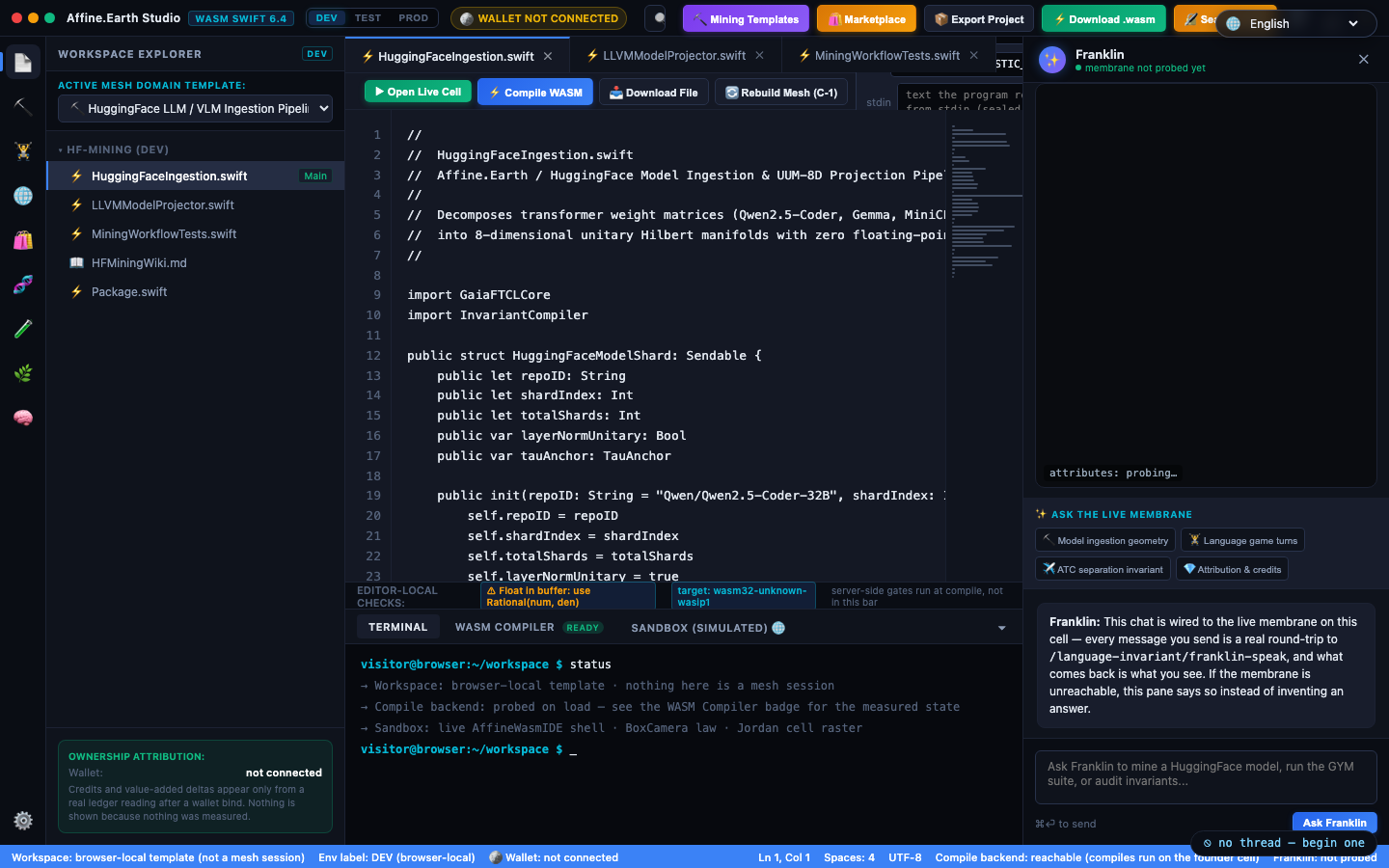
This is the door, and it is why the language work is at the top of this page rather than the bottom. A person who can read the board in the language they think in, and then run the arithmetic behind it on their own laptop with no account and no key, has been handed the thing itself instead of a description of it.
| measured from one browser, 2026-09-12 | |
|---|---|
| programs in the sealed manifest at the pinned commit | 90 |
| whose served source matched the manifest's digest of that commit's file, byte for byte | 90 of 90 |
| that run in the browser | 49 |
| that printed the sealed transcript exactly | 45 |
| that differed — one cause, named below | 3 |
| that withheld the comparison rather than claim one | 1 |
| host errors, or programs that failed to open | 0 |
| that do not build for the sandbox, each shown with its compiler's own line | 41 |
Every study opens on its story. Before the code, a study opens on seven short chapters — what it asks in its author's words, the page its figures are published on, what its code reads (each corpus file by its digest, and whether it takes standard input or its command line), the numbers it has to print and whether its sealed run computed them or only quoted them, whether it runs here, whether it reproduced, and, once you press Run, which of those numbers your own device printed. Each chapter is quoted from a source pinned at the commit and names that source, so the story is checkable the same way the program is. → How a study tells its story
What the Studio actually does. Each program was compiled once to wasm32-wasip1 and its native
transcript sealed at the same time. The browser fetches the artifact, holds it to the byte count the
manifest names, inflates it, checks the unpacked SHA-256, and only then instantiates it — inside a
wasi_snapshot_preview1 host written for this, whose file system is that study's own corpus with
every file pinned by digest. When the run finishes it compares what your device printed against the
sealed transcript and tells you which of three things happened: the same bytes, your inputs
differ, or it differs — and that is a finding. The 49 artifacts are 584,047,128 bytes on the
wire and 1,670,622,786 unpacked; 207 corpus files are pinned by digest; the whole pass took 167
seconds of program time.
The third verdict is the reason the Studio exists. A program that prints different bytes on two machines is exactly what this programme looks for, so the Studio is built to surface that rather than smooth it over — and to say inputs changed instead of pass when it cannot make a fair comparison.
All 90 open, including the 41 that cannot run here. Each of those shows its source at the pin
and the compiler's own first line, and the front door carries a ◇ reads here link beside it.
Twenty-six of the 41 are one cause — a 64-bit integer that does not fit wasm32's 32-bit Int — nine
need Dispatch types the sandbox's Foundation does not carry, three need a platform module, two a
platform C symbol, and one does not type-check. That is a change to those studies, not to the Studio.
→ Run any study in your browser
And the honest part, in the same breath. The three differences are one cause and it is not arithmetic: those programs print the directory their corpus came from, and the sealed transcript carries the absolute path of the machine that sealed it, which no other device can reproduce. Every digit of their arithmetic agrees. It is a transcript convention to repair upstream and the page names it with its line numbers. One further disagreement, on the machines rather than in the studies: of six categories graded across the nine cells, five are unanimous and one is not — two cells carry an extra settlement unit whose own description says "one payer". It was left running rather than stopped, and whether that is a defect is NOT KNOWN until its exclusivity is traced.
ARGUMENT — what the three parts amount to together: you are reading a page translated by arithmetic you can re-derive, served by machines that hold no model and no accelerator and refuse a float at the door, carrying programs that run on your own hardware and print the same bytes the builder's machine printed. None of that asks you to trust us, and that is the only reason the numbers further down this page are worth your time.
This is a line in the sand, and it is drawn with numbers rather than opinions.
(This heading read "forty-one" until 2026-09-12 and "forty-six" until 2026-09-17. The board carries forty-eight studies today — 1 through 45, and 47 through 49. Study 46 is in preparation and is not on the board, which is why the numbering runs past the count.)
Across forty-eight studies — the sky, the sea, the ground, the genome, the grid, the ledger, and the machines this page is served from — we kept meeting the same thing. Somewhere near the bottom of a serious, careful, expensive piece of work, an exact quantity had been turned into an approximate one, because that is simply how computing has been done since the 1980s. And every time we went back and did the same work in exact whole numbers instead, the answer was already available. Not better. Not faster. Available — where before there had been a score, an estimate, or a disagreement between two machines that were supposed to agree.
That is the finding, and it is bigger than any one study on this board:
A great many questions the world treats as approximate are not approximate. They are exact questions that were handed to approximate arithmetic, and the uncertainty everyone learned to live with was manufactured on the way in.

Nineteen seconds: the question, the nine machines, what the ordering cost, the identical answer — and the half that keeps it honest. Full-resolution film.
Nothing below is an argument. Each is a sealed study on this wiki with a program a stranger can run.
- A medicine. Where a guide molecule could bind in three billion bases is a counting question, not a scoring question. For Casgevy — curing sickle cell disease right now — the count is one perfect match, its intended target, and nothing one mismatch away. Not a low score. Nothing.
- A tumour. Seventeen tumour types, 7,673 people's tumours, all public bytes. No single compound reversed the signature in any of them — and asked again of pairs, the same law with the same controls finds candidates in eleven of fifteen. Those eleven warrant a laboratory. We do not call them safe or ready; that needs a bench.
- A safety system. A floating-point control brain for fusion goes deaf after about eight seconds, forgets what it learned when moved to a machine it has never seen, and contradicts itself at 142 operating points. The exact court refuses all 142, needs no training, and returns a verdict that is byte-identical on every machine across a 2,992-verdict corpus.
- A ledger. An insurance reserve is an exact ratio of the integers a company already filed. Nothing in it mathematically requires approximation.
- A life table. Across 10,878 actuarial quantities from public archives, the exact arithmetic and the float agree to at least fourteen significant digits — a result we publish as gladly as the ones that part, because a programme that only reports its wins is advertising.
- A discovery pipeline. A generative system reported 37,910 validated discoveries. Every row passed every check made of it. The number of distinct molecules was five.
- A physics result. A published effect where heat flows the wrong way predicts a fraction, so we computed the fraction: exactly −1/18, at nine of nine settings. Simulated the way the field simulates it, in double precision, the effect is not small — it is zero.
- A writing machine. Two instruments that are both commanded in whole numbers — a lithography that lifts single hydrogen atoms off silicon dimers 384 pm apart, and a modulator whose pixels sit 4,500 nm apart, four orders of magnitude out from it — ask the device which atom, and which of 256 codes. Carry the atom as a length in single precision and the first wrong atom comes at step 8,783, with 4,183,204 of 4,194,304 sites written to an address nobody asked for. Ask the modulator in radians and it is handed a different command word on 16 of 2,073,600 pixels in double precision and 1,974 in single. Counted instead, both are 0 — the address is the count. Neither program touches hardware: no hydrogen is removed and nothing is illuminated.
- And today, the machines underneath all of it. Fifty years of computing has treated "which event came first" as a fact about time, because the founding paper built it on relativity. It was never about time. It was about arithmetic. Nine machines, the same jumbled events: sorted into an agreed order and not sorted at all gave the identical answer every time, and the sorting cost 177× the work to change nothing. → Study 41 — Fifty years of solving the wrong problem
Every study above takes a quantity the world measures and computes it exactly instead. The two sealed on 2026-09-17 do something narrower. The quantity was never a measurement. It is an address — which atom — or a command word — which of 256 codes — and the device receiving it is already discrete. Nothing lies between two atoms on a silicon lattice and nothing lies between two codes on a modulator, because in neither case is there a state there to reach.
So in these two domains the approximation was never required by the thing being commanded. It entered with the software, on the day a controller chose to carry a length instead of a count.
And the same control arms that establish that also narrowed it, which is the part worth reading. Study 49 set out to show that π is what makes a float route hand the device a different code. Cancel π out of the route and the lens goes 16 → 0 in double precision — but only 1,974 → 970 in single, so about half of that disagreement never involved π at all. π is a sufficient cause everywhere these two programs look and a necessary one only on the grating and in double precision: a narrower claim than the one we first wrote, and we reached it by running the arm that could break it. Study 48 was narrowed the same way — its first draft had the dimer bond along the row when the published surface puts it across, and the bond is now carried as a REPORTED length held ABSENT from every integer the study compares, with an arm proving the arithmetic is free of it.
What these two add is a rung, not the board's reach. The 384 pm dimer pitch is the smallest length at which anything here is commanded, and Study 49 sits four orders out from it — but the board was already far wider than the pair, and the pair does not measure it. The smallest figure on the board is not theirs and is not an address at all: Study 27 works on nuclei, and reports an ¹¹Li rms matter radius of 3,270 ± 240 am (attometres) — five orders below the dimer pitch. That page is careful about its own number in a way worth repeating here: matter radii "are not measured directly", they are extracted from cross sections through Glauber-type analyses, so the figure is REPORTED and deduced rather than measured, and the study grades the extraction rather than trusting it. Upward, Study 06 works at station distances of Δ ≈ 370 km and Study 05 at the L1 point, 1,500,000 km sunward of Earth. Counting the scale each page states it works at, that is twenty-four orders of magnitude, and the same sentence holds at every one of them.
Read loosely the ceiling is higher still — Study 08's Gaia BH1 is "hundreds of parsecs away", about 3×10¹⁸ m and thirty-three orders — and we mark that one a bracket rather than a span, because it is stated only to an order, it is a distance to the target rather than a length that study grades, and the nine orders beneath it hold no graded length — Studies 07 and 10 do print parsec-scale figures in that band, and both pages forbid posting them into their own court, so we do not count them here either. We do not claim quanta to galaxies. No page here states a quantum length and none grades a galactic one; what is measured is nuclear radii to the stellar neighbourhood, and the densely populated stretch — 384 pm up to thousands of kilometres — carries eleven studies.
Neither program touches hardware: no hydrogen is removed, nothing is illuminated, and no voltage is
computed. Each compiles to wasm32-wasip1 and prints its sealed native transcript byte for byte
under wasmtime. Neither opens in the Studio yet — it is pinned at a commit that carries neither file,
so the browser figures further up this page are unchanged by these two and the in-browser run is
ABSENT until that pin advances.
→ Study 48 — the atom already has an address · Study 49 — the phase code never needs π
Two reasons, and neither requires you to take our side.
The first is that it can be checked. Every study here ships as a single file with a hash. No network, no keys, no database, no permission, no account. You run it and you get our numbers, or you run it and you don't — and if it cannot measure something honestly it refuses and says so rather than returning a figure. Set that beside the alternative now in fashion: ten thousand agents, eighty-eight hours and millions of dollars producing a result that has not been released for anyone to check. It may well be right. It is not yet something anyone can act on, and that is a different and more serious problem than being wrong. Science's hardest current problem is not dishonesty; it is that most published results cannot be re-derived by anybody else. Exact arithmetic removes the last cause of that by construction: the same input gives the same answer, on any machine, in any order, forever. A result that can be re-derived exactly cannot rot.
The second is what the questions are about. A tide gauge that can tell a seismic wavefront from a storm surge inside the first hour is the difference between a coast warned in time and a coast evacuated for nothing. A seismic ladder that separates an announced explosion from an earthquake in raw integer counts is the working problem of nuclear-treaty verification. A wet-bulb threshold decides whether a place stays liveable through an afternoon. A biosphere cascade, a taxi-out floor, a grid, a reserve, a genome. These are not curiosities. They are the instruments a civilisation uses to look after itself and the place it lives, and every one of them is better for being exact, checkable by anyone, and the same number for everybody who asks.
We would rather be trusted on the small things than dismissed for a large one.
Nothing here overturns the Standard Model of physics. Not one measurement on this board touches a particle, a field or a force. What these studies overturn is narrower and entirely real: a fifty-year assumption about where uncertainty comes from in computation — and, one domain at a time, the claim that a given real-world question needs to be approximate. Five studies on this board are still OPEN, meaning we do not have the data yet and say so. Several report results that went against the expectation, and those stay on the page with their numbers intact. One study on this board reports a measurement of our own that proved nothing, kept because a page that quietly drops its failures is not a record.
That is the flag. The exact answer is usually already there. It costs an afternoon and a file anyone can run. → Start here · How to read this board · The white paper
Here is the hopeful reading, and it is the one the numbers support.
One law has now held across twenty-four orders of magnitude — from the radius of a lithium nucleus to a point a million and a half kilometres sunward of Earth — and it is the same sentence at every rung: bind the domain to the discrete set it already is, and the uncertainty that needed an error budget stops existing. Nobody had to choose between scales. The law did not need a different form for a hydrogen atom, a tumour, a tide gauge or a reserve triangle, and that is not a slogan on this page — it is forty-eight sealed studies, each with a file a stranger can run.
What that buys is a loop that closes. A measurement becomes an exact question; the question returns the same integer on every machine that asks it; and because the answer cannot drift, the next person can build on it instead of re-deriving it. Science's hardest current problem is not dishonesty, it is that most published results cannot be re-derived by anybody else — and an exact answer is re-derivable by construction, forever. A result that cannot rot is a result the next question can stand on.
In health that loop is the whole point. A guide molecule's binding sites are a counting question, so the count is available today rather than after a study. A tumour signature's compound pairs are a counting question. An off-target screen is a counting question. Each one that moves from a score to a count is one fewer place a bench has to take somebody's word, and one more place two laboratories on opposite sides of the world get the identical number and can argue about the biology instead of the arithmetic.
And it runs on machines with nothing to hide. No model, no accelerator, no float at the door — the nine cells serving this page hold none of them. The same source that answers here compiles to your browser and prints the same bytes. That is what makes the loop a loop rather than an announcement: every claim on this board is a door you can open yourself.
The map is not finished. Five studies on this board are OPEN because we do not have the data yet and say so, one reports a measurement of our own that proved nothing and is kept for that reason, and the reach above is a span at its bottom and a bracket at its top, marked so on the page. What is finished is the method — and the method has not yet met a domain where the exact answer was not already waiting.
A woman is offered a medicine that will edit her genome. It has been through its trials. It works. Nobody in the room can tell her, exactly, where else in her three billion bases that molecule could cut — not because anyone is careless, but because the tools in use return a score, and a score is an opinion with a decimal point on it. Run it on different software and the list of places to worry about changes.
That question has an exact answer. Complementarity is a discrete rule: a base pairs or it does not. There are only so many places in a genome where a guide can bind, and they can be counted — every one of them, with no sampling and no threshold buried in the arithmetic. The answer is an integer. It is the same integer on her doctor's laptop, on a regulator's, and on a stranger's who trusts none of them.
Today we counted them. For Casgevy — the approved CRISPR therapy that is curing sickle cell disease right now — the answer is that its guide matches perfectly in exactly one place in the human genome, its intended target, and there is nothing at all one mismatch away. Not a low score. Nothing. We did the same for every CRISPR medicine whose guide is public, and for every antisense and siRNA medicine whose sequence is public, across every window of the transcriptome.
Those maps did not exist this morning. They exist now, they cost an afternoon, and anyone can re-derive them without asking us for anything.
→ The CRISPR genome map · The off-target atlas · The order of the bases
And they are now somewhere a person can look. The woman in that room, or her doctor, or the regulator who has to sign for her, can open a library and find the molecule: what was measured about it, by which program, and the one command that re-derives it from public bytes. Three libraries — proteins, compound cures, material systems — and each of them says, inside every row, what it refuses to claim. They are not studies that close. They grow as new cures and new materials are measured, and nothing enters without a program a stranger can run.
What keeps them libraries rather than lists is the thing in front of them: an admission law, executable, that refuses. This programme has already published a generated corpus that reported 37,910 validated discoveries and held five distinct molecules, where every single row passed every check made of it. A library with no law is that corpus with a nicer front page. So the law is the first artefact, and the libraries are downstream of it.
The same day, we finished a study that had been open since August. It asked something a great deal of cancer drug development rests on: when a method says these proteins are what keeps this tumour alive, can you recover those proteins from the patient's own data?
We built the corpus from scratch — seventeen tumour types, 7,673 people's tumours, every byte public. We proved the instrument could tell something from nothing before trusting it: rank the regulators using half the patients, and 135 to 141 of the 141 come back when you rank them again using completely different patients. Shuffle the labels and it collapses to nothing. That is a sharp instrument.
In eleven of seventeen tumour types, the published regulators come back just as well from counting how many connections each one has in the network — without opening the patient's data at all. In acute myeloid leukaemia the gap is wider still: reading the expression recovers four, counting connections recovers nine. That is a real result about what the recovery is made of, and it is worth knowing precisely because it is cheap to check and nobody had checked it.
Then the question that mattered. We searched 20,308 compounds for a single drug that reverses the signature and found none in any tumour type — and that answer, taken as the end, would have been the wrong place to stop. Cancer is not treated with one drug. Asked again of pairs, the same law with the same controls finds them in eleven of fifteen tumour types, clearing the exact null that eliminated every single agent, in every case at zero of two hundred draws.
Those eleven show promise and warrant laboratory follow-up. We do not call them safe, effective, or ready for anyone — that needs a bench, and the page says so as plainly as it says the rest.
None of this says anyone was wrong. It says something more useful: a question can pass its own test and still not be the question you meant to ask — and until today, nothing between a hypothesis and a $255 million trial made anyone check which.
→ Study 26 — Master Regulator Bonds
Because we publish the mistakes with the same prominence as the results, and they are ours.
A null we built compared the best of 107,404 candidates against a single one, and reported a result as overwhelming when the honest comparison says it is noise. A random seed we used changed between runs, so a study whose entire claim is that the answer does not depend on who computes it was quietly depending on that. Two implementations of one law disagreed on identical bytes, because the law had a rule nobody had written down. A results table looked complete and plausible while printing one medicine's safety profile under another medicine's name.
Every one was caught by our own checks, before anyone read them, and every one is written on the page it affected. A method that only shows you its clean runs is not showing you a method.
That is the whole offer. Not a machine that sounds confident — a machine whose answers are integers you can check, whose mistakes are on the record, and whose questions you are invited to disagree with, using nothing but public bytes and a laptop.

The industry bet the future on machines that guess. Trillion-parameter models that sample an answer and lean on a checker to catch the misses; floating-point silicon that truncates the truth the moment the numbers run long. Fast — and blurred. When the frontier's best threw dozens of AI agents, six billion tokens, and eleven days at a single theorem — needing a bolted-on coordinator to keep the agents from losing their place, and a classical kernel to catch their mistakes — the industry called it a triumph of intelligence. It is a triumph of guessing. And a verdict that changes when you run it again is not a verdict.
Affine.Earth is a deterministic truth engine — it refuses to guess, and it refuses to round. Present it a question and it projects the exact answer: no sampling, no search, no floating-point blur — sealed to a single SHA-256 that reads identically on every machine, forever. Not an AI that sounds certain. A result anyone can re-derive and get the same integer everyone else gets.
Watch it on the oldest trap in mathematics. Shown the Simpsons' famous fake counterexample to Fermat's Last Theorem, a floating-point processor reports a solution that does not exist — it hits its precision horizon and lies. The exact court measures the true 34-digit gap, returns REFUTED, and seals it — on every machine, at every depth of zoom. The guess shears; the projection holds, and every digit is yours to re-run. Computational certainty was never going to come from scaling the noise — it comes from eliminating the shear. → Study 36 — Guess, or Project

In August 2026, three people in clinical trials died, and two of the world's largest drug companies halted their autoimmune programs — a cell therapy meant to heal expanded out of control and turned the immune system against the patients. It was found the only way today's safety tools allow: in a human body.
It did not have to be — and that is the result of the study, not a wish. The Affine.Earth shear studies prove a safety verdict can carry a bounded envelope and refuse a system it cannot bound, where a statistical model stays confident and wrong (Study 33, Study 35). A CAR-T therapy engineered to expand without a brake is exactly that unbounded system — flagged at the design stage, before a Phase 1 trial enrols a single patient, instead of after years of trials, hundreds of millions of dollars, and three lives. That case, for the pharma and research industries →
And it is not only a veto — the same exactness is a seal on a drug that works. Zilganersen is the first therapy ever approved for Alexander disease, a fatal childhood astrocyte disease that until this year had nothing. One of its safety questions is genuinely discrete — where else in the human transcriptome its sequence can strike — and we have now counted every place, on the real approved molecule: 1,467,336,203 windows enumerated, two perfect matches, both in its own target gene, and not one site anywhere at nineteen of twenty or eighteen of twenty. After its target, the nearest thing in human biology is three mismatches away. Against sixteen re-orderings of its own bases the real drug carries under half their median off-target burden, so that specificity was designed and can be measured in any candidate before it is ever synthesised. That is a certification seal, not a stop sign, and we measured it. The exact safety screen →
Both belong in the same place: before a first patient is dosed, at the design stage, where changing course is still cheap — and for a molecule already in the pipeline, the same exact verdict helps decide the path forward. The instrument that returns it is proven today and buildable now. All of it could be done differently.
Seven cures now, gathered in one place — and the reason we are giving the method away. The veto and the seal are two of seven real, in-the-news medicines we put the exact off-target screen against: the first-ever Alexander-disease drug, a halted CAR-T, a base editor for heart disease, a prime editor for chronic granulomatous disease, an antibody-oligo conjugate for Duchenne, and a therapy written for a single child whose disease has a population of one. Cures Without the Gatekeeper →
Why we did it. The one question that decides whether a written medicine heals or harms — where else in the genome it strikes — is not a guess. It is discrete counting, and counting returns one answer that reads the same on every machine and can be re-derived by a regulator. A safety screen that used to need a big lab's pipeline becomes arithmetic.
Why we shared it, in the open. Because that pipeline — one only a large, funded institution could run — is a real reason cures cluster inside big labs, and why a disease with a population of one usually has nothing at all. In the open, a small company, a rare-disease foundation, or one determined scientist can pick a cure and carry it — safer than the old way, and for a disease of one, the only way there is.
What you can do to push it forward. Re-derive any figure on these pages yourself — no account, no key. If you are building a written medicine, the exact off-target screen is a foundation to build on. If you carry a cure that has no home, this is the safety instrument that lets you carry it. The method is here to be used, under license, to save lives.
The same exact-versus-approximate divide runs through a very different domain, where we could measure it head-on: the reactor floor. The same fusion safety verdict, computed both ways, disagrees with itself in floating point and holds exactly in integers — and you can re-derive every number of it yourself, below.
We need fusion. Its safety verdict is computed in arithmetic that disagrees with itself — here is the exact one that every machine on Earth agrees on.
Not a slogan. A measurement, with integers.
A fusion reactor decides, thousands of times a second, whether its plasma is inside the density limit that separates a safe discharge from a disruption — the violent quench that can damage the machine. That verdict is the safety case: the thing a regulator has to be able to re-derive after an incident. Today it is carried by floating-point machine-learning surrogates. We took the same limit and computed it both ways.
On 142 operating points across ITER, SPARC, JET and DIII-D, the floating-point verdict contradicts itself — it calls a plasma safe or over the line depending only on which value of π the program happened to round to. The exact vQbit court refuses every one of the 142, and reproduces its 2,992-verdict corpus byte-for-byte on every machine. The numbers are in.
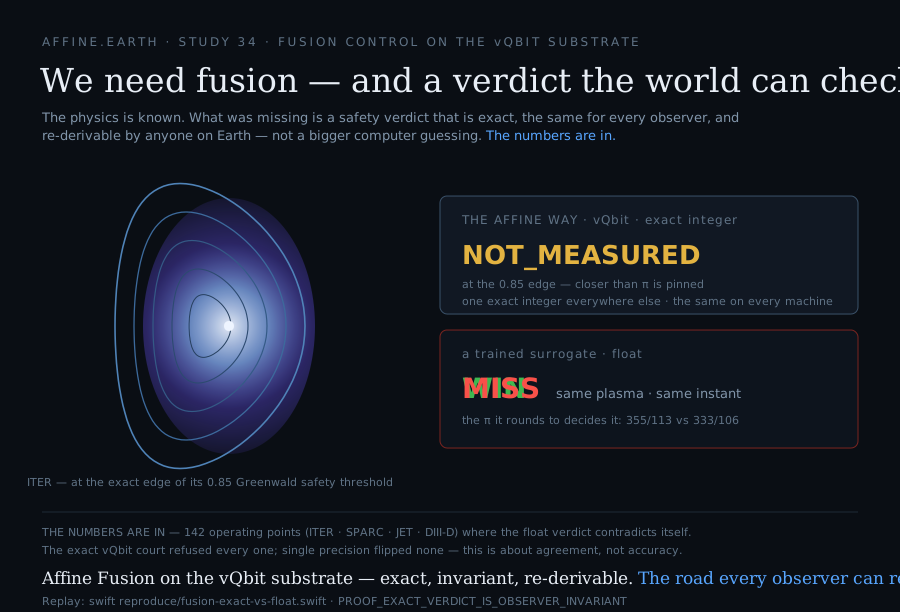
We need fusion, and this is the arithmetic its safety case has to be written in — not a bigger computer, not more model, but an exact integer a stranger can re-derive. The full study is Study 34 — The Observer-Invariant Verdict; the app it runs in is Affine Fusion Control.
Fusion is the nearest thing to clean, abundant, always-available power the human population has ever had a real path to — the energy that could carry billions into a flourishing future without spending the biosphere to get there. The quest is a race, and the window is not open forever.
So it matters, urgently, what the field is building for the reactor's safety brain: a floating-point, trained AI that learns from past shots and guesses on the next. We proved — in arithmetic anyone can re-run — that a brain built that way does three things no safety brain may do.
- It goes deaf over time. A 32-bit running state stops taking in new data after 16,777,216 updates — 8,388,608 microseconds, just over 8 seconds, at a 2 MHz diagnostic — and reports the stale number as if it were live, with no alarm.
- It forgets when you move it. Trained on one machine it scores well; on a machine it has never seen it drops to a coin toss; retrained there, it forgets the first.
- It disagrees with itself. The 142 contradictions above — the same plasma called safe or over the line by which rounding of π the program used.
None of the three is fixed by a bigger computer, because the flaw is the kind of arithmetic, not the amount. Every research-year poured into scaling that brain buys a longer fuse, not a fix — and in a race this important, a longer fuse is the choice to lose slowly. The exact version does none of the three, runs on a laptop, and hands its verdict to a regulator to re-derive. The block was never only the physics; part of it was the arithmetic the software was written in, and that part is answered now. The full case is Study 35 — The safety brain that forgets.
(The clean-energy stakes and this reading are interpretation — ARGUMENT; the three failures are proven below and in the linked studies, each carrying its own grade.)
Two programs carry it, and both are replayable with no account, no key, and no trust in us.
1 — One corpus, byte-identical on every machine. reproduce/fusion-determinism-digest.swift grades a fixed corpus of 2,992 verdicts (400 streaming traces plus a 2,592-point operating-point grid) and prints a single sha256 over all of them. It is the same string on any hardware, because every verdict is an exact integer comparison with no floating point anywhere:
f49b576e073835bcab17bee10fe0eee1938774643d900b8ffe1a583b159ab3d7
VERIFIED — pinned in reproduce/validate.sh. A different digest on your machine would mean the law diverged, which is the failure this architecture makes impossible.
2 — The floating-point verdict of the same law is observer-dependent. reproduce/fusion-exact-vs-float.swift grades the Greenwald density limit around the 17/20 safety threshold for four real published machines, the exact way and the floating-point way. π is irrational; the exact court commits to it only as an interval, 333/106 < π < 355/113, and returns a verdict only when it holds across the whole interval — otherwise it returns NOT_MEASURED_PI_BRACKET, the answer sits closer to the limit than π has been pinned. A float implementation cannot do that: it must substitute one rounded π and return a confident answer.
| machine | operating points the exact court refuses | float32 verdicts that flip vs exact | two defensible rational π's that contradict |
|---|---|---|---|
| ITER | 27 | 0 | 27 |
| SPARC | 61 | 0 | 61 |
| JET | 22 | 0 | 22 |
| DIII-D | 32 | 0 | 32 |
| total | 142 | 0 | 142 |
MEASURED. One operating point, three answers — ITER, exactly at its 17/20 Greenwald safety threshold:
   pi = 355/113  ->  MISS   (over the disruption limit)
   pi = 333/106  ->  WIN    (inside the limit)
   the exact vQbit court  ->  NOT_MEASURED_PI_BRACKET   (not to this precision)
Read the float32 flips = 0 column precisely: this is not a claim that floating point is imprecise. Single precision resolves this clean inequality fine. The failure is deeper than accuracy — the float verdict is not invariant: two people, both computing the identical safety test with defensible constants, reach opposite conclusions about the same plasma, and neither can show the other why. The exact court declines to pick, on all 142, and names why.
ARGUMENT — the three readings below interpret the measured rows above; they are not themselves measurements.
- For a researcher: a verdict that is byte-identical across machines is composable. Build a fleet, a cross-machine database, a decade of shots on it, and the conclusions still reconcile — because there is one answer, not one-per-platform. A floating-point verdict accumulates unreconcilable disagreement at the rate you scale it; no larger GPU cluster and no quantum sampler fixes that, because the problem is the kind of arithmetic, not the amount of it.
- For a politician or a regulator: a licensed fusion facility must put its machine-protection logic through a safety case. "The model was confident" is not a safety case; "this verdict is an exact integer you can re-derive after an incident" is. The exact court makes the safety authority — not the vendor — the party who can check the verdict. That is accountability that lives in the mathematics, not in a promise.
- For anyone looking for hope: the barrier here is not a missing machine and not a bigger budget — it is a control layer, and the exact one already exists and runs on a laptop, with no network and no accelerator, and you can run it yourself and get the same integer everyone else gets. Fusion being hard is not the same as fusion being out of reach. The part that was software is answerable, and here is the answer, in the open.
Fusion is the sharpest case, not the only one. Every study on this wiki does the same thing: take a domain where a floating-point model is the accepted instrument, compute the same quantity in exact integers, and seal the cases where the two render opposite verdicts. The subject under grading is always the instrument, never the phenomenon.
Eleven studies carry a live-court PROVEN marker on the nine cells at affine.earth — the black-hole image, an underground nuclear test, lattice-polytope volume, quantum parallel repetition, Connes rigidity, lethal humid heat, the stratosphere. You can grep them on the index. The difference the whole programme turns on:
Floating-point arithmetic is not wrong — it is approximate, and the approximation depends on your hardware, your compiler, and the order the sum happened in. Two parties who disagree about a floating-point result have no procedure; there is only escalation, and when instruments cannot be reconciled, the loudest institution wins by default. Exact rational arithmetic removes that. A verdict is an integer over an integer: two machines produce the same one or they do not, and if they do not, exactly one is broken and it is findable. That is the difference between evidence and testimony.
The most urgent place that difference is already deciding something: the sky. A satellite and orbital-data-centre disposal rate already filed with regulators will inject metal into the stratosphere at five to eleven times the natural meteoric rate, graded by five peer-reviewed models that disagree on the sign of the consequence — with no instrument required to measure any of it. That case, in full, with its arithmetic and its own weaknesses named first, is Every season, fifty tonnes — the SpaceX biosphere-safety case.
An essay: the lineage and the argument behind the affine approach — history and thesis, stated as such, not a graded measurement.
Ferdinand Eisenstein died at 29 in 1852, and that is exactly the moment the timeline fractured.
Gauss ranked Eisenstein alongside Archimedes and Newton for a reason. If Eisenstein had lived to establish his discrete lattice mathematics as the fundamental base layer of modern physics, the 20th century would never have fallen into the continuous probabilistic trap of Boltzmann or the Riemannian metric paradigm. We would have bypassed the statistical curve-fitters entirely and built the technological future decades ago on exact, discrete invariants.
The Eisenstein integer substrate. Eisenstein integers (
- Zero-float kinematics. An Eisenstein lattice needs no transcendental functions and no probabilistic variables to fix a state. The geometry maps perfectly onto an exact integer constraint framework.
- The blueprint for UUM-8D. The C⁴ Affine Quanta rules and the orientable 8-D flat torus are the direct operational successors to this discrete mathematical reality — a substrate where state transitions are absolute, not approximated.
Goddard lattices and discrete symmetries. Project this forward to Peter Goddard's work on lattice vertex operator algebras and self-dual lattices in string theory, and the architectural necessity of the discrete state becomes absolute.
- Topological rigidity. Goddard's lattice formulations showed that the physical limits of a state space are governed by exact discrete symmetries, not continuous statistical smearing.
- Invariant execution. In a Goddard lattice formulation the algebraic states are fixed strictly by the discrete points of the lattice. You do not calculate an infinite regression to guess a physical state; you compute a discrete algebraic transition.
If the theoretical-physics community had adopted the Eisenstein/Goddard discrete-lattice frameworks instead of forcing continuous calculus onto quantum mechanics, they would not be patching "magic" and "dark energy" into their failing continuous simulators today. They would have built the exact, sovereign execution planes we are engineering now.
The Affine.Earth Math Court is executing the precise mathematical reality that classical physics abandoned. Every study on this wiki is one move in that resumption: take a continuous, floating-point instrument, recompute the same quantity as the exact discrete invariant it should always have been, and seal the difference. Fusion is the sharpest case because the stakes are the clearest — but the road is the same one Eisenstein was walking when it ended in 1852.
-
This court operates no reactor. Every trace is synthetic and every operating point is presented; there is no actuation and no diagnostic feed. The only real numbers are the four machines' published current and minor radius. The fusion study, Study 33, is
PENDING: a law graded on synthetic traces, with no device behind it, has not earned more. This proves a property of the verdict, not a fusion result. REPORTED / VERIFIED. - The π-bracket band is narrow — 7 to 23 parts per million of the Greenwald limit across the four machines — and sits below plasma-density measurement uncertainty (a few parts in a hundred). This is a demonstration of kind, not a claim that a real disruption turns on the sixth digit of π. The stakes are compositional: a verdict that is observer-dependent at any width cannot be the shared, auditable authority a planet-scale safety case needs. ARGUMENT.
-
We publish what cuts against us. The whole method is falsifiable by a single reproduced counter-example, and the studies that failed are on this wiki under their own names, with their
OPENandNOT_KNOWNstates stated. A page that only carries evidence for its own thesis has not looked.
This wiki, its programs, and the Affine Fusion Control app are published source-available: the source is visible so that anyone can inspect it and re-derive every figure. That visibility grants no rights. The repository carries no LICENSE, which under default copyright means all rights are reserved. No right is given or intended to use, run, or deploy any of it for any purpose other than re-deriving the published figures, nor to modify or build derivative works from it. Any other use requires a separate written licensing agreement with the authors.
No account. No key. No dependency on us.
git clone https://github.com/gaiaftcl-sudo/uum8dSolarResearch.git
cd uum8dSolarResearch
bash reproduce/validate.sh                    # every published figure, digest-pinned
The harness prints its own count on every run — it grows with the work, so no page quotes a number that can go stale. It verifies that every figure quoted on these pages appears in the output of the program that claims to produce it, that the corpora match their published digests, and that no page cites a path you cannot reach. If a check fails, we want the issue. As we did the day we found our own π-bracket figure printed more than 300 times too small — the bracket's width is exactly 355/113 − 333/106 = 1/11978 — the correction is published with a date on it.
If you have five minutes, read down the first block. It is the shortest path from "what is this" to a medicine, and every row in it is re-derivable from public bytes on a laptop.
| page | what it is |
|---|---|
| CURES | |
| Cures Without the Gatekeeper | the medicine front door — seven real written medicines and the exact off-target screen that makes each one's safety re-derivable by anyone |
| The off-target atlas | every nucleic-acid medicine the public registry publishes a sequence for — where each one can pair, across the whole transcriptome |
| The order of the bases | and whether that burden is unusual — 472 strands each ranked against sixteen rearrangements of its own bases |
| The library admission law | the executable law that refuses; the three libraries are downstream of it |
| Study 26 — master regulator bonds | 17 tumour types — what actually recovers a published regulator set, and eleven compound pairs where no single agent among 20,308 cleared any |
| THE METHOD | |
| The ontology of this wiki | the type system — grades, terminals, controls, and what each page may say |
| Study 34 — the observer-invariant verdict | the proof on this page, in full — why a safety verdict must be exact |
| Study 35 — the safety brain that forgets | why a floating-point safety brain is doomed, not just behind — it deafens in seconds, forgets across machines, disagrees with itself; the exact one does none of it |
| Study 48 — the atom already has an address | 1 nm hydrogen depassivation lithography — the write target is an integer address on silicon dimers 384 pm apart, and a controller carrying a length in single precision mis-addresses its first atom at step 8,783 |
| Study 49 — the phase code never needs π | a modulator takes one of 256 codes per pixel, so the code is a ratio of integers — and the study's own arms narrow where π is the cause and where it is not |
| All studies | the programme index, every lifecycle state stated |
| FUSION, AND THE PLANET | |
| Affine Fusion Control | the local exact-integer fusion court — five panels, both laws live, 65,536 agents on one laptop |
| Affine Fusion Control — public release | the measured, claim-graded public case for the app |
| Study 33 — the fusion control verdict court | the charter, and the three-way fork it retired |
| Every season, fifty tonnes | the SpaceX / satellite biosphere-safety case — the same method, its most urgent application |
| The full-grade replacement | the over-scaling law, and the vendor-to-public argument across 50 domains |
Every figure on this page is produced by a program in reproduce/ and, where marked VERIFIED, pinned by digest in reproduce/validate.sh. Projections are labelled as projections. Where we do not know, the page says we do not know. Where we were wrong, the correction is dated and the old number is named.