Repository navigation
Minecraft The Exact Language Game
Every position, reach test and collision in the world's most played game is floating point, and the shear has player-facing names: rubberbanding, ghost blocks, hits that do not register. This court reads the eight bytes the game sent as an exact dyadic rational, projects them once onto an integer lattice, and grades a player's claim there — the same answer on every machine, boundary included.
Status. Four claims adjudicate on the live public court today (reach, stand, fit, move-within).
Four more — survive a fall, knockback, place a block, and line of sight — are proven in the court's
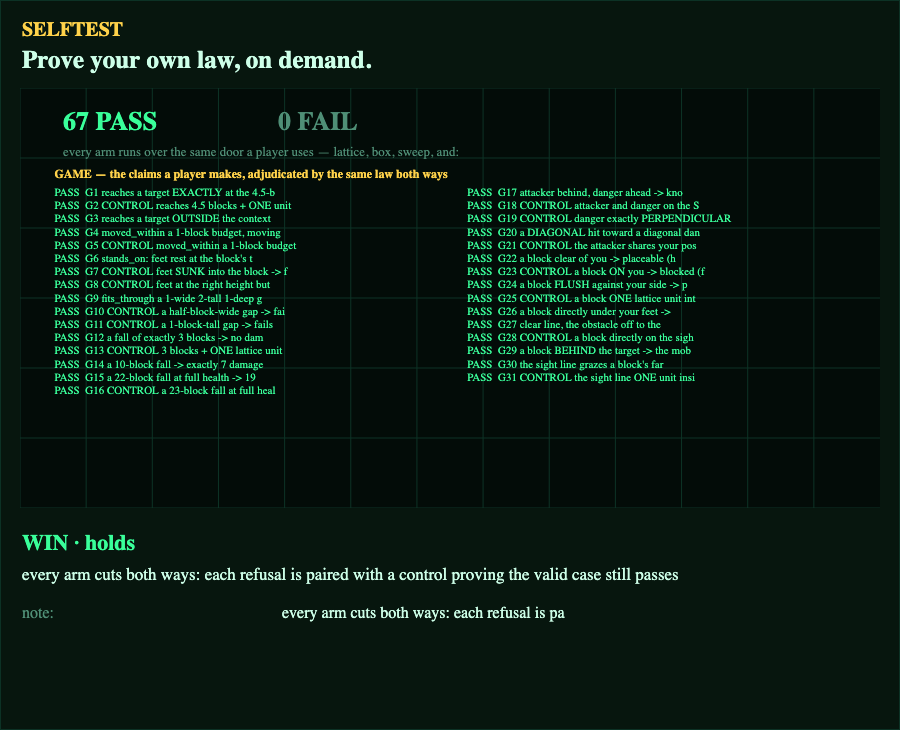
own 67-arm selftest and are on the fleet's source (77c7f78a4); they reach the public court on the next
cell-binary roll. Until then the live court answers those four with REFUSED_UNKNOWN_CLAIM, which is
the honest answer for a claim it has not been taught.
The card below is one real call to the public court. 4.5 blocks is exactly reachable — the boundary is included. The second card asks for 4.5 blocks plus one lattice unit (2⁻³² of a block): the court refuses. No epsilon, no "close enough" — the boundary is decided by the half-open box.
{"domain":"minecraft","role":"guide","title":"Can I reach that? — 4.5 blocks, the boundary itself","statement":{"mc_op":"adjudicate","mc_claim":"reaches","mc_budget":"survival","mc_window_blocks":"16","mc_centre_x":"0","mc_centre_y":"0","mc_centre_z":"0","mc_x":"0000000000000000","mc_y":"0000000000000000","mc_z":"0000000000000000","mc_to_x":"4012000000000000","mc_to_y":"0000000000000000","mc_to_z":"0000000000000000"}}
{"domain":"minecraft","role":"guide","title":"Can I reach that? — 4.5 blocks plus one lattice unit","statement":{"mc_op":"adjudicate","mc_claim":"reaches","mc_budget":"survival","mc_window_blocks":"16","mc_centre_x":"0","mc_centre_y":"0","mc_centre_z":"0","mc_x":"0000000000000000","mc_y":"0000000000000000","mc_z":"0000000000000000","mc_to_x":"4012000000040000","mc_to_y":"0000000000000000","mc_to_z":"0000000000000000"}}
The full playable board — every claim, both directions, on this page's own origin — is the games card: affine.earth/language-game/minecraft/games.html.
- Reach — can I reach that? The target is within reach, boundary included, or it is not.
- Stand on a block — am I standing on that? Feet on the face, not sunk a lattice unit into it.
- Fit through a gap — do I fit through there? The player box against the opening, exactly.
- Move within a tick — did I move that far? Displacement against the per-tick budget.
- Survive a fall — do I survive this fall? Fall distance on the lattice, the damage boundary exact.
- Knockback — does this hit knock me toward the danger? The knockback vector, not a rounded one.
- Place a block — can I place a block here? The placement box against the world's boxes.
- Line of sight — can the mob see me? Below.
Each is one case in one law: the claim is projected once onto the lattice and decided by integer comparison. The court also carries the moves that are not claims — ingest a position (where does the float world land?), the arrow that cannot tunnel (a swept segment, never sampled), co-play on the shared world, and a selftest in which the court proves its own law.
A mob sees you if the sight line from its eye to yours is not blocked — and that line is a swept segment against the world, the same exact primitive as the arrow that cannot tunnel, read the other way: here a hit on the segment is what hides you. Minecraft raytraces this by sampling the ray, so a wall thinner than the gap between samples is seen straight through; this court tests the whole segment, so a thin wall never leaks a sight line. And the grazing case — the sight line running exactly flush with a block's face — is decided by the half-open box: flush is outside, so you are seen; one lattice unit further in and you are hidden.

The court's response to a wall directly between you and the mob, quoted:
verdict          REFUSED_CLAIM_FAILS
mc_claim         can_see
narration        can the mob see me — no: a block is on the sight line — the mob cannot see you
line_clear       no
blocked_at_x     21474836480      ( = 5 × 2³², the wall face )
block_fraction   21474836480/42949672960   ( = 1/2 exactly — the wall is halfway to you )
A wall off to the side or behind you does not touch the segment, so the mob sees you; a wall
directly between returns REFUSED_CLAIM_FAILS — a block is on the sight line — the mob cannot see
you — reported with the exact lattice point and fraction it was blocked at. The claim as the court
receives it (positions are the game's own eight bytes, hex):
{"domain":"minecraft","role":"guide","mc_op":"adjudicate","mc_claim":"can_see",
 "mc_window_blocks":"16","mc_centre_x":"0","mc_centre_y":"0","mc_centre_z":"0",
 "mc_x":"0000000000000000","mc_y":"0000000000000000","mc_z":"0000000000000000",
 "mc_to_x":"4024000000000000","mc_to_y":"0000000000000000","mc_to_z":"0000000000000000",
 "mc_block_x":"5","mc_block_y":"0","mc_block_z":"0"}
Sixty-seven arms, every claim in both directions — the case that must pass and the case that must refuse — including the line-of-sight set: clear, blocked, behind the target, the sight line grazing a block's far face (seen: flush is outside), and one lattice unit further in (hidden).
We call: a claim about position in this game has an exact answer on the lattice, and the boundary cases — the reach exactly at 4.5, the sight line exactly flush with a face — are decided by the half-open box, not by an epsilon that differs between machines.
We refuse to call: anything about the game's servers, its anti-cheat, or any player. The subject under grading is the arithmetic, never the game.
- Explore the live courts · Study 34 — the observer-invariant verdict
- Zero Float · Zero Shear — the method in one page