Repository navigation
AI Act
Standards tour · stop 20 of 20 · ← Machinery Regulation · back to the tour →
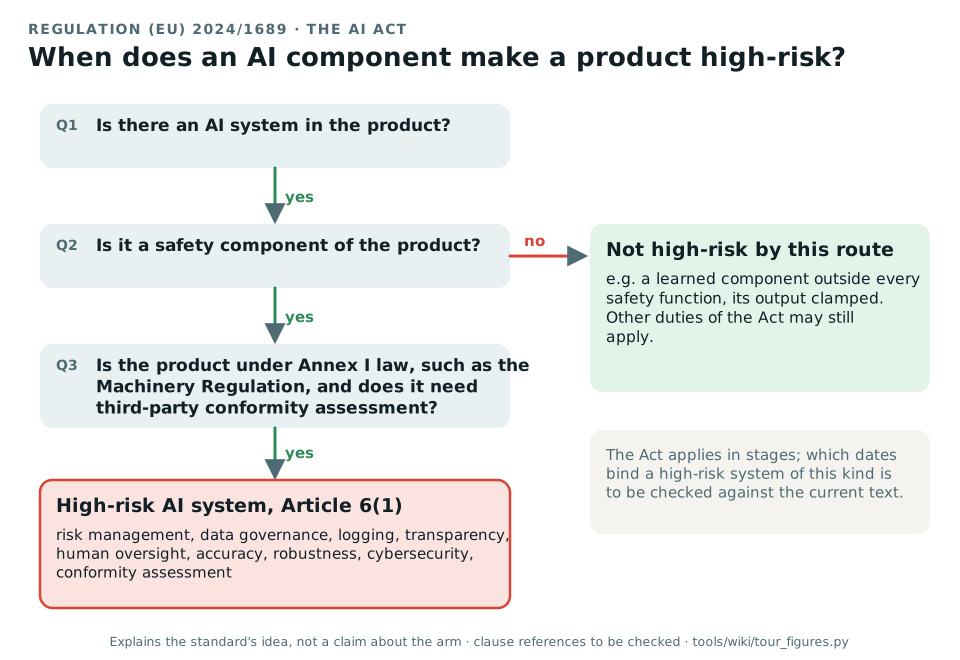
Three questions: is there an AI system, is it a safety component, and is the product under Annex I law with third-party assessment. Yes to all makes it high-risk under Article 6(1); a learned component outside every safety function is not high-risk by this route. Generated by tour_figures.py; it explains the standard's idea and claims nothing about the arm.
In one sentence. The AI Act is the EU law on artificial intelligence; for a machine, the question is whether an AI component is a safety component of a product that needs third-party assessment, because that makes it a high-risk AI system.
Regulation (EU) 2024/1689, laying down harmonised rules on artificial intelligence. It entered into force on 1 August 2024 and applies in stages; which dates bind a high-risk system of this kind is to be checked against the current text. Annex I lists Union product laws, the Machinery Regulation among them.
Under Article 6(1), an AI system is high-risk when it is a safety component of a product, or is itself a product, covered by a law listed in Annex I, and that product must undergo third-party conformity assessment. A high-risk AI system carries duties for risk management, data and data governance, technical documentation, record keeping, transparency, human oversight, and accuracy, robustness and cybersecurity, with a conformity assessment.
The arm runs learned policies. If one were made a safety component, the Machinery Regulation would call for a notified body (its Annex I Part A), and the AI Act would make the policy a high-risk AI system on top. Keeping every learned component outside the safety functions keeps both thresholds uncrossed, and the record monitors that threshold.
| What the record takes | Where |
|---|---|
| The AI Act conformity record | WP-K-07 |
| Where the learned policies sit | The policy question (DQ-008, answered: outside every safety function, clamped) |
| The machine-learning safety plan | WP-M-09 |
That the arm is outside the Act. Whether the policies are a safety component depends on an open decision, and other duties of the Act may apply whatever the answer.
- AI system: the Act's defined term for a machine-based system that infers from its input how to generate outputs such as predictions, content, recommendations or decisions.
- Safety component: a component that fulfils a safety function, or whose failure endangers health and safety.
- High-risk AI system: one the Act classifies as high-risk, under Article 6.
The numbering is to be checked against the current consolidated text.
| Where | What it covers |
|---|---|
| Art. 6(1) and Annex I | High-risk classification through Union product law |
| Art. 9 to 15 | The requirements on high-risk AI systems |
| Art. 43 | Conformity assessment |
| Art. 113 | Entry into force and application dates |
Standards tour · stop 20 of 20 · ← Machinery Regulation · back to the tour →