Repository navigation
EN 60204 electrical equipment
Standards tour · stop 6 of 20 · ← IEC 61508 · ISO 13850 →
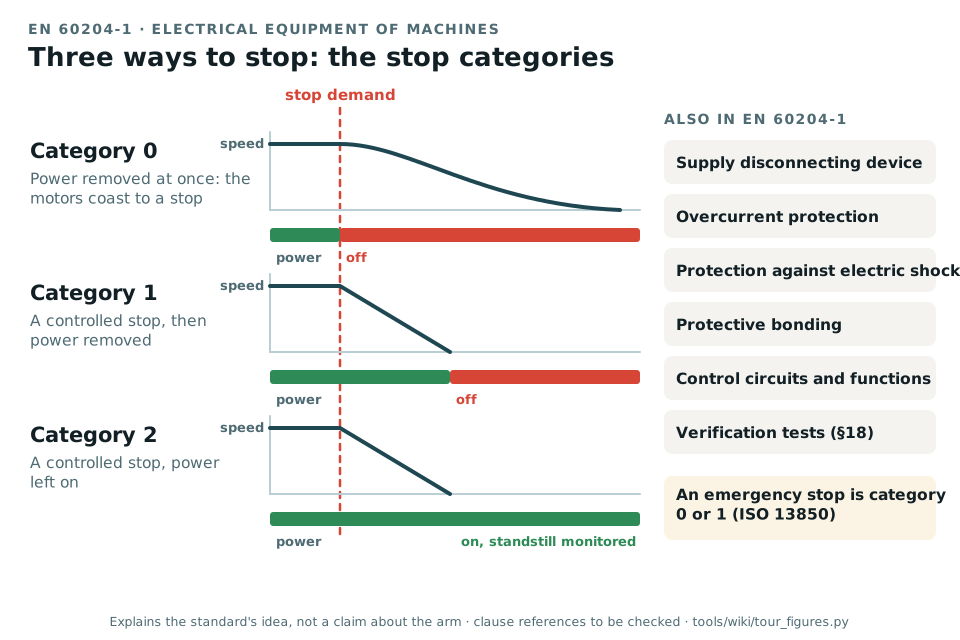
The three stop categories of EN 60204-1 against one stop demand: category 0 removes power at once, category 1 stops under control then removes power, category 2 stops under control and keeps power. Beside them, the other topics of the standard. Generated by tour_figures.py; it explains the standard's idea and claims nothing about the arm.
In one sentence. EN 60204-1 is how a machine's electrics are made safe: a way to isolate it, protection against shock and overcurrent, sound control circuits, and three defined ways to stop.
EN 60204-1:2018, Safety of machinery: electrical equipment of machines, Part 1: general requirements, the European adoption of IEC 60204-1. A type-B standard for everything electrical on a machine, from the supply terminals to the control circuits and the final tests.
Every stop function belongs to one of three stop categories:
- Category 0: power to the drives is removed at once; the machine coasts to a stop, uncontrolled.
- Category 1: a controlled stop with power available to the drives, then power removed once it has stopped.
- Category 2: a controlled stop with power left available, standstill held and monitored.
An emergency stop must be category 0 or 1 (ISO 13850). The rest of the standard covers the supply disconnecting device, protection against electric shock, overcurrent protection, protective bonding, control circuits and functions, operator controls, and the verification tests of the finished machine.
Upstream's design takes a 24 V supply straight into a daisy chain of seven actuators: no lockable disconnect (GAP-09), no fuse per branch (GAP-10), an open-frame mains supply with exposed terminals (GAP-11), and no emergency stop (GAP-08). The first engineering act of the fork is to fix exactly these on the test bench.
| What the record takes | Where |
|---|---|
| The electrical safety design: disconnect, fusing, shock protection, bonding, the 24 V bus as SELV | Electrical safety, WP-H-05 |
| The safety chain's wiring and stop category | Chain design, WP-H-02 |
| The verification of the chain and the emergency stop | WP-V-04 |
| The supply disconnecting device | The disconnect question (DQ-018, answered: a mains switch on the enclosed supply and a lockable DC disconnect at the arm) |
| The emergency-stop hardware on the bench before any powered test | The bench stop question (DQ-006, answered) |
That any arm is wired to the standard today. The bench chain is a planned engineering act behind a hold point (WP-V-07).
- Stop category 0, 1, 2: the three ways to stop, by when power is removed.
- Supply disconnecting device: the switch that isolates the machine from its supply, lockable for maintenance.
- SELV, PELV: safety and protective extra-low voltage; circuits at a voltage low enough, and separated well enough, that touching them is not a shock hazard.
- Protective bonding: connecting exposed conductive parts so a fault cannot leave them live.
No standard is held by the project, so every clause number on this page is to be checked against a licensed copy. The lead decided to buy them only when an assessor is engaged (DQ-011).
| Clause | What it covers |
|---|---|
| §5 | Incoming supply terminations and the supply disconnecting device |
| §6 | Protection against electric shock |
| §7 | Protection of equipment, including overcurrent protection |
| §8 | Equipotential bonding |
| §9 | Control circuits and control functions; the stop categories (§9.2.2) |
| §10 | Operator interface and control devices, including emergency stop devices |
| §18 | Verification |
Standards tour · stop 6 of 20 · ← IEC 61508 · ISO 13850 →