Repository navigation
Reading the safety case
The safety argument is published while it is being built. This page explains what the safety case is today, what the dashboard shows, and what it does and does not promise.
The safety case is the document WP-K-01, with the
machine-readable records in assurance/case/. Its claim structure, from
WP-M-01 §3.2:
- G0 The B601-DM, fixtured on a bench and operated within its limits by a trained operator with nobody else in reach (OE-1), poses no unreasonable risk.
- G1 Every safety function reaches its required Performance Level: the emergency stop, the safe stop on watchdog, the manual reset, the joint torque and speed limits, the joint position limits, the heartbeat, the contact detection and stop, the gripper holding, the thermal and overcurrent cut-offs, the shared-workspace functions.
- G2 The complementary electrical and mechanical measures are implemented: the supply, the disconnect and fusing, the connectors; the joint gaps, the end-stops, the fixing, the printed parts.
- G3 The command path cannot defeat the safety functions: every motion path is authenticated and bounded, and no learned policy carries a safety function.
- G4 The evidence was produced under a controlled process: a baseline exists, the hazards are complete, and the motion-critical software has verification evidence.
No claim has accepted evidence. The known counter-evidence is GAP-01…GAP-36 in the gap assessment, one defeater each, all open. The concept-phase package the fork published before this record is evidence at "partial": a drafted analysis nobody has reviewed.
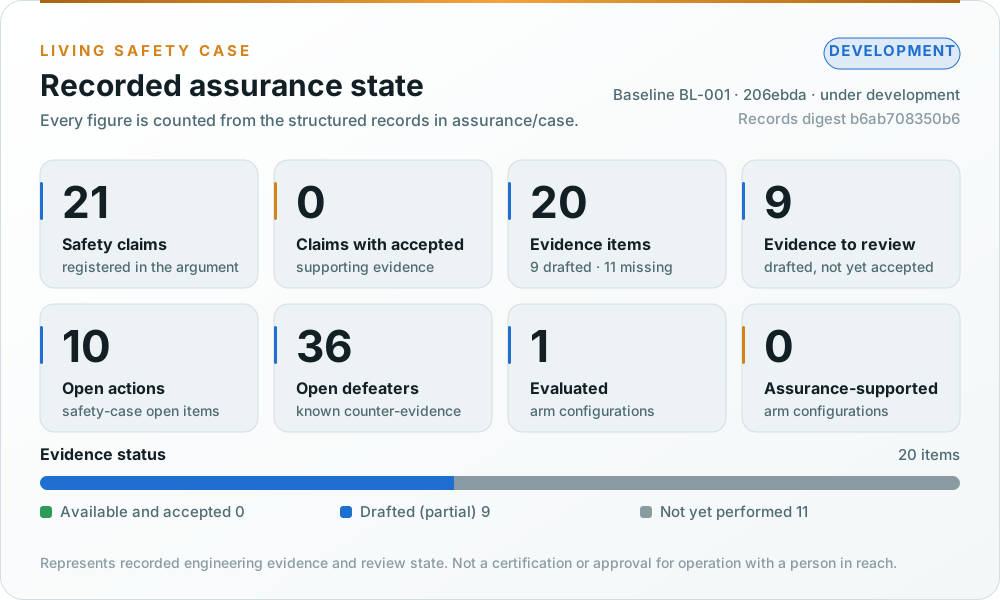
assurance/case/ holds claims, arguments, evidence items, defeaters, actions,
configurations, baselines and reviews as machine-readable records, a validator, and a generator that draws this
dashboard, the lifecycle-area card and a one-line headline on the README: the assurance state, the baseline, the
number of claims and how many have accepted evidence, the evidence items and how many are accepted, the open
defeaters, and a digest of every record. These rules apply:
- A claim counts as accepted only when a recorded review accepts it, every piece of evidence it cites is available and accepted, and no defeater against it is open. The validator refuses anything else.
- A passing CI run, a passing test or the existence of a document never accepts a claim on its own, and an AI-generated review is not a substitute for independent confirmation.
- Every figure is generated from the records, never typed by hand, and the assurance workflow fails when the committed dashboard is out of date.
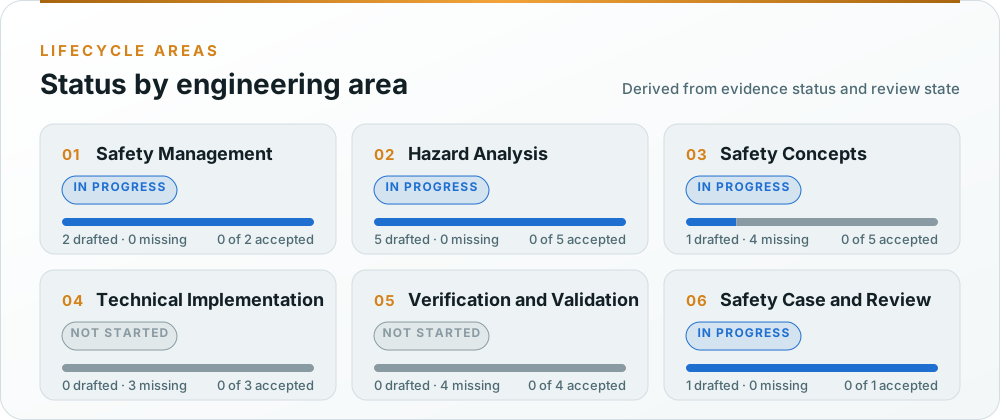
Evidence becomes accepted only after a confirmation review by someone independent of the author (WP-M-06). No work product has had one, no assessor is engaged (DQ-009), and the project has one person. A dashboard that showed accepted evidence before any review had happened would be the one to distrust.
-
Hazards and safety functions, from the risk assessment
and the safety function specification, as trace
items in
assurance/trace/. Each function carries a required PL. - Claims: the argument that each function achieves its PL and each hazard is reduced, broken into statements that can be evidenced, with the assumptions of use AOU-01 to AOU-08 attached.
- Evidence, linked to claims: the PL calculation, the component certificates, the stopping and holding tests, the separation or force measurements, the fault-injection results, each with a review state.
- Defeaters, attached to claims: the gap assessment, the open interfaces of the process model, the performance limits of the insufficiency analysis.
- Baselines and reviews: named states of the whole, and the confirmation reviews recorded against them.
- Read the safety case, WP-K-01
- Known gaps
- Gate skeletons, generated from the process model
Assurance status represents recorded engineering evidence and review state. It does not constitute certification or approval for operation with a person in reach.