Repository navigation
ISO TS 15066 collaborative robots
Standards tour · stop 11 of 20 · ← ISO 13855 · IEC 60812 →
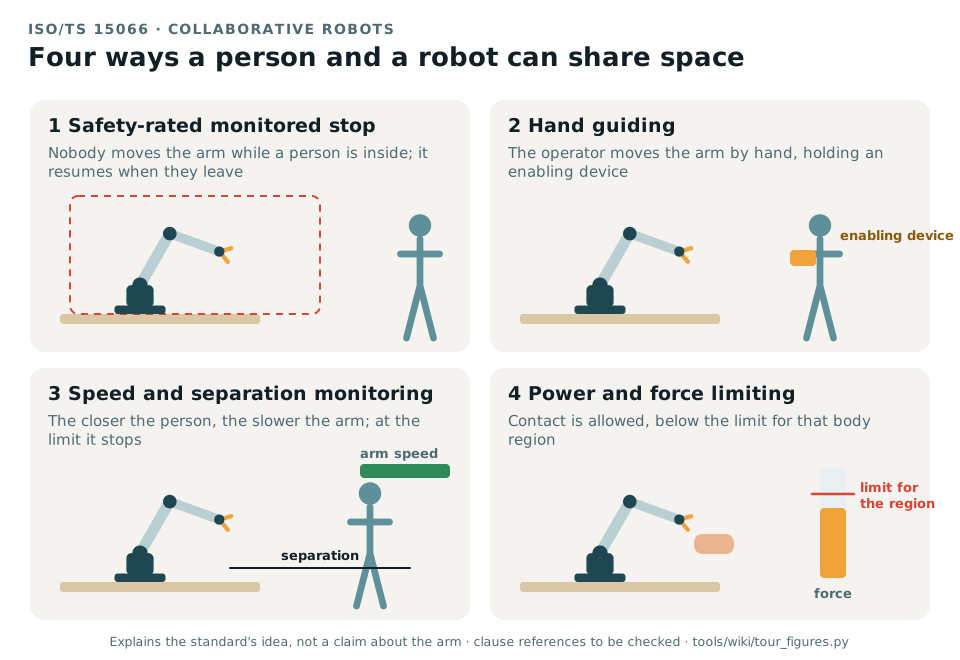
The four collaborative modes: a stop while a person is inside, guiding the arm by hand with an enabling device, slowing and stopping as a person comes closer, and contact kept below the limit for the body region. Generated by tour_figures.py; it explains the standard's idea and claims nothing about the arm.
In one sentence. ISO/TS 15066 describes four ways a person and a robot can share a workspace on purpose, and gives the force and pressure limits for when contact is allowed.
ISO/TS 15066:2016, Robots and robotic devices: collaborative robots. A technical specification that extended the 2011 editions of ISO 10218; the 2025 editions bring much of it into ISO 10218 itself, and the record uses the TS where the 2025 text is not held.
- Safety-rated monitored stop. The robot stops, and stays stopped under monitoring, while a person is in the collaborative workspace; it resumes when they leave.
- Hand guiding. The operator moves the robot by hand, with an enabling device and limited speed.
- Speed and separation monitoring. The robot slows as a person approaches and stops before contact, keeping a protective separation distance.
- Power and force limiting. Contact is allowed, with the force and pressure kept below the limits for that body region. The specification's annex gives the limits for quasi-static contact (clamping) and transient contact (impact) by body region.
The arm looks like a collaborative robot, but it has no joint torque sensors: contact can only be estimated from the motor currents, and no force or pressure has been measured (GAP-28). A collaborative claim would need a measurement campaign and limits bound to the joint torque and speed caps.
| What the record takes | Where |
|---|---|
| Every situation with a person in reach, and the foreseeable misuse | Human-robot interaction, WP-C-06 |
| Validating whatever collaborative claim is made | WP-V-03 |
| What a torque estimate cannot sense | Insufficiency analysis, WP-C-10 |
| Whether to make a collaborative claim at all | The collaborative claim question (DQ-005, answered: no claim, separation only, with contact detection as defence in depth) |
Any of the four modes. Contact detection by torque estimation (SF-02, SF-04) is planned as defence in depth, not as a power and force limiting claim.
- Collaborative workspace: the space where the robot and a person can work at the same time.
- Quasi-static contact: clamping, a body part caught between the robot and something else.
- Transient contact: an impact, where the body part can recoil.
- Body region: the parts of the body the specification gives separate limits for, from the head to the lower legs.
No standard is held by the project, so every clause number on this page is to be checked against a licensed copy. The lead decided to buy them only when an assessor is engaged (DQ-011).
| Clause | What it covers |
|---|---|
| §5.5.2 to §5.5.5 | The four collaborative modes |
| §6 | Verification and validation |
| Annex A | Limits for quasi-static and transient contact by body region |
Standards tour · stop 11 of 20 · ← ISO 13855 · IEC 60812 →