Repository navigation
Machinery Regulation
Standards tour · stop 19 of 20 · ← Automotive SPICE · AI Act →
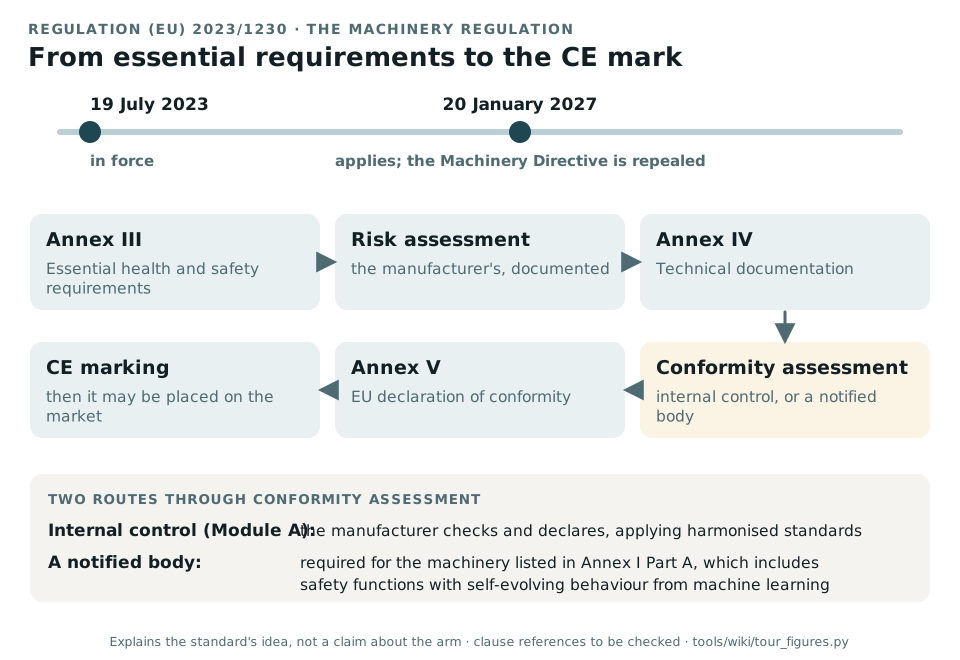
In force since 19 July 2023 and applying from 20 January 2027, when it replaces the Machinery Directive. The route: essential requirements, risk assessment, technical documentation, conformity assessment, EU declaration, CE marking. Generated by tour_figures.py; it explains the standard's idea and claims nothing about the arm.
In one sentence. The Machinery Regulation is the EU law a machine must meet before it is placed on the market: its essential requirements, a technical file, a conformity assessment, a declaration and the CE mark.
Regulation (EU) 2023/1230 on machinery. It replaces the Machinery Directive 2006/42/EC and applies from 20 January 2027. Being a regulation, it applies directly in every member state. It is law, not a standard: the harmonised standards (ISO 12100, ISO 10218, ISO 13849 and the rest) are the usual way to show its essential requirements are met.
- Meet the essential health and safety requirements of Annex III.
- Do and document a risk assessment.
- Compile the technical documentation of Annex IV.
- Follow a conformity assessment procedure: internal control by the manufacturer (Module A), or a notified body. A notified body is required for the machinery listed in Annex I Part A, which includes safety components and machinery with fully or partly self-evolving behaviour from machine learning that ensures a safety function.
- Draw up the EU declaration of conformity of Annex V.
- Affix the CE marking; only then may the machine be placed on the market.
It sets the target the whole record aims at, if the arm is ever placed on the market in the EU. And its Annex I Part A is one reason the record keeps learned components outside every safety function: a learned safety function would require a notified body.
| What the record takes | Where |
|---|---|
| The regulatory strategy | WP-M-13; the frame question (DQ-002, answered: the EU frame) |
| The route to conformity | The conformity route question (DQ-012, answered: internal control, Module A) |
| The register mapped onto Annex IV | Technical documentation index, WP-K-02 |
| The unsigned declaration draft | Release record, WP-K-06 |
Conformity, or any obligation incurred. The fork places nothing on the market, and upstream's CC BY-NC-SA licence forbids commercial use, so the obligations are planned for, not incurred (GAP-35).
- Essential health and safety requirements: the legal requirements of Annex III every machine must meet.
- Harmonised standard: a standard whose use gives a presumption of conformity with the requirements it covers.
- Notified body: an organisation a member state designates to carry out third-party conformity assessment.
- Placing on the market: making a machine available in the EU for the first time.
The record cites these from the Official Journal text; the numbering is to be checked against the current consolidated version.
| Where | What it covers |
|---|---|
| Art. 10 | Obligations of manufacturers |
| Art. 25 | Conformity assessment procedures |
| Annex I | The machinery needing third-party assessment (Part A) or allowed internal control with harmonised standards (Part B) |
| Annex III | Essential health and safety requirements |
| Annex IV | Technical documentation |
| Annex V | EU declaration of conformity |
Standards tour · stop 19 of 20 · ← Automotive SPICE · AI Act →